In this episode Jeff Hassemer and Nate deliver a rapid‑fire roundup of the week’s biggest AI headlines. They frame the industry’s shift from hype‑driven chatter to a hardware‑centric battle for compute, highlighted by SpaceX’s $60 billion acquisition of the developer‑tool platform Cursor and the looming scarcity of data‑center capacity. They discuss Anthropic’s near‑trillion‑dollar IPO and its controversial “AI pause” marketing, noting the tension between public perception and the company’s financial reality. The hosts spotlight Apple’s strategic pivot: instead of building its own large‑scale models, Apple will make Siri “agentic” by wiring it to external LLMs such as Claude, ChatGPT, and Gemini, turning the voice assistant into a task‑executing agent. They also touch on the broader compute crunch, the prospect of space‑based data centers, and the relentless churn of new model releases (Claude Opus 4.8, Fable, GPT‑5.5 Instant, Gemini, Notebook 2.0). Throughout, they reflect on the cyclical nature of AI skill trends—from prompt engineering to agent creation—and speculate on the next phase of AI‑driven workflows. The episode ends with a teaser about upcoming coverage of the EU AI Act and further Anthropic news.
Chapters
Hey, and welcome to the AI Cookbook podcast.
I'm Jeff. I'm Nate.
He's back. Can you believe it? After a long, long vacation. All right, top 5 stories in AI this week. There's a lot going on, lots of money being exchanged as well. So number 1, AI is moving from hype to hardware. $60 billion in acquisitions and near trillion IPOs this week. Compute's getting scarce and it's getting sucked up by big names and the platform captures. So I think this is pretty interesting and probably the most interesting piece of the week is the, the news from Apple and what they're going to do. Um, so let's start though with the big news. Um, Elon's a trillionaire, SpaceX buys Cursor for $60 billion. Um, they already have been renting compute, or rents compute to Anthropic and Google. Now they picked up Cursor, which is a development framework tool for vibe coding and, and things like that. Um, any thoughts on this, Nate?
Outside of Michael, their CEO, uh, being an intern for 4 years and then founding this company and getting acquired for $60 billion, pretty good.
24.
Yeah. That's an awesome story.
Yeah.
This to me is just a good continuation. I've seen so many different pundits on this topic about why Cursor and this is better and that is better. And I think people are missing the point is that there, we've just already, like everything else, accelerated this acquisition cycle. In this case for Cursor, which was the affordable option to instantly leapfrog ahead. And we're gonna see so much more of these, what we think are crazy valuations, but in the long run probably turn out to be wildly profitable.
I think you're right. It's going to get— I mean, Cursor is pretty amazing as a tool. It's a good move. But I also think it kind of, you know, these are geeks buying geek hardware or geek software, right? The IDE that is Cursor is about programming, but programming is what gets us to the future as well. Yeah, so I think this is a really smart move. You know, what I see Elon doing and SpaceX doing is really— and I've said this a couple times— focusing on the physical and the, and the ability to code things. Um, and so, you know, they're going to be in the lead of data centers, they're going to be in the lead of robots, they're going to be in the lead of, um, self-driving cars and things like that. And this gives them a framework to do that while hitting the enterprise play of what they're doing. So be interesting to see how this all plays out. Um, Anthropic, we knew this was coming, filed for almost a trillion-dollar IPO themselves. But then they called for an AI pause, which I think is mostly just marketing on their part. They have an interesting way of marketing, um, probably because they don't have a CMO. But basically, they, they basically scare the public at the same time as, as putting out pretty powerful models. What they're doing. I think it's wasted energy, to be honest. But I think that, you know, the IPO is real and this is a real company that's making real money at this point.
Yeah. I know, I agree with you. I love the everything around what's happened with Anthropic in the past few weeks because it's beautiful marketing. It's like, look at this amazing thing. You can have it for 2 days. The government won't let you have it anymore, right? I mean, it's just like this. This demand creation is just amazing. So, so yeah, and, and it's again, we're going to look back. I mean, we already look back and like, like the long view of which is just one year. We're going to look back a year from now and look at all the various models that came out from all of the, you know, leading companies. And this will just be another one, another little stepping stone. But every single time they're really good at this, uh, oh my gosh, you know, this is a tenfold increase and the system won't let you have it for now. Yeah. It's so powerful, can't let you all touch it.
But it was fun while it lasted. I coded a whole CRM system with it in a couple days, which was pretty cool. I think this is the most interesting story of the week. Apple has basically said, we're not building our own AI, we're gonna allow you to connect Siri to Claude and ChatGPT and Gemini underneath there. But I think the other side of this, The story that people don't really see is this makes Siri very agentic in the same way that Gemini Spark is coming on. People by the end of the year are gonna be able to talk to Siri and have it book appointments for them, book, make purchases for them, do everything that it needs it to do and book that straight out just by voice control.
Yeah.
And I think it also finally makes Siri a valuable AI at some point. You need thoughts on that?
Yeah, I think that catches Siri up, right? Again, this is one of these things where we were all like, just what's, you know, why is Apple behind? Why are they slow on this? But I also look at, this story makes me think about how we were all like into prompt engineering and that was a job, right? Like a year ago, that was the hot thing. And now it's agentic, like can you create and deploy agents and rebuild with agents? That's the hot, topic, the hot capability, if you're going to play in this race. And you start to see what's happening here, this already gets us out of, over time, hey, I'm great at building agents. It's like, well, the, the system can build agents for anybody very quickly. Um, I don't know what comes next, right? I don't know what the next big phase is. I think that it's going to be back to workflows that actually make money and deliver results. So it's going to get back to the project management, the product management, those types of skills again. But yeah, it's just, you and I have often remarked, you know, there's like these 6-month windows. There's this hot skill that we acquire and it gets us a lot of clients, gets us a lot of interest. And then that's something that becomes codified, right?
Yeah.
Into the way that's operating. And that's what Apple's doing here. And I love the fact that they're surfing across all the models, right? There's gonna be new models, there's gonna be industry-specific, vertical-specific models. That outperform everybody. And I love how Apple is basically just saying, we're gonna open up to everything.
Well, and I think this makes sense for Apple. They're a hardware company.
Yeah.
Not a software company. And AI is software.
Yep.
And I don't think they were set up internally with the right people to keep up with this from an AI, from a software perspective. And I think this is brilliant. It absolutely moves them forward in the environment and it solidifies their hardware as a core part of, you know, what's gonna happen in the future.
Yeah, and that's where I still really, that long-term vision of Apple, which I really believe in, which is, hey, everybody in your own home, you're gonna have your own data center in your house.
Yeah.
And it's gonna be Apple. Apple's gonna be the hardware.
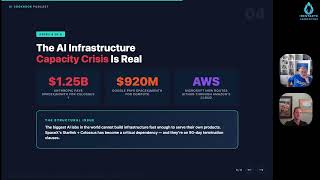
Exactly. So the capacity crisis is real. We are running out of data center and compute, here, um, that's showing where a lot of money is being sent over to SpaceX to get onto Colossus within that environment. Google's also running the same thing, so there's, there's putting, you know, Google has its own infrastructure and they're paying SpaceX for infrastructure at this point. So it'll be interesting to see, um, where we go. I mean, there's a big backlash on data centers right now. There's a big backlash on getting compute here. I do think we have to solve a few problems as we go forward here and really get this going. The ultimate is yes, data centers in space, which we have now or moving towards, but those are 5, 10 years away.
Yeah.
So what do we do in the interim for this? I don't know what else is there to say. I think I might have covered it all in this one, but if you got something to add, Nate, go for it.
No, I think you nailed it. I think that the only other thing I would add to this is as people, it's just like the dawn of the internet as we know it now. As people start to see real benefits in their life that they would scream if you took them away, you're gonna start to see the data center resistance dissipate, right? It's—
Yeah.
Yeah. Because people will say, well, don't take that away from me. I love this new thing. It's like, well, you need a data center for that to happen. So as you were saying, let's move them to space. Let's move them someplace where they're much more efficient.
Yeah, Christine and I were talking about that. She's— because there's a new data center coming here in Parker. Right now. And she's like, I don't want that here. And I'm like, I do. I want it right next to my— right next to me.
You wanna— you want a hotline straight through your yard?
Give me all that compute I can get. Um, so, you know, this happens every freaking week, right? There's new, new models that come out that are better than the last models. Um, and, you know, Claude Opus 4.8 Boy, Fable was awesome. 4.8 is good. Fable was incredible, and I can't wait for that to come back for sure. GPT-5.5 Instant is decent. I haven't really played too much in there, but I also like what Google's doing with Gemini as well. And they keep getting better on image creation and all that. And by the way, if you haven't looked at Notebook, 2.0, jump in there 'cause it's insane good.
Yeah, I haven't even touched that yet. That's the thing, it's like just keeping up with all these models is near a full-time job.
It is, but boy, Notebook 2.0 is incredible. Like, yeah, you gotta check it out. It's pretty amazing.
It'll be on my weekend rules.
All right, we'll add it to the next. So bottom line, you know, I think we, did you say, did you wanna say something? I'm sorry, I overtalked.
No, no, no, no, I said I just put Notebook 2.0 on my list for the weekend.
Yeah, yeah, yeah. So I think we're definitely not in the research phase anymore. This is infrastructure and it's deep and more and more people are starting to come in. So it's already changed business, it's changed our ability to execute tenfold and getting us into new areas for revenue and all of that, which I love. Um, yeah, the future is now. It's pretty crazy, um, how this— how fast this is all going. But, um, so that's a wrap for us this week. I think next week we'll be talking a little bit about the, the EU AI Act and how that's going to kick in. Um, we'll see what happens with Anthropic's IPO, probably new news there. And, uh, and, you know, I'm sure there'll be something new and amazing that pops up in the next week or so to, to talk about. So looking forward to it. Thanks for your time again, Nate, and thanks for time for— thanks for listening, everybody. Take care.