AI Cookbook Podcast - March 13
In this episode of the AI Cookbook Podcast, hosts Jeff Hasmer and Nathan Lamas provide a weekly AI industry roundup for practitioners and entrepreneurs. They open by explaining the podcast’s purpose: to translate fast‑moving AI developments into actionable "recipes" for listeners. The conversation quickly moves to the headline news of Anthropic suing the U.S. Department of Defense over a supply‑chain risk designation, which the hosts frame as a negotiation between emerging AI firms and governments, with Jeff calling it a marketing ploy and Nathan emphasizing the long‑term view. They then discuss the shifting competitive landscape among large language models, noting that many users have migrated from OpenAI’s GPT to Anthropic’s Claude and Google’s Gemini, and that GPT appears to be losing market share. The hosts highlight Google’s expanding AI toolbox—NotebookLM, AI‑coding features, the Flashlight model, and new creative capabilities—as a key differentiator. The duo raises concerns about AI‑driven white‑collar job displacement, referencing Anthropic’s job‑impact spider graph and arguing that AI is becoming a scapegoat for broader economic issues. They advocate for an entrepreneurial mindset, encouraging listeners to build personal AI‑powered businesses rather than fear replacement. A rapid cadence of model releases is noted: over a dozen new models (including GPT‑5.4) were launched in a single week, each adding features like larger context windows, reduced hallucinations, and new multimodal tools. This flood of capabilities fuels both excitement and creator burnout; the hosts acknowledge the overwhelming pace, the risk of “brain drain” from over‑reliance on models, and the need for community support to stay current. Finally, they discuss regulatory lag and ethical challenges. Both agree that governments are reactive and ill‑equipped to regulate AI, citing fragmented state laws and a Massachusetts governor’s 19‑point guideline as examples of piecemeal attempts. They warn of potential misuse, deep‑fakes, and large‑scale societal harm if regulation does not keep pace. The episode closes with a self‑promotion of their Firestarter Marketing service, which helps displaced workers launch AI‑focused ventures, and an invitation for listeners to suggest future deep‑dive topics.
Chapters
Welcome to the AI Cookbook podcast with Jeff Hasmer, and I have with me my partner Nathan Lamas. Hey Nate, how you doing?
Doing well. Excited to get this thing going.
Yeah, I think we've heard enough from our clients that they want some regular update on what's going on in AI. And of course, you know, we're trying to give as much of the cookbook and the recipes of how to do AI through the channel itself, but You know, I think this is moving so fast it warrants at least a weekly conversation between us and what's going on.
Absolutely. I mean, I think, uh, we, we've been doing this for a couple of years now, right? Um, kind of like pathfinding and making all kinds of mistakes across, uh, this, this new world of abundant AI. And, uh, you know, hearing from all of the people that we're talking to that we should just start talking about this and building a channel— we've been a little reluctant about doing that, but man ready to dive in and start making that happen. So, uh, to the audience who starts to see this, start recommending topics in the future, things that we can go really deep on, um, and happy to do so.
Awesome, sounds good. Let's start with what's going on this week because there's always a lot of news. Um, obviously the big news was Anthropic suing Pentagon for their supply chain risk designation here. Seems like there's a little bit of a fight going on in the AI world around this kind of thing. Do you have any thoughts on this?
You've worked with me long enough to know, I mean, I'm long-term view on this type of stuff, right? So I look at all of this, I don't get caught up in the day-to-day and the emotions of it. It's, uh, it's negotiation, right? This is— these are these new innovative companies, these are governments, and I'm not going to just, you know, talk about specifically with the US. I mean, this is happening worldwide. And my view on this is this is negotiation. There's going to be some type of an agreement that's reached, um, where across society and governments and these private enterprises, we all get comfortable with some level, um, of what these things are doing and how they're working together. My other thought on this too, I actually saw a good article on this like a week and a half ago when this was starting to boil over, um, is that don't forget this, these are early days, right? These are, this is Anthropic and OpenAI and Google and other companies who are leading the charge on stuff. But the government itself will be coming up with its own LLMs, if it hasn't already, and they will have access to data that none of these other companies have access to through various means. And so yeah, I just kind of— I look at this where this is obviously a very important topic for all of us who play with these technologies because, um, and you know, specifically in this case, this could massively impact how a lot of us are actually doing our private work. These days, um, and what happens to these companies and how they get financed and funded and used and so forth. But, um, I kind of, you know, look back at our early days in the, uh, the internet, you know, in the mid-'90s to late '90s, we saw similar types of things. I don't think to this level, um, but, you know, taking a long-term view, everything kind of worked itself out and leveled. How about yourself? I mean, what do you, what do you think about on this?
I think this is a marketing ploy. This is not a negotiation generally that happens in public. Um, I think Anthropic saw an opportunity and took it, and, uh, I think this is all marketing. I think you're right, the long-term view, this is going to get worked out. Uh, and, and, and honestly, from some of the people I know that are in government and around this industry This is like, it'll take months to unwind Anthropic from what they're doing in the security front of this. So this, this will get worked out. I think it's a marketing ploy, and quite honestly, it's working because if you look at number 2, um, GPT took quite a hit over their call for a replacement to, uh, to, to them within the defense industry. And this is— I actually think this is bigger than the defense industry. So, you know, we— I spent a lot of time on AI forums and, and, uh, group meetings during the week. One of them, uh, our AI Marketing Summit that we do every Tuesday, uh, there isn't a person in that group that's using GPT anymore. Like, we've all canceled our, our stuff. Everybody's part Claude, part Gemini at this moment. Um, so I think this is actually bigger than just the defense thing. I think GPT, in my mind, is, is losing users because they're falling behind. Yeah. Yeah. What do you think?
I, I absolutely agree with that. I mean, the, the thing I think about most with this is over the past few months, I have brought my parents and step-parents— you know, we're talking late '70s, early '80s, up to speed on AI. They have been blown away once they've learned, you know, some of the basics and some of the things that you and I teach to companies. And none of them are using OpenAI. You know, that's what they— they all signed up for ChatGPT originally and used it as a chatbot. And the vast majority of the, you know, the use right now is actually within Google. But like my father in particular is in love with Claude. Every day he's sending me stuff like, check out what I just built with Claude, look what I did with this, look what I do with that, right? Somebody who's 80.
Right.
And so, yeah. And the other thing, again, it's a long-term view I have on this. You know, I think back on what's going on with the innovation and the wars that are happening right now among these companies. And remember that in the mid-'90s, I learned HTML via Netscape, right? And using AOL. And my first social network was MySpace, right? So we're going to look back and kind of laugh, right? At like, oh my gosh, remember when we used that and we used this and used that? The only one I feel confident about is our, like, overlords at Alphabet, right? But those folks will keep on, you know, looking at what's happening in the market and they kind of say, hold my beer, and then they launch something that is incredibly useful to the masses. So I don't discount any of these other companies. I think Anthropic's going to do pretty awesome itself as well.
But yeah, yeah, yeah, I, I think we're heading for a bubble. There'll be a sacrificial lamb. I think it's GPT.
I, I agree. Yeah, I think that would be—
and yeah, we'll look back someday and be like, oh yeah, I remember that, like, like we do with MySpace today.
Yeah.
Um, yeah, it's interesting, and I think you're dead on about Google, uh, which I think we're going to talk about here in a minute. Um, but what, what impresses me most about Google is the breadth of tools that they're putting us in, right? It's not just the chat, it is AI coding, it is NotebookLM, it's all these other tools that are just so powerful, especially now that they're tying them all together as well. Yeah. Um, so this was interesting too. You know, we're starting to see AI replacing workers, and, and companies are now coming out and saying it. Um, I— so I, I'm not sure I believe that these companies are really— I think AI is a scapegoat for some problems in the economy, right?
Yeah.
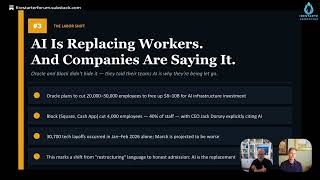
But The— I think the thing that really got me was the, the thing that Anthropic put out where they said what AI is— what jobs are AI going to take. Yeah, you see that spider graph? Yep. Um, and I think, I think that one is actually, you know, this is, this is a short-term economy issue, but we're going to start to see a white-collar replacement out there.
Yeah, yeah. This is This is the topic, like, this is my purpose with AI, right? I mean, this is what, like, gets you up and gets you fired and up and, you know, really wants to, like, makes me want to, like, attack AI and learn AI and evangelize it to others. This was really the thing that a lot of us saw a couple years ago, like, wow, you know, I've spent my years, all my years in sales and go-to-market, and I can blow my own career up. You know, this is going back 18 months ago. You and I could blow our careers up. With this stuff. And we just started screaming from rooftops like, people, you got to pay attention to this. So yeah, finally that snowball has grown. People are understanding it. You're right, there's a ton of stuff where you just have fundamentally bad businesses who blame this, you know, like, oh, we're making this move because of AI. I'm like, no, you can use AI to dig into their balance sheets and understand that that's not what's, uh, really going on. Uh, but this is— it's not to undercut this. This is a very valid point for white-collar workers. And I think you and I and many others are the ones that are out there trying to show the world that essentially you become your own company. That's what's going to happen for all of us. And it's a pretty awesome future if you figure it out.
But yeah, yeah, if you have the entrepreneurial spirit, right?
That's it. That's it. Again, you got to lean into this stuff. If this is something you want to do and something you want to continue your career in technology, you really just need to lean into this and you owe it to yourself to understand this and be at the forefront of it. It's sloppy. We don't have it figured out. Nobody really has it figured out, but you just got to stay on the cutting edge of it. Um, and that's what's going to protect people.
Well, and you know, let's be shameless a little bit and do a self-plug here. This is what Firestarter Marketing is all about, right? Like helping these people who are finding themselves out of a job build a business around a product like we're offering, right? So, you know, we— I, I think we both believe and we know that this is going to be an entrepreneurial economy And if you can't build a lifestyle around this, you're gonna be struggling. And so, you know, we hope to enable that, you know, with what we're doing. But, you know, hopefully people start waking up and getting on board. As I say in the trainings that we do, you know, it's not AI that's gonna replace you. It's people that know how to use it that are gonna win the day, right? At least for now, until our robot overlords take over.
Exactly. None of us can say what's gonna happen 12 months from now, right? Exactly.
Because, you know, like we said, it's happening fast, right? So 12+ AI models were dropped in a single week. Yeah, everything from GPT-5.4 with a larger context window, um, reducing hallucinations, and the API, um, at 2.5 per million output token tokens. That's pretty good. Google just keeps dropping stuff left and right, um, with the Flashlight, the ultra fast, ultra cheap that they put together, but they also added in some amazing functionality into NotebookLM, uh, with new creatives, new, uh, like cinematic videos that it creates, uh, some really cool tools there. Um, and then same thing with ChatGPT. I'm starting to see like little things come out. They just did that interactive charting thing like yesterday. Um, it's just like every day, every— we're seeing, we're seeing new functionality come out in these tools, and, and it's more and more powerful.
Yeah, again, it just goes back to that, um, early wars we've seen in innovation, right? Uh, throughout our career, um, over the past 30 years in the space. And it's just, it's so much fun, but it's just overwhelming, right? I mean, we make it our business to go play with all these toys and turn things on and spend $20 for this and shut it off next month, right? And play with these things. And like, the amount of graphic design tools and AI-assisted imagery tools that you and I have burned through, and we have a new favorite every week, right? I mean, it's just— that's just one example of this stuff. We do. And it's just not going to stop. Things will, you know, will settle on the winners in the future, um, but, uh, it's just an amazing innovative world right now. And you and I, we run into trainings like where we're, you know, hey, we're the experts, we're gonna show you how to do this and teach you what we've learned over the past couple of years, and then somebody brings up a tech that we've never even heard of. Yeah, you know, right there we sign up for it right in front of them, start playing with it like, this is amazing, never even heard it. There's no press release on this.
Yeah, it's pretty wild, uh, but it's so much fun too. I get lost in this stuff and burn a weekend just sitting at my computer.
Yeah, that's, you know, that's a topic. I've seen this with myself, I've seen this, you know, in the work, um, across a lot of people like us who are really diving into the services aspect, um, and the software development aspect of this stuff is slop, right? Everybody talks about AI slop on their, their channels, but I'm getting sloppy as like a person. So this is a topic we should talk about in the future, and it's because of this, it's because of this overwhelm. It's like keeping up with everything and, and, uh, you know, burning out so many, uh, you know, outputs each day from all these different models and these different technologies just to see what they do. Yeah, you start to kind of look back and say, wait, is this my best work? Right? And maybe not in some of these cases. So that might be a topic for the future.
Yeah, that will be a good one. Good one to cover for sure. And that, I think we can couple that one too with like the, what's the brain, is there going to be a brain drain? Yeah.
Right.
Yeah. Uh, of, you know, if we start relying on these models too much, do we forget how to do things like write and, and think for ourselves as well? Um, that's starting to become a big topic and something burning in my mind as well. Yep. Yeah, I mean, I think I would— on this one, I would just, just keep plugging away and play and get in there and, you know, figure out what it can do for yourself. And absolutely use the recipes that we're putting out there to try things out.
So that's where you have to build that community too, right? Build that community with people who are going to keep you in touch with what's happening because you get so lost in the work that you're doing week by week.
That's helpful for me. Like, I'm in 3 different communities that we just talk about this stuff all the time, and it's, it's really helpful just to sit there and see what other people are doing with it too. Uh, it's pretty amazing. So here we go. Uh, now the government's starting to wake up, and you got a bunch of AI laws coming down, uh, down the pipe on this. What do we think?
Again, something we've seen before, time and time again in our career. Um, You know, legislation can never keep up with what's happening, but I'm happy to see that these movements are happening, right? I mean, the nefarious aspects of what I've already seen, I've still got, you know, kids who are in middle school and already, you know, some of the kids out there who are using technology to do things they should not be doing. It's stuff that I want to see, you know, some very fast advancement on a lot of these things faster than I did previously. You know, we were talking about privacy concerns, things like that. It almost seems trite to me now versus the things that, uh, that can happen with this technology. Um, the— think about the amount of things, again, with parents, um, and really, I mean, across any generation where people will send us stuff like, you know, is this AI? Like, did this really happen? I'm like, no, that didn't really happen. This is absolutely AI. Yeah, you know, and, and it's just gonna be harder and harder for a lot of people to figure this stuff out. As we go forward. So we need this. Looking at this topic though, this is one thing, I guess it, I don't really know what it is, maybe it's a plea for myself out there is ethicists, right? Like AI ethics, everybody talks about it. We know some brilliant people in our network who have made it a focus of their career going forward to be involved with AI ethics. And I'm not seeing enough of that. I'm not seeing enough of them just screaming like, hey, you know, this has to happen. Um, there's kind of this low boil, I guess I put it right now, of people talking about, yeah, yeah, we all have to have ethics, and then it just— we move on to another topic. Um, but I, I hate to say this, but I feel like just some really, really bad stuff is going to have to happen, like something that convinces an entire state that some horrendous thing is happening, you know, it involves all kinds of real-world calamities because of that, from, uh, from an AI hoax. Before people just really jump up and say, oh my gosh, we gotta, we gotta rein this in and put some controls on this.
Yeah, unfortunately I agree. Like, I, I feel like government is just reactive to what's going on, um, and, and I don't think it's well equipped to regulate technology like this. Yeah. So we're kind of in this conundrum, right, where I, I agree, like, there's— we've got to figure out ways to put guidelines around this, although I just don't have a whole lot of faith that the government can do it. Um, yeah, it was interesting, I was watching the Moonshot podcast and two of the guys were out in Massachusetts. They have a fairly forward-looking governor and they, they laid out guidelines of 19 things that they should regulate or do, you know, to help both push the industry forward but also, you know, figure out on ethics and guidelines of what we're supposed to do. And the, the government just said, yeah, I don't understand any of this, so why don't we just— I think we're gonna have to wait till something happens. Yeah, like, that, that's scary because something bad is likely to happen, right? Um, and it's, you know, at the same time, I just feel like, I don't know, like, we're in a race right now. Regulating this can only hurt. Yeah. And so I'm of two minds on this, and, and I don't know where to fall on it, but I— what I do know is our government, whenever they've tried to talk about technology, just isn't ill-equipped to do it.
Absolutely.
Maybe because it's run by 80-year-olds. But I mean, something's got to change there because we've got to figure out how to get ahead of this game. But individual state regulation doesn't work. Yeah, not in the US. Like, we have to figure out something national if we're going to do this. And this is what scares me with these 78 CHOP-OUT bills. It's the same problem with privacy, right? You got California has a law, Texas has a law, and which— how do you follow all of them and build one system? Well, you always have to go to the most restrictive if you're going to do that, and that might hurt innovation.
You know, but it's an absolute balance that, that's going to be, that pendulum is going to swing back and forth like we've seen before. But the ramifications of what can be done with this, you and I, you know, so many people see it and they fully understand it and you understand how bad it could be, um, you know, very quickly. I mean, you, you could see a massive amount of people's personal wealth disappearing overnight from some of the things that can happen. You can see terrorist-level attacks that happen. From some of the stuff, all through just fake stuff disseminated, you know, via AI at scale. So yeah, I'm with you. I, you know, none of us has the perfect answer for this, but we see the threats behind it. I mean, we've turned down work, right? Like, like, yeah, I'm not going to do that. Like, that's something I just don't want to be a part of, right? Like, in our case, it's been— it would actively eliminate jobs. Um, in certain areas. And it's like, you know, I just want to be a part of that, but somebody's going to take that, you know, that work. And, and that's at the lowest end of the scale for the threat, right?
Yeah, that's the sad part. Yeah. Well, anyway, but the revolution's here. You got to keep up with it. That's why we're doing this. So, uh, listen, thanks everybody for listening. Love to have the conversation, Nate. And, uh, keep on— we'll try and do this every week.
Throw topics our way. We're about to deep dive into some of this stuff.
Yep. All right.
All right. Thanks, Jeff.