The AI Cookbook - March 20
Jeff and Dave argue robotics is hitting an iPhone moment with deployment in manufacturing and homes within 3-5 years. Claude now solves previously unsolved math problems and has new visual explanation tools. AI is actively replacing knowledge work, and self-optimizing models already exist, contrary to Morgan Stanley's 2027 prediction.
Chapters
Recorded this computer. Hey, welcome to the AI Cookbook podcast. I'm Jeff. I'm Nate. All right, well, let's, uh, let's hop right into it. Hopefully this won't be too long. Um, there's some— I wanted to jump into a topic to start with because it's been kind of gearing at me. I think I see AI bifurcating into physical AI and then the electronic AI. So, the first topic I wanted to talk to you about was robots, and they're having their iPhone moment right now. So, there is a lot going on in robotics and a lot of massive investment that's going on in what's out there. And we're heading into this physical robotic world where you're going to start to see robots do manufacturing, they're going to be our taxis, they're going to be— you know, all this physical labor is going to be robotic. And I think we're in within like 3 to 5 years of that really being fruition. What do you think?
I absolutely agree. I mean, it was like, uh, you know, I haven't thought about this much because I've been so heavy into like just the electronic aspect, you know, the, the LLM aspect of AI and where that's going. But, you know, 4 years ago I started looking heavily at ag tech, and there's a lot of robotics in that. And 4 years ago, the robots blew me away and what they were doing and how AI was being applied there. And I catch up with those things every now and then, and it just astounds me— functional robotics in the entire agricultural industry. And, and it's not going to be long before we have, you know, these more of these Roomba-type things in all of our homes that just do incredible things.
Yeah, factories and all that kind of stuff. I mean, oh yeah, you know, it's interesting, like you hear about these frontier models and you hear a lot about Anthropic, you hear ChatGPT, you hear Gemini from Google and all that. But you're not hearing much about xAI and Elon's companies, right? I actually think that's because he's abandoning this consumer-based AI and the business-based AI, and he's going hard at the robotics. Yeah. And I'm willing to bet we're going to have a data center in the sky, in space, from xAI, and we're going to have a moon base where they're going to be building stuff on the moon, but it's all robots.
Crazy. Doesn't matter how far, like, how fast we move, it's still science fiction stuff. It's crazy.
I know, it's gonna be really wild, really wild. I don't want to talk about what it's going to have an impact on, you know, work and economies yet.
Yeah, yeah.
All right, let's get lighter. Um, Claude released a new feature, and they seem to be releasing a new feature every week on something, but They have the interactive visuals in chat now. Have you seen this?
Yes, yes, this blew me away.
Yeah, super cool. I was playing with it and, and the, the really cool thing is the prompts can be like really light. Like you don't have to go into prompting framework. You can basically say something like, hey, show me how, show me how the time value of money works and teach me how that works in an interactive visual. And boom, all of a sudden it comes out. Yeah, that was super cool.
Yeah. And it's funny because it literally, you know, so many things we've been doing over the past year with these tools, with these frontier models. I'll still have a sketchpad, right? And I'll, and I'll say, okay, you know, this is interrelating in this way and drawing little flowcharts and scribbles and stuff. And I was like, all of a sudden Claude's doing this for me. Oh, this is amazing.
Yeah. Yeah, deeper and deeper into this for sure. Um, I just, I love following all these changes and how fast it's coming.
And it's like every day, yeah, I open up Claude and it's like, oh, now we do this.
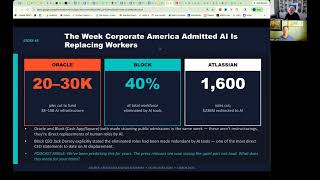
All right, well, and you know that I think the sneaky, the sneaky group is Google on this whole thing because Google is so quiet about their releases, like so quiet, but I was playing with Notebook, uh, this morning, and they've added like 5, 6 things in the Notebook that we've got to have another, another session on. But like, yeah, just to jump back in there today, this keeps getting better. That's pretty incredible. Anyway, let's move on. So, um, Corporate America— all right, we are going to talk about jobs. Corporate America admitted AI is replacing workers.. And we're seeing this in massive form right now.
Yep.
Where do you think this goes?
I felt like we were alarmists, or people thought we were alarmists when we started talking about this over a year ago. Now it's like people like, okay, this is actually real. There's still a significant portion of at least my network that's like, oh, these are all just excuses for bad businesses, right? They're just using AI as like the crutch. But I think this next wave, everybody realized, no, this actually wipes out knowledge work. And when people— we see this all the time when we start taking people through our training and they start realizing, I just did what took me years in my career to do, and I just ran that in 5 minutes. Then they start to— it finally hits, like, this absolutely does replace, you know, knowledge work. And, and this is going to keep on snowballing.
Yeah, I'm hearing more and more of those personal stories too. You know, a marketer of 19 years gets laid off without severance. With nothing, right? Like, and, and more and more people, you know, it— what was it, the jobs report was negative last month too?
Yeah.
So I think we see more of this, but I think what it means, I mean, there is no recourse. We all got to become entrepreneurs.
Yes. You know, yeah, that's probably, you know, that's a good personal reminder. I should probably like put that on the, uh, you know, the sticky note on the mirror for each morning, which is like remember that we're a bit further ahead on this wave than others because we're all enthusiastic and opportunistic and realizing, oh, we weren't that way when this kind of happened to us. We started seeing this happen to our initial batch of friends. So yeah, you're right. There's a bigger wave. The tsunami probably of this is starting to hit and there's a lot of just very scared folks. And it's up to all of us to show everybody how they can become entrepreneurs with this technology.
Yep, shameless self-plug, we are running a program starting March 30th where we're teaching people to become entrepreneurs through their own marketing agencies. Just, just so you know. But I think this is coming for all of us. Yeah, I'm pretty soon. All right, story 4: shock, shock, Claude solved his unsolved problem. This is a crazy story. Like, I think this just speaks to the value of these models and how good they are at solving complex theories. I have no idea what this means, to be honest. Like, I, I couldn't tell you what the algorithm was and all that kind of stuff, but the fact that it's starting to solve math and physics and things like that leads us into a world where, you know, AI is, is really leading and solving massive problems for us, right?
This is even— yeah, this is the kind of stuff where I'm with you. Like, I don't understand, you know, these geniuses. I'm like, I don't understand what they're working on or what algorithms they created, or, you know, what they've been asking for computer assistance with for ages and now can suddenly do. All I know is that when people like that are like, I'm shocked this actually works, then yeah, then I'm just like, okay, this is astounding.
Exactly. If it's, you know, as the podcast Angelist says on here, if Newt is surprised, the rest of us should be paying very close attention right now.
Yes, absolutely. Yeah, you and I get into this stuff where we can like explain how, you know, this is how this amazing result is happening. And maybe some of the shine has gone off it for us. It's like all it's doing is just assembling, you know, words in the order that we want to hear them. But it's like, wow, there actually is something much deeper going on with these models when you hear people like this saying it solved this problem that I wasn't able to solve, or it took me weeks to solve. Yeah.
But I think, you know, I think it's important to note here too it still requires direction, right? The models aren't thinking, they're predicting, and they're putting things forward that are pretty, pretty amazing. But that's after directed information. So I think about like the websites we've been delivering, right? Um, they're great, they're amazing what we've been delivered, but they're amazing because we put the brand framework before it. Yeah, yeah. And, and it's the things that we know and that we've done for years in our business in our business lives and our corporate lives, like the brand framework, the messaging framework, all that kind of stuff that we pull together that make these things really, really shine. Yeah, right. So there, I think, you know, just to leave some hope out there for people, you know, this isn't about AI taking over for us. This is about AI aiding your knowledge and really taking it to another level. Yeah, because it wouldn't have happened if Neuth didn't know what he was talking about, right?
Yeah, absolutely.
Okay, last one. Uh, Morgan Stanley: most of the world is not ready, and GP 5.4 proves it. So the, uh, the numbers on, on this, um, and they're estimating recursive self-improvement comes in 2027. I would argue it's already here. The models are, are working themselves. If you look at what's going on with OpenClaw and how they're doing and how that's working, the models are absolutely improving themselves on this. So I think Morgan Stanley's wrong. They're like way off.
Yeah, this is, this is the part that starts to scare me, right, is how fast this happens. So we, we just talked about, you know, we, we open up every couple days, uh, one of the, the generative models, and there's a new feature, like, oh, that's really cool. And that, that's going to happen so quickly that they can't even update humans anymore. It's just like, yeah, this stuff's all just happened. You can ask us these questions now and, and we'll take care of it for you.
Yeah, exactly. And I, you know, it, it'll be interesting to see what's going on, but, you know, this is, this is where we, we talk about this all the time. If you're not in this game, if you're not playing with AI and you're not injecting it into your everyday, you're falling behind faster and faster. You know, I, I, I hate to be that, that person to be like, you know, alarmist about this, but I just know the work that we've been doing over the past couple years and how much better it's gotten and how much more I do with it every day that I can't imagine somebody who's just getting into it right now.
Yeah, absolutely. Yeah. Yeah. I still had a way of thinking this morning for setting up one of these training cohorts that we have coming up here starting on the 30th. And, you know, in my head, as I was talking to somebody, I'm like, oh, I need a syllabus and I need a bio intro for everybody and I need all this, you know, kind of pre-prep work. And you still revert to, okay, that's like a day of time. I've got to set a day aside. And then I realized this is either a notebook or a Claude task that's going to take 5 minutes. Yeah. And then you start to think, I won't even have to instruct it in the near future when these things get so recursive. It can just listen to my phone call and I'll say, hey, just based on that phone call, you know what I need? And it's going to do it. It's just crazy. Yeah, it is.
It's crazy. It is. You know, people see my eyes like, why does he keep looking to his right? It's because I'm vibe coding while we're talking.
Yeah, exactly.
Yeah, it's my favorite part about coding our YouTube, uh, integration right now.
It's my absolute favorite part about our prospecting calls we do with prospective clients, and they say, you know, I really need something that does this, and then I can tell that you're vibe coding it on the side, and we're half an hour into discovery, and then you say, hey, you want me to show you a prototype of what you just asked for half an hour ago? They just fall out of their chairs. I love it.
Those are my fun— yeah, I love that stuff. Well, all right. Well, that's the, uh, that's the podcast for this week. We went quick here on it. Um, I think the story here is jump in as fast as you can, start building a business around this, and think about becoming an entrepreneur. Because if you're not, um, you know, something's coming for your job these days.
Absolutely. If it happens to you, reach out to us. Like, we're— we've been here to help. We've gone through it ourselves, and we're trying to lift everybody up.
Yeah, time to go. Let's go. All right, thanks, Dave. Great talking to you.
That was good. Thanks, Jeff.