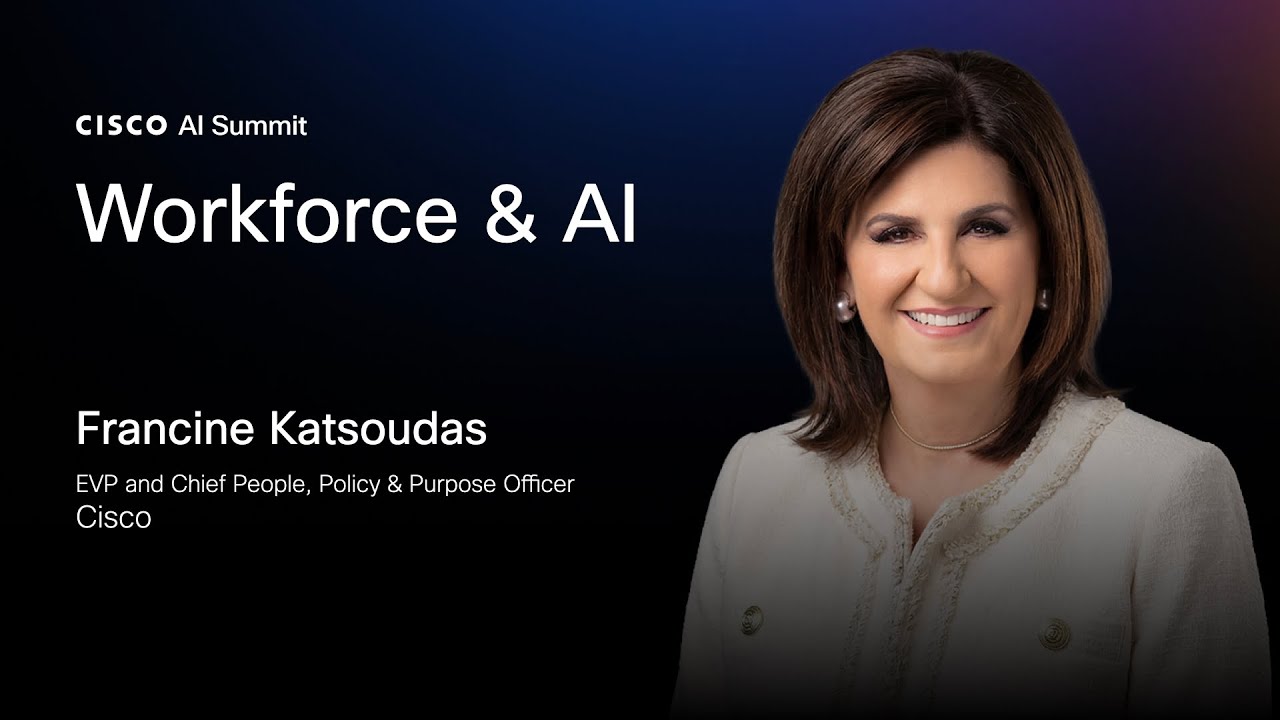
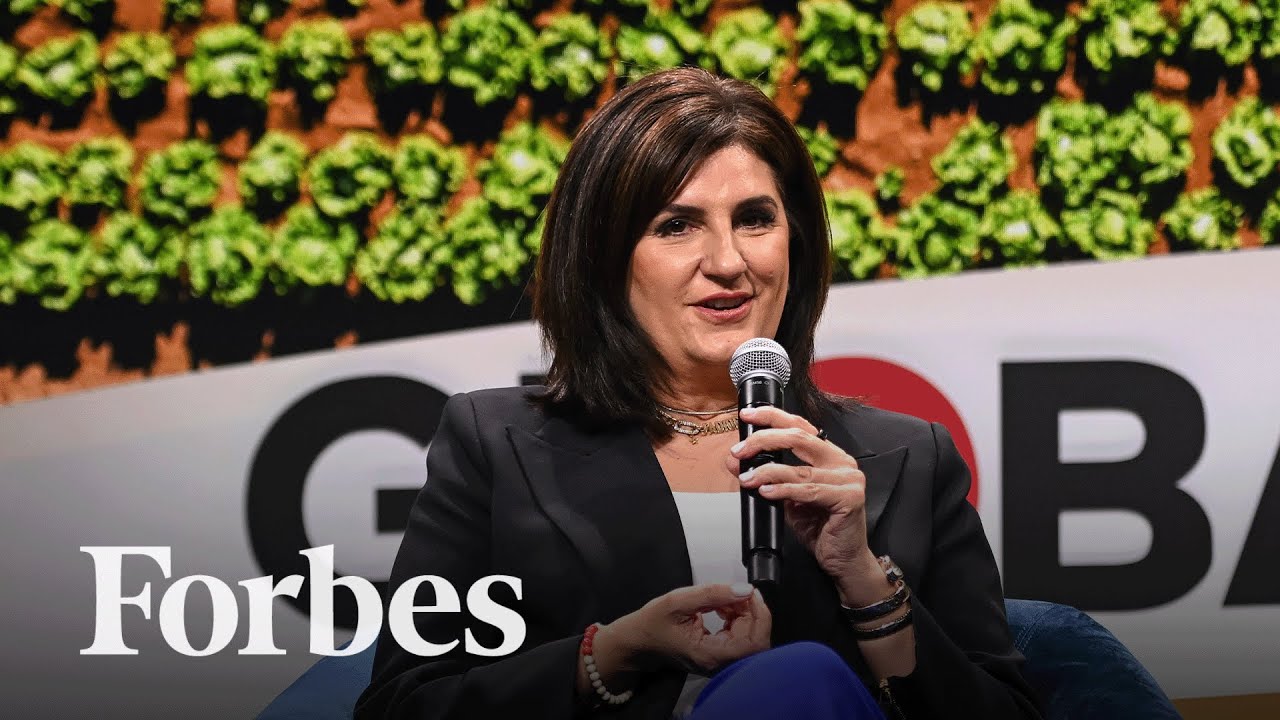
In a Reuters at Davos 2025 interview, host Nazneen Mashiri speaks with Francine Katsoudas, Cisco’s Executive Vice President and Chief of People, Policy and Purpose. Katsoudas frames resilience as a three‑fold concept—individual (employee well‑being and skills), technological (secure, robust AI models and network infrastructure), and community (supporting societies to adapt to digital disruption). She explains that AI places unprecedented stress on networks, and with over 85% of the internet running on Cisco gear, the company is positioned to help enterprises ready data‑centers for AI workloads. The discussion references Cisco’s AI readiness report, which finds 98% of firms feel pressure to adopt AI but only a shrinking minority have concrete plans (down from 14% to a lower figure). To close this gap, Cisco collaborated with eight leading firms (Google, Microsoft, SAP, Accenture, etc.) to study technology roles, discovering that 92% of such roles will change moderately to significantly, underscoring the need for continuous reskilling. Katsoudas highlights public‑private partnerships with governments, especially the U.S., to ensure cybersecurity and responsible AI practices. Finally, she outlines Cisco’s new 10‑year commitment to build resilience in 40 global communities, focusing on government digital services, education, technology, and the environment. The interview concludes with observations from Davos: a growing reliance on cross‑sector collaboration, optimism about AI‑driven growth, and governments’ focus on upskilling citizens.
Chapters
Hello and welcome to Reuters at Davos 2025. I'm Nazneen Mashiri, and I'm delighted to be joined by Francine Katsoudas, Cisco's Executive Vice President and Chief of People, Policy and Purpose. Cisco has really been at the forefront of leveraging technology to build resilience, drive innovation in AI, and foster trust in what is a rapidly changing world. And these are key themes, of course, here at Davos and in many discussions around the world. Thank you so much. Let's dive straight in. I wanted to ask you about building resilience. We hear a lot about that when we're talking about AI. What does that mean for Cisco and what you're trying to achieve?
So I think we're using the word resilience more and more, and I think we look at it from an individual perspective and we want our employees to be the best that they can be. We look at it from a technology perspective, and then we look at it from a community perspective. As it relates to AI, I think when we're talking about resilience, we're talking about both, in some cases, having the talent and the skills that we need to really take advantage of what the technology can do. But there's another element of resilience, which is ensuring that data is secure, that we have a way to protect the models that are out there and that from a customer perspective, they have the ability to get those insights, especially when something goes wrong from a cyberattack perspective.
And we're hearing a lot about the AI revolution. I think your CEO has talked about it as well. And here in Davos, it's just dominating a lot of the discussions. How is Cisco positioning itself to lead this revolution, which is everyone— which is on everyone's agenda at the moment?
It really is. And I think this is something that stands out a little bit this year. I think we were talking about AI last year, but this year I think there's more clarity that all of us want to leverage AI to grow. And so from a Cisco perspective, what we recognize is that all of the AI models, they put a significant amount of stress, if you will, on the network. And given the fact that today 85% plus of the internet runs on Cisco technology, we have a great opportunity to help our enterprise customers build that infrastructure. And I think also we see from a web-scale perspective, they are building out for the future and Cisco is going to be a key part of that. So many of our customers at this moment are readying their data centers for the demands of AI.
Yeah. And also, your readiness report highlights actually that there are a lot of gaps there as well, and gaps that need to be filled. Can you tell us a little bit more about that?
Yeah, this was really fascinating. So what we saw in our readiness report is that 98% of people feel pressure to implement AI within their company, but they're struggling with the plans. And something that was really interesting— so we ran our readiness report a year ago, and what we found was that only 14% of companies companies were building out their plans. We anticipated that this year it would be a higher number. And in fact, the number went down. And I think something that I think about a lot in my role is that we need AI to be something that is not only top-down but bottoms-up, which means you have to put the technology in the hands of your people as they will then start to leverage and really evolve their roles with Yeah,
I mean, so how can that be possible? Because I mean, the global workforce is obviously hugely important in getting them ready for this change. And so what, what advice do you have for closing these gaps?
It was really interesting. We did a body of work with 8 other companies, so companies like Google, Microsoft, SAP, Accenture, and we looked at roles within technology. We studied about 85% of roles. We found that 92% of technology roles will change moderately to significantly in the near future. Those insights helped us to understand specifically what part of roles are going to change. And this is something, by the way, if you look at Cisco AI ICT report, you'll find it online. This report, I think, gives all companies some guidance around how we start to evolve and understanding that some tasks today that are of great value will be managed by AI and that roles will have to pivot. I think the more that we have these conversations with our people, the better that they can prepare. And the last thing I would say here is it's a new world where all of us are going to have to continue to refine our skills on a very regular basis.
That partnership you're talking about with various companies, including Google and Microsoft, it's also about making sure that, you know, government data and various data is secure as well. How important is that agreement with all of these different or various companies?
So, you know, the body of work that we did absolutely focused on the technology roles, but you're right, there's a tremendous amount of work that we're doing with governments around the world, with the U.S. government, to ensure that as we step more and more into AI, we do have the protections in place. And when I say that, I'm not only talking about cybersecurity, security, but I think all of the responsible AI practices that we're seeing around the world that we can adopt as well.
And look, you know, you do have big ambitions at Cisco, and I think you— your next big ambition is to help communities around the world to become more resilient, as you've mentioned what resilience means to you, which I think is really important. You know, what inspired this vision of Cisco, and how do you see it unfolding?
At Cisco, our purpose is to power an inclusive future for all. So we have spent a lot of time really thinking about what that looks like. It was a little more than 10 years ago that we set a goal to positively impact 1 billion people around the world. We actually met that goal a year early. And we did that, as you would imagine, through a lot of the education that we do, our partnerships with nonprofits, with other customers and partners. When we reached the goal of impacting 1 billion people, we really thought about how can we have the greatest impact. And what we realized is that communities around the world are really struggling, especially against the backdrop of AI, to remain current, relevant, to take disruption and turn that into growth. And so our new commitment is to, over the next 10 years, work with 40 companies— or I'm sorry, 40 communities to really help them build resilience. And what that means is that we're going to focus on areas like government and digital services. We'll focus on people and society with particular focus on education. We'll focus on technology, the environment, and through this work, hopefully build resilience that will have a great impact on the world.
And obviously, you've been here on the ground in Davos. What have you been hearing? You know, what insights can you give us about what you're hearing in this sector in this field?
You know, a few things. The first thing that I'm hearing is the dependency that governments and I would say the private sector has on these public-private partnerships and the realization that for a lot of what we're talking about, it is going to take collaboration, which is the theme of the session. I think that's one thing that I'm hearing. The second thing is I see a lot more optimism around how we can leverage AI for growth. And so in the same way that Cisco feels incredibly bold about what's ahead of us, We're seeing more and more companies and use cases getting more clear around some of those opportunities as well. And then the last thing that I would say is that many of the governments that I'm talking to are really focused on how they're going to skill their people. And this realization that governments want to take their services and digitize them, and they need to have the people then to really receive these new services. And there's quite a bit of opportunity there as well.
Francine, thanks so much for joining us here in Davos. And I think it's really important that we remember that Cisco is trying to leverage the AI technology, but also there are— these are difficult transformations which are taking place as well. Thank you so much. Please do stay tuned to Reuters at Davos 2025 for more really essential conversations from here. Thank you so much for joining us.