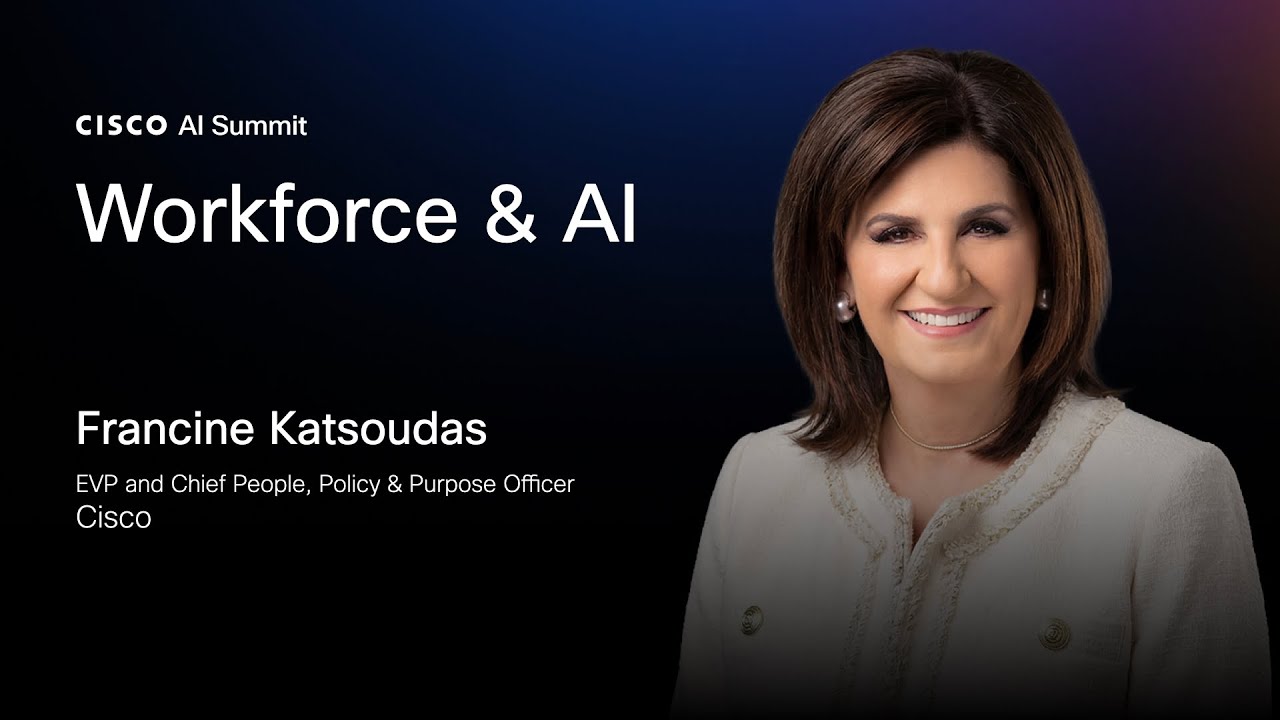
In this keynote, Cisco EVP & Chief People Officer Francine Katsoudas frames AI adoption in the workforce as a cartographic challenge, using the historic "Here be lions" metaphor to highlight unseen AI power users who are often low‑visibility, non‑critical employees. She shares findings from Cisco’s three‑year AI research study and the AI Workforce Consortium, revealing that only 13% of companies feel they are extracting AI value today, while 78% of technology roles now require AI skills. The presentation showcases concrete skill stories, such as Jordan’s evolution from a manual cyber‑analyst to an AI‑augmented proactive defender, illustrating how AI can augment rather than replace work. Katsoudas emphasizes that leader‑driven AI use doubles team adoption, positioning leaders as a 2× multiplier. She introduces the concept of "activated employees"—those who combine performance, engagement, and self‑motivation—who adopt AI twice as fast, retain at higher rates, and express greater brand pride. However, she warns of the "efficiency paradox": rapid AI use can erode team trust, demanding new trust‑building practices. The talk calls for a leadership transformation toward curiosity, agency, and cross‑functional tech enthusiasm, and stresses collaborative impact through partnerships like Cisco’s eight‑year alliance with Global Citizen, which has mobilized millions of actions and billions in aid. The overarching message is a shift from fearing the unknown to walking confidently with the "lions" of AI, urging organizations to map, activate, and support their workforce for an AI‑driven future.
Chapters
It has been such an amazing day, and every conversation has been so interesting when you think about the assumptions and the beliefs around our people and our workforce. And I want to start by asking you a really simple question. Who in your organization is using AI most effectively? When I asked my leaders to share who their power users were across the organization, The names that came back, they surprised us. They were not the people that we talked about on a usual basis. In some cases, they were not the loudest voices. They were not the most senior people. And I think the thing that alarmed me is that many of them were not marked as critical to retain. So our systems didn't see them. And it was at that moment that I realized we had a map problem. So let me explain what I mean by that. Has anyone heard the term, here be lions? One, yes. A couple. So for centuries, when explorers drew maps, there were places that they couldn't describe, and not because nothing was there, but because something was. At the edges of those maps, they wrote warnings like, Here be lions. And by the way, this is an actual map from the 10th century. How cool is that? The map didn't end at the boundary of knowledge. It ended at the boundary of risk. For the last 3 years, Cisco has been running an AI research study where we've looked at the readiness of companies to truly get value from AI. Some of you know this number. How many companies really feel like they're getting value today? 13%. Why? I think today's lions are ambiguity. I think work is evolving faster than skills. There are leadership gaps and ethical uncertainty. And this is why we came together with 9 companies to analyze the future capabilities needed for technology roles. And I want to say a huge thank you because I know many of these companies are in the room right now. And we did something really unique. We shared a lot of information with one another. We talked about the different roles that we had, how we see them changing. We compared the definition of a software engineer. We looked at how skills were evolving. And the fact that we haven't done that before tells me that this is such a unique moment. And I think we did that both for our employees, but we also did that for communities around the world. Together, we found that 78% of roles, technology roles, now require AI skills. So the shift isn't coming, but the shift is already here. And today, we are making our report available to all of you. Within the report, we have over 200 learning courses, and most of them are for free from all of the 9 companies. A playbook for how do you connect your capabilities to the architecture for the workforce, a skills glossary because we all like to call things by different names, and then skill stories. And skill stories tell us how roles evolve or are augmented with technology. Let me show you a quick example. So I want you to meet Jordan. And in 2023, Jordan was a cyber analyst, and he spent his time manually looking at incident reports. He was looking at the compliance that he needed to adhere to. It was a very manual job. I think he felt like he was playing whack-a-mole. Today, Jordan's role has become so much more proactive, and I think maybe more importantly, impactful. So today he runs AI-generated triage. He looks at attack simulations. He automated those compliance standards. And I think it's so important for us to tell more stories like this because in doing so, we reduce the fear and we make it so much more clear how technology is augmenting roles. But it's not just about the technology. So at Cisco, what we have found is that non-AI users, they remain non-users unless their leader intervenes. Our data is undeniable. Adoption doesn't follow an email. Surprise! It follows you. When a leader uses AI, their team adoption doesn't just grow, it doubles. So you are the 2x multiplier. As I look back, that talent review wasn't an anomaly. It was a signal. AI isn't replacing our best people. It's putting a spotlight on the skills and the behaviors that we need today. Last week, Jeetu told me a story about a distinguished engineer within his organization. And he shared that this engineer who's been with the company for 24 years just had a major AI breakthrough. And what I want to share with you is this isn't just a story. What our data shows at Cisco is that people that are new to the company and people that have been with the company for more than 20 years are leading the way in AI adoption. So what does that tell us? It tells us that we as leaders have to expect that every demographic of the workforce will have a breakthrough, and that we have to work to encourage it. 2 weeks ago, I was in Davos, and I had just finished a panel on skilling. And this woman came up to me, and she said, there's a perception that the C-suite is blaming employees, blaming the workforce for the fact that we haven't transitioned. And I've been thinking about this. Every single article, every headline talks about skill gaps, job loss, resistance to change. And it strikes me that we rarely say things like, you know what, we have confidence in the workforce. I think we need to commit to a new narrative and put a spotlight on the employees who are adopting new technologies and enabling innovation. And you have to forgive me because I'm about to take this lion theme one step too far, but if we don't do this, our employees are going to feel like they're being chased by a lion.
Run! Get out
of here! Oh my God, it's a lion!
Move, move, move!
Like I said, I took it too far, but it's a great AI simulation. And what it just reminds us is that this is a moment where we have to have fun. But this is also a moment where there has to be a leadership transformation and a call to action. And as I've listened to all of the conversations today, you can feel this pivot into what we value. So traditionally, We all valued stability, polish, predictability, past performance. But today, we need more curiosity, more agency. We need tech enthusiasts, not just in IT or product, but in people, in finance, in legal, across the enterprise. And the good news is that for all of us, there are these people who are willing to step into the new terrains, And so the question for all of us becomes, how do we find them? At Cisco, we have been searching for what we call the activated employees. So activation is performance plus engagement plus self-motivation. And I want to share with you a few of the powerful things that we've uncovered because I, I think it's going to surprise you a little bit. So the first is they've adopted AI twice as fast as their peers. The second thing is that they're really leaning into learning. Now, you would expect those that are most marketable to then have the highest attrition rates. We're holding them. They have a higher retention rate than the rest of the company. And we also see that they're scoring higher in their pride for the Cisco brand. So it's so interesting that we see a connection between AI adoption, Brand and retention, and, and that's exactly what we all want. There is a concerning finding, which we call the efficiency paradox. What we've seen is that the most active AI users are sometimes reporting lower levels of team trust. So while AI makes individuals move at light speed, it can fracture that trust. Again, this is another call to action for us as leaders. AI isn't breaking teams, it's stress testing them, and it's showing us that the old ways of building trust, they have to evolve. At Cisco, we've always believed that AI is a team sport, and if we do this right, we're not just losing connection, we're elevating what is deeply human about work. And through our AI Workforce Consortium, we learned that when we collaborate, Our impact isn't limited, it multiplies. By partnering outside of our company walls, we saw greater trust in our findings, more clarity for our people because we could represent it as something happening in the industry, and acceleration for all. I think together we have an accountability to ensure that nonprofits, that schools, that small businesses are not left behind. At Cisco, that worry about the digital divide has shaped our work for decades. Think about this. If the lions of AI are paralyzing for large enterprises, imagine what they are for communities around the world. And this is why I'm so thrilled that at so many points throughout the day today, we talked about the good work that we can all do together for the community. This is why our Global Citizen partnership is so important to us. Global Citizen's mission is to eradicate extreme poverty, and we've been working with them now for about 8 years, and I wanna just share a few stats with you. To date, they have brought activated people around the world together, resulting in 43 million actions taken, 1.3 billion lives impacted, $49 billion distributed. I said million by mistake the last time I did this. And 30 major policy commitments. That is significant. Along Global Citizen, we are committed to bringing together the private sector to scale technology, to enable education, and to leverage our collective resources. Please scan this QR code. There is so much work that we need to do together, and we realize, like, Look at the power in this room. If we all come together, we'll be able to take our platform and our playbook and bring this partnership to do amazing things for communities. And I wanna let you know that the founder and CEO of Global Citizen is here with us today, Hugh Evans. Please find one of us during the break. We'd love to talk to you about how we can use AI to really support communities around the world. At Cisco, we've always seen the power and the perspective that comes with stepping outside of our company and into the communities. We realize that we're not just building the playbook for the Fortune 500. I think we're building the playbook for the global workforce. In an AI-driven economy, the most dangerous risk is not challenging the status quo. We cannot let the lions of uncertainty and fear hold us back. The future does not belong to those that wait for the map to be finished. It belongs to those who fearlessly walk with the lions. Thank you. Thank you.