Audio Recording Francis Wade at PSOJ Mentorship
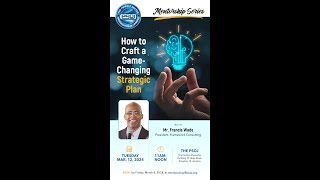
The recording captures a PSOJ (Private Sector Organization of Jamaica) mentorship session led by management consultant and author Francis Wade. After brief introductions of participants from diverse industries, Wade launches into a workshop on creating game‑changing strategic plans. He defines a game‑changing plan as one that transforms an organization’s position and outperforms competitors, and he introduces his "Endpoint Method" – a three‑step process of (1) assessing the current state, (2) articulating a future vision, and (3) designing a strategy to bridge the gap. Wade illustrates the method with real‑world cases such as Digicel’s disruption of Cable & Wireless, Amazon’s long‑term seed‑planting, and the Jamaican national football team (the Reggae Boys). Participants engage in hands‑on exercises to imagine 3‑year, 30‑year, and 100‑year horizons, identifying a "sweet spot" for each organization and brainstorming concrete actions (e.g., talent pipelines, patriotic branding, multi‑country talent programs). Wade then shares four practical steps: pick a long horizon, define what game‑changing looks like at that horizon, back‑cast from the future to the present, and embed the plan in performance management. He stresses the importance of group dynamics, early staff engagement (surveys, focus groups), and change‑management rituals to avoid common pitfalls: poor implementation (lack of balanced scorecard), weak communication of the vision, and a tendency to copy competitors rather than innovate. He also discusses how to persuade boards without over‑promising, using back‑casting to ground visionary targets in realistic projects. Throughout, Wade encourages participants to stay for the full session, promises a recording, and provides his contact details for further consulting. The latter part of the session shifts to practical leadership challenges. Participants discuss the difficulty of extracting information from CEOs, the need for "managing up" and predictive thinking, and the importance of clear, frequent communication. Emotional intelligence is highlighted as essential for understanding CEO stress, financial pressures, and the broader impact on the organization. Generational dynamics surface, with observations about Gen Z’s rapid learning style, the need for personal accountability (the "I in team" concept), and the importance of paying staff on time. The group summarizes key takeaways: game‑changing change does not happen in a year, backcasting, short‑term wins paired with long‑term goals, measurement and storytelling, and the upcoming ESG sustainability forum as a strategic tool. The session blends instructional, conversational, and persuasive tones, with an overall enthusiastic and supportive sentiment toward long‑term, game‑changing strategic thinking.
Chapters
—involve their business. Today's presentation will be no less so. George, I will introduce Mr. Francis Wade, our speaker, but I just wanted to welcome you to the PSOJ. Thank you for being members of the PSOJ. This is part of our value proposition for you. We work with you in terms of growing your business, growing the knowledge, networking opportunities, and basically giving you all the opportunities to succeed as part of the Jamaican private sector and contribute to economic growth. So welcome today. We have a few people who are running late, so we hope that you will join us shortly, but I will not detain you anymore. I think we'll just step into the introduction of Francis, and I wish you a very productive session this morning.
Enjoy. Good morning everyone. Again, welcome and thank you for joining us right here today. It's always a pleasure to see our members and engage with them and have these type of leadership sessions that we have. Is one of yours? Yes. Okay, so our speaker this morning, Francis Wade, he is a management consultant and author. He is the founder of Framework Consulting. Which has engaged in long-term strategic planning for companies for over 2 decades. That's a very long time. Francis produces a regular stream of content for Caribbean executives, including advisory columns for the Sunday Jamaica Gleaner. So we want to thank Francis for doing this ever so relevant home to craft, and we should Changing Strategic Plan. We all know the saying, if you fail to plan, you plan to fail. So thank you very much for joining us today, Mr. Wade. Um, in terms of the flow, we're just going to ask everyone to go around the table and do a brief introduction of themselves so that Francis can pull on some relevant, you know, 20 decades experience and inject it— 2 decades— so we'll start with this beautiful, beautiful Good morning.
My name is Tirza Mahabir.
I've been in the aviation industry for 14 years now. My experience has been safety and diversity management. Nice to meet everyone. Welcome.
Good morning again, everyone. My name is Nkechi Campbell and I'm in manufacturing.
My company is in Antwerp, Belgium. What's your name, Nkechi? Yes, Spinatrol. Spinatrol is okay.
Hi everyone, my name is Enic Sarr.
So I'm in the automotive industry.
So it's my team mobile and I'm here just to learn some more strategic and also run an AB&B audit for some more corporate, corporate partners.
So good evening everyone, I'm Yelane Hilton. I'm an HR consultant with Hilton Insights. Um, this month will actually be 2 years in business, so of course this is a great time to learn some more about strategic planning to ensure that everything will be going on the right track. Hi, good morning ladies and gentlemen. So I'll be introducing myself and my co-founder here. He's a bit shy. I'm Abigail Crossman and this is doing— Gabby Watson. And we're from CCIS. I'm the business development officer at the company. I'm here really to get grasp a little bit more of how Cameroon is planning to grow our operations and to start work and meet you guys. Thank you. Good morning, I'm Grace Henry from Digital Global Marketing and I am the marketing lead. I have been the advertisement marketing, um, for over 15 years, and I'm hoping to learn a lot and of course network with all of you here today. Hi everyone, my name is Simone Barrett Powell.
I'm from Incomex Jamaica Limited.
I've been there for 17 years in sales, so of course this is quite a topic to—
yes, yes, strategic planning, all of that.
So I'm here to learn a lot.
Good morning, everybody.
My name is Claudia Bermúdez, for the Spanish-speaking among us.
I am the sales manager at Incomex Jamaica.
I've been in Jamaica for 24 years with Incomex for 23. I'm Colombian from Bogotá.
I'm sure we can claim you as an honorary Jamaican.
So I'm very happy to be here, and I'm here to also learn, refresh, and share and network with you, get to know you, everybody, because that is what the world is about, working and knowing people.
Good day, my name is Damar Hutchinson from Traveler Taxi. I'm the owner of Traveler Taxi, and my aim is to take Traveler Taxi to the next level, to be the number one taxi service in the Caribbean.
Everybody inspired right there. Is it Damar? Damar. And is it— Damin. Damar and Damin. I'm confused as well. Two Dams. Okay, Damar and Damin. Yes, so we have members of our team here with us in the room. I guess we can go around and introduce as well.
I'm Ronald Blake, Policy and Economic Research Analyst.
Good morning, I'm Anita Jangir, Principal Relations Manager. Kemal Brown, that's my CEO. We're not going to punish him for reaching late. Maybe he has to tell us a little— just one thing about yourself. I'm a dog dad. You're a dog dad? Okay, wonderful. Welcome to all. Francis, over to you.
Morning and welcome everyone. Let's jump right in with a question. How do you create a game-changing strategic plan? So as I mentioned, or ask the question, you probably have an idea of what game-changing would look like. It would separate you from the other folks in your industry. It would cause some kind of transformation. It'll allow you to do things that others can't do, allow you to beat the— beat them so that you win. Allow you to survive in some instances, allow you to do things that are game-changing. So how do you do that? If you're here to answer that question, you're in the right place. And I encourage you to stay to the end because I am actually recording the presentation. If it comes out fine, you'll get a copy. And at the end, I'll also give you access to the details of how to conduct a retreat, a 2-day retreat, in which you actually accomplish game-changing strategic thinking, commitments, and more from your staff. So I encourage you to hang out all the way to the end. I know lunch is going to be coming at around 12, and I know your stomach might start to— but stay around. Alright, so I'm going to say that maybe the example that we are most familiar with is that of Digicel versus Cable Wireless. So all, yes, all of us were alive then. There's nobody, nobody too young, right? But we remember when Cable Wireless, to get a mobile phone, you had to apply. It took 2 weeks. You had to leave the phone. It took a month. And when you came back after the month, the guy in Ligonier told you, "It no ready yet." And you just came back later on. There was this one guy at the desk who used to control all of the mobile phones. Phones, and it was very expensive. And Diesel came in, and according to someone who worked there at the time, he tried to warn Cable Wireless Jamaica, Cable Wireless in Miami, and Cable Wireless in England that something was coming that was game-changing, and they refused to listen to him. He was eventually fired, but he was right, because what happened in that weekend in 2021 or 2022. So who remembers what it was like when they came in? Claudia, you remember? Sorry, sorry, 2000. And there was lines around the block. They just opened on a Friday. They brought down the Cable and Wireless network by the Sunday over the weekend because they generated so much new traffic that it brought Cable and Wireless's network down because they were using Cable and Wireless's network in part. And that's when a game-changing strategy started to play out. They went from 0% market share to somewhere around 60, 70 today. So it happened in our lifetime. But take a look at that board. How many of you recognize some game-changing examples of strategies that have revolutionized an industry just by looking at it? Yeah, which are the ones? Yeah, remember when we all had BlackBerrys? It's going to come back. How many of you know about Capriati versus the Williams family? No, I just saw the— so there's a video you have to see how the patriarch of the Capriati— of the Williams family, rather— sat down and created a 25-year plan before he had the two girls. Watch the movie, Richard Williams, a great movie. Anyway, point is that there is a way to outthink your competitors, but there is a way to accomplish outstanding results, but you have to submit to a certain kind of mentality, a certain way of thinking, and a certain process. So I'm going to share from you, share with you the details of how these things happen and why the naysayers are not correct, because there's a whole set of people out there arguing that game-changing is not possible. And what they will tell you is that it needs luck, or you need to be in foreign. Em thing na na go on a Jamaica, man. You need a lot of money, or you need to get every single stakeholder on board. And boy, with our staff, we can't do that because our staff is not on board in the way that you need to, to produce game-changing results. Or, "Boy, we kind of tried that, you know, but it didn't really work." So you see, we hear, "Stay same way." So there's an argument that history will repeat itself. So here's what people say when you bring up the idea of a game-changing strategic plan. Sometimes you just run into cynicism, resignation, and despair. And people who are unwilling to think outside the box or think in ways that are different. Sometimes you need to transform them or just wait till they leave, but if you can't wait— whoop, hmm, what did that happen? Sorry. If you can't wait, then there's more that you can do. And what I'd like for you today is walk away with at least one insight with respect to how to conduct a game-changing strategic planning activity. At least one. So don't leave here empty-handed. You can probably get more than one. Mr. CEO, you need to get more than one because your people want more than one. Good. So today we'll be taking questions along the way, and I request that you close your lap— close laptops, turn off phones, because this could be, you know, the one where the game-changing Strategy actually turns the corner on your company and gives you a future that you've been dying for. So today I'll be speaking for, or to, if you fall into one of those buckets. So let's talk about the sort of typical example that we see. So we've been doing this for Only two decades, but this is sort of typical. A local CEO, he has a new board, and in the first meeting he said that they're kind of asking him, after they've done the usual reporting, they're kind of like, that's all? Because all they're hearing is small delta stuff, little bitty business as usual continuation of ideas that have been around forever, and they're not excited, and they're, you know, they're falling asleep, as boards tend to do during these presentations. And they kind of start to grumble, and they said, we want to see some kind of breakthrough plan. You know what, our investors don't just want kind of regular old returns. How can we get extraordinary returns on our investment? Or we have a new investor who's interested in coming on board. I'm not coming on to come here the same old something that you've been telling us for the last— we need more, we need new, we need fresh. Where's the— you guys are younger than— typically boards are older— you guys are young, you're supposed to be coming up with the new thinking. Where is it coming from? And they kind of scratch their head and say, well, we don't really— we don't really— and I didn't join this board just to keep things the same. So there are board members who, and investors who don't want just a mere continuation of business as usual, because that's a waste of my time to come to your board meeting and just sit on there and hear ditto ditto ditto and not see the needle actually changing. So in response, Mike, Mike gets a little bit defensive. Sorry. Talked about distractions, apologies. He gets anxious because he's now on the hook. He maybe may join the naysayers and start to become one himself because he doesn't want to be— doesn't want to create new expectations that he can't fulfill. Doesn't see that strategic planning is the answer to the problem that he has, and he thinks the staff is not capable, but he still dreams, you know, in his heart of hearts. He didn't become a CEO for mediocre results. Oh, apologies, apologies, apologies. I should have followed my own instructions. Yeah, let me turn off the— turn off the ring or the sound. All right, there we go. So he dreams of producing these kinds of results, but they just don't come easily. I didn't really learn to do this in his MBA program. So if he never solves this problem, he could ultimately lose the work, right? Why have Mike if all Mike is doing is keeping things the same? He could feel as if I'm going through the motions but I'm wasting my time and my life is just not producing what it should. I have all this potential and I'm not seeing it. At the same time, it's very hard because, as I said, he wasn't trained to think in terms of game-changing results. There was no MBA class in how do you make a breakthrough happen in your company. There's talk about— in the typical strategy course, you look at what happened in terms of case studies, but when you actually get the job and sit in and have to now lead the team, it's a different story. Two different stories. It's a whole different situation. So, These factors don't make it easy, and the kind of things that he would try to do normally don't work. So as someone who came through the ranks, Mike learned how to accomplish short-term results. So if you know what the typical manager, typical company is charged with, it's to hit their numbers, right? And their numbers are 1, 2, 2 years maybe, they get a bly. And all of a sudden, Mike gets to the executive suite and the board starts asking for all these things that he doesn't know how to provide. If they gave him a little target for 1 year, yeah man, I can do that. But game-changing doesn't happen in a year, so he has a problem. And the way he's been trained and his formula for success up until now is not going to work. Working harder won't help. So I'm going to be sharing from you some of our experience. We've done some 53 short, long-term strategic plans of a game-changing nature. I'll share you some of the cases. They all have 15 to 30-year horizons, all in organizations and they span that time frame. And if you want to tap into some of the thinking that we're doing around long-term strategy in particular, you can check out longtermstrategy.info. But here's what we do differently that I want to share with you today. It's called the Endpoint Method, and it start— it basically chunks down into 3 steps: current state, where are you today? We do it in a very peculiar way, but vision where you want to be and strategy to fill in the gap. That's not even basic, right? You hear that everywhere. I'll show you more details in a minute as I share 3 secrets. So secret 1 is how do you provoke game-changing thinking? Second is how do you inspire and be inspiring, and the third is how do you actually persuade others and get them on board. How do you persuade a board? Okay. So some say, you know, people in my executive team aren't smart enough to think in game-changing ways. They are kind of ordinary. They just got promoted because they stayed here long enough. I hope that's not true for your company, but it's true for some. That, you know, you can look around the room in the executive suite and it looks like the marketing manager is now the VP of Marketing, but it's the same guy. He's not thinking any differently and he's not doing anything much different. He's just the same guy. So you can look around and wonder, well, where do I get the geniuses that are going to give me the game-changing thinking? So I'm going to show you a shortcut for game-changing thinking. So this is the endpoint method that we use. It's the same, follows the same outline I shared before, but here are the gruesome details and what we do in a 2-day activity. A very intense 2 days, but this is the steps that we take a team of 20 or 33 people through, and you can do it in your company. Okay? In this— for this first secret, I'm going to talk about the spot, which comes after you create that initial snapshot of where you are today. Okay? So, the spot. So which spot am I talking about? We'll see in a minute. I'm going to see if you can guess. Take a look at this guy. First of all, does anyone not know who this guy is? He's not in the PSOJ, by the way, just in case you're wondering that. What jumps out at you based on what he's saying there? Somebody. Say again, Claudia. Goals. Dream bigger. Dream bigger, right, right. Larger than the short-term goals, right, right.
Say again.
Not being as stiff, but open to change and different perspectives.
Right, but there's a but, right? Stubborn on Stubborn and division.
Planting seeds.
Tell us some more about that.
So planting seeds would look in how we invest in resources, and any company's biggest resources would be their people. How are you investing people that you have, or are you developing them towards seeing them expand more in the position that they're going, in the position that they want to go? What is their desire for the long term? And does that— can we align what you want personally to what the company needs?
Now, most companies don't engage in what— what's your name again? Abigail. What Abigail just talked about, right? Most companies basically enter into an agreement with their staff that say, "We pay ya money and you do the work." Work, right? Not even work. But it's very transactional and basically what you do is what I tell you to do. And don't worry about it past anything that I am telling you to do. And that's the prevailing— it's not just a Jamaican thing, but it is here in Jamaica like everywhere else. It is the prevailing management model. At least a predictable kind of thinking, which is that, you know, Bezos is basically saying that all my competitors are all focused on short-term and they're all fighting up with each other for short-term results, and that's all they're focused on. Now, every company has short-term issues it must address, so this is not about either-or, this is an and. I want to underline that. This is not either/or, it's an and. So he's saying we're beating them in the short term and we are planting seeds that are allowing us to win in the long term. Now, anybody here remember when Amazon was big in the 1990s? First came— I'm like the only one. Claudia, help me out. —in the '90s when Amazon started, everyone was laughing at Bezos. It was like a joke because he was losing so much money on his bookstore. So there was a time when Amazon only sold books. I see two heads nodding. OK. Everybody else, there was a time when Amazon only sold books. Only selling books, right, right. But we have a very young crowd here, or a very vibrant crowd, or we're all too busy doing other things. Point is, people thought he was crazy. And he wrote a letter, and this, this comes from the letter that he wrote to his stock shareholders that said, if you don't want immediate returns, you know, he said it in, you know, nicer terms than I'm saying. That is essentially what he said. He said, we're planting seeds. If you're not willing to stay around to see them grow then get rid of the stock. No, nobody said it back then, and they're still not saying it now because most CEOs are scared, scared bad, scared plenty. They are petrified at the thought of losing out in the short term and an embarrassment that comes from that. So they focus on immediate results and immediate results only. Let's talk about the spot. So the spot is the sweet spot. It's not any other spot, alright? Sweet spot. So what is your sweet spot? So we're going to do an exercise and I want you to— let's each person find a partner for this exercise. So turn to the person next to you. Even if you're in the PSOJ. Everybody have a partner? Mr. CEO, you have a partner? You have a partner? You guys can have a three. It's fine to have a— I can't say threes. I can't say what I want to say, but you get the idea. Okay, great, thanks. Gracias a ti. Okay, so what's your sweet spot? I'm gonna ask you some questions and I want you to answer them by writing down the answers. Don't just kind of throw words around, but write them down so that you have a little record of what we're doing, because when I ask you to answer back, you can have something to answer from. What is your sweet spot? Sweet Spot that we're going to consider is The Reggae Boys. So as you know, we made it to World Cup— '98?
1998! Right, close, close.
In 1998. And we've not been back since. And we haven't come close since. And there's all of our talk as to why but let's imagine that you're in the strategic planning retreat for The Reggae Boys. And in that particular retreat, they're coming up with a 3-year plan, which is typical of most companies. This is the average, you know, for most people do. So what I do is write down some strategies that the Reggae Boys could engage in so that they could get to the World Cup in your 3-year plan. You still have to do the exercise. 3-year plan. You can do anything you want to do in 3 years. So take the current team if you, you're a football man. Okay, stop there. Let me get some answers. Hold on, let's wait till everybody is finished. Not, not finished. Sorry, I have to stop them. Stop where you are, folks. Okay, go ahead. I would say the current team, you have to basically find out who is really on board with staying around for the 3 years to make to the World Cup, because some persons are just here for the good time, not the long time. Okay, I would say try to align, as said, try to find out who's aligned with the end goal. Okay, align the current team to the World Cup, to find out who's here for the long time, who's willing to put in the work. Next World Cup is 2026, right? So we have just enough time. Barely enough time to get to the next World Cup. So weed out the ones who aren't committed to 2026, keep the ones who are. Great. Get progress updates on each individual's abilities and capacities.
Excellent. They're not right.
Okay, more weeding out. Great. Team over here, I didn't catch your name, by the way. Carla. Hi, Carla. Go ahead.
Fatherland first.
The second thing would be—
right, you were also saying that we needed greater team— increased team training where they're all together at once, because they're from different countries and oftentimes don't get to meet as a team on a frequent basis with all the players.
Okay, so get all the players in the squad to meet. Yeah.
And then the last, the last thing would be to build more, more of, um, a patriotic sense for the team. Because look at the Super Bowl in America, people will skip work just to watch it, but out here is just a betting game. So if there were more incentives or more of a sense of, oh my gosh, they're really going to be able to, right? If we could build confidence that way.
Good, good. So building some confidence in the people of Jamaica that they could actually— we could actually get there again. One more. Yeah, we were talking about a 3-year plan. You take persons from the high school level and allow them to explore like Europe and interact with the different footballers in that area, and so they can learn. So when they bring that, that expertise back to Jamaica, then it could be very beneficial.
But that's a 3-year—
but if you start from an early See, that's a brilliant idea, right? And we love it because we have a sense that—
however, let me give you a big but.
However, when you're in that 3-year planning retreat, what happens is that an idea like that gets thrown out because no, no, no, no, no, we're only looking between 2026 and now. That going take too long, no bother with it. Same goes for problems that we have in our football system or in your company that take more than 3 years to solve. What you're doing by establishing a short horizon is you're saying any problems that can't solve in that time frame We leave them till later. You're punting them for some future team to deal with at some future point when we have more profit and we're more stable and we're more happy and we're more— the cows come home or whatever it is.
What can we break down that 10-year plan as it were to mean that what can we do to achieve it in 3 years? What can we do to achieve your plan?
Let me free you up right now and give you a longer horizon to work with. So here's what you are hoping for. All right, so now do the exercise again, but you now have 30 years as opposed to 3. Go ahead, 30 years. 30-year plan versus a 3-year plan. Yes, bossy. Um, over here. You guys not meeting? You guys not doing the exercise or you finish already? Finish already, man. I call on you first then. Hold on, hold on, hold on, hold on. I call on you. Being briefed?
Hi, morning.
Thank you. There's a seat over in that corner. It's Claudia's. All right, let's hear some ideas. We're looking at a 30-year strategic plan for the Reggae Boys. We just did 3 years. And now we're looking at 30. And I'm recording this, so the slides and the recording should work out. Okay. Shh, shh, shh. Let's hear from different folks this time. So, team.
Sure, sure. So, come on, Ravi. So we can distill the knowledge, because clearly he has some working winning formula. So we can distill the knowledge and create users that can understand it, get, um, what you call it, um, dual party buy-in, because any strategic change and budgetary guidelines is going to need the government to actually, irrespective of who's in power, to kind of allocate budgets to ensure that, you know, we can actually do it. And finally, multi-country and multidisciplinary talent programs. Clearly Jamaicans abroad, Jamaicans locally, to find the best players, incentivize them properly, ensure that one, they're not going to come back, two, there's a lot of national prestige, but also try to create a system where we build natural earning potential of Jamaican football. So a friend of mine was buying one of the local football clubs and he wanted me to invest in the local football club. I'm a Virginian, I don't know nothing about football, and I looked to get the money. Creating that plan that's akin to all the sports leagues in the States. We have merch, we have this, we have that. We create a kind of culture and simplicity around it, um, to make it more authentic, incentivize the playing and players.
You have the whole plan laid out. That's excellent. That's exactly what I ask for. Well, you can, you can hear things happening on a scale. So the, the, the volume of talent coming through a strategy that he described would be tremendous. It would be, and it would be far-reaching because you're talking about players who aren't even born today, right? You talk about not even conceived yet, and that's who's going to be in the team 30 years from now. So by the way, Australia, Australia's Test cricket team did something like this. In the early '90s when they were getting beaten by West Indies left, right and center, they sat down and said, our talent, which is not even born, needs to be born into a system, and that system isn't going to pay off for another— it took them 10 years to start to show results, but it took a long time. Meanwhile, Well, I won't tell you what we were doing, but we weren't doing that, and that's where we are today. All right, so here's the boom lick. Okay. Oh my, what is he doing? Oh my, 100-year plan. So allow your mind to go free and to think about 100 years from now. It's hard. Wait, wait, wait, shh, shh, shh, guys. So do it with your partner first. I want you to struggle through this because it is hard. It is hard. Go ahead and do that. Oh, you guys need each other.
Yeah, stupid.
100 years. Francis Reed. Nice to meet you. Oh, I should have put my name tag on. Okay, let me hear one idea that has not been mentioned yet that would fit into a 100-year plan. That could start to be implemented?
Go ahead.
It's a long-term program for coaches. Excellent, excellent. Go ahead.
So when the systems and people change, the processes will remain the same.
Ooh, I got the tingles with that. A process-driven plan as opposed to one driven by personalities. So you don't need Renee Simoes necessarily. You have a system that produces Renee Simoes types. Claudia, and then— She's first.
The problem I have with the reggae boys and the football I went to UA and a lot of the job, a lot of like Jamaican people are not interested. All of us are business people. Some persons are not interested in business, they are interested in playing football. So there's, there's no planning this. For example, my friend, I went to UA, he played for, he was on the UA football team. He's a footballer, so he's really interested. He has a master's degree and whatever, but he really was, all he wants to play football. And I'm saying there's no plan for these type of— they don't have a plan. That would be a 100-year plan.
So there's a route for them to develop their interest.
So yeah, because that's where Craig Butler, Craig Butler, Craig Butler, coming to a place where he is now seeing that there is a problem because the youths, they get to you, they want to get rich, and he is grabbing them as the chest is English, that's the next one year. So there needs to be that type of plan for male students. They have no interest in business like us, they just want to play football.
Excellent. Excellent. Again, it sounds very process-driven to use what you guys said as opposed to personality. Claudia, and then—
is the force that unites people the most in the world. Yep.
That is some hidden, probably no scientific proof, but emotional proof shows it. Now, in 100 years, I agree with what everybody has said, but you also have to start adding elements as it relates to the sustainability to include aspects as it relates to medicine, technology, technology so that this process-driven plan will be on par in 100 years, because we don't know where humans will be in 100 years, what they will be doing. So we have to really be so futuristic that we need to have these elements of technology and help artificial intelligence for predictions of your behavior into, into part of the process.
It's a new kind of society that would birth accomplishments like Reggae Boys in World Cup. Last one.
Yes, I think all of what we all said, yes, but it needs support. The plans can't get ahead without financial support and support of the wider stakeholders. So I think we would need a continuous engagement plan, and that would ensure that the companies— for example, Grace Kennedy, like you mentioned, took over Track and Field and said, all right, even if the CEOs or whoever, the heads change, there is always some continuity in terms of support.
Excellent. So you're almost like you embed it. Again, process-driven, you embed it in society in a way that makes it political-proof. People-proof. I'm going to move on just because of time. But, alright, so what I want you to observe is that different kinds of ideas come up. Game-changing ideas to implement today arise when you lengthen the time horizon. Even though it's uncomfortable and it's unfamiliar and it feels impossible, once you put your mind to it, in just a little 5 minutes that we spent on each one, You actually start to see things that the JFF should be saying. I don't know if they are, but you can only say these things when you're convicted of a destination that forces you to think of what you need to do today that you wouldn't do if you didn't have a long horizon. So in other words, a long horizon forces you to think in a different way about today. All right, so this is just the beginning. No, this is— reason I put no is that educate children No. Plant trees? No. Plant rice? No. These are all short-term consequences of a long-term commitment, and that's what makes them game-changing. If you're willing to think long-term and have that thinking change what you do right away, now, then you'll be doing things that other people aren't doing. So Bezos's Amazon.com is a perfect example of that. They did things that everybody said were a waste of time and they were laughed at. Now in retrospect, it's like, why them? They were brilliant because nobody thought, thought they were. But when you think long term, you plant seeds that nobody else around you understands, and you make investments that nobody else really cottons on to. So if people ask me, so I write for the Gleaner, as we shared before. People ask me, what does it take to write for the Gleaner? And I tell them two stories. First story I tell them is I wrote a blog for about 5 years that nobody read. Do that. Nobody don't want to do that. The second part of the story, I said, well, I got the commitment to write for the Gleaner in 1993 or 2. I did a course on management consultants and how they need to market themselves by being in the press. After I heard that, I said, okay, I want to do that. I was living in the US at the time, did this course in Manhattan, and I got committed to do it from then. So it took about 20 years to get that done, and I've been writing for Guyana for 12 years now. So the second part of the story that I tell them, they don't want to hear that one either. They want to hear, oh, them put out 2 TikTok and 3 Instagram and editor, you know, blow up and force them to put them. It doesn't work that way often. Sometimes it does. Sometimes buck up. But most times it doesn't work that way. Instead, you've got to craft a future that gives you a way of being in the present today that looks strange to everyone else around you who doesn't understand what you're doing. But make sense to you because the future is what's giving you being now. I'm using strange language, but you have to use this kind of language in order to bring out exactly what changes now. So we're not talking about 100 years changing 100 years. You educate children now. So we're looking at now actions ultimately, short-term actions. That bring about these futures. And that's how you get game-changing thinking. The first part is to think long, pick a target year that's in your sweet spot, in your company's sweet spot. So we— while we recommend 15 to 30 years as a possible bandwidth to think of, some companies go longer, some go shorter, but the point is that for your company, there's a sweet spot for your company that makes sense. Your competitors, your situation in Jamaica, whether you're privately held or you're publicly held, whatever it might be. Pick a sweet spot and focus on, okay, our strategy is going to be 10, 20, 30, whatever it is, and start to create from there. Alright, I'm going to move on because time, time, time, time, time. So here's 4 steps to do right away. Yeah, I'm going to send it, but you can take a picture if you want it immediately. It's going to take a while for it to go through. Pick a long horizon. Determine what game-changing looks like for that year. So you stand over there in 2040 or wherever. You create the future from there. You translate that future into a plan to get there, and once the retreat is over, you focus on planting immediate seeds. Those are the actions. But there's more to the picture, and I mentioned before that there's a whole business of being inspired. So I used to do transformation programs, part of our business, and JMB was one of our early clients. Anybody here from— no? So back in 1990-something or the other, late '90s, we did work right after Mrs. Duncan died and worked with Donna and Keith. And anyway, one day Donna called me up in the early 2000s and said, yeah, I want to do a strategy kind of thing. You know anything about that? And the answer was no. And I said— I don't know what I said. Maybe I said no. But I eventually did lead my first retreat with her. Yesterday or day before this week, I just heard that they're entering Barbados. So what happened was, sitting down with her and chairman of her board and Keith Duncan, who is now their CEO— she was the CEO before— they created a 25-year plan. She's on public, she's gone public and said that this is what they did. And today they're in Trinidad, DomRep, and going into Barbados. As of here last week. But that began back in 2002 or so when I sat down with them. So they thought that far out when others didn't, and many of their competitors have disappeared. And if you wanted more examples, more details on the example, you can research them. But it was a 20-something-year-old strategy. Jace Grace Kennedy also had a 20/20 strategy back in 1995, 25 years long, to transform themselves from being a food business to being a food business and a financial services business. So they got rid of a whole bunch of distractions, invested heavily, and today it might look like, yeah man, but no, if you talk to Douglas Sorin, which I fortunately have done. It was very risky and there was a lot of opposition at all levels to the idea that this is what Grace Kennedy was going to become. Alright, so when you create a future that's that far out, it sometimes by itself it can be inspiring, but let me tell you some more about what it takes to inspire your people. And this is hard for some CEOs. Mr. CEO, talking to you. This is hard for some CEOs to stomach, but this is what you have to do. So there's a group dynamic, development dynamic, that I just mentioned on the prior page. Group planning dynamic that I'm now going to suggest that you also use, and we'll put something in the box in a minute. So our personal development kind of junkie. This was my introduction back in 1990, a little bit. These were the books that were popular then, and I read these, and I read a whole bunch of others as well, because personal development, as far as I knew, was something you got from a book, which is kind of true. You know, if you're far away from— you kind of need a book. Then I did this program called the Landmark Forum. Anybody here done that program? Yes? Pegasus. Yes. So I did this course called the Landmark Program in Florida— in New Jersey, yeah. I was part of the team that brought it to Jamaica for a while, but the big thing that happened in that program was that I saw things happen in 3 days that didn't happen in years. In people's lives, in my own included. And how could this happen in a room of 150 people? Well, when you're in a room of a lot of people, things can get done faster than if you get them done by yourself sitting and reading a book. It accelerates the whole process. So guess what? The same thing happens in strategy. And this is the part that CEOs sometimes grumble with me about, because some CEOs and managing directors, big man them, figure out the strategy for themselves in their head. They go away for the weekend, maybe let's say they go to Sandals, Ocho Rios, and they camp out and they think about the company. And it's kind of a bit like Moses going to top of the mountain come back on Monday morning with the answer, right? I have found it! And they bestow the answer on the people there because they have now arrived and they figured it out. That's the popular model, especially for smaller companies. That's a little bit like me reading those books and relying on my own own knowledge of the books. There's something available when you work in a group. We work with groups of up to 20, but the thinking— you could imagine if we locked up, if we locked the door and said, "Alright, we're gonna come up with a plan for reggae boys by 5 o'clock," you would get some good ideas, right? Because the people that you have in the room are really smart from what I've seen, and you have a lot of ideas. Put the ideas together and have them build on each other, and you have a dynamic in which you can produce better results than you can as just being a CEO alone. A team behind you to execute. One of his people wrote a book about how he led them.
Yeah, you have to find the right team who has the same vision as you, who will stick through it.
Well, I'll take away that one line you said about have the same vision, because when they come in, they don't have a vision, but one gets created with them. Well, Not persuasion like he had it and they didn't. What I'm suggesting here is that you get everybody together and you go through the stages as a group. Even if you're a solo, getting together with other people to go through these steps is way more impactful than doing it alone. Now, it's more difficult in some ways to coordinate people, and you don't really like what I want to have for say, and the one they have a bad mind to you anyway. And you know, you have your dynamics that you need to overcome, but consistently we've seen the results at the end. CEOs tell us that they are shocked and surprised at what happened and where it got them because they were working in a group. So we worked with a financial institution once, and we were in the middle of the retreat and all of a sudden they couldn't go any further. They couldn't figure out a vision for their company. And it was weird because I'd never seen this happen before. I said, well, what happened? Why are you not able to go? And they said, well, they get real quiet and it was like a dead spot, right? And I was like, why? Retreat mashup? No. Gotta go? Okay. Retreat mashup? No. So they said, "Can we close the doors?" And I said, "Alright, let's close the doors." And we closed the doors and they said, "This cannot leave the room, but we all know that the ownership is corrupt." And I said, I'm thinking to myself, this is not the strategic planning retreat I signed up to. I thought it was about market share and advertising. This is not— where is this coming from? Anyway, long story short, they had an official strategic plan and they had an unwritten strategic plan. And unwritten one said find new owners. Now, when you say something like that in most companies, you are signing up for some bad things to happen. And it did happen. So about half the team got fired. Eventually, but during the course of their trying to find these new owners, they did find a new owner and this institution was sold. 3 years later, I'm in the country visiting, a big headline because the corrupt owner's company has fallen apart and he loses everything as a result. Everything was interlinked in ways it shouldn't have been and it goes bankrupt. Bankrupt. No, they were interlinked. Companies were independent. It was keeping from one company to keep the other ones alive. The whole group fell apart. So that wouldn't have happened, this conversation that they had, if I had talked to the CEO alone. Now he didn't mention to me, you know, he grumbled about the owner and said, boy, but there was no intent to make it happen as a team. You bring the team together, all of a sudden this magical outcome existed. France's institution is doing well today. Depositors, credit, everybody is intact because they are managed by a finance— a reputable institution. So they saved the company. Now they lost their jobs, some of them. CEO lost his job. But if you ask them today, Was it worth it? Them say— No. No. They would say it was worth it. It was terrible what happened to me personally, but it was worth it in terms of the thousands of people and millions of dollars that were saved as a result of the decision that we made. So, see, all that to say, you get people together, you'll get them committing to things that are bigger than they think they commit to— can commit to, because the group dynamic that you just saw kind of starting as you started to build on each other's ideas takes on a life of its own and produces nonlinear game-changing commitments because there's a game-changing strategy, even if it's not written. That's animating everything that happens in the foreground. Okay, let's move on to something very practical. How do you persuade others without overpromising? So when I'm here about— you have this multi-year thing, them go foolishness because they've been in these retreats where they put up all kind of big thing on the wall, on the screen, and say, yeah man, we're going to save the world. And it has no basis. It come in like a gas balloon, you know, Mylar gas balloon where you let go and just fly off in the sky. That come in like the targets that were set. Oh look, see, gone there. Oh well, that not coming back. And I'm going really fast, but I'm cognizant that it's 12:04 and I can hear stomachs growling. But there's something over here to eat, by the way, so there's some reprieve at the end. So before I put up the endpoint method and I talked about the sweet spot, now I'm going to talk about an actual technique that prevents you from creating balloons that fly off in the sky and float away. In other words, prevents you from creating visionary ideas that really are just foolishness because they don't have any basis in reality. And that's the danger of doing long-term thinking, is that you can easily say, yeah man, Vega Boy is gonna win every year between 2047. You can say all kind of stupidness with no basis in reality. So how do you bring it down to earth? So that you have some reality. Sorry, I meant to go forward. You do what's called backcasting. Anybody familiar with backcasting? No? OK. All right, so what you do is you start from the future and you work back. It's a— some project managers know it. But this is the same idea. Which came from the social sciences, by the way, applied to a long horizon. So when you create your vision, you're creating a vision of more than just vague words and vision statements. Everybody has a vision statement, right? Nice and vague. You could go change it for somebody else's company and you wouldn't even know, right? Usually, thing out there somewhere. The specific vision I'm talking about is, for example, saying, Reggae Boyz will make the World Cup in 2040, make it to the next round in 2044, make it to the next round in 2052, and eventually be in a final by 2060, for example. But for most cases, you guys aren't— you're not in the football business as far as I know. You're in the money-making business. Let's talk about revenue. So you can talk about revenue in the future, but here's what you need to do: you need to backcast. And this is what makes it realistic. So watch the steps as they unfold on the screen. If I had a movie, I'd show it to you, but I don't. I have steps where you start from the future and work back to the present. That's the first part. Second part is you add in other descriptors, measurements, milestones, and you drive those numbers with projects which are all aligned with the results. So you start to see the beginnings of some reality, right? Because as you do this exercise, foolishness start to walk out the window because— or walk out the door because you start to say, well, that $5 billion in revenue you say you wanted, you can't have it. There's no project in the world that's going to get you to 5. However, project number 2 will get you to 2. And here's what the final result could look like. It's an old chart, but— so it's now telling a story, a story of how do you get from this year to a future year with solid projects and realistic numbers. Now, I gotta tell you, doing something like this takes a team of a CEO and a CFO and whoever else have brains in the company. We lock them in a room, 5 people, 6 people, and we tell them, you have 2 hours, come up with the answer. I'm dramatic— dramatizing. But it's hard because a roadmap like this is built on so many assumptions, deep understanding of the business, a deep understanding of cause and effect. But here is your long-term strategy. Now why is this inspiring? Somebody tell me why. Why do I say this is inspiring? The end result. To your dreams. That's what you said, right? It gives you a roadmap to your dreams. It gives you a way to accomplish what people think is impossible. This is a practical analysis Is there an analysis of it, a financial model, to really see how it would reach from level 1 to level 2 rather than just in words? There's a financial model behind it, but we don't actually do financial modeling in a retreat because you don't usually have enough time. That could come afterwards. This is a strategy. No, they're in— well, in a way yes, but in a way no, because they're connected to where you are today and you have the projects to drive them. Okay, so you do your financial modeling, the kind of detail I think you're talking about, as the next step. But this gives you at least where you're headed and an idea of whether or not you can get there. But you may, you know, as you go through this, you may find that the model that you're running today, like the JNMB model that they examined when we did the snapshot in 2020, 2002, was we're a Jamaica-based company company. When they created the Future, they said, "We're a Caribbean company," and today they're a Caribbean company. They diversified their risk and their profit sources, and they're a whole different world than they were way back when they were just a Jamaican money market company. So another reason why this is inspiring, and this is going to sound weird, is that it's credible. We've all been there and seen those balloons fly up in the air, right? We've all seen where people make these big commitments and we kind of go, hmm. Remember 5 in 4? 5 in 4. We wanted 5% growth in 4 years. This was not long— everybody was alive then, right? So 5 and 4, I suspect, didn't have this behind it. It was just an aspiration that was just kind of floating out there, but had no real— I talked to some of the people who should have been doing the planning, and they were left out of the process. And them said, me na want to say about 5 and 4. It kind of flopped, and it kind of was just forgotten, and it's now been left behind as if.
But there's Vision 2030. Right.
Right. Vision 2030 is— not on target. We'll have conversations about that one. It's not 5 and 4, OK? Definitely not that. And there are things that need to be happening because we have 6 years left. And they need to happen in this kind of format. I could give you my opinion, but I won't at the moment. But the point is, your company put this up in front of your staff and they'll go, 'What?' Of course, at first, 'cause never see anything like this. But as you talk about the destination, somebody's gonna They say, but that, we can't get there. And then you say, well, let me tell you how we'll get there. And they start to go, oh, hold on a minute, because it's actually making some sense. And if you let them into the fact that there are parts of this vision, like the $5 billion, that we discarded because it's not feasible. We'd love to have $5 billion, we'd love to have reggae boys win the World Cup in 4 years' time. Not credible, not feasible. But here we're talking feasibility, and that's why it can be inspiring, because it looks as if it's achievable. You know, getting a medical degree by the time you're 16 is, for most people, not credible. Getting it by the time you're 30 puts it in the zone of possibility where you can now commit yourself to accomplishing it, because ultimately that's what makes things inspire. You know, something is inspiring is when your member of staff, without your telling him to do something, does something that makes this happen. But they have to believe. And in today's world, just floating balloons isn't enough to get people to believe. They want to see analysis, they want to see numbers, they want to see that smart people have dug into it and are just rabbit— you know, parroting off some vision statement that doesn't really inspire us any longer. So it's a hard way to go. I'm not telling you this is easy. This is very, very hard work. This exercise is the hardest of the retreats that, that we lead, but it produces the biggest results. So back to your mission to create a game-changing strategic plan. I give the example of Vision 2030. So I spoke to, I spoke to Wesley Hughes recently. He was the person who was behind Vision 2030, and up to the point where he was, he was exactly following the model that we're talking, which was about the early 2000s, 2010s, '11, '12. So the way it was set up was right on point. The moonshot that got the man walking on the moon, the Apollo mission, also did the same. So I'm going to take questions, comments now. If you want to contact me or tune into some of the content that we produce, the Gleaner articles are usually reproduced in a form of my blog.
And Francis, if anybody in here would like you to do some consulting work for them in In terms of giving them a strategy or— Well, we don't give you the strategy, but we take you through the process. Produce a game-changing strategy. What would they propose?
So you can contact me on LinkedIn, and also every single article has my email address at the end of it. What is the email? Francis@fwconsulting.com.
Or you can reach out to us, and we can give you permission to share Of course, of course, of course.
So I'm available. You know, we can consult and I have a lot of resources that if you have questions about any more thing that I've said, there's a lot more that I've not covered because the time, but it goes deeper. It's like a rabbit hole that you're just kind of entering into at this point. So let's take some questions and comments and what you're taking away from our conversation today.
What are the 3 largest pitfalls based on your experience that you've seen hinder a company's capacity to scale and grow to the dreams that they have? 3 largest challenges based on your experience.
Implementation of strategy is probably number 1. So they don't rigorously use a tool like balanced scorecard to follow up on progress that people make. They don't reexamine their strategy because your strategy may be wrong. You know, the thing that you think will make the difference for the Reggae Boys may fail for some reason. So you need to reexamine your initial thinking and then go back and change it. I think the third is, and this is a Jamaican thing, alright, we're too follow-fashion. Or companies carbon copy each other. They watch what the other competitors are doing and them say, "Nega do that." So, there's all sorts of reasons why that approach is ineffective and you need to do your own thinking because your own thinking will take you to far more creative places than, "Boy, if demma do it, then we should do it too." So that's one big pitfall. You think they have one, right? They probably don't have one. They're just reacting to what's in the moment, and if you follow them pee-pee, clock-clock, and say, well, we need to react the way they're reacting, then you're going to end up where they do, which is someone like a Digicel comes along and they just kind of whoosh, and all of a sudden you have no company and you don't know what happened.— we did all— BlackBerry CEO said, we did all the right things, but we still failed. Yolande, and then—
Another one, which is a big one before we even get to implementation, which is communication of the strategy. Because based on my observations, what I notice is that the CEOs will have the ideas and the vision in their head, but it's not communicated to other persons on the floor, and so you are unable to bring people along. So when you look on even engagement and that type of thing, the biggest challenge is communication. And if I can't communicate with the John, I can't even think about implementation because I'm not bringing people along. We're just going and I don't know where we're going to. Why am I even here? It's just a work. I don't know what is the impact that I'm making.
Let me, let me address— he sees a part of it, but it's a special problem by itself. Let me, let me speak to it a little bit, give you an idea of what you need to do when you're doing the planning. So the first thing, you need to engage your other staff so that they're— you're not doing this alone. So if you're the CEO and you're the only one who has the vision, you have a problem, and you can't solve it by talking to everybody and telling them what they need to do. You need to engage people in the process of developing the strategy. Once it's developed, from an HR point of view, there's communication, but then there's deeper communication like, "Your performance will now be measured by, in part, by your contribution to this new strategy. And in your performance review, there's 3 actions for you to take this year that move the strategy forward." So now you're interested not only in the 3 actions you need to take, but you need to know the overall strategy because this has a context that you need to know, pay attention to. There are very few companies in the world, in Jamaica, that take it all the way into performance management, but we've seen the most lasting results when it becomes embedded in that way. Now it's not easy to do that. It's very challenging. But once you do it, people get interested all of a sudden because they realize that their pay is directly engaged and related to the contribution they make to this strategy in the next year. So that's a way to— and it's not easy. Yes.
Communication of the strategy has always been the hardest. They don't know where they fit in the whole. And from my experience, what we normally do is sit in the room, all the senior managers. Well, the general manager would come with the strategy, ask for game-changing ideas, and then those, because it doesn't fit within an agenda, they get thrown out. And then he tries to communicate what he really wants to communicate. So there's not much buy-in from senior management to let alone the lower staff. Right. And they don't know where they fit in the world. So even if it's on their performance management, they'll even fight it.
They'll even fight it, right.
They'll even fight it. So you have to find a way other than call it a compliance-based approach.
Right, that's a good name for it.
The balance sheet, right? And not balance sheet, um, the balance scorecard, compliance, um, the performance, um, appraisal, right? Say this is your objective, achieve it. They will also write and say that this doesn't come under my jade. Even the jade is coming to play.
Everything, everything comes.
So when it comes on to communicating, you have Right.
So a good change management plan, and the way we happen to do our retreats, we spend about a month before asking for input from staff via surveys, focus groups, and interviews. So by the time the retreat starts, some decent percentage of staff has already been engaged in in the process and they're expecting to hear the result because they want to know what happened to their good ideas. Afterwards, once the retreat is over, they're now prepared and they have a client right now, the staff is now knocking on their door, "Retreat was a week ago, I want 'em." They want to know, "Was my idea included? Was my bright idea?" And they want to know what the results are, what do I need to do? No, where are we going? Did y'all come up with something new or is it the same stale old thing? Should I stay or should I go back on LinkedIn and go find a next job because y'all not saying nothing. So from a change management point of view, you see it that way, there's a before, the middle is very short, and there's a very long after. And you can engage staff if you're smart all the way throughout the process and especially in the retreat as I mentioned. Last question, I think. Because I'm over time. Agreed, agreed. And there's a, there's a, you know, people don't like to hear that answer. When you tell them that, they get vexed. They say, well, where's the overall vision and where's the overall strategy? You don't need that, man. Just go ahead and do your thing. They don't like to hear that, but of course it's the, it's the only way to go.
When you start a business, you are an icon. At least depends on the stage of your founding, you know, if you're just doing a bootstrap company versus if you start with capital. With capital, it allows you to plan a bit more strategic, and with your bootstrapping, it is very organic until you grow to that point where you need to expand the basis of the team and expand on your leadership, develop more leaders. And then that is where I would say that it fully, fully comes on stream.
Money because then what you're getting is a theoretical plan because you're not really drilled down on supporting a specific set of initiatives. It doesn't have to be one thing, it can be 10 things. You could be thinking 10 different things. Um, you with your taxi business, you might want to increase customers and increase your fleet and whatnot. You might not be able to do all that at one time, but at least you have the objectives in your head, and then your marketing, you work to support that. But if you just marketing for the sake of marketing, and now you're—
oh no, completely agree.
So we're saying we need an established framework then.
There's actually always a framework. It's just that in a company of one person, it's only in one place. So you get the framework out of your head. The thing is, the minute you hire the next person and it's the two of you, that person needs to know that strategy in your head to some degree. And if you can communicate, or better yet, develop it with them, you can say, this is what I had before you came. Now that you're here, let's revisit and rethink because you're here. If you're someone of that— if you're like an equal partner, because an equal partner wants to have a say anyway, so you've got to— as a CEO or founder, you've got to back off and say, alright, let's rethink. We're now at 5 people. I had my assumptions coming in, some are right, some are wrong, but our destination now needs to be a joint change-managed activity that we share. And document. And document and put it to performance management and then give us a basis for it. Very last question, third time. I'm here, I'm here all afternoon, you know, so don't— it's not me.
One more question, and I think this goes to you, sir. Um, how do you mind— mind? CEO mind— big open information or get information? Sometimes communicating with the CEO is a little bit tough, getting that information from over his down into paper and distributing that across the staff.
I think hearing from the horse's mouth in this case is a good tactic.
I would say Grace. I mean, I, as a CEO, I prioritize communication. That's my top management. I think my team can speak. Um, I prioritize it, so I, I don't, I don't think— well, I'm sure my I think in terms of this getting information out to the CEO, what one of my team members does really, really well is she manages up really well. So she tries to, one, enable a lot of predictive thinking. So try to learn your CEO over time. CEOs do communicate, but just not in the typical manner. So we communicate a lot, you know, in terms of what we— and weekly and daily in terms of what we're doing. What we like, what we don't like, where the company direction— sometimes it might come up in stressful moments. You have to really listen and try to understand the individual as well as the company. And clearly, you know, try to align your goals with where we're going because managing ambitious CEOs— as much as people love Jeff Bezos, Steve Jobs, and all these guys— they were monsters, or seemingly monsters, because they were just so driven. So it's understanding that, you know, passion does breed. So how comfortable do you have to be with that? From time to time and to reconcile that with the fact that we're all on one team.
Right, and so to his point then, means that the staff then needs to have some kind of emotional intelligence to understand—
Oh yeah, big deal. They are different animals, right?
It's not normal. It's not average.
—so if you reach us, so we have about 25 people in my company and there's a lot of stress because everybody wants me to give them, to talk to them. And this one's sick and if this one's sick and I don't call him, I mean, and I don't care what to do. Even though I have a billion things on my HR model already, it's all of these things that you have to know, like, you know, like Jeff Bryant said, you know, so it's a lot and I think a lot of people have to understand. To be understanding with the CEO. Most of all, I think the least thing that CEOs get is understanding. That's true. Pay everybody. Nobody cares if, um, my bill is late, you know. No, nobody cares if your bill is late.
We know we pay on time, can't we? So we don't have a challenge.
You must not get paid on time.
I think people do not consider the emotions of the CEO, the reality of the CEO that we have to report to the board, and we don't want you to drape up an embarrassing board meeting. And you know, there's just a lot more factors. And you know, I think Brian Tracy said it well, you know, typically what happens is if a team member loses their job, they can find another job relatively easy. The CEO loses, he loses the house, the wife, happens. No, no, no, it's facts.
No, Francis, it's facts.
She's gone, right?
And you have to borrow that loan, so you're— You see, I have to come with the money tonight, right?
Then you're mentally inflamed, so you're not confident anymore. All your budget, them company fine, and yours not fine, and then you lose friends. So it's a lot. It's true. It's true.
Helping CEOs in that way.
I just want to compliment, in one of the meetings that we held with our a team that's here. I don't believe in the traditional saying that team means what? Together everyone achieves more. So there is no team without an I, and that was primarily— there is I in team because it is each It's one of us role and understanding of where we are playing in the football field as the Raider Boys. Not because I'm the goalkeeper, maybe I'm running the least, but I am the one that people blame the most when I make a mistake because the goalkeeper is supposed to have the advantage of using his hands and everything and moving around in a smaller— you see? So there is I in team. I mean, definitely everybody needs accountability for the role that we play, and that emotional intelligence is one that drives us as persons. Now, the aspect of the variety of, you know, the generational thinking, you know, the Gen Z and the Gen X and the Gen F and G and ABCD, that I love. We have— we're gonna have to start with that. Gen Z I didn't excel in spreadsheet, but it's that how you work with it. It's I play a role in this company, and I am to blame if many of the things don't work. Don't blame the CEO. Don't blame your manager. Don't blame your supervisor. Take accountability. I am part of the team. For me, it's one of the challenges that we face in many of the companies nowadays. As we say, pay on time, but when you ask for going to work extra— Nasa!
I would add this one thing, what CEOs are here, that I just realized something. You said something about the Gen Z, they think different, you know. I'm sure, man, it's not that they think— they just— they learn way faster than us. So I, I am a CEO right now. My company started for financial reasons. So I saw a young lady, she probably about 21 or 22. So I said, clearly I don't want to work at IBEX, but this was approach. I said, oh, you know, I, you know, I want to work at IBEX. So do I go— what— how do I get a chance internet. But she's rude, but at the same time she answered the question. So it's like, you yourself, you can't take it personal. This is how they think. So you have awesome— because some of us are millennials, we think that's rude, but she's not rude. She answered the question.
All right, everybody. So folks, I'm going to hand back over to, to the PSOJ to cut us off and get something to eat and send us out the room because we are over time.
Oh, this was a very engaging, um, session. Yeah, definitely. We have to keep the conversation. I was saying Francis, based on the topic that I envisioned that we might need a part 2.
I'm happy to— happy to—
so a part 2 would be making— I definitely want to thank Francis for executing this wonderful mentorship session for us. For me, I'm going to just list out some top takeaways. What you try to do normally might not work. Agreed? Agreed. Game change— game changing does not happen in a year. Agreed? How to provoke game-changing thinking? How to inspire? How to persuade? Be stubborn on the vision and plant seeds. Have short-term wins and long-term goals. Find the sweet spot, wherever that is. Get involved in backcasting, work from the future back. Add measurements to ensure that you're accomplishing your goals and use the information to tell a story and to just build your strategic goals. So for me, this was very inspirational and very knowledgeable, and I'd love for the team to give Francis a big round of applause.
Thank you very much.
Aka fon. Thank you.
All for coming to make this session possible. Yes, and we are having a forum on sustainability tomorrow, I think, at 8:30. I think you all should register and attend because it will speak about ESG and how it is an effective tool, um, in terms of strategic plan and building organization.
Did it say how we register?
Yeah, yeah, so it's not, it's not gonna send you an email, but it will just
More from Francis


Ep 35 Your Strategic Stagnation Isn't a Framework Problem—It's a Story Problem



The YouTube Strategy School: Why Your MBA Didn’t Teach You Strategic Thinking





