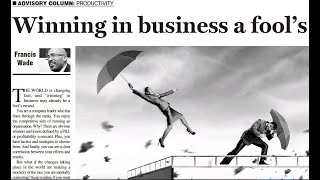
Francis Wade challenges CEOs to move beyond win-or-lose thinking, arguing that pure competition blinds leaders to new rivals like Digicel disrupting Cable Wireless, breeds short-termism that harms the planet, and ignores regulatory pressure like the FTC's Amazon case. He proposes a Triple P bottom line: Profits, Planet, People, built on collaboration instead.
Chapters
Hello and welcome back to Chronicles from a Caribbean Cubicle podcast. I'm Francis Wade, and here's an article I wrote for the Jamaica Gleaner. It's entitled CEO: Who Cares If You Win? The world is changing fast, and winning in business may already be a fool's errand. You Here you are, a company leader who has risen through the ranks. You enjoy the competitive side of running an organization. Why? There are obvious winners and losers defined by a P&L scorecard. Plus, you have tactics and strategies to choose from. And finally, you can see a clear correlation between your efforts and results. But what if the changes taking place in the world are making a mockery of the race you are mentally contesting? Keep reading if you want to stay ahead. Why you are like Usain Bolt. The 100-meter dash is undoubtedly one of the purest forms of gamified athletics ever witnessed. But before the Olympics were invented, people just ran. There were no medals or clocks or heats, sponsorships, television appearances, etc. Over time, these elements were added in and made this human invention appear real. Is the game of business also fabricated? If you are a CEO, you are probably immersed in it without question. Let's take a step back and outside of it for a moment. Maybe we can discern its outline and see some shortfalls. Ask yourself the following: Who are you competing against? Who are the winners, the losers, the middle-of-the-packers? What do you use to measure the score? When do you feel pangs of jealousy as opponents pass you by? Do you enjoy the intellectual, social, and emotional challenges? Notice your reaction and write them down. You might become a bit nervous as you draw this picture. Why? Because you may uncover the motivation behind your accomplishments and believe that too much insight is bad. These feelings are natural. Most hard-driving, overachieving Type As who tend to lead organizations don't spend time reflecting on their competitive nature. It's taken as a given. Here I speak from experience. When I finally came first in my class at Wilmer's after 5 years of effort, I saw myself as the winner, the one who crossed the line ahead of others when it counted the most. I didn't question it for a moment, even though I gave up playing sunlight cricket for a year to achieve the goal. Today I wouldn't. Why you are not Usain Bolt. But the truth is that business is not an actual game. While this mental construct can be energizing, there are definite limits to seeing it this way. Just ask Amazon.com. Reports have emerged that Jeff Bezos empire is about to be dismantled by the FTC. Why? Apparently, they have determined that the company is taking its winnings from one area and using it in another—unfairly. Consequently, the US government may use antitrust laws to redefine the game Bezos has been playing. Remember, they did just that to Microsoft and AT&T, among others. If you have a strong competitive streak, It could be time to step away to reimagine the game you have been unconsciously and unwittingly engaged in. Here are some strategic reasons to revisit this construct now. Reason #1: You become blind. When a fresh substitute enters your environment but doesn't look like a competitor, you miss seeing them. Cable Wireless dismissed the arrival of Digicel because the new entrant was playing a different game top leaders didn't recognize. Reason #2: You become short-sighted. If you study your current competitors too closely, you end up following their every move and stop being creative. Reason #3: You live in short-termism and endanger the planet. Your imaginary game is probably more of a sprint than a marathon. If so, long-term planning may be repeatedly delayed. As such, Europe's Corporate Sustainability Reporting Directive requires companies to pay attention to their carbon footprint. Indirectly, they are pulling organizations into their Green Deal objective of climate neutrality by 2050. This move implies that corporations have been playing win-or-take-all games for decades which now endanger our well-being. As you enter this new game, by choice or by necessity, you may find that it's not the zero-sum contest you have been enjoying. Instead, you'll be joining companies which are focused on the Triple P bottom line: Profits, Planet, and People. Unfortunately, this is not the kind of competitive strategy taught in business schools. By contrast, it's more of a function of high-quality collaboration and cooperative outcomes. In this context, it may look foolish to persist in the old game of massive profits or personal wealth. On a globe threatened by global warming, who cares? Fortunately, you can regamify yourself and go in a different direction. You could still win, but so could everyone else in the entire world. Thanks for listening. Do you have an unsolved problem in your Caribbean company related to strategy, productivity, engagement, or business process improvement? Just visit a searchable listing of all my prior articles and you may be able to help yourself to a fresh line of thinking. Go to blog.fwconsulting.com or see the show notes.