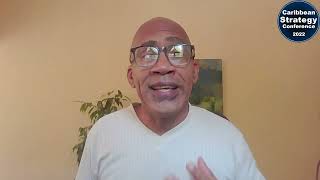
In this promotional talk, Francis Wade addresses CEOs, managing directors, chairpersons and founders who feel exhausted by the burden of leading strategic planning retreats after COVID. He describes how leaders often end up doing almost all the strategic work while their teams remain short‑term focused, reluctant, or unable to shift into a strategic mindset. This results in long, draining retreats where the leader must drive the process, leading to fatigue and the temptation to draft the strategy alone. Wade proposes a remedy: the Caribbean Strategy Conference (June 23‑25, 2022). The conference offers a mix of Caribbean‑tested and international speakers, downloadable content, and a step‑by‑step blueprint designed to equip participants with the skills, ideas, and tools needed to co‑create a breakthrough, game‑changing strategy ready for implementation by January 2023. He advises leaders to compile a list of key stakeholders (board members, senior executives, technical leaders, etc.) and invite them to the conference so they return empowered to contribute meaningfully to future retreats, reducing the leader’s workload and revitalising the strategic planning process.
Chapters
So you're a CEO, managing director, or maybe the chairman of a board, or a company founder. You're someone who is committed to a powerful future of your company. You've seen the impact that COVID has had. You've seen people become short-term oriented. But you know that the success of your company requires more than firefighting skills and short-term thinking. You need to secure the future. In fact, you need to balance the— all the emphasis that has been on survival of companies and your company and balance that with the long-term commitments that will allow you to win. And allow you to compete effectively. So you want something, for example, like a game-changing strategy that you could implement in January 2023, and the time between now and December could be spent preparing for that. But you are wary because in the past this has translated into— this kind of commitment has translated into a lot of work for you. Because as you look around you at your colleagues and think about planning the future with them, you get a little tired, a little weary, a little, a little, ah, you kind of look forward, not looking forward to the whole process. Why? Because as the leader, you've driven it every single time. You brought your energy, your ideas, your perspective, I mean, you're the leader and you're expected to lead, but you've experienced this huge gap where you're the one doing almost all strategic planning work and the others are kind of sitting back and listening and watching. I know that there's exceptions to that, and in any team there's a blend of people, but lots of CEOs that we've worked with in the last couple of decades tell us that too many people in their team aren't providing strategic leadership. And when they come to the retreat, it takes them a day and a half or the full 2 days or the full 3 days just to start thinking about the future in a way that's effective. And it's not— part of it is not their fault. Part of it is that they've just been working in the trenches and trying to meet their short-term deliverables and trying to make budget. So it takes them a while to, to go from that mode to strategic planning mode, and unfortunately it means that you're left having to do a whole bunch of hard work to get the team rallied and to get them thinking in the right way. And as you look forward to it, you feel a little bit, a little bit tired. You want them to make a bigger contribution. And you may even feel, you know, in some cases exhausted or resistant to the idea. Maybe you'll even just this time around, you'll just write the strategy yourself because it's easier than having to get everyone up. You know, you feel this innocence of maybe impatient. But the truth is, you know, a great strategy isn't an individual effort. Not a corporate strategy. It requires everyone to share in the heavy lifting. It's just that the people who you expect to do the heavy lifting with you are sometimes not able to, not willing to, scared to say the wrong thing. They'll tell you all kinds of things behind closed doors. When they come into the open session, all of a sudden they're They get quiet, and once again you're left having to say things like, "Joe, didn't you just mention to me that idea that you had for that new product? Tell us about it." And Joe looks around at all the people in front of him, board members, and what comes out of Joe's mouth is not what you expected. It's not the kind of visionary leadership that you wanted. So as I said, I'm not saying this just to make something up or to exaggerate. This is something that we've seen in companies in the Caribbean here for the last 20, 20 years, working with different companies, with different teams. We always do our planning in a team situation, and we help CEOs to get their ideas out, but they also know that they need the participation of their colleagues in order to make it work, whether it's colleagues at the board level, the senior management, thought leaders, or, you know, people lower down in the company who can, can be of assistance. They need all these people rowing in the right direction. And we know that this is the process that you can just delegate to someone else and say, okay, you lead the retreat and you provide the leadership. It doesn't work like that. If you try to do it, you probably will realize that This takes a particular kind of skill, and as the leader, you probably have this skill present in your lineup more than the others who happen to be in your, in your strategic planning team or in your executive team, but the gap is too great. So we thought about this problem, and I've written about it also in my articles in the Gleaner. And in putting together the conference I'm about to tell you about, we looked for speakers who could help fill gaps like these because they have hands-on experience as well as we do. So they're bringing their hands-on, their working with clients across the region to bear to solve some of these same challenges that I just described. But what's a way to get around it? Well, I know that you're busy. And you've probably heard about the Caribbean Strategy Conference that we're putting on from January 20— sorry, June 23rd to 25th. And as you're hearing it, you probably wince because you know you don't have 3 days to give. So what's a process that would work if you can't attend and you're looking at a 3-day conference and know that you can't do it justice? Well, one idea is to make a list of the stakeholders that you would like to have attend your next retreat with the kind of leadership and strategy skills that you want them to have. Whether, again, this could be the chairman of your board, it could be your CEO, if you are a chairman, your managing director, it could be board members, it could be senior executives, it could be senior managers, it could be technical leaders, whoever they may be. The people who you want to be in your strategic planning retreat coming up between, in the next year. So invite them to attend the conference, follow up after they attend to see what they got, and help shape their contribution because we're promising to provide them something pretty unique. So when they come to the conference, First thing is that they're going to get all the downloads and all the videos from the event, so they won't miss anything. So they'll have that for at least a year. They're going to be exposed to ideas and inspiration from different industries that aren't their own, because there's no way you have one company that covers all the industries that we're going to have panels on, but they could get inspiration from these other industries. Industries that they're not aware of and not close to. We're going to have ideas shared by folks like us who work with strategic planning retreats across the Caribbean. I've done so for years, and we're going to be sharing our best ideas ourselves and the other presenters. And these are Caribbean-tested ideas. These aren't from a textbook, and these aren't from North America or the UK. These are from our region. We'll also have international speakers who will bring an international perspective and let you know some of the best practices— let them know some of the best practices that exist in the world. But here's the big thing that we're giving them: a blueprint. So we'll be providing them an outline of activities to follow step by step to plan a breakthrough or game-changing strategic plan. Our hope is that your company will have this plan in place, ready to implement for January 2023, and that people who come to our conference will use the period between July and December to develop this plan. And the blueprint will give them the shortcut, the insights, the way of thinking that's not strategic planning as traditionally taught in business schools or from textbooks, but is geared for these post-COVID times, tuned for the disruptive world that we now live in, and that your attendees, people from your company who come, will take this outline that we give them and customize it for your company. They'll hear presentations, they'll talk with other participants, they'll listen to the downloads, and they'll change the outline that we give them and customize it for you so that when the conference ends on Saturday, on Monday morning they'll be in your office and they'll be knocking and they'll say, "Time for us to talk." And what they'll say is something like, "We need a breakthrough, game-changing, disruptive strategy for our company." and we need to kick it off by January. And not only that, I have a process for us to follow. And what would that be like? Maybe you could take a big deep sigh and feel, ah, maybe I'm not alone this time around. Maybe, you know, in this post-COVID time when it really counts, I won't be the one who has to be the only one exerting all this energy. And one who ends up doing all the thinking and the one who does all of the decision-making. It could actually be shared. So I'm going to invite you to have this conversation with your stakeholders. Make that list, talk to them, invite them to be at the conference. And you know, you could be someone who goes from kind of doing it all and being weary and a little bit tired and not looking forward to doing it all again, to being someone who is looking forward to their contribution because they would have been at an event that they would have been inspired by. And maybe you'll be able to sit back a little bit in the retreat and just kind of watch them as they bring their energy and their ideas, and that you never again have to be the one who drives the process at that level to that degree, and you're someone who has empowered them with the skills, knowledge, exposure, inspiration, ideas, and blueprint that they've desperately needed to step up and make a great contribution. So this is Francis Wade from the Caribbean Strategy Conference 2022, and I invite you to come, and I invite you to register the people around you so that they can make the kind of contribution that you've always wanted them to make. Please talk to me with any questions that you have. Good luck.