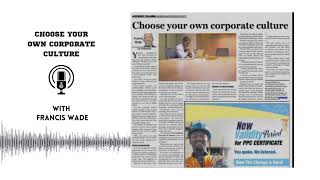
In this episode of the "Chronicles from a Caribbean Cubicle" podcast, Francis Wade expands on his Jamaica Gleaner column "Choose Your Own Culture: The Role of Planning" to give executives a practical way to understand and influence corporate culture. He defines culture as the automatic, habitual behaviors that occur without conscious thought, using meeting etiquette as an illustration. Wade contrasts macro‑level interventions (formal business‑process management) with micro‑level dynamics (day‑to‑day conversations, emails, and informal chats) and argues that the latter are often the source of cultural drift. He shares a Caribbean case study—Trinidadian executives feeling awkward in Jamaican offices due to differing title‑usage norms—to show how language encodes cultural values. Drawing on Dr. Fernanda Flores and futures‑literacy pioneer Dr. Real Miller, Wade explains that an organization’s view of the future shapes present behavior, and that leaders can use futures literacy to craft realistic, shared visions that align with strategy and reshape everyday conversations. By linking vision, strategy, and conversational habits, leaders can build a resilient culture that sustains momentum through uncertainty. The episode ends with a call to action for listeners to explore Wade’s blog for more articles on strategy, productivity, engagement, and business‑process improvement.
Chapters
Hello and welcome back to Chronicles from a Caribbean Cubicle podcast. This is Francis Wade, and here's an article I wrote that's based on a column that was published in the Jamaica Gleaner. This one is entitled Choose Your Own Culture: The Role of Planning. Your company is chasing bold results, but something keeps getting in the way. Again and again, your corporate culture seems to sabotage your efforts. Should you push forward anyway, or is this just the way things are? As a seasoned executive, you've seen a variety of workplace environments—some vibrant and inspiring, others toxic and draining. You know how much culture matters, yet you might still be unsure whether it's worth focusing on. Culture often feels vague and untouchable. Should you even bother trying to change it? Before you give up, here's a practical way to look at culture that might change your mind. Culture Defined. You've probably heard Edgar Schein's famous phrase, "The way we do things around here." That's a simple, usable definition of corporate culture. I'd take it a step further and suggest this: Culture consists of the automatic, habitual behaviors that happen without anyone thinking too hard. Take meetings, for example. Do they start on time? Do they end as scheduled? Is it okay for someone senior to show up late? The answers to these questions reflect ingrained norms—habits—everyone follows without being told. These invisible rules add up to what we call culture. Changing these norms can be tricky. At the macro level, formal initiatives like business process management can help define and improve the activities that drive value. These methods are well understood and widely applied. But at the micro level, where people interact in meetings, emails, and casual chats, there's often no playbook. These day-to-day behaviors tend to evolve on their own without guidance. And that's where things get messy. Without structure, internal communication fills the gap. Stories, rumors, and assumptions spread like wildfire as people try to make sense of what's acceptable and what's not. Still, you're not powerless. There is something you can do. Conversations shape culture. One powerful lever for change is everyday conversation. If you've ever switched jobs or moved to a different country, you've likely felt the shift. New phrases, new topics, new tones. What people talk about and how can differ dramatically. Consider this: In the Trinidadian Executive in Jamaica study, we found that foreign leaders often felt awkward in Jamaican offices. Why? They were surprised by how formal local workplaces were. Most Jamaicans don't even notice this, but we often address leaders with lofty titles: General, Boss Lady, or Sir Francis. It's a form of respect. But to some Trinidadians, this feels like a barrier. Their culture celebrates an egalitarian ideal: "All a we is one." Using made-up titles seems to contradict that value. And introduces a hierarchy they'd rather avoid. This small example illustrates a bigger point: culture lives in language, and once you can see the patterns, you can influence them. As Dr. Fernanda Flores suggests, organizational life is really a network of conversations. Shifting this network is shifting the culture. Becoming literate about the future. Every organization has its eyes on the future, but few realize how much our view of what is going to happen shapes our experience of the present. It's why people are often in better spirits on Friday afternoons and on Sunday nights. Even if they're still at work, the prospect of the weekend lifts their moods. Yet most managers aren't trained to talk about the future with any real skill. Instead, they fall back on vague optimism or worse, Helpless pessimism. That's a missed opportunity. Dr. Real Miller, a leader in the field of futures literacy, argues that we're more effective when we treat the future as something we can shape, not something that's already decided. Here are 3 key insights from his work: Number 1, the future is open. It's not set in stone. Number 2, the future, well, it affects us now. For some, it energizes; for others, it weighs heavily. 3. Leaders can help teams pursue viable, meaningful futures, even in the face of uncertainty. This means the way leaders talk about the future matters—a lot. Many fall into the trap of writing vision statements that sound inspiring but lack substance. Others go to the opposite extreme, declaring ambitious goals no one really believes. A better approach? Develop a clear, realistic long-term vision, one that aligns with your strategy. Then, use that vision to shape how people think, act, and talk. This future-focused perspective becomes a powerful tool for transforming culture. In uncertain times, when fear is common and change is constant, a shared view of what's possible can unite and energize your organization. When you connect culture, With vision and strategy, you create a resilient system—one that can keep moving forward even through turbulent periods. Over time, this foundation enables your team to build momentum and stay inspired. And that's when the real transformation begins. Thanks for listening. Do you have an unsolved problem in your Caribbean company related to strategy, productivity, engagement, or business process improvement? Just visit a searchable listing of all my prior articles and you may be able to help yourself to a fresh line of thinking. Go to blog.fwconsulting.com or see the show notes.