Day 2 Opening Francis Wade Julian Rogers
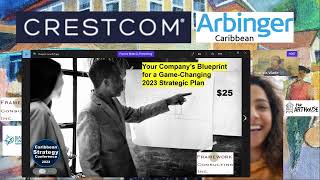
Francis Wade opens Day 2 of the Caribbean Strategy Conference, recapping the concept of the "crux" – the core problem organizations must solve to avoid wasted planning. The day includes five panels on analytics, talent, manufacturing, economy, and founders, plus an optional Blueprint guide for building breakthrough strategies. Julian Rogers emphasizes that effective strategy requires bottom-up conversations and listening to employee voices.
Chapters
that beats the competition, serves customers at a whole new level, integrates technology, and has it all happen by January 1st, 2023? If you're here to answer that question, you are probably someone who cares about your organization's success. Both you and your company made it through the pandemic, but as you look to the future, you kind of wonder, How do we make sure that we're the ones who are doing the disrupting and we're not the ones who are at the receiving end? And again, if you're here to answer that question, you're in the right place. My name is Francis Wade and I am the host, co-host of the Caribbean Strategy Conference along with my colleague and partner and wife Dale Pilgrim Wade, and we're just the tip of the iceberg with respect to a team that has been working on this for the last few months. And welcome! And if you're hearing my voice and you don't know the routine, just drop a note in the chat to make sure that you're hearing me and everything is okay with my volume, my voice. So good morning everyone! Let's see some hellos in the chat so I know that you're in the right place and you know what to do, that your fingers are working. Okay, okay, there we go. Mr. Al Antonio gonna be coming on up later, and he's a managing director of Business Suite Magazine Online. Who else do we have this morning? I know people may have stepped away, it is Saturday morning after all. Kudos to you for showing up. Keli Makitas, good morning, Rob. Keli says morning. So we have one day left to continue our deep dive into what it takes to create a breakthrough strategy, a game-changing strategy, one that has an impact on your company. But, and yesterday, if you were around yesterday Just to give you a quick recap, we started off with Douglas Sorin in the morning, and if you know Douglas, he's very high energy talking about the 25-year strategy of Grace Kennedy. Then we had a couple of very high energy panels that were excellent. I could just leave it at that. Remember, they're all being recorded and there will be replays. I'll explain how that works in a moment. And then in the afternoon, we had two more panels and they were awesome, and we had a speech by Richard Rommel, a strategy expert, talking about the crux. A really amazing, amazing set of activities, and we ended up on a very high note. And I just want to thank those of you who showed up yesterday. But let me ask you, if you were here yesterday, what are one of the things that you walked away with? Just drop that in the chat so we can just do some sharing. What did you walk away with from— what struck you about yesterday? What did you notice, see, what really struck you from all that happened yesterday? Go ahead, let us know. The crux of the problem. So yesterday we learned about the crux, which is the heart of a strategic problem that your company needs to solve in a strategic planning retreat. We learned that if you don't get to the crux, essentially Dr. Rommel said you're wasting your time, that you're talking about And he described all these other things that you could be talking about, and companies do talk about in strategic planning retreats, and essentially said they're a waste of time because they don't get to the crux. And getting to the crux of the matter is— it involves a certain number of steps, it involves a certain mentality, and if you somehow skip over it, essentially he says, again, you're wasting your time. And he said he's gotten thrown out of companies because they don't want to get to the crux. When they get to the crux, they don't like what they see because, you know, they want to think that they're all that and a bag of chips. And it's very inspiring because it was really talking about getting to the truth of the matter and how hard it is to get companies to do that. Um, Rosemary Fuller says, looking forward to today. But somebody else, what did you get from yesterday? What do you bring into today's conversation? What did you notice? What did— what breakthrough insight did you have yesterday? Or just what did you like?
Next person.
Play the waiting game now as the fingers work. And actually, let me, let me start sharing my screen while I wait. Kelly says she's also thinking about digitizing, not just automating a bad process, but also optimizing customer experience. And that could be at the crux, right, for the company that Kelly McIntosh works for. And if that's at the crux, then it involves some digital innovation. And for some companies, we learned yesterday, the crux may involve some new technology, and for others, nothing to do with technology. Vanessa Narcisse, the difference between a strategy which pertains to doing something differently because you have a problem versus goals which are ambitious. Yes, that was Richard Rommel. Something different, as opposed to coming up with a bunch of kind of very hairy, fairy wish list type things. Okay, um, before I go into the today's schedule, let me just start off at a very high level in case this is your first time here. Our conference today is taking place in 3, basically 3 chunks. So you probably landed at a page looking like this when you logged in. We have 5 pre-recorded content videos that are available today. Today is the smallest number based on the prior 2 days. We— you are currently in the bottom left-hand corner, if you click there, a live session on Airmeet, and happening in the background is a Pretty quiet so far, but existing conversation on Volley. So after today, we're actually going to be continuing the conversation between all who participated in the conference on Volley. It's the way that we're going to be forming basically a little community to keep talking about the ideas that have opened up here. And here is a list of the downloads that are available today for 24 hours. So these downloads expire tomorrow morning. So if you're someone who, if you get up early tomorrow morning like 4 AM, you'll be able to watch all, or if you stay up all day tonight, or if you just want to binge watch, however you want. I probably won't be up all that early and I probably will leave them open for a few extra hours, just between you and I, okay? Don't tell Dale. So today's schedule, I'm gonna actually invite Actually, before I do that, let me just jump around a little bit. Sorry guys, to tell you about the blueprint. So you probably are aware that this— okay, you probably are aware that there are two ways to participate in the conference. A free pass gives you many, many benefits, but a full ticket gives you all the benefits including access to all the replays for a year. And also this mysterious item called the Blueprint. Plus, you'll be able to see the innovator videos. So we have 3 videos that we've done with innovators from around the region, and you'll be able to see those if you purchase the full ticket. And let's jump back just a bit to where I was before. What's the Blueprint? So the Blueprint is a step-by-step guide for creating a breakthrough strategy that— and all the steps between July and December are laid out for you, including the nitty-gritty of what you could do in your strategic planning retreat itself. So we go through all the prep, what to do in the retreat, what to do after. And good news is this is not a cookie-cutter business, it's a custom document that we want you to customize as you, you know, go into it, make changes, hear things today, heard things yesterday, customize and make it yours. So if you've not purchased the full ticket for $199, you can purchase the blueprint for only $25, and that's available in the store, which you can find sort of up here in the top right-hand corner. The conference store. Okay. And if you haven't— don't know how to upgrade to the full ticket, just ask us, ask Dale or I in the chat. We'll add a note. If you don't know where to— you need the link to get to the conference store, just let us know again in the chat. All right, so before I go into today's action, let me introduce to you Julian Rogers, the Julin, I'm going to give you the— oh boy, look at all that. Okay, you gotta love, you gotta love Windows. Things just keep jumping in and happening when you're not expecting them to. So Julin, I'm going to bring you on the stage. Julin Rogers is the managing director of the Jamaica Observer. He's a media manager, a journalist, a broadcaster, and trainer. He'll be our host for just about the whole day today, and he's a graduate of the University of the West Indies and a man that I met in Barbados a couple decades ago. Is that not really—
could be.
And he has Caribbean-wide experience ranging over 50 years. Julian, are you hearing me? Looks like your camera isn't on. You turn that camera on and so that we can see you and hear you. Julian might be looking for the controls at the bottom of this screen. If you click turn on audio, turn on video. Okay, not seeing Julian yet. Julian, drop us a note in the speaker chat to let us know what's happening.
You're having a difficulty.
Okay, not seeing Julian. Okay, well, we'll sally forth.
Morning, Tony.
Morning, Rosemary. Loving the informal feel of this. It is Saturday, so we need to— okay, here's Julian Rogers. With a very fancy background. Folks, I assure you he is not somewhere in cyberspace or in a helicopter floating over a picturesque, picturesque view of the Caribbean. That's actually Julian's background. Oh, and here he is in a— wearing Trinidad and Tobago colors. Julian making the grand entrance this morning. Not hearing you, Julian. Aha, coming to you from the Rogers studio.
Still not hearing.
Still not hearing. All right, I'm going to go through— start going through today's schedule as we get Julian online. Um, so today We're in the opening session, and at the top of the hour, I'll be inviting up two of my colleagues over the years, Marianne O'Brown, who is the CEO of Arthur Lok Jack/UE Graduate School, and also Aldo Antonio. And the two of them are— the three of them, sorry, are going to be talking about See, hold on a second. Sorry, just got a note from Julian. Technical— excuse us while we figure out technology. Okay, uh, Julian is asking about turning on his microphone. Um, Julian, if you click on the three dots, um, that are below, below the screen, below your screen here, you should be able to access your controls. Which will allow you to do that. Just click on the three dots and it would change the microphone over. Okay, three dots underneath the video. And let me pull him from the stage. Oh, sorry about the snafu that we have happening here. Okay. So at 9:45, Julian will introduce the analytics panel right after 9:45, 9:50, because we're going to hear from one of our sponsors, Ram Ramesh, at 9:45. But right after Ram shares with us why Crescom and Arbinger, our major sponsors, are involved in this conference and what they bring to the party. They are the two awesome training brands that belong to his company, are affiliated with his company. He brought them to the Caribbean from North America. And at 9:45, 9:50 or so, we'll introduce the analytics panel headed up by Kieron Ranganesh. Now analytics is, as you probably know, digital analytics, they are everywhere and they are completely transforming the way strategy is done and the way businesses are run. So we're looking forward to hearing from them. Not only that, this isn't only about technology. If you attended one of my webinars a few weeks ago, you'd have heard that there's a very big push right now to recognize the fact that the bottleneck is no longer technology. We have more technologies than we need. The bottleneck is people. It's actually talent management. 11 o'clock, we're going to be talking about talent management, headed up by a panel with Safiya Johnson. Then we're going to take a break for lunch, come back, and talk about manufacturing. And that's going to be headed up by moderator Derek Lopat. And not just manufacturing in the traditional sense, but any kind of operational challenges and activities. And then at 2:30, we'll be talking about The economy, the economy panel with Valda Henry. And as you know, the major, one of the major impacts over the last couple years has been watching the economy do what it's done. We were in a recession, we're in inflation, we have supply chain disruption. It's been very, very difficult. And what we're going to be asking is, how has strategic planning changed as a result of the changes to the economy? How do you need to be doing your forward thinking given the new realities that we're now in? And then our final conversation of the evening, final discussion will be with the founders of JMB. So the, the grand founder was Joan Duncan, parent of Donna and Keith, and Donna, Keith, and Dan, who were there from the very beginning, are going to be coming to share their story and why coming up with a 25 to 30 year strategy back in 2000 and somewhere in 2000, 2002 made all the difference to what they've accomplished over the years. I happen to sit in on one of those sessions and I will tell you it was amazing. So that will bring us to the closing session of the evening where we'll have Julian and Dale and myself close out our evening. And once we're done, we'll be going into another networking session, a chance for you to meet and greet. And that will be your final networking session of— well, I'll tell you what's been a really high-energy experience so far. All right, so Julian, let's try it. Let's try Julian again. Oh, it says he's not available. Okay, I'm thinking that there's technology issues happening there. Um, and let's see, let me just reiterate the purpose of why we're here because I didn't do that. And at the same time, let me just throw in there, uh, another challenge for you. If you're interested in getting a full ticket for free, listen up, worth $199. So here's the giveaway for this morning. The first person to name an overseas speaker, overseas outside the Caribbean speaker from today's lineup, put it in the chat, will win a full ticket compliments of the Caribbean Strategy Conference.
Go!
I don't think I even said go. I thought it was that yesterday or today, because the question was today. Russell is today. Great. So Alana covered her bases. Okay, great. Alana, congratulations, you've just won. Great, she explains it all. Alana, you won a free ticket, a free complimentary full ticket. Congratulations. Great. All right, so, um, Dale, we will contact Alana and transfer that off to her, uh, make sure she gets it. And once again, to remind you of the purpose, so we're on a mission to create something special in the 2023 strategic plans of every Caribbean organization, a game-changing innovation or a breakthrough result. And we want to make sure that companies go into next year with these plans in place. Now I'm saying that because it's our huge aspiration. For a big aspiration like that, you probably just don't get there very easily. It's not one of those things you just wave a magic wand and accomplish. But let's talk about the challenges that your company may have, or companies may have, as they craft a game-changing strategy that starts in January. What are some of the challenges you'd like to see your company or companies in general overcome in the next 6 months as they go to craft these strategies? Just put it in the chat. I'll reiterate the question. So, what are the challenges? I'm going to send a note to Julian as we answer that question. What are the challenges your Caribbean company or Caribbean companies are having crafting game-changing strategic plans? Go ahead and drop that answer in there. So Current does not have a strategy. So that's the current company. However, we need a set of objectives for the next 3 years. The immediate challenge is changing culture and mindset. So the challenge is creating culture and mindset, and as you know, folks, those things don't change slowly, right? It's not like you change a culture or a mindset all of a sudden. It takes time, and it definitely won't happen in 3 days, 3, 3, 3— if you're lucky, it may start to change in 3 years' time. All right, we have Julian Rogers coming back onto the stage, but it takes a longer-term commitment. Julian, are you there?
I hope so.
Yes, you are.
Great.
Good. Fantastic. Good to have you. Good to have you here, folks. Welcome Julian Rogers from Jamaica, but Jamaicans are going to listen to his accent and say he's not from any part of Jamaica. Where is he from? I'm not sure. Trinidad sometimes, Barbados sometimes. Antigua sometimes. I think his parents are from Ghana. I think he worked in St. Kitts. If you add all of those up, I'm not sure what you get, but it's, it's kind of a Caribbean person. So Julian, the conversation is what are the challenges your Caribbean company or Caribbean companies are having crafting game-changing strategic plans which starts in January 2023? And Rosemary has responded and said her company does not have a strategy. And guys, this is not unusual. There are many companies across the region, by virtue of COVID or just by virtue of having a founder who has a strategy up here, maybe, but they don't share it with the staff. The point for them is not telling you the details and not, certainly not crafting it with you. But then the point is, I tell you what to do and you do it.
Yeah, and that works.
Julian, that used to work, right? When they had monopolies and there was no threat from the outside, it kind of worked, but it no longer works, does it?
It certainly doesn't. And I think you hear it a lot from people at the lower level of the organization who keep saying, we don't know what this company is about. We don't see, we don't understand our role because there's not enough of a conversation one-on-one that is not like a boss to somebody at the lower level of the organization. I found that particularly in my so-called walk around, that there are a lot of ideas that are coming from people who are the lowest rung of the organization because I think they have an opportunity to view the organization far differently from so-called people at the top. They have a— in some ways they have an even broader view than we give them credit for, so that they see a number of things. So if you, for instance, you say, hey, we can't afford to do this and we can't afford to do the next thing, they come along the way quietly, say, but maybe you shouldn't be spending money on this or that, etc. Even in areas that may very well affect them, they very well see that there's an opportunity for making adjustments which are, which turn out to be critical. So I think that the, the importance of a conversation that is not a boss, boss down conversation is, is critical across the organization. And the conversations must take place, um, not just the head of the organization but every other manager down the chain. With their own people. And in, in, and in those instances where you're— I don't know, maybe I say your personality allows you to interact with other people even outside of your particular department or unit, as the case may be. Be surprised what you learn and the impression that people have about the company and, and its ability to succeed.
Okay, so my internet just dropped. You probably saw my image flicker.
I noticed.
It was a momentary power cut. And here we are in the Caribbean, folks.
We were disrupted.
Happens everywhere in the world. I'm sorry, I won't ask you to answer that again. But let me see if there are any other answers to that question. If not, it's actually time for us to bring up your panel.
More from Francis


Ep 35 Your Strategic Stagnation Isn't a Framework Problem—It's a Story Problem



The YouTube Strategy School: Why Your MBA Didn’t Teach You Strategic Thinking





