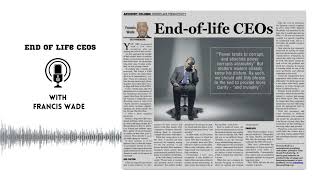
In this Caribbean corporate podcast episode, Francis Wade expands on his Jamaica Gleaner column to examine the hidden risks that arise as CEOs near the end of their tenures. He identifies several behavioral tendencies that intensify over time—most notably the rise of "Yes‑Man Syndrome," ego‑driven decision‑making, and an invisible corruption of power that blinds leaders to succession planning and dissent. Wade explains how these dynamics create echo chambers, especially when boards lack the skill or willingness to challenge the CEO. The Olympus scandal is used as a concrete case study, showing how a whistle‑blowing COO can expose entrenched misconduct and ultimately save the company. Wade argues that these challenges are largely natural consequences of prolonged leadership rather than purely personal failings. To mitigate the threat to long‑term value, he recommends proactive measures: targeted training for board members and executives to recognize blind spots, fostering a culture that views the end‑of‑tenure challenges as inevitable, and encouraging honest feedback mechanisms (e.g., “court jesters”). The episode concludes with a call to action for Caribbean companies to apply these insights to protect strategic, productivity, and engagement outcomes.
Chapters
Hello and welcome back to Chronicles from a Caribbean Corporate Podcast. I'm Francis Wade, and this recording or this article is based on a column I wrote for the Jamaica Gleaner. This version is entitled End of Tenure CEOs: A Hidden Challenge to Long-Term Value. In the business world, The end of a CEO's tenure often brings about significant challenges. As CEOs near the conclusion of their careers, a troubling pattern emerges: their actions can sometimes undermine long-term value and pose serious risks to the organization. This phenomenon is rooted in several behavioral tendencies that intensify over time. The "Yes Man Syndrome." One notable issue is the increasing presence of yes-men, colleagues who are excessively compliant and unwilling to challenge the CEO's decisions. This situation is not necessarily a result of intentional manipulation. Critics argue that some CEOs deliberately remove independent voices to create an environment where their authority remains unchallenged. This view paints CEOs as Machiavellian figures who prioritize their power above the organization's best interests. However, a different perspective suggests that the problems faced by long-tenured CEOs are natural consequences of their extended time in office. A 2013 Harvard Business Review article by Luo, Kanuri, and Andrews describes a pattern of declining performance among leaders in their later years, likening it to a natural change in seasons. The role of ego. Ego plays a significant role in this dynamic. CEOs, driven by their egos and their relentless pursuit of results, become more competitive as they advance in their careers. This drive, while necessary for reaching the top position, can become counterproductive. Over time, ambitious managers, fueled by their unchecked egos, surround themselves with sycophants who reinforce their decisions rather than challenge them. The famous dictum by Lord Acton, "Power tends to corrupt, and absolute power corrupts absolutely," is well known among modern leaders. However, we should extend this insight to include the notion that power also corrupts invisibly. A CEO's growing power can blind them to certain realities, leading to poor decisions and a lack of succession planning. For instance, some CEOs fail to prepare for their succession or accept misguided advice from insiders. Others may go to great lengths to conceal corruption. Fortunately, there are exceptions. Some CEOs actively seek out individuals who can provide honest feedback, appointing them as court jesters. In medieval times, jesters had the unique role of criticizing the monarch, often delivering difficult messages in a palatable manner. The importance of enablers. While internal change agents can introduce opposing viewpoints, companies also need board members who can effectively challenge the CEO. Many board members, despite being intelligent and ethical, lack the skills to push back against the CEO. They often fail to seek out and defend unpopular opinions that could safeguard the company's long-term value. As a result, CEOs find themselves in an echo chamber of agreement. The case of Olympus, the Japanese camera company, illustrates the consequences of this dynamic. In 2011, a fairly new COO, Michael Woodford, was promoted once again in an attempt to silence him as the leadership hid a longstanding financial scandal. When Woodford refused to ignore the misconduct, he was abruptly fired. His subsequent whistleblowing led to the removal of the entire top management team, ultimately saving the company. Proactive measures for boards and executives. To prevent such scenarios, Proactive measures are essential. Board members and executives should receive training to help them recognize and address their blind spots. They need to understand that their judgment can decline over time and learn to communicate effectively to counteract this deterioration. By fostering awareness and providing tools for effective communication, companies can mitigate the risks associated with long-tenured CEOs. Viewing the challenge as inevitable rather than personal can shift the organizational mindset. This perspective reduces the likelihood of a respected CEO unintentionally becoming a liability. Therefore, intervention through training and awareness can safeguard long-term value and maintain organizational integrity. In conclusion, the end of a CEO's tenure present unique challenges that can threaten long-term value. By understanding the natural tendencies that arise with extended leadership and taking proactive measures to address them, organizations can navigate these challenges effectively. Empowering board members and executives to challenge the status quo and recognize their blind spots is crucial for sustaining long-term success. Thanks for listening. Do you have an unsolved problem in your Caribbean company related to strategy, productivity, engagement, or business process improvement? Just visit a searchable listing of all my prior articles and you may be able to help yourself to a fresh line of thinking. Go to blog.fwconsulting.com or see the show notes.