ep 25 Drowning in Data | How AI Can Rescue Strategy w Dan Bruder EXCERPT
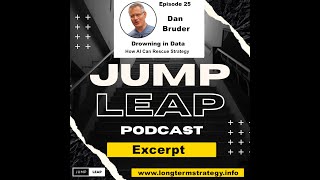
Francis Wade and Dan Bruder discuss how facilitators drown in interview transcripts, surveys, and competitor analyses before strategy retreats. Dan's AI system records employee responses and uses language models to surface themes and patterns. With the right framework, a facilitator can turn data overload into decision-ready insights without hiring consultants.
Chapters
It's the Jump Leap Long-Term Strategy Podcast, Episode 25. You're a facilitator or a sponsor of strategic planning offsites. Recently, you noticed that it's become easier than ever to gather pages and pounds, I guess, of interesting and pertinent information about your client companies. You're pleased because this is a far cry from the days when you were forced to walk in empty-handed because the company had nothing to offer you. But now you have a new problem. The best clients are collecting a ton of information and providing it to you in buckets. You want to go through all of it, of course, but with limited time and resources, you can't. You don't want to fake it till you make it, right? But what else can you do? Tune into this episode to hear from me and my special guest Dan Bruder as we tackle this wicked problem together. I'm Francis Wade and welcome to the Jump Leap Long Term Strategy Podcast. And welcome back. And as you can see, I've been joined on the stage here with— by Dan Bruder, our special guest. And you may have met Dan in a previous episode. I'll introduce him shortly. Just before I do that, and also before I tell a quick story, let me welcome you if you're— this is the first time that you're listening to this podcast. Why? Because you may be wondering what the heck is going on, because it doesn't seem like a regular old podcast where I'm interviewing an expert and asking them what their favorite colors are. Oh, this is different. What we do is we pick a problem, a difficult problem, and we diagnose the heck out of it in the hope of finding some kind of insight in real time. And why do we do that? Well, it's better for us to show you or demonstrate our thinking or brilliance and have you decide for yourself whether it's really that brilliant or not, but have you understand how we arrive at some of the conclusions that we arrive at. Because you're able to hear the underlying thinking and you can understand what data we're using, what experiences we're drawing from. You can also tell where you may think that we are full of it and disagree, or you have other information that would lead you to a different conclusion. Anyway, the point is to get you engaged because we don't really know where this is going to come out. We're looking for insights, some serendipity. We're hoping to move the needle. In the right direction. And if we— if and when we come up with some good insights, you'll hear a bell which indicates that we have just discovered something that is new to one or maybe even both of us. So welcome. And if you've not heard our episodes before, you may not know that we start with a story. So this is the story of John. He's a sponsor of a strategic planning retreat— retreats. So he's a facilitator. In the past, he used to start retreats with very little client information, and frankly, this used to work out fine. But recently, he's had a few rude surprises. In each case, in the middle of the offsite, some pertinent information popped up that he should have included in his thinking and his planning beforehand. In one case, his client actually pulled him aside and told him, hey John, this little oversight of yours, the fact that you didn't know this, it cost us about at least a couple of hours. You know, not to complain, but it did, it did cost us. So he's, he's, he got the feedback, and this time around, ahead of a 15-person, 3-day offsite, He's gathered a ton of information. So for example, he's used an AI tool to gather information from interviews for the first time. Hundreds of people, 3,000 to 4,000 words per interview. If you do the math, you may see that he has a lot of information. He's also done some external analysis, a PESTLE analysis. He's also done a study of their competitors. They've given him some industry analysis, and they've also given him some economic forecasts that pertain to their industry. Fortunately, the company is quite analytic, so he could also do a decent analysis of their internal situation. So for example, he did a SWOT survey, and he also had a couple of meetings. They also suggested some areas of focus coming from those SWOT meetings. He did a cultural analysis based on some survey— or he didn't do it himself, but they did it for him before, a couple of years before. He did a core competency study. He's done some— gotten some feedback on some goals and targets that, that some of the employees want to hit, some of the stakeholders. And he even has the prior strategic plan that was developed some 3 years ago. It's a lot, it's a lot. And now he's a bit scared. Well, he doesn't want to miss anything important. He just can't pass on this information to the client. He just can't feed, feed this all back to them, he would need 2 weeks. Frankly, he needs a way to put it all together so that they can make sense of it in the upcoming retreat. So let me introduce Dan Bruder. Dan is the CEO and co-founder of Blendification, a company driven to connect company focus and employee focus, leveraging an AI-powered software suite. His vision materializes in strategic and personal planning tools highlighted in his book The Blendification System and also a TEDx talk that he's given with almost a quarter million views. He has a background in banking, hospitality, and real estate, and blendification has been the foundation for his teaching. And he's— because he's taught at the MBA and Executive MBA levels, yeah, at his home state Colleges, universities, tertiary institutions in Colorado. Dan, welcome to the show.
Thanks, Francis. Glad to be here. Yes, probably a little colder here in Colorado than down in Jamaica, huh?
It just might be. But one thing we do— but one thing we do know, folks, if you don't know, this is not Dan's first rodeo. He's been with us before. And actually, the, the, the solutions that we talked about in the prior episode feed into the problem that John is experiencing in this episode? Because in the prior episode, one of the solutions that we came up with was to use an AI-powered interview system, which Dan actually includes in his software. So we're assuming that John has actually used the software, hence the reason why he has all this data from all these interviews. Um, Dan, you want to give a quick introduction just in case folks missed the prior episode in terms of what the software produces and what, what John actually has in front of him on his laptop?
Yeah, basically the focus is, is, you know, as you pointed out, there's so much information that we can use that will help us make better decisions, but at some point the information becomes too much and we end up, um, it ends up paralyzing our ability to make decisions. And when we look at information, we've got sources, as you laid out in the intro, in the story there. You've got external information reports, internal reports, analysts' reports. And most of what we use in strategic planning is sitting in the heads of a few people within the organization, generally the executive team. Maybe we're aggressive and we get a few survey questions out there. And then a lot of internal reports and whatever we read along the way. But in my belief, in my opinion, the greatest, the greatest information that exists in how we should run our company and where we should take it lies in the heads of the people that work there. And that's not just to get basic information. We want to go deep and really interview these people. So on the software side, the AI gives us the ability to capture and bottle up a professional strategy consultant and say, go ask everybody in the company a bunch of specific questions about strategy. And then based on how they answer, let's layer in another question as opposed to a survey. So as we come to this section and where we are now, what we're really focused on is now we have all this information and that's the interviews, what they're looking at is a series of interviews from the balance of the employees that contain a dramatic amount of information, but also some very valuable information. They also have information from reports. They also have information from external analysts, industry studies. So essentially, they have this boatload of information. And if we're not able to really process this, synthesize this, and direct this information down a path that will help us make better decisions, we really are no better off. And that's really what we have to figure out now is like, now that we have all this information, it's not what do we do with it? How do we make a format or create something that we can make meaningful decisions that can enhance the lives of the employees, the customers, and impact our communities through our business?
Hope you're enjoying this free excerpt from the Jump Leap Long Term Strategy Podcast. Interested in finding out more about getting a subscription to full episodes? Visit www. So let's, let's, let's say that. So, so John has, you know, John has had the fortune of, of being able to have a lot of information and have a lot of interviews. And, and he's now, you know, has a new enemy. Let's put it that way.
That's his point.
His old enemy was lack of information and, you know, starting a retreat with empty hands and clients that wouldn't give him what he wanted. But I've noticed in my practice as a facilitator also that I do get a lot more information than I ever did. I used to get almost nothing. No, I, I'm not quite where John is, but I definitely get more information and it's very helpful. Some of its quality is dodgy, but at least it's, you know, you can tell something is definitely shifting in the world, which is a good thing. Uh, and he also has, uh, you know, he doesn't have a lot of time, so we don't have— we've set up the case so that John doesn't have 6 months to analyze all this information. He can't go hire a team either, just so in case you're wondering, folks, why doesn't he just get his 4 associates to do the work for him? He doesn't have access to 4 associates. He's a one-man show. He's not McKinsey, uh, or, or, or Bain or, or BCG. He's, he's a one-man show. And in any case, he, he couldn't go find these people. He couldn't outsource it to a company in India and say, give me, figure out all this stuff and come and get right back to me. So you're probably thinking that there are some solutions here, but he still needs, even if he uses ChatGPT, Claude, um, any of the others, he still needs a sort of a framework, a method. You can't just throw that stuff into an AI and say, just tell me what it says. My impression is it doesn't work that way, and I've used it for some stuff, but I've never tried to throw all that information in there and say, tell me what's useful and throw away the rest. Doesn't quite work like that if you're going to use a large language model that is available to the public. Um, so he needs to make this information useful. He's, he's probably tried to use one of these tools and gotten more confused, more overwhelmed, and he's sort of baffled at his good fortune. But he's now, you know, facing that he doesn't have a lot of time in this 3-day retreat to spend on all this information, and he can't ask the client to do it. Client doesn't have resources either. So there should be a way for him, given the, the trend and what's happening in, I would say, the, the off-sites and in retreats, that there will be more information available than there ever has been in the past. And how does he make use of it? Um, so is that a decent summary of John's dilemma? Um, Dan, or you want to add anything to that?
Yeah, I think, I think you're right on. And we're seeing this information overload in our email boxes from AI-generated emails. I'm seeing it in texts. We're seeing it all over various different social media platforms where it's all AI-generated stuff. And we're just exposed to so much content right now. And unfortunately, a lot of that content is actually good content. And for me personally, I say unfortunately Unfortunately, because I really don't pay attention to it. So now we look at AI, and I think we're overloaded right now with AI information. And most of the people I talk to are clearly aware of AI, but very few business leaders are aware of how to apply this with a specific use case that they can use today to help their business tomorrow. And, um, and, and I've been to a lot, a lot of various different AI conversations, sat on some, um, panels and such. And what they turn into is a fascination with how ChatGPT can plan our vacations. And that really, while that's super cool, it has no business application. And then they walk out of there going, well, AI can't help my business. And I think what you've proposed here is a specific business use case where we have a problem, information overload, so much information, and we're unable to process this. How can we use AI in order to process this and consolidate this information in a way that we can make better decisions? And I think that's right where we are right now. We're seeing it in all aspects of our life. And now I think for the benefit of the people out there, it's like, it's time that we start applying this conversation conversation or these conversations related to AI to specific business use cases so people can act. And, um, and I think that's where we are right now. And then really the purpose of this discussion and then moving forward is like, how do we— what do we do now? What do we— how do we solve this problem for John? How do we solve John's problem, um, using AI? Because like, like you said, Francis, I mean, this isn't, uh, you know, his consulting practice isn't charging $2 million like some of these large firms would charge for a strategy retreat. I mean, he's charging a lot less. He doesn't have the resources. But with AI, can he complete a better strategy retreat in a fraction of the time with a fraction of the resources at a fraction of the cost based on AI alone? And I would say yes, he can today. And that's the big quantum leap that we're seeing right now.
Right, right, right, right. Well, before we get into the, the, the quantum leaps, uh, if just to, just to, just to, to sound the depths of the problem, because, you know, we might have some folks out there who are thinking, heck, I've been in this situation, all you got to do is kind of go through and pick the most important stuff. So you can do some fancy cherry picking. Um, can he cherry pick, you know, just by putting in some extra legwork and some edible grease?
Oh, of course. I mean, yeah, yeah. Can he physically be done? Yes. So what does cherry-picking mean? Right? It essentially means I'm going to pick the things that I want to pick, which brings in an element of biasness. And, uh, and, and, and so we really, we, we finish where we start. We're not very— we really haven't advanced things beyond where we were last year. Um, so And I think that's the point. Cherry-picking is basically introducing an element of bias. And again, we as human beings, we're naturally biased towards trying to find shortcuts. And a shortcut is, is, hey, this resonates with what I think, I'm going to pick that one, right?
And, and I'm sure our listeners, if they've been in the strategic planning retreat, know the difference that a small— some important but seemingly small bit of information has that if you read certain documents or if you do gather information in a certain way, you get one view. You do another, you get a completely different view. And I, I like to share the difference between doing a survey, which we do in our retreats prior to our retreats, and a focus group, which we also do before. And the two are completely different. The way we conduct focus groups is not, you know, not like a marketing focus group where you just ask a bunch of canned questions and record a bunch of canned answers. No, we're actually digging in and asking, you know, based on this, what does that mean? What do you mean by that? And what did she mean by that? And is this what people talk about? So we ask a lot of probing questions which are intended to be transformational in nature, in that we want things to come out that normally would not come out. And that doesn't happen in a survey. And if unfortunately sometimes some companies tell us we don't have time to do the focus groups, and all we can say is, well, that's a mistake because you're going to be missing a lot of information. But even if you do the focus group and, you know, the participants usually don't want us to record them, they don't want to hear their voice saying, I think the CEO is an ass. They don't want to hear that being captured on some audio. So we have to take notes. And again, our notes are, as you said, they're biased. And at the end of the third focus group, or fourth focus group, in a couple of days, we're tired. And our bandwidth drops, and the information kind of loses its clarity and potency. And we go back to our notes, and we're like, what the heck did that mean? So it's not a perfect way of doing it. But Again, it adds more information, but it's also subject to, again, a lack of bandwidth. So even in the way we do things today in our company, there is unintentional— if it's not cherry picking, then it's kind of like when we got tired, we stopped writing stuff. No, it's just human, human nature. What do you, what do you think of my sort of guess at that?
Yeah, I think you're, you're right on. And as human beings, we get tired, we fall back on various different behaviors and habits that have worked for us before. There's also the element of maybe we spend a little bit of time with the leadership team and we're looking to, you know, satisfy them a little bit. So, I mean, I know I've done this. You interview the leadership team and then you go seek confirmation of that bias that they planted in our heads when you go talk to other people on the team. Maybe not consciously, but, you know, subconsciously we're looking for people that agree with what the CEO said, or the leadership team, because then we feel like we're providing value. So there's a lot of things that happen. Now, one thing, and I think we talked about this last time, Francis, too, is that the— what we're saying is that over time there's been a progression of technological and there's just been advancements on ways to do things better. So a year ago, focus groups, surveys, Flip charts, meetings, whiteboards inside, you know, 3-day retreats was technically the most advanced thing you could do in a strategic planning retreat.
And here's an excerpt from our next episode with Seth Gordon.
I've had the problem my whole life. And I don't know anyone who doesn't have the problem, because systems— existing powerful successful systems— are very good at hiding. They create culture to establish themselves as normal. And once we see that the system we're in is normal, we're like goldfish that don't notice the water. And I'm not sure I could teach goldfish what water is, but I'm pretty sure I can help people realize that there are these unseen, undiscussed systems that they take as normal and live within them, as opposed to taking a step back and saying, oh, this is what's getting us the results we don't want. We could use effort to change the system. Or playing a new system that would get us the outputs we do want. But if you rush over this part, you have no chance of doing strategy. What you're actually doing is tactics. What you're actually doing is figuring out how to spend time and money being busy, but you've accepted the existing system. You haven't figured out what it is or how to change it.
And if you like the work we're doing, feel free to follow us at our website strategyconf.fwconsulting.com or like or leave a comment on one of the popular podcast apps such as Stitcher or iTunes. This is Francis Wade, and I'm signing out from the Jump Leap Long-Term Strategic Planning Podcast. See you later.
More from Francis


Ep 35 Your Strategic Stagnation Isn't a Framework Problem—It's a Story Problem



The YouTube Strategy School: Why Your MBA Didn’t Teach You Strategic Thinking





