Ep 26 - Stuck in Stale Strategy? Seeing Systems Holding You Back w Seth Godin
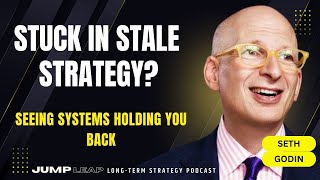
In this episode of the Jump Leap Long‑Term Strategy podcast, host Francis Wade interviews marketing legend Seth Godin about the pervasive problem of organizations operating within hidden, entrenched systems. Godin argues that powerful systems create a culture that normalizes themselves, making them invisible—"like goldfish not noticing the water." He warns that jumping straight into tactical planning without first diagnosing the underlying system results in short‑term fixes rather than true strategy. The conversation weaves through vivid examples of systemic blindness: Yahoo’s missed opportunity to acquire Google, Blockbuster’s failure to see Netflix, Walmart’s early decision not to compete directly with Amazon, and the college‑industrial complex that shapes education choices. Godin emphasizes that strategy is fundamentally about storytelling that changes behavior, and that emotional engagement is essential for clients to recognize systemic constraints. He offers practical ways to surface systems—observing meetings, customer interactions, and contrasting similar contexts (e.g., supermarkets vs. food banks). The dialogue also critiques traditional consulting and firms like McKinsey, suggesting that their value lies in providing a defensible story rather than a solution. Godin recommends building a small, curated deck of 20 powerful system‑change stories to trigger insight in clients, and stresses the importance of naming what is already visible to enable action. Throughout, he blends philosophical reflections with concrete anecdotes, urging strategists to adopt a long‑term, systems‑aware mindset and to help clients become agents of systemic change.
Chapters
I've had the problem my whole life, and I don't know anyone who doesn't have the problem, because systems— existing powerful successful systems— are very good at hiding. They create culture to establish themselves as normal, and once we see that the system we're in is normal, we're like goldfish that don't notice the water.
It's the Jump Leap Long-Term Strategy Podcast with Seth Godin, episode 26. Your company is built on systems, a whole bunch of systems which are intertwined. Understanding how they work together is critical for any strategic changes you want to make However, you've also seen system diagrams. They look awful, they got too much detail, and they don't capture the essence of what happens at any level of the organization. Plus, they take forever to build. So you know you need to have this knowledge. It's good knowledge, but how do you begin to grab hold of it so that you can use it in your strategy? And where is the practical application in all this? Tune into this episode to hear from me and my special guest Seth Godin as we tackle and even try to solve this wicked problem together. I'm Francis Wade and welcome to the John Pleep Long-Term Strategy Podcast. Hi again. Just before I start the interview with Seth Godin, I want to tell you a couple of things. One is that we're going to be digging into the ideas that Seth and I go into in this podcast at the June Long-Term Strategy Conference coming up in 2025. It's an all-virtual event. It runs for 48 hours continuous all the way through from June 25th to 26th. So go ahead and save the date. It's an excellent opportunity to explore the ideas, the obstacles, that arise as companies try to create game-changing preemptive long-term strategy. To visit and maybe add your name to my newsletter, check out longtermstrategy.info. And also, if you want to go straight to the conference website, you'll see a link on that page, longtermstrategy.info. So see you inside. And one more thing. If you're a long-term listener of the podcast, you may have asked, you know, what happened to the insight bell? Well, in the excitement of interviewing Seth, I forgot to add it in, but I'm going to add in the sound of the bell at different points where I thought that we came up with something that was particularly new, insightful, and maybe fresh. So Keep listening.
You're—
and welcome back. And as you can see, we're joined on the stage by Seth Godin. In case you don't know who Seth is, he's the author of This Is Strategy, a strategy book. He also, he also put out the Udemy course, a Udemy course on the topic of strategy. He has 22 bestsellers, and you can find him at sethgodin.com. Seth, welcome to the podcast.
My pleasure. And what a great way to begin the conversation. Your intro was terrific.
Thank you. Well, when I tell the story of someone who's read your book and has all these questions, you may ask me, "Oh my goodness, I've just thrown you into the deep end." But folks, that's the nature of the podcast that we do here at Jump Leap, which is that we pick a problem and then we try our best to solve it. And I've invited Seth to help us solve this problem of determining systems in strategic planning, existing systems. He touched on the problem in his book, introduced, opened up like a can of worms for those of us who are strategic planners. We usually know a lot about systems, and here we're here to analyze what happens next now that you know you need to understand systems, but you have no idea even where to start. So, we'll spend the first part of the show diagnosing the heck out of the problem. Then, we'll transition to solutions after we've hopefully given you some insight into the nature of why this is even a problem because lots of people, you know, they've heard the terms. They've read The Fifth Discipline by Peter Senge. They know that you need— of course, systems are important. But that's all most of us know. Okay. So, here's a story to start us off. It's a story of Heather. And who is Heather? Well, she's a brand new CEO of a company which hasn't done a strategic plan in 10 years. She's a fan of systems thinking ever since she read The Fifth Discipline, and recently she picked up Seth's book, This Is Strategy. As a result, she's excited. Why is she excited? Well, her company needs a new strategic plan, but her C-suite colleagues only seem to have kind of a surface grasp of their current situation. She's pretty sure there are some deeper insights to be leveraged because their core technology is almost obsolete, their R&D efforts have been sputtering, but she's sort of wondering to herself, is my being a fan of Systems Thinking enough? Do I need to lock away these executives through a Systems Thinking 101 training? Should they read a book? Should I give them Seth's book? Should they listen to a podcast? So, she's stuck because she wants to do something practical that would have an impact on the upcoming strategic planning session. So, as I mentioned before, in the first part of our program, we look at the problem and the nature of it. Seth, have you come across lots of people? I imagine you have, who have this problem or Have you had it yourself? What's your relationship to this problem of systems thinking and strategy?
I've had the problem my whole life, and I don't know anyone who doesn't have the problem. Because systems, existing powerful successful systems, are very good at hiding. They create culture to establish themselves as normal. And once we see that the system we're in is normal, we're like goldfish that don't notice the water. And I'm not sure I could teach goldfish what water is, but I'm pretty sure I can help people realize that there are these unseen, undiscussed systems that they take as normal and live within them, as opposed to taking a step back and saying Oh, this is what's getting us the results we don't want. We could use effort to change the system or play in a new system that would get us the outputs we do want. But if you rush over this part, you have no chance of doing strategy. What you're actually doing is tactics. What you're actually doing is figuring out how to spend time and money being busy, but you've accepted the existing system. You haven't figured out what it is. Or how to change it?
Ah, so I've seen this rush, this rush of which you speak, in which a CEO wants to just jump into the new strategy. They want to spend zero time understanding where they're at because their assumption is, we talk about this all the time as an executive team, so we already know where it's at because we talk about it all the time. My impression is that they are deadly wrong because the things they're talking about are not the same as the things that give you an appreciation of the system. Have you seen that in your work?
Oh, for sure. So, let's use one that isn't related to business. When a kid is 6 years old, they come home with their first report card. And their parents want them, particularly in the suburbs, their parents want them to have good grades. Why? Is there any correlation between good grades and emotional resilience, good grades and actual learning, good grades and initiative? No. Why do we want kids to get good grades? Because the system of the college industrial complex, 400 years old, is so deeply ingrained, we don't discuss it. And now that kid's 17 and he's in my office and we're talking about applying. He wants to get into a good college. Well, You want to go to a good college or a famous college? If you want to go to a famous college, why is it important to you that they have a football team and this and this and this and that you're going to go a quarter of a million dollars in debt? That's just normal, apparently. And when the world changes, and it always changes, systems are under stress. And so the college industrial complex is under stress. So now we can see it and we can decide to respond to it if we want to, if it's going to help us get the better life we seek for our family, maybe it's worth saying, well, but why did I buy into the system that is that when it is no longer functioning for me the way I would want it to? So that's one sort of invisible system. But in capitalism, in industrialism, they're everywhere we look. And, you know, tell me again why everyone has to go back to the office, you know? I mean, it's the same conversation. It's because we're in a system, and that, that, that system on a social level keeps us locked in.
And when it comes to strategy, so it doesn't seem as if C-suite spend a lot of time appreciating the system they're in, even though according to what you're seeing and what your book is saying, they're locked in it. So, so this is, this is like you assume that you know, but the truth is you really don't. And I, I had, I had, I see this in the work that I do also, but I saw it in In the example you gave in your book, when you worked at Yahoo and these Google, Googly types showed up, it was like, what are they talking about? What? And I don't want to steal the punchline, but can you share the story a little bit so that—
Sure. It's one of the most expensive mistakes in the history of business. Yes. Yahoo in 1998 had a powerful, successful, elegant strategy. And their strategy was the internet is a wild, weird, and woolly place. So we're going to build a site, Yahoo, and when you get there, we're going to want you to stay. So we're going to build Yahoo Kids and Yahoo Mail and Yahoo News and Yahoo Finance. And on the homepage of Yahoo was 183 links. Google showed up. We had the chance to buy Google for $10 or $15 million, and they didn't buy Google. And the reason they didn't buy Google is because Google's strategy was, come here and leave. There are only 2 links on the homepage of Google, and their arrogant but correct perspective was, we know everything that's on the entire internet. When you tell us what you're looking for, we're going to get you to go somewhere else. That created a company worth perhaps a trillion dollars. But because Yahoo was engaged in the old system of how do we harvest attention on an ongoing basis, they couldn't imagine a different transformational system that says what happens if there's an open web? And now when AI shows up, Again, the systems are going to get shuffled. And if you try to use AI to make your old system work better, you're going to lose to somebody who uses AI to make a new system.
And this is happening today in, you know, as a strategy facilitator, I try to tell my clients this, but as you can imagine, the system that they're in prevents them from seeing the wisdom that I'm trying to impart. I don't get very far. They may even agree in theory, but when presented with an actual system that doesn't match the one they're in, they reject it so quickly. You know, they've already heard it before, or they already know that I've not been able to get them past just being in the system, let alone believing that there are limits to what they're seeing in the moment. So when we get to solutions, I'm gonna ask you this question, because it's an in-the-moment thing. It's one thing to have to know that they're blind, It's another thing to break that blindness so that you can actually open up, open up a doorway where they can actually see something. And presumably that if, if you had been there, because I know you weren't there in the room when this decision was made by Yahoo, but if you're—
but it's okay, they didn't listen to me.
Yeah, but you also give examples of Yahoo not listening, Western Union not listening when AT&T came knocking on the door, or the creator of the phone came to them and said, yeah, I have an alternative. Uh, Blockbuster didn't listen when Netflix came to them. And folks, as you're listening, you could probably assume that your strategy team, your C-suite, has very similar blinders, and it's the system that's preventing them from seeing other opportunities that are out there. Is that characterizing the problem accurately?
Well, there are many problems, but that's a great example of it. And it's not always leaning in and embracing the new technology. So in 2000, 25 years ago, I gave a speech in Bentonville, Arkansas to the entire digital team at Walmart, 250 people. And I was amazed at what I saw. When I walked into the room, there was a banner, 3-foot-high letters all the way across the front of the auditorium. And it said, 'We can't out-Amazon Amazon.' 25 years ago, the biggest retailer in the history of the world gave up and said, 'Amazon's building a different system, and if we try to compete with that, we're going to destroy the stores we have now. So let's not do that. Let's do a different thing.' And they got 20 really good years out of that decision. So seeing a competing system doesn't mean you have to embrace it, but it really helps to see it.
And what happened in the 21st year?
Well, now, because Amazon's flywheel continues to gain in momentum, Walmart is going to find itself in a place where just getting cheap container ships of stuff made overseas is insufficient. And what I believe they have done for the last bunch of years is worked very hard to build little tiny tendrils connecting them to their customers, selling them services, building habits, so that when the customer has a choice to go online— because they all have a phone now— to go online and buy something even cheaper than Walmart will sell it, they hope that they will have some insulation there. But most organizations don't last forever. You're not entitled to last forever. But if in 2000 they had tried to please the stock market and compete with Amazon at the same time, they would have failed at both.
So, so it's not the case that they had a competitive advantage by changing their technology. Did they think, we will get 20 years out of this, and then in the 21st, we will be prepared to be retired. Okay, so they assumed that they would one day be in the same game. They didn't just say no like a matter of religion, like we don't believe in that but they do and we're not gonna, because that would lock them into another system that would have prevented them. Matter of fact, there's probably a good number of companies that lock themselves into a protective system that then gets them sort of into a failure mode, right?.
But most people listening to this aren't the biggest retailer in the history of the world, right? And so the real question is, so let's say you're a book publisher. Even the biggest book publisher has very little market power. The system of book publishing is 500 years old, and ever since Gutenberg, it's been a very similar structure. And it's— in the last 5 years, the system is completely upended. There is no scarcity of shelf space. There is no scarcity of alternatives. And book publishers, if they keep doing what they're doing, will disappear. They're— the system that they grew up in, that they love, is going away as we watch. But they have this tremendous advantage. They have smart people and they have copyrights, and they can now walk into a system under stress and rebuild it. But they're all afraid to do so because they don't see themselves as people with agency. They see themselves as folks who have to react, and the long-term thinking for them is 6 months. And that's a shame because they're going to get really stressed in the next few years.
Hmm. So there's a, there's a, a possible error in the way you see yourself in the system. Yes. All right, let me ask you an obvious question because, you know, most people listening to this are probably going to be consultants. So why not hire McKinsey? Why can't McKinsey come in and show you your system, show you the limits of your thinking, tell you what to do essentially?
So it's interesting you bring up McKinsey because we can learn a little bit about American enterprise just by thinking about McKinsey. A McKinsey consultant, a senior one, probably makes $3,000, $4,000 an hour. And if they leave McKinsey with the same brain and start their own firm, they can't even charge a third of that. So what changed? What you buy when you buy advice from McKinsey is not the answer. You know the answer. What you buy is a story you can tell the board. What you buy is defensibility. And some stats. Well, McKinsey told us we got to shut this plant, don't blame me. And so the book publishers that have thrown me out of their office over the years know that I am correct. They're not stupid. But when they think about the system that they're so, um, part of, the same way The New Yorker magazine is part of the system of magazines, and as magazines begin to disappear for the last time, they're doing nothing about it. When I sat with the people at WNYC, the biggest public radio station in America, at the dawn of podcasting, and I said, "Look, you win. You have all the talent, you have the shows, you have the audience. What you need to do is make 100 podcasts and use the radio to promote them because you can then lock people into the podcasts that they love." And they looked at me and they said, people go into the public radio business because we love spectrum. We love the fact that we own a slice of the dial and we decide what you're going to listen to at 4 o'clock in the afternoon. That is what it is to be a program director. Think of those two words. So if I— if the president said, so if I go to all the other public radio stations and say, here's this huge list of stuff keep promoting people to turn off the radio. They don't want to live in that system. And she was right. But now it's over for radio because the smart people aren't listening to radio anymore. They're listening to the shows they want to listen to.
So they didn't— they didn't get the insight from you. Do you think McKinsey would have made a difference?
I, I think that McKinsey works if you choose to hire them. But that's the hard part is the choosing, not them giving you the advice. So, what we see is most organizations are a system within a system. People end up in the C-suite because they outlasted everybody else. And they outlasted everybody else by complying to the dominant system, right? So, Lee Iacocca makes it to the top. At Chrysler because he's a car guy and because he knows how to go to meetings and because he knows how to maintain the American mindset of how we make cars around here. They all saw what Japan was doing. All of them knew exactly what a Toyota could do. But the cultural system of Detroit in the 1970s and '80s is everyone was driving an American car. That was the only city in America where that was still true. So you were surrounded by people who were driving Chevelles and Novas and, and Chryslers. You didn't think they were— you could— oh, we'll be fine, we'll retire before it's a problem. So again, what we keep coming back to is what is normal in a world where that normal isn't solving the problem anymore? And the, the last part of the riff is, you know, if we think about the healthcare system in the United States It doesn't make health, it makes treatments. And so if we pay attention to what the system is rewarded for doing, we will get a clue as to what the system will keep doing. So if you are in the business of treatments, you probably want to embrace the existing system. If you're in the business of health, you have to realize the system is going to fight against you at every turn because it wants treatments.
And having them, I guess, the art of strategy. And you say strategy is the philosophy of becoming. I love that phrase because as someone who helps companies become, I am able to be present to their philosophy and I'm able to— they invite me in, hopefully, and I help them shape their philosophy of becoming so that they do their becoming a little bit differently because I'm around. And I imagine that's the same for people who are listening in as well. Folks, you want to be influencing your C-suite, I imagine, like I do, because you want to be able to have them have an insight and bam, their way of becoming changes because you help them see something that was there but not visible to them before. How does that sound like an aspiration for me and maybe all of my— most of my listeners, Seth? Does that sound reasonable?
Or— Yeah, I mean, that's— and most organizations, if you stick— if you talk to the people at the Museum of Modern Art, if you talk to the people at Gillette, who are you trying to help your customers become? They got no clue. Who are you trying to help your team become? That's not what— no, it's like, we need to make the stock price go up. We need to get more people to come to the museum. We need to make sure that we're you know, profiled in The New Yorker. That's what we're here to do. Okay, well, thanks for telling me the truth, so I'm not going to bother you anymore. But if you can be very clear about what journey you're trying to help people go on and hopefully find an insatiable need, a hole that you can keep filling, and the more you try to fill it, the better it gets— now you have a project.
Now you have a worthwhile thing to commit I think you've, you've just described my, my favorite strategic planning projects, and probably that of, you know, as my listeners tune in, you know, when we have that happen, it's like heaven, because anything becomes possible even though the circumstances may be, may be dire, even though they may be the backs are against the wall, because there's this insight about the system My sense is that a powerful insight about even the worst system offers hope. Is that where we're heading here towards sort of a grander self, a grander aspiration? When things seem lost, they're not so lost.
I think so. It— you need to have optimism about the human condition. And so, uh, you know, my friend Jim builds schools in some of the poorest countries in the world, and he has learned firsthand that nothing will disrupt a shockingly, tragically poor community better than a school that the community builds together. Because what happens is, when you build a school in Mali, or you build a school in rural, uh, Ecuador, for the first time kids grow up knowing how to read. They grow up understanding what it is to be in an intellectual community. Now, next year, their brothers and sisters come. 5 years from now, they're reading to their parents. 10 years from now, they're getting really good jobs. Commerce— the entire system of the village is transformed because one person showed up and said, let's build a school together. That sort of system thinking is precisely the opposite of giving a bag of rice to a hungry person. I'm not opposed to feeding a hungry person. But as soon as that bag of rice is gone, you got to start over. You haven't made any systems change whatsoever.
Oh boy, no, no, I'm feeling like easy to say, hard to do. And, and unfortunately, in my case, when it happens, it feels like accident, like serendipity rather than design. So let's transition to solutions because the, the, your book Your book picks up on 4 big themes, and strategy is the system— sorry, is the one that is the sort of the one that jumped out and sort of hit me in the face. All of the others are connected. So, um, why, why write This Is Strategy? Because you're, you know, you're really a marketing guy. So my audience of strategy people are like, hold on, isn't he a marketing guy? Purple Cow and, uh, The Dip. And, you know, it's more of a kind of a Advertising, messaging, he invented e-commerce. Isn't he that kind of guy? What the heck does that have to do with— So, what inspired you to even write a book on strategy because it just seems like different kind of water?
You know, I think we have to have a conversation about what marketing is. I decided marketing is telling a story that makes a change happen. I have never written about advertising. I don't think it has a future. Um, I just called what I do marketing because it needed to go in some section of the bookstore. And plenty of my work, like Linchpin and The Dip and What to Do When It's Your Turn, isn't about something that could be thought of as promotion. It's about making a change happen by telling a story, a story to yourself or a story to other people. And so I wrote This Is Strategy because I know so many people who are just like your clients. So many people who are working hard and aren't getting what they should be getting because they're doing things they shouldn't be doing. They don't see it. And, you know, when we consider how many worthwhile projects there are to do and how hard it is to get them going, it's because we don't build a strategy around— we don't understand time. And games and empathy and weave them together to make a change happen. So if you want to use that to do marketing, it'll work. But you can also do it to change a village.
In other words, to do strategy that moves the needle in a profound way and causes a big change. So the change that changes a great product, the way it's marketed is the same. The philosophy isn't very different is kind of what you're saying. Correct. Is that you need to You need to get to this level in terms of systems. You need to get to this level where you found the sort of the magical point that you could press in the system that then almost effortlessly causes like a whoosh ripple effect. And, you know, and when I've seen this happen a couple of times, but once again, it's more like luck. So in your book, so you You take us down a path of saying that systems are important. You introduce us to Dana Mendel, who I'd never heard of before. And so, I read her book. I watched her videos online because I was like, "Okay, Seth is into Dana Mendel. I've got to find out who she is." I'd never heard of her before. And she does some— boy, I've got to say it's theoretical and it's pretty abstract because the average manager is not going to pick up a Dana Mendel's book and read it.
No, I mean, I think Donella was an academic and she died way too young, but she wasn't trying to talk to your clients. She was trying to establish the philosophical framework of systems. So she's talking about, uh, you know, giant things of water with pipes between them and what gets refilled and what doesn't. That's helpful if you're thinking about things from an academic makes sense, right? But Russ Akoff, who worked about the same time, was much more accessible. So one of the things Russ did is he tells the story of trying to help a school in a neighborhood that was under-resourced, and the kids, 7-year-olds, 10-year-olds, didn't know how to read. And they didn't know how to read because there were no books in their homes. They didn't know how to read because their parents were struggling to make ends meet and they didn't have time to read them stories and to outfit them with books. So if there's a cultural bias against reading, if 7- and 10-year-olds have been raised to think it's not going to do them any good to be good at school, why are you surprised that the system that's living inside this school building is not functioning very well? Kids aren't behaving very well. They don't want what the teachers want. So what did Russ do? Well, he tells the story of getting a bunch of silent movies, 100 years old, that had basically subtitles. And they made a rule in the school— they were comedies, Charlie Chaplin, Laurel and Hardy, stuff like that. They made a rule in the school: you don't have to go to class ever. If you're not in class, you got to go to the cafeteria and watch movies, your choice. And the thing is, the only way to enjoy the movie was to be able to read the subtitles. And so now kids had an incentive and they taught themselves to read because we teach ourselves almost everything. They taught themselves to read and all of a sudden they were curious. Well, what else you got? What else you got that's, that's worth me reading here? And that transformed the culture in the school and in the community. That's systems change. And What we often do instead is say, this system isn't working the way I want it to, I'm going to just insist. But if you don't have the market cooperating, eagerly cheering you on, the market's going to do what the market wants to do.
And it strikes me that a Russ Akoff kind of sort of inspired insight. I'm wondering So given Dana and Ross and you and Peter Senge and other people who think in terms of systems and see systems before other people see them, if for those of us who are strategists, who work in companies, how would you recommend that we prepare ourselves to see what the others aren't seeing? So being an outsider helps, of course. That's a, that's our ticket to see some things, but the profound things that you're speaking of don't— they wouldn't hit everybody who's an outsider, right? They would hit some. How can we prepare ourselves? I don't think the preparation is drawing system diagrams and becoming good at doing that kind of theoretical stuff. So what are some, what are some insights, or what's some coaching you could give us so that we can see systems quickly? Let's just deal with the seeing first. We'll deal with the convincing later. But let's talk about the seeing because if we can't see them or if we can't help our clients see them, then we're just operating inside of the same old, same old business as usual and then getting the same old results. So, how should we prepare ourselves?
So, I think the key question— well, the first thing I'll say is you don't need everyone in the organization to understand systems. It, it's, it's a little bit like a logo. No, the organization should not vote on their new logo. A tiny group of 1 or 2 people should say, this is the new logo, here we go. And strategy at some level is like that. We need a few people to assert what's going to be happening around here and then give people freedom to work on the tactics. But the system You know, the system that Howard Schultz built at Starbucks, that's Howard. That wasn't 40 people in a committee. That's somebody who could in 6 sentences describe the system strategy change. Okay, so the first thing I'd say is this: the question, what are things like around here, is deceptively difficult. And if you don't travel you won't understand which parts of it are interesting. So, for example, when people visited Yahoo when I was there, they thought what things were like around here were the pinball machine, the purple couch in the lobby, right? When they went to Google, they talked about the Grateful Dead chef, right? That, that was a distraction. That's not really what it was like. But if you go to a meeting, you learn a lot. So I used to go to the meetings, uh, at JPMorgan Chase's venture group. They were responsible for one-third of the bank's profits in the year 1997 and 2000 during the boom. And you walk in and there was a table with 45 people sitting around it, and then behind them all their juniors, 90 other people who would take notes. The hierarchy was obvious. And if you went to a meeting the same time at Amazon, you would see a meeting that would blow your head off. Totally different dynamic and interaction. If you went to a meeting at Yahoo, it was a lot like at the bank. There was all this self-defense. A lot of truth was never spoken. People were maintaining the status quo. I have an email from my boss at the time. He said, our stock price is going up $3 a day. Just cool it. Don't talk about anything. Because the mindset was, we— everyone's on the train and we're just going to sit still. Whereas at Google, just down the street, the attitude, what it's like around here, was different. It was a different system, a system that has strategy at its core, a change they sought. To make. And so if I'm talking to a company of substance— and I don't do any consulting at all, I leave that to you, Francis— if I'm going to a company of substance, I want to know, show me what it's like when your customers interact with you. Show me what it's like when your customers talk to their friends. What's it like around here when employees say that was good, that wasn't good? These are symptoms of the system that you are within. And so go to a Blockbuster store, you will see the emotional system at work, which was totally different than what Reed was busy doing just 100 miles up the coast. So now I can say to the clients, do you see how this meeting feels totally different than that meeting? Do you see the system at work? Now, Let's try something else. Let's walk into, you know, a supermarket and compare it to a food shelter. When someone walks into a food bank and they're hungry, are they treated the same way as when they walk into a high-end gourmet grocery? What is different here and why is it different? They're both for the same thing. Getting food to people who are looking for food. If we can understand how that system got here, we can now have a strategy for changing it.
Ah, so asking, "How are things done around here?" with a view to discovering how they became that way. And I guess that also means what the limits are that you're not seeing or you're not noticing that if you could get past the limits, If you could get your origin story straight and see, okay, it was great. It worked for a while like Walmart. But now, it's not working the way you want. No, maybe you could see past it. So, we're almost guiding them to see differently.
Right because then, they can become emotionally enrolled in the journey that we want to take them on.
Aha! No, see. No, Seth. No, hold on a minute. We are strategists, right? So, we deal with logic. Getting people emotionally involved is— that's a marketing-sounding thing. So, there's somebody listening now saying, God, get out of here. Strategy is a matter of filling out templates. It's a logical progression. AI can do it. So, you're arguing that getting getting our clients emotionally bought in from the minute we start to ask them questions about their system. As a matter of fact, the two happen at the same time. Is it a safe way for them to explore the limits of the system just because we're kind of naively asking without knowing what the answer is necessary? Because we can't know when we ask the question the first time. But are you saying that taking them along that path is a way to help them see the boundaries that they're not seeing?
The question I ask people is, is strategy you're using now and the system you're in now getting you what you want? Because if the answer is yes, what's— you don't need my help. If the answer is no, then the thing that built the system is no longer what you need the system to do. It is not serving you. They're shoes that don't fit. And just because the shoes were really expensive doesn't mean you should keep wearing them because they're hurting your feet.
So, it's kind of like presencing the pain of their lack of success opens their mind to considering what you're saying.
Yeah. So, and again, let's just boil it down not to a big organization but to an individual. So I, I was talking to an individual the other day. They've been trying to get their book published by a fancy New York City book publisher for the last 3 years, and there's a system in place. And the existing publishers want you to have a well-known agent, and the agent wants you to have a huge following online, because nobody in book publishing wants to work hard enough to turn an unknown into known, a massive bestseller. They want to find someone who's going to sell a whole bunch of books right away. So this person is feeling like a failure because they have decided that the only way to accomplish what they want is to walk in the front door of this kind of place, get picked, and then those people get the word out because their idea is so good. Well, if they had spent the last 3 years building their podcast they'd already have more listeners than they would ever reach with their book. If they had spent the last 3 years making a TED Talk every— a TEDx Talk every couple months, sooner or later one of them would be as good as Simon Sinek's or Brené Brown's, and it would reach more people. Would they get a book advance? No. But they didn't tell me they wanted a book advance. They told me they wanted people to know their idea. And so if the 500-year-old book publishing system isn't working for them I'm sorry you fell in love with it when you were a kid, but it's ailing. It's not healthy. And it's telling you that. It's saying, we don't have the resources we need to help you become J.D.
Salinger.
So please forgive us, but go do it without us because there are all these other methods, strategies available to you to accomplish the thing you said you wanted, the philosophy of becoming. You want people to know your idea. Okay. Well, go find a different route to do that as opposed to just waiting to get picked.
It's kind of like translating that to us. We need to help them find their way of becoming. We need to be an agent for them, so to speak. An agent for their kind of greatness. An agent for therefore a strategy that would produce their greatness. Sometimes though, they tell us things like, "I want this to be quick and I only want to look 3 years in the future." So we in the industry are— this is a conundrum that we're facing. And most, all of us I think, have compromised because we know there's something not quite right about asking that question or answering that question or meeting, working under those terms. We know that something is being left on the table, that there's some capability that we're not addressing. We know that we're not able to ask questions that take a trend all the way to its nasty conclusion. Like, "Oh, if you keep selling VHS tape recorders or you keep renting them, do you think that's going to end up well in 10 years, 20 years, 30 years?" We don't get to ask those questions. We get sort of boxed into these sort of small kind of boxes of thinking. And that's a common one for us. Any suggestion as to how we could ask questions that would allow them to see that deeper insights into the past could yield greater results in the future? But you've got to sort of be willing to think outside the— think outside the— I know it sounds trite, but it is think outside the 3-year box. You've got to be willing. Any insights as to how to help people in terms of temporal problem? It's a time thing. This one kills us as strategists because it's ruining our industry and we don't know what to do about it.
Well, so the biggest concept here in response to this question is later in the book where I say when you pick your customers, you pick your future. That we can always short-term ourselves into a compromise. But if you do that a few times in a row, you're not going to get the clients that you actually say you want. So at some point, Option A is, here are the names of 3 people who can help you with a 3-year plan. I am not one of them. That when you are ready to understand what it is to build something of substance. That's what I do. You're not qualified to be my client right now. That's hard to say. The other thing that goes with it is you can try to transform the person in front of you into the kind of client you need before you give them the answer, right? So You know, this, this is the challenge coin that we made for the Alt MBA, and part of the reason I made it is because if you go like this and, and people are amazed that it's gone. Now, when you do that to most people, they're like, oh, and then they want everything to go back to normal. But there are other people who say, teach me how to do that. And so one of the things that we can do to transform a client is create small systems changes that light them up, to get them hooked on what it is to do this sort of highly leveraged systemic change. And then they come back to you enrolled in the journey saying, "I see that now." So changing meeting culture is one of my favorite examples. That it doesn't cost any money to change meeting culture in a certain way. And when it works, the people you did it for are often so stunned at the power of what just happened, they now become a willing student of, well, what are the building blocks here to become the kind of institution that does something of significance?
So we need to be prepared then to— because there are, there are the ones that I've turned down, and I'm sure others have as well, you know, the, the crazy short, short-term financial only, selfish, I just want to cash out in 2 years. We all have those. But so we need to be prepared to have these conversations, uh, in which we enroll them in a shorter spicier kind of insight where we say, you see that, you see that insight that you had into why the meetings aren't working? Expand that to your whole company. And guess what? There's a reason that your system as a company isn't working. And the same way you couldn't see why your meetings aren't working, believe it or not, there's things in your company that— and they might say, well, what are they? And you say, well, we got to take a journey and find out what they are. But The fact that you're not getting the results that you're getting means that they do exist. So, we've got to prepare to make that case in a way that includes the client and engages them and catches them emotionally. Is that what you're describing?
Yeah, exactly. And there are a lot of things positive and negative to say about the book, The Goal. But that is at the essence of what happens in that book is the center third of the book is about the client growing up so they could actually hear what they needed to hear. My, my dad, for many years before he passed away, ran a hospital crib company in Buffalo, New York. My sister runs it now. And when he took it over, it was, uh, the company was over 100 years old, uh, but when he took it over, the amount of crap in that factory because every time they made a bed or a mattress pad or anything, they had to get all the spare parts for it, all the nuts and the bolts. You know, it's in— it was a giant facility filled to the top with stuff. And he figured out that if he bought a million-dollar laser cutter, which was a big stretch for him, he could set it up at the end of the shift on Monday, and Tuesday morning they would walk in and the parts they needed for Tuesday would be waiting for It made nuts, it made bolts, it made each piece. And so this entire, you know, football-sized place filled with cruft, no longer needed. You just make the parts you need for today. That feels like an obvious shortcut, but almost no one has ever done something like that because the system that's in place, the system of foreman and storage and what we do around here pushes back against that, right? Because it feels weird to say, well, we're not going to do any of those things, everything is going to be just in time. And when we look at big strategic shifts, even in the heavy metal production world, they always feel like that. They always feel like, what are we going to do? And, you know, Edwards Deming had to leave his country and moved to Japan because no one wanted to hear about quality. That's a systems change.
You know, those who are engineers are very inspired by those two stories because The Goal is all about— The Goal by Eli Goldratt, folks, is all about systemic change. I read it when I was, I think, 22 or so, and I read it. I tried, I almost read it in one sitting because it was so compelling. And I was an industrial engineer, so this was like the answer that I wasn't being taught in but having them get that kind of insight very quickly. Now, it strikes me also though that in addition to demonstrating the insight that gives you that systemic change experience, the use of stories because— so I did your Udemy course and at the start of every chapter, and folks, there's 290 chapters in Seth's book, And there's maybe 50 chapters in the Udemy course.
It's about that.
Each one, each one of the Udemy course started with a story. I don't know how you get these stories and how you get so many of them and how they're so appropriate to what you're teaching. I don't know how that magic works because I'm— I don't have anywhere near as many stories. But I bring it up to say that Your stories of systemic change are convincing and compelling. And if I could share them with my clients and I had them at my fingertips, then my clients could see, oh, Blockbuster versus Netflix. Oh, Yahoo versus Google. Oh, Walmart versus Amazon. If I could put them in the right context and tell the stories in the right way, then my clients could understand what's happening really quickly. Would you by any chance recommend that we have these stories of systemic change sort of ready, we have a bunch of them, ready for the circumstances as they appear? And as I'm asking you, I get the impression that there's an endless list of stories you could tell us that would illustrate different parts of your book.
But I'm not sure it's endless. So yes, you're the, the best consultants I've ever met. That's what they have. They have 20. That's all they need, 20. 20. Okay. And so I made this deck. This is the strategy deck. You can get it, uh, at seth.blog/tis, and it has 5 million combinations of questions and prompts on it. And what I'm going to recommend people do, if you're a consultant, is make your own deck. You can do it by hand and just put 20 stories, prompts for 20 different stories on 20 cards. And, uh, you know, you can go online to Amazon and buy a blank deck and write on it with a Sharpie. And then when you're sitting there talking to somebody, you just, oh yeah, this one. That's enough. 20, you know, the best magicians in the world only carry a dozen tricks with them. They don't buy new tricks. They do the same thing over and over again because they know which one is going to work in which setting. This isn't about variety. This is about being profound. What it means that it's profound is you're telling something to somebody that they already know, but they hadn't named it before. Right? So walking through that factory with the people who'd worked there for so long, my dad says, 'See all that stuff over there that's covered with grease that we haven't touched in 10 years?' Well, until he said that, no one had ever seen it because it was just sitting in plain sight, but it had not been named, right? Or if I'm sitting in a meeting and one person has been talking for 20 minutes and 5 people are just sitting there taking notes, that feels normal. Why are those 5 people still there, right? In an age of AI, someone— a computer can take the notes. What's— what's— what are we doing here? Well, what's actually happening is a performance of status, that the boss has announced that they are important enough that they can command 5 people who get paid a lot of money to sit there and do nothing. So let's name it. Now, what do you want to do about it? And I am not smarter than most people I know. I'm just collecting a story, or I'm not teaching it. If I can't find a story, then there's nothing to be taught. If I can find a story, then I can hold on to it for quite a while and bring it out when I need it. And if it doesn't work, I'll never use it again. And if it does work, it becomes part of the dozen. Whoa.
So I wanted to grab a hold of the words that you said around understanding the profound insight into the system that they already have because it strikes me as true and it rings to my experience and I suspect it resonates with folks who are listening that in the highest form of the work that we do, We're not quite telling people stuff that's way out of left field and things they can't understand. It's that we're saying things that, because we're telling them in a way that's acceptable, that it allows them to see things about themselves or their system or the company. We sort of emphasize an inkling, you know. So it's a, it's a great It's a great affirmation of what we do when we do it really, really well because the client enjoys the story or whatever. We do kind of put on a performance, to use the language you used.
Of course.
We kind of put on a show and during the show, great things happen and we want more of them to happen systematically as opposed to— I never caught the importance of the stories I tell. I never, I never got that. It didn't seem to me— it just seems to me to be like a, a device that's helpful, but not that it's not a device that gives them profound knowledge about themselves. So on that note, Seth, anything, anything more you want to say about that particular point before we wrap up?
I want to tell one story that I learned from a dear friend of mine. He was building a nonprofit to help feed the hungry. And it has gone on to become extremely successful, made a difference in the lives of an enormous number of people. And he would have meetings with very well-off people, because most of us can get a meeting if we need one, but what you're ultimately going to do is ask that person for $50,000 or $100,000 to help a family they're never going to meet. How do you begin the conversation? Do you show up and open your laptop and start showing slides about how many hungry people there are? Because the fact is, very few humans can feel emotionally different between the number 80,000 and 800,000. They're the same in our head, right? So what he did was he turned to the person early in the meeting and he said, what was it like for you at the dinner table when you were growing up? And everyone has an answer to that question. My dad would always ask me hard questions. My mom would ignore me. We didn't get to eat with my family. We always ate as a family. Everyone has an answer. And what happens when you ask a question like that is you have brought somebody into their childhood, their dreams, their youth, the system they were part of. And from that spot, you can then make their circle of us bigger. And you can say something like, what do you think it's like for other people at their dinner table? What do you think it's like at the dinner table of a million New Yorkers who are on assistance and don't have anything in the house on the 25th of the month? 'Will you want to help me do something about that?' And that's what makes people take action, because they're telling themselves the story that they know is true.
So we need a similar kind of— similar kind of opening, or a night—
well, it's not the opening. I'm not talking about a tactic here. No, I'm talking about remaking your practice so that you will find clients who want to go with you to make the change you know is possible, that you are proud of, that will enroll in the journey so you don't have to fight with them. You can help them get there. And, you know, the hard part about being a consultant is not the right answer. That's the easy part. The hard part is getting the client to do it.
Seth Godin, well, first, uh, on behalf of the strategists of the world, I want to thank you for This Is Strategy, for delving into some unfamiliar waters, and for bringing a philosophical perspective to what we do. Because your book is like nothing else I've ever read. And so folks, you want to, you want to grab a hold of Seth's book, and, and I recommend that you treat the 296 or 297 chapters as a one meditation per day because that's kind of how it's written. It's a nonlinear kind of experience. Each one is different. But how can folks get a hold of you and find out more, Seth, and follow you more closely on the work you're doing, especially in strategy, especially?
So, we're coming up to the 10,000th post on my blog in a row, all written by me. Seth.blog. That's the best place. I'm not a very good correspondent, but you can go back 20 years of reading stuff. And once you see that I'm on to strategy, you'll see that almost all of them are about strategy.
Excellent. So folks, don't miss a chance to learn more and make sure you grab a hold of that book. And Seth, thanks for joining us on the Jump, Leap, Long-Term Strategy podcast. And folks, I want to tell you about the next episode. So, keep listening for 2 more minutes.
See you in a bit.
If you happen to be a fan of Seth Godin or the whole idea of systems thinking in strategy, check the show notes. There's a special link to some further resources that I'm gonna make available, and what it'll allow you to do is to dig into this topic in even greater depth. Don't miss the link in the show notes. And here's the excerpt from our next episode. So embedded within a snapshot are insights, and our contribution to those insights come from different methods and ways in which we engage with their data. We do research, focus groups, surveys, interviews, um, talk to stakeholders in different areas. We do a lot of the traditional things that most people do. And we do these things so that there can be insights that drive the snapshot. So we felt comfortable doing this, using this process, because it forms a basis, a foundation, both in terms of knowledge and in terms of the social dynamic of the planning team. In that it brings everyone onto the same page altogether at the same time, usually for the first time, because those weekly meetings that they have been engaged, engaged in all this time haven't been about establishing this kind of understanding. They've been about solving problems immediately. So this requires a different kind of mindset than the problem-solving mindset they've used in the past. The point of doing this snapshot is not to solve anything. The point is to gain collaborative or joined-up appreciation based on these insights. So as I'm speaking, I'm thinking, okay, but obviously the quality of the snapshot is essentially the quality of the insights. And as I said, we've been happy with this process. Until recently. And what happened was there was a client who came to us and said, your 2-day process is all well and good, 2-day process for 20 people, but we want to engage 60. If you liked what you heard from our podcast episode, go ahead and subscribe or like or recommend us on iTunes, Spotify, or YouTube. More information, log into longtermstrategy.info and subscribe to our newsletter. Our annual conference is coming up in June 2025. You can register at longtermstrategy.info with a free visitor's pass or a full ticket. See you later, and thanks for joining us.
More from Francis


Ep 35 Your Strategic Stagnation Isn't a Framework Problem—It's a Story Problem



The YouTube Strategy School: Why Your MBA Didn’t Teach You Strategic Thinking





