ep 27 Missing Insights| How to Find Breakthrough Strategies in the C-Suite
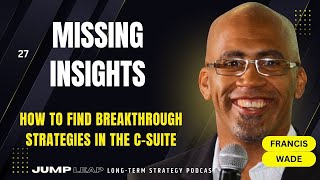
Francis Wade uses a fictional CFO to explain why C-suite teams fail to generate breakthrough strategies. He argues insight generation must become systematic, not luck-based, using structured frameworks and AI tools like Deepseek across cross-functional teams instead of relying on individual intuition or one-off consulting.
Chapters
Maybe if the McKinsey guys could do it, or we in the McKinsey team could do it and did it to some degree with a lack of firsthand information, what if you put the same resources in the hands of a client team? So in a room of 60, you divide the room up, you know, the teams up into groups of teams of 10. Give them data, give them the, teach them a framework, um, give them time and you give them AI to tap into anything that they could pull from or use from, you know, around the world, way different than having Google. Could they come up with insights if you set them up with the right prompt? It's the Jump Leap Long-Term Strategy Podcast, Episode 27. You're convinced that your company or client needs a game-changing strategy, but you've also worked with them and you've seen that their thinking is pedestrian, kind of ordinary, run of the mill, and it's more business as usual than anything else. You realize that one element which is lacking is a set of powerful insights. Without them, you, your team, your client, they'll always be stuck no matter how well they do at implementing their strategy. And God forbid, if a competitor comes along like Deepseek, competitor in the AI LLM space, you'll be disrupted. How do you prevent that? Can insights make a difference? Tune into this episode to join me in tackling this wicked problem. I'm Francis Wade, and welcome to the Jump Leap Long-Term Strategy Podcast. And welcome back. So if you're new to the podcast, you may not quite understand exactly how this particular kind of recording works. It's different from other podcasts because we spend quite a bit of time doing something kind of strange. We do quite a bit of diagnosis before we get into the solutions. So the reason we spend all this time in diagnosis is that we're hoping to reveal some of the underlying thinking that is used to solve or tackle some of these wicked problems. And it's a lot different than just sharing the end result where actually I'm actually going to share with you how I come at and why I decided on a particular course in action so that you know where it comes from. And hopefully you can use that thinking to decide for yourself whether there's value to what we're doing or not. This is kind of— we're trying to take a note from Einstein's book. Einstein said that if he had an hour to solve the problem, he'd spend 55 minutes thinking about it and 5 minutes thinking about the solution. So in these solo episodes, that's exactly what I'm going to be doing as well. So I invite you to join me in looking into this problem, taking a deeper dive than normal. And if you want to drop me any comments, you can look at longtermstrategy.info. And just check out this episode and, um, you could take it from there. But let's start with the story. So Raheem, fictional person, is a CFO. He was hired 5 years ago from McKinsey where he was a partner. He's trying to convince the CEO that there must be a way to tap into breakthrough insights that could change their strategy for the better. So truth is, the company has been putting together plans that are no more than carbon copies of ones which were written years before. Raheem is the last person, he's the most recent hire to the C-suite. So all of the other colleagues have been there for more than 5 years, and frankly, he thinks that the group is suffering from same old thinking and kind of a lazy, fair, laid-back attitude. In other words, they don't detect any incipient threats on the horizon. You know, they've kind of been looking out, but Rahim thinks differently. He believes it's just a matter of time before a competitor or a regulator or some new technology shows up and changes everything, or something external like a pandemic, or even, hey, A president of a powerful country, someone new comes in and changes everything, or maybe a prime minister, but something happens external to the company that changes their landscape significantly. So he thinks, I'm gonna be a little bit paranoid and I'm gonna preemptively scare myself into thinking ahead. And he's been sort of getting inspiration by reading case studies of complacency. And he can list them all off from memory. Kodak, Blockbuster Video, Jack Welch, GE, Apple when it was under John Sculley. So in each case, leadership teams of these well-known companies assumed all was well until all of a sudden it wasn't. The strategy that they were following fell apart. So Hindsight, of course, is 20/20, and he's a big believer in foresight. So he recognizes the power of looking back, but that doesn't tell him what to do looking forward. He wants his company to develop foresight so that they can prepare and again be preemptive about what's coming. He believes that the key to that is Powerful insights. Now, as a former member of McKinsey teams and a leader of McKinsey teams, he knows that now and again when the company would go into work with a client, they would stumble across a breakthrough insight, you know, game-changing insight. And they would find this insight and then they would champion it to the right level, you know, to the board and the CEO. And, you know, his clients at that level would be really impressed and amazed that You know, here was something, you know, just, just under their nose. And here McKinsey came in and helped them to see this thing for the very first time. But having been on a few of these projects, more than a few during his time with the firm, he's not convinced that hiring an outsider is the best way to do this. He's not convinced that what they were doing at McKinsey as a part of a team was all that unique or special, and that it could only be done by, you know, paying a million dollars here or there for that kind of advice. He thinks there's a better way, but he doesn't know what to do. And the truth is, whatever he comes up with, he must be able to persuade others in the C-suite, the CEO and the everyone else that there's a way of finding these insights that would make a difference. And boy, the fact that he has to share this with other people, well, that just complicates everything. So you may find yourself feeling a little bit like Raheem. You sense that these insights make a difference, but as you look around you, you don't see them popping up every day. You know, there is an argument that says that insights are a function of what the CEO or what the board chairman does. And if he or she comes up with these insights, then everybody's job is just to do them. So he does not believe in that. He doesn't think that that's the way it should work or can work. And he's aware that if you don't follow a good methodology, then there'll be no insights. There'll just be some run-of-the-mill kind of approach and results and insights that they came up with before. In other words, not insights, but really just affirmations of the way things are, anecdotes. He's also aware that some believe that insights are a matter of luck, that if you, you know, you should engage in strategy and hope for the best, and maybe if you're If you're fortunate, then the gods will smile upon you and you'll, you know, you'll discover, you'll have a eureka moment and all of a sudden something will happen. He doesn't like that thinking. He wants something systematic. And he thinks that the premise, the mindset around insight generation might be off. And that if they don't get, you know, this, find a method, find a way, then they could be stuck in some really stale thinking, which for him would, you know, it's just frustrating to be in that wanting to see something happen mode and then not seeing it happen and trying to be creative about making it happen. And you know, he perhaps has also picked up that there are some people in the C-suite who sometimes think the same way, which has created a kind of a tension because some think that there's got to be a way for them to do better game-changing strategy, which therefore means there must be a way to find these insights. But so he's not alone in his thinking, not entirely. He thinks the strongest, but there's others. And there's a bit of a tension that's being set up between those who think that that's not possible and those who think that that there should be a way. Hope you're enjoying this free excerpt from the Jump Leap Long Term Strategy Podcast. Interested in finding out more about getting a subscription to full episodes? Visit www.longtermstrategy.info. So he wants to make a, a shift from being stuck and just hoping for the best and to the point where every opportunity they have to generate these insights could actually be effective. And, you know, he's drawing from not just the losers, as I mentioned before, but very recently Deepseek, the, the AI LLM company cobbled together some insights that allowed them to take a leading role in the industry. And, you know, I don't know how long their lead is going to last, but they busted several paradigms and, um, with a much lower budget and a much faster time, essentially produced a game-changing offering that's in here in the beginning of 2025, has totally changed the landscape. So depending on when you're listening to this episode, if you're listening to this many years from now, things probably will have changed. But right now, the prevailing wisdom is that they've done something almost miraculous. So if, you know, Raheem believes that somehow the insights that they came up with, they put them together, worked for them in this way that seemed to be Almost magical. So how could he do that? Obviously he can't copy what they did. He's not in that space. That's not the company, isn't— they're not an LLM company. But what, how can, how can he spur his colleagues to develop insights at that level? Usually, you know, as I've mentioned before, companies believe in luck. They try to have the result. They often don't do it. So they kind of, many just, most just kind of ignore it, I would say, and just say, business as usual. Let's just keep doing what we're doing. And perhaps they don't even talk about it. So they don't necessarily even enter into a strategic planning process with the intention of producing a game-changing strategy. For many, especially if you're a subsidiary of a larger company, it's just a matter of just checking the box. And, you know, some of the methods they might try in addition to waiting and seeing and living in hope and hiring an outsider is that, you know, they try to send around some reading. You know, they copy an article from Harvard Business Review or, you know, from a popular journal, and they send it around and have everybody, you know, come up with, you know, see what they can come up with bring them together and hope that they're going to think differently as a result of the article. You know, that could happen. I've seen companies try surveys and even focus groups to try and, you know, get people thinking. They, you know, might survey the whole company, survey customers, try to find a source of breakthrough ideas and breakthrough thinking. Hopefully, maybe sometimes that would work. They may gather a whole bunch of analytics and, you know, have someone crunch through the numbers and hope that maybe, you know, the business analytics will tell them where the next insight could come from. And sometimes that does, that can be a source, but how reliable is that if they don't have the data? And often the data about the future just isn't available. What's available is a projection of the way things have been done in the past. So it's not really about the future, it's really more about the past, and that could get you into all kinds of trouble. He's noticed, let's say, that his, you know, those who belong to the team and believe that they do have the ability to do this have been trying to engage and trying to extend, you know, or deepen their weekly meetings. So the company, the C-suite rather, meets every week and they get together and they do problem solving around the hottest items of the day. And usually all of the functions are represented. And they've been trying to kind of take those regular meetings, add to them, you know, maybe ask a different question or two or introduce a new topic or A couple of weeks ago, they talked about Deep Seek, how can we be like that and have it be an extension of their regular meetings? But he found that that's not worked. For some reason, the mindset that they have coming into that meeting doesn't lend itself to the insights that they need. It lends itself to short-term problem solving, but not the deeper kind of game-changing insights that they actually do need. So it's not more of the same, he thinks, that's gonna produce the result. And that's been my experience also. There's a big difference between strategic thinking and regular old problem-solving, weekly thinking, different mindsets. So Given that that doesn't work, what makes this particular problem so hard to solve? Well, one of the challenges is that there's a lot of complexity in most companies, that there's no individual who can get the insights together to have the answer. Some companies still believe that an amazing CEO who started the company based on a handful of insights or, you know, a team that founded the company, you know, they had 3 or 4 insights and they founded the company and that was what the company needed to get going. And they believe that, you know, if they send the CEO away on a vacation, um, to the right location, to the right place, um, hopefully somewhere warm, sunny beaches that he or she will jump on a plane, go away, have a great insight, and then come back and deliver it to the company. It'll be like Moses coming down from the mountain with the golden tablets, and on the tablets will be the insights that will change everything. Because in a way, it kind of worked before. It worked in the beginning. Not working so well anymore. Because the complexity that exists doesn't allow for an individual to easily come up with these insights on his or her own. It takes a team activity is what he's thinking and what many think, that reliance on a single individual, something about the complexity of the world that we're living in, this does not work. Same applies for reasons why, uh, outside consulting firm has a difficult time because they don't have the depth of experience that C-suite has. They come, they, you know, bring a bunch of usually younger folks in their 20s, early 30s or so, and they try to study a whole bunch of data and they work long hours, paid very, very well. And what they're looking for are Insights. Difficult to derive them from either of those approaches because there's too much complexity and there's some history that has happened that nobody is going to necessarily tell an outsider, um, or even a CEO, even if he or she is a founder. So I, I would say that the, the reason why this problem persists for so long um, why it's not been easily solved is that there's not enough subject matter available, content, uh, prompts, answers, data available to the typical team so that it can engage in insight discovery. So the complexity means that you must manage more information. And what's missing is that there's not a process for combining and finding this information and presenting it to those who need to do the thinking. In other words, there's a gap. So sometimes I know, you know, the way McKinsey used to work was that they would canvas the entire world and find case studies of, in your industry, so that they could tell you things that you've never heard before. And you go, wow, it's amazing. You found the exact same problem in Singapore with some other company that's almost exactly like ours. We would never find it on our own. Problem, of course, is that as an outsider, it doesn't belong to the team. This is an outside piece of information that the team would have to assimilate, make its own, sift through, figure out which parts are applicable, which parts are not applicable. And here's a look at our next episode with Devlin Molyneux.
And I would start with asking people what their personal goals are. And then the follow-up question is, how does your role here at the company help you get that for your own life? We have to appeal to people. Yeah, it all starts here.
So she takes them there.
It's all here.
She invites them to go there. And not have this be about the company for a moment and have this just be about you.
Correct. That, that demonstrates caring about the other human being.
If you liked what you heard from our podcast episode, go ahead and subscribe or like or recommend us on iTunes, Spotify, or YouTube. More information, log into longtermstrategy.info. And subscribe to our newsletter. Our annual conference is coming up in June 2025. You can register at longtermstrategy.info with a free visitor's pass or a full ticket. See you later, and thanks for joining us.
More from Francis


Ep 35 Your Strategic Stagnation Isn't a Framework Problem—It's a Story Problem



The YouTube Strategy School: Why Your MBA Didn’t Teach You Strategic Thinking





