Ep 28 Strategizing Around a Toxic Culture - Look to Employees' Proudest Selves
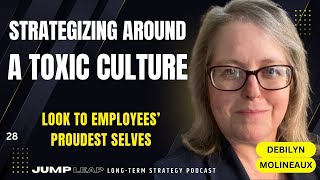
In this excerpt from Episode 28 of the Jump Leap Long‑Term Strategy Podcast, host Francis Wade and guest Debilyn Molyneux diagnose a fictional case study about Nancy, a newly appointed CEO of a 5,000‑person company plagued by a transactional, fear‑based culture inherited from two previous CEOs. The conversation explores how Nancy can win staff buy‑in for a strategic plan despite deep‑seated division, silos, and low morale. Key ideas include: identifying a supportive "posse" of internal and external allies; clarifying how different stakeholder groups (board, employees, customers) define success; reframing the company’s work as a life‑affirming purpose that aligns with universal human motivations; examining the worldviews and motivational drivers (kindness, money, fear of loss, etc.) that shape employee behavior; and using personal, non‑egoistic pride as a compass for a future‑oriented vision. The hosts adopt an Einstein‑style diagnostic approach—spending the majority of time understanding the problem before proposing solutions— and suggest that Nancy spend the two months before her strategic retreat conducting deep research on staff motivations, building relationships with allies, and articulating a purpose‑driven vision that can unite the organization.
Chapters
Yeah, it all starts here.
So she takes them there.
It's all here.
She invites them to go there and not have this be about the company for a moment and have this just be about you.
Correct. That, that demonstrates caring about the other human being.
It's a Jump Leap Long-Term Strategy Podcast. Episode 28. You're leading the development of a strategic plan in an organization, maybe yours. The company has a very transactional culture in which staff members are doing just the minimum required to get by. However, your company, this company, needs to develop a game-changing strategic plan to stay relevant in its industry. As such, you're concerned. Why? Well, staff members don't really care about the future of the organization, but their buy-in is essential to any kind of plan. How can you get them interested in a shared future vision for the organization beyond more paychecks, maybe a bonus, maybe a promotion here and there? Tune in to this episode to hear from me and my special guest, Debelin Molyneux. As we tackle this wicked problem together. I'm Francis Wade, and welcome to the Jump Leap Long Term Strategy Podcast. And welcome back. As you can see, we're joined on the stage by Débélène Molyneux. And just before I introduce her, I'd like to welcome you, our guests, because this is not the typical kind of podcast that you may have listened to in the past. Reason is that we're approaching this one, and all of the ones that we do where I have a guest, as if neither of us has the answer. So what we're trying to do is diagnose a problem, diagnose an issue, tackling it together in the hope that we may come up with something brand new to share with you, our audience. If we do come up with something brand new, in fact, we even have a bell and you'll hear an insight bell, which means that we've come up with some insight that's new to either one of us. And something that we want you to pay attention to. If we get to the end of the episode, and we have no insights, we'll even play a buzzer, which shows that we ran out of time. So far, I've had no buzzers yet, but you never know. No, we're not just diagnosing and tackling this problem for the heck of it, although we do like to tackle problems, the two of us. This one is a juicy one. We're hoping that by revealing our thinking or assumptions or backgrounds or knowledge or the things that we already know will help you to understand where our thinking comes from. So we're not just sharing the end result with you, but you'll be able to apply the logic that we're applying so that you can use it in your own life. And that's the point of this very strange sort of problem-solving episode. Here at the Jump Leap Long Term Strategy Podcast. We're kind of following Einstein. Einstein said, why not follow him? He said that if you have an hour to solve a problem, he would take 55 minutes to diagnose the problem before getting into solutions. And that's a little bit of the ethos that we're going to be pursuing today. So just before I introduce our special guest today, let me tell you a story about Nancy. She's the CEO of a 5,000-person company. She was recently promoted, but she has only been with the company for a year. As such, she's new to the culture and very concerned. The top line has continued to fall even after the end of COVID It's been a few years and it's still falling. They've lost some 25% of revenue since 2020. She came as someone committed to creating a workplace that empowers people to be their very best, and that's kind of why they liked her. And she promotes the idea of stakeholders caring for each other, which includes staff, board members, customers, and any other stakeholders that happen to be involved in this little ecosphere. Instead, what you see is every day are people, staff, doing the minimum job possible to stay out of trouble. There is in fact a real culture of fear where people seem stifled by separation, mostly between the levels of management, between like upper management, middle management, and non-management, but also between departments, between silos. Folks have tried to explain to her, trying to be helpful, that Nancy, this is a legacy of two prior CEOs, and what they used to do is that would put people against each other, and that way they kept their influence. Well, apparently they were kind of effective because today there are lots of separations with groups pulling in opposite directions. As a result, some of the best talent is leaving, and they aren't pulling punches in their exit interviews. In other words, they are repeating the problem with this level of divisiveness that's causing the company not to make any progress. In fact, they even added the fact that they have an East Coast office and a West Coast office, which means they have two different cultures. People don't talk to each other, finger-pointing. They've even talked about what happens in locations where racial groups during lunchtimes are kind of a feature of this company. And that's not a good thing. Nancy, fortunately, has a strategic planning retreat coming up in 2 months' time. And this will be the first such effort in company history. Is there a way to begin to reverse the tide so that staff can start imagining and believing in a future that doesn't suck and is worth sacrificing now to get there? Should she wait until the retreat and start there, or would that be too little too late? Debilyn Malenu, our special guest today, serves as the catalyst for the American Future Project to help everyday Americans discover and believe in a future that will be worth it, to work together for the sake of our nation. That's the USA. Debilyn is a serial entrepreneur, co-founding many organizations and tripartisan projects over her 20-plus-year career in establishing the democracy ecosystem. Debilyn, welcome to the show, and let's jump right in. What do you think of Nancy's situation?
Ah, yeah, Francis, thank you so much. Well, Nancy has certainly, uh, has her work cut out for her, and the first question that I want to ask her that I want Nancy to like respond to is like, who's your posse? Who are the folks in your corner that are helping you through this transformation?
Hinting that somewhere, somewhere along the line, there are people who may be internal, may be external. Maybe we should, we will talk about both. But if she doesn't have a support group in her corner in a tough situation like this, and she's only relying on what the organization has done, which is nothing, or her past, which may not apply, it could be that she's up a creek and she does not have actually any new way to think about the problem. Is that kind of where you were headed here?
Yeah, well, I'm thinking, you know, taking on a transformation project like this, and I would classify this as an organizational change mandate, right, in order for them to recoup profitability, which is what I'm sure the board of directors is asking for. She has gone in and seen that there are— that the, the trauma, if you will, from the previous two CEOs that has caused division and strife within the workforce make it impossible for profit to be recovered. And, and she, she is going to need her posse, her support, her true believers, if you will, within and without the company to help support this transformation project. Because even though she's CEO, it's really rare that one person alone can do it, can make this type of transformational change throughout an organization.
Right. So on one level, she needs 4,999 others. And on another level, she needs a team, if not a logical, a team of logical people who can think her through the problem, at least a team that could offer the kind of emotional support she needs.
Correct. Yeah. And I think this gets into another situation, which are another question to ask, and that is like, how, how does Nancy define success? How do the board of directors define success? How do the employees define success? And what is, what is the customer, a good customer, a happy customer expect and receive? Right. So if you look through the multiple stakeholder groups, Success is going to be defined in different ways, and a successful change strategy is going to include success possibilities for each one of those stakeholder groups.
Right, right, right. Let's say for sake of argument, and because it is made up, that she's the only one right now who— well, everyone wants to reverse the tide apart from the ones who are the most stuck and the ones who are the most negative. So apart from them, she wants to reverse the tide. But, but she also has a hint that believing in a future that doesn't suck. So she's coming in with, let's say, a bit of an idea as to how to tackle this problem. She's not starting out from left field having no clue. She, she hasn't— Hope you're enjoying this free excerpt from the Jump Leap Long-Term Strategy Podcast. Interested in finding out more about getting a subscription to full episodes? Visit www.longtermstrategy.info. Idea that she wants us all, everyone in the company, to be headed towards some direction, and it should be the same direction, and it should be a good direction. So let's assume that she's starting with that kind of premise. She just doesn't know how to get there. She's probably, like many executives, worked in companies that weren't this dysfunctional or weren't this toxic. So she's having to sort of revisit the basic assumption of, or the basic sort of groundwork, which is, how do I even create such a future before even getting people into it? How does that sound like a starting point, just for the sake of argument?
So, and I think this ties in a little bit to the American Future Project that I'm working on, because it's how do we infuse that? I'm going to reframe your question into how does the work of the company have purpose and meaning in the world that's actually contributing to life-affirming choice? Right. And I think that's a great way of seeing the problem she has, right? Yeah, right. Because if the work that we're doing every day that we're putting in our time and our life force into work We want that life, that time, and that work for— you're gonna have to edit this part out. We're gonna— but people really want to contribute to a life-affirming world. They don't want to contribute to the destruction of the planet per se, or to things that aren't going to be helpful. That's been my finding so far, is like the future that doesn't suck is a future where we all live in a place where we feel like we belong, we have deep connections, and we contribute. So how could, you know, if those are common human desires, how can Nancy then start to infuse that sensibility within the company itself? So the company is making a life-affirming change on behalf of a higher purpose.
I'm writing life-affirming change on behalf of a higher purpose. Okay, let's say that she doesn't know that for the moment. So she, she just wants a future that's halfway decent, and she wants some kind of transformation to happen. And she's, she's, she sees the, the, the sort of the evil of me-first thinking and the, the what happens when people are afraid of each other. And she's seen the divisiveness. And she's sort of well aware of the toxicity because she's seeing it every day. And she's hearing about it in the exit interviews from the great staff members who are leaving. And she has a— let's say she has an idea that if that continues, if that sort of transactional way of people dealing with each other continues, then the company is going to have major problems in the future. And personally for her, let's imagine that she's someone who, she's not done this before, but she's someone who knows what it's like to make a positive difference in someone else's life. So let's assume that that's an understood kind of outcome that she wants, even though she may not say it say it as well as you did or have the words to even say it. She kind of has this kind of wanting to make a difference and having it be positive. You know, it's a little bit rainbows and unicorns in a way. But it's where perhaps many CEOs are, you know. But what do you think?
Well, so there's a couple of things that kind of crossed my mind as you were more deeply describing, like maybe Nancy doesn't have experience with this type of transformation yet. And I often find when I'm working with people that the first place that we start is with ourselves, inside of our own beliefs and assumptions about the world. And so I would actually work with Nancy a little bit to understand, like, two things, two primary things. The first is, what is her What is her intent in taking on this role? There's a difference between being, helping coach people up and rescuing them. And the same is true for a company. Is she going to coach the company up to become a better force for good? Or is she going to rescue the company from this bad possible outcome? Because there are different approaches depending on what that intention is. And the second thing, and I can go more into that in just a second, the second thing that I would ask her to think deeply about is, is her, the worldview that she's coming from and how that matches or is a mismatch for the board of directors and for the, the staff at the company and for the management teams. Because chances are, and this is happening around the world right now, we have 3 to 5 different worldviews that are existing in our culture, which means it's going to be existing within company structures.
Okay, that's interesting. Okay, we're going to hold on to those. And I've made a note so that we can circle back when we get into the solutions because it sounds as if it might give her— before, you know, in the situation she's in right now, which is too big, 2 months ahead of the retreat, it might give her ways to think about the problem that are useful, but also intervene before she actually gets to the actual event itself.
Correct. Yes, she actually— I would spend those 2 months, if I were Nancy, I would spend those 2 months doing some deep research into like the different motivations that are existing because of the worldviews within the staff of the people working at the company, to have a real sense of like, you know, who is motivated by acts of good or acts of kindness? Who's motivated by money? Who's motivated by fear of loss? Who's motivated, et cetera. So you kind of break out this, the motivational factors, if you will. And then I would find allies. I would, build relationships with allies, starting with like a, in the future, you know, Nancy is thinking about what she wants to be proud of 5, 10, 15 years from now. So if she can think about like, what is it that she wants to be proud of, that's gonna help inform a vision that she has for the purpose of the company and for how the stakeholders engage with each other. And this isn't pride. And when I talk about what are we proud of, or what do you want to be proud of, I'm talking— it's not a place of like ego pride. It's more like a sense of self-satisfaction. Like, I know that I contributed good. It's that kind of pride rather than the ego-driven, like, look what I did, pound my chest kind of pride.
Because I imagine, you know, she, she She wants great things, but she doesn't want to be the one who rams through great things because she doesn't want to be the one who forces them. She wants to lead, but she doesn't want to pressure because she's getting into dicey territory here. You can't quite pressure people to transform, not really. But that's really what she wants. You can cause it to happen, but you can't really entice them with more money. So she knows enough that, you know, if I try too hard in a particular way, I could really make a mess of this.
Well, and I would suggest, or I would presuppose, since we're making this as a whole made-up company scenario, I would presuppose that the previous two CEOs who left it a mess were probably that forceful dominant type personality that set up a whole series of passive-aggressive reactions from staff.
Right.
Which is what actually contributes to a transactional culture.
Right, right, right, right. So maybe she's, maybe she has a sense. She's been with people like that before. Yeah. Because there are more managers who are transactional than there are transformational. I think that's fair to say. And she's run into them before in her previous jobs or where she's coming from. And she's like, I don't want to be like them. I want to do this in a way that is— you use the term life-affirming. So she might not say that phrase, but she's— I don't want to make it suck. Make this like the new way that people— new reason people leave is because her transformation program is chasing them out the door because it's awful.
I think it's important to realize that One of the biggest roles of organizational leadership is to have a vision that you invite people in to help you make real.
You've reached the end of a complimentary clip from the Jump Leap Long-Term Strategy Podcast. To hear the full episode, go over to www.longtermstrategy.info. And grab a subscription or a free trial. See you there. And here's the excerpt from our next episode. If you're in the US, you probably want something very similar, which is stability. Not the stultifying kind of deadening stability, but the kind that you can plan around and raise your family and your children in. Stability that you can run a business within, you know, one that you can plan for a future for your kids, uh, your communities, your neighborhoods, places where you can explore opportunities, not have them taken away from you for whatever reason. But it seems as if the current political divide is in the way of what used to be that kind of stability. If you liked what you heard from our podcast episode, go ahead and subscribe or like or recommend us on iTunes, Spotify, or YouTube. More information? Log into longtermstrategy.info. And subscribe to our newsletter. Our annual conference is coming up in June 2025. You can register at longtermstrategy.info with a free visitor's pass or a full ticket. See you later, and thanks for joining us.
More from Francis


Ep 35 Your Strategic Stagnation Isn't a Framework Problem—It's a Story Problem



The YouTube Strategy School: Why Your MBA Didn’t Teach You Strategic Thinking





