Ep 31 - Escaping the Short-Term Trap - How to Build Strategic Muscles for Lasting Success
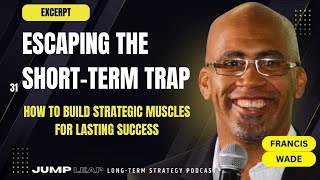
Francis Wade explains why leaders slip into short-term crisis mode, using a manufacturing CEO distracted by tariffs as an example. He argues that rah-rah leadership and five-year plans don't work, and proposes building "strategic muscles": habits and skills that let organizations handle daily shocks while staying focused on long-term goals.
Chapters
It's the Jump Leap Long Term Strategy Podcast, episode 31. You have a hunger for game-changing results. You may be a CEO, a board member, a manager, a consultant, or a strategic planner, and you aspire to produce big results with your company or perhaps your clients. You know some methods which do work, but you still find yourself and others drifting back into short-term thinking, especially in these tumultuous days. But below or behind the latest crisis or tariff, you know better. Without daily activities which take you towards a true north, kind of a preferred long-term destination, you run a huge risk, a huge but slow-moving risk. You could end up at the end of it all being sucked in like so many other organizations into a 24-hour news cycle or the latest drama that happens to be happening so often, or the most recent news about the economy or the stock market. Do you build the muscles necessary to withstand even daily shocks and surprises? Tune into this episode to join me in tackling this wicked problem. In this episode, I'll be sharing the approach we're taking to design the Long Term Strategy Conference 2025 taking place in June so that it helps you, someone who wants game-changing strategy. I'm Francis Wade and welcome. To the Jump Leap Long Term Strategy Podcast. And welcome back. If this is your first time joining us, you may be wondering how exactly is this conversation going to proceed? Because it's a little bit different than most of the podcasts I've witnessed or listened to. The first is that we're gonna spend a good amount of time diagnosing the problem that I mentioned, diagnosing the issue. We're gonna be tearing it apart in different ways. And the point of our doing that is not just to delay some kind of final answer, but this is a wicked problem. The diagnosis of it is what we think is the most valuable takeaway that you'd have, where you'll be able to examine, in this case, my underlying thinking, my assumptions, my experience, the frameworks I'll be using, and you'll be able to walk away with an experience of how I've used them and I've been analyzing the problem. Uh, in other words, I'm going to show you how, how we make the sausage and not just tell you what the sausage is at the end. So you'll know kind of where that comes from, you know, where my conclusions come from. Some of them are very counterintuitive, and some of them are run against the counter, you know, the cultural common wisdom, kind of the common thinking. And, uh, I'm basically trying to follow Einstein. Einstein said that If you, if I have an hour to solve a problem, I'd spend 55 minutes thinking about the problem and 5 minutes thinking about solutions. In other words, the quality of the problems has to do with the quality of the diagnosis or the thinking. So if you have any feedback for me, uh, just send it over to, or visit longtermstrategy.info or find me on LinkedIn. Look for this episode if you want, and then drop a note and I'd be Really happy to hear from you. So let's jump in with a story. Story is about Thomas. He is the longtime CEO of a mid-sized manufacturing company. Let's pretend that he's in the US. As such, his company is subject to new tariffs coming at him from all directions. They have their suppliers who have, who are in Vietnam, bunch of them have new tariffs, and they have customers. Who are in China, who are gonna be subject to new tariffs as well. And he, as a result, his C-suite is understandably in shock. He looks around the meetings and people come in and what they talk about is tariffs. That takes up half the meeting, way too much time. And he finds the conversation and the point of focus devolving into short-term strategic sort of emergency mode. He's not happy with it. He's disturbed by it. It's the opposite of the way he thinks things should be. And in the past, you know, he always had for himself a clear mental picture of where the company should be in the next 10 or even 20 years' time. Matter of fact, he had made, he's made notes to himself, all kinds of details. He's been a CEO for a long time, so he's made lots of notes and he's changed them over the years with respect to where he wants the company to go. He's always infused with a picture of where things should be headed, but he really hasn't shared any of those details. No one else has the map that he has. They have some vague idea, a little bit that he's shared with them now and again. The fact is they haven't really seemed all that interested and they haven't asked him. So he's been kind of like, well, you know, let me keep them focused kind of on short-term stuff. And, um, Let me think about the long term on my own. No, you know, he's having a rethink cuz he believes that he's, his team needs a, a, a complete reorientation and it needs to be pretty dramatic because nothing else is gonna disrupt the thinking and the rut that he sees them falling into. All of a sudden there's this new daily habit. Of focusing on kind of what happened this morning or in the last 24 hours. And he knows that he has, you know, he has some Asian competitors and they're all very long-term oriented and they have detailed plans and their staff knows about these plans, which makes him think, you know, how do they, what do they do this? How do they get to the point where their staff is not just aware, but they're actually engaged? So he's thinking to himself, okay, I've had a true north. Should I announce it or should I ask for input to correct it or make it more current? It's a dilemma. What should he do? So perhaps you're like me and you can actually relate to this particular challenge that Thomas is going through, that, you know, you are someone who is, you know, you know, you know your way around the head of a head of a company, you know, you, you've been around the C-suite either as a member of the C-suite or you are someone who has, you know, is a leader in the company. You're maybe a board member. And as you look around, you, you want these kinds of game-changing results more than ever. Matter of fact, you know, knowing that the entire world is in a swirl makes you think that may— there may be even an opportunity. To do something that would really be disruptive, that would set your organization apart from either the competitors, or if perhaps it's a part of government, that would get it to the point where it becomes indispensable to government as opposed to superfluous, which happens from time to time, and they shut down government departments because they become irrelevant or outdated. So you either want to achieve, uh, uh, maybe a profit. Kind of result or a shareholder stock result-based result, you may have a bit on your mind, or you want to be able to point to results that you're producing that maybe you're, if you're in government or if you're an NGO, that your beneficiaries are actually experiencing that the results are moving in the right direction. However, you don't really have a roadmap to accomplish this that is strong enough, robust, uh, has enough detail to deal with the contingencies like tariffs. Truth is, many companies kind of assumed that things would continue the way they are. I, I, I think of Canadian companies, for example, that basically assumed that the US would always be there. And now they're finding out that that's just not true, that the America that they always knew and respected and liked and relied on and counted on and maybe took for granted is gone and maybe gone forever. And all of a sudden, the long-term prospect, the long-term comfort and stability that they had unintentionally been relying on has now disappeared. So that's perhaps the most egregious, the most exaggerated example in the world of companies in the world right now within a country that are having to do, uh, a forced rethink. And, um, you, you know, as you hunger, let's say, for these game-changing results, you want to make a fine start, you know, good start, and you fear stepping out on the wrong foot, that maybe you'll make a mistake. And one way to make a mistake in the way you start is by having the wrong context for long-term strategy. If you have the wrong context, you could turn people off. You let managers think that, oh boy, here we go again. Or you could have your board think that you've lost a screw. Or board members may think that this is a bad idea. We need to be focused on survival and this true north business needs to be put off indefinitely. Hope you're enjoying this free excerpt from the Jump Leap Long Term Strategy Podcast. Interested in finding out more about getting a subscription to full episodes? Visit www.longtermstrategy.info. So you are concerned that if those results, if that kind of start to the whole process. If you do start the process is a bad one, then, uh, it won't end well. So I think that you're kind of confused because all the information out there is, is big about the need for a true north, the need for a long-term strategy to accomplish it, and the method. And if you don't sort out your own internal kind of confusion, you may not be trusted by your stakeholders. You know, they may think they hear you, but they're not sure if they actually believe you or that they're willing to follow you. So there should be sort of a formula, uh, that a company could follow and a way to think about the skills that are needed to react when there are— there'll always be tariffs. I suspect we're moving into a world in which daily drama is a regular part of business life. And if that's the case, then you need something strong. It's like strong medicine, right? If you need something that's robust because as you observe other companies sort of getting sucked down into the vortex, do you just surrender and just go with them where you're all scramble scrambling and hoping to survive this week and today? And as you articulate the problem that I'm describing to other people, you want to do it in a way that's not just panicky. That's, that doesn't sound like you're just trying to scare people into thinking that they need to be thinking of long-term game-changing kinds of outcomes and strategies. You wanna sound like you know what you're talking about with some degree of confidence. You also want the right framing to frame the problem in the right way so that when you sh— when you describe it to others, they, you'll see some heads nodding. They won't be looking at you with blank looks. That it'll actually resonate to something that they've been thinking or experiencing themselves. Because everybody, you know, you got, this is the last few weeks and I'm recording this at the end of April. Every business person in the entire world is facing a level of disruptions that are unprecedented. There is no one left out. And the momentum to just get sucked into the vortex is tremendous, especially if your organization's leaders are used to looking around the industry for guidance. If they're not used to defining their own true north, instead, they kind of take an average of what's happening, what their competitors are doing, or if you're in government, taking an average of what other agencies and departments are doing and kind of doing that. That you're not used to thinking, doing the kind, this kind of thinking on your own. You're used to following the average and that's gotten you to where it's gotten you. It's kind of worked to some degree. Um, and if a game-changing result happens, you kind of shrug your shoulders, maybe perhaps some, and said, well, they got lucky. Well, in this podcast, in this discussion, I wanna introduce you to the idea that maybe it's not luck, something else. And what's that something else? Well, let's, let's, let's talk about that because if you don't sort of pay attention to where game-changing results come from, they'll always seem to be a function of these things that you can't control. 'Cause you can't control luck. If you're not in the right country, can't control that. If you are not already a, you know, a $5 billion company, US dollar company, then you're not big enough to be able to set your own course. You've just got to sort of follow what everyone else is doing. And any discussion around game-changing results for your company would just seem like something magical that you could never have within your grasp, that it's not within your, your means to accomplish it. Now, I've talked to consultants, strategy consultants, who tell me that they have clients who call them and they know they want game-changing results for their clients, and their clients say, I just want a 5-year strategy. And they don't know, aren't able to engage their clients effectively to say, that's a problem, if that's all you want. And let me tell you why. They don't have a conversation, know how to have a conversation with clients that persuade them that a 5-year context isn't sufficient for game-changing results, that something more is needed. Now typically, you know, companies will hear about this game-changing business and figure, oh, oh, all I need to do— CEOs have traditionally done this— is let me just ask for twice the results in half the time. So if you're a CEO, you may think that that's what you do every day. Everybody who comes to you gets the same treatment. How about you double the results and give it to me in half the time? And it's not necessarily based on any analysis, it's just instinct, or, um, it's a habit, uh, it's a routine because you know that people are coming to you with, you know, padding built in and you hope and believe maybe that if you keep doing that in the future that it'll continue to work. Uh, I want you to consider that. That's not working the way it used to. And well, why? Part of the reason is that your stakeholders are smarter than they've ever been before. They're more savvy. In years past, maybe you were the only one with an MBA. Maybe you were the only one with 20 years experience in the industry. Maybe you're the only one who understood The technology was more of a level landscape. Now you've got 20-year-olds using AI to dig up facts that you don't even know where they come from, find information, find resources, and get themselves trained in ways of thinking that you thought took 20 years to develop. So you can't quite use the— you can't at all use the same approach that you used before. That kind of forcing people double the results in half the time doesn't work. You also, you know, being hopeful and being like a rah-rah kind of CEO, if you're a rah-rah CEO, I don't mean to insult you if you are, but if you're a rah-rah CEO and you're always upbeat and you're always the most positive and you're always there energizing folks and telling them, yeah, we can do it, guys. You're always cheering from the sidelines. If you're trying to follow that approach in this environment, I imagine that is pretty tiring. 'Cause you know, a disruption once a month, maybe you can rah-rah your way out of that and rally the troops, be the most energetic, the most positive, the most upbeat, the most, you know, energetic, the one who's the most visionary and who's, you know, gregarious and you're engaging and you walk around and you talk. When the disruptions are coming once a month, that's probably, you know, maybe you could get by with that. In today's world, you may find that you can't do that on a daily basis, that that method is no longer working. Some would also argue that you need outsiders. You need to bring in a fancy consulting firm and they'll tell us what to do. I'm gonna suggest that whereas consultants like me can be really useful and really helpful, that it's not our business to tell you what to do or what the answer is. At best, we can offer expert guidance as you find your solutions. But the days in which we would disappear for a week, having analyzed all your data and then emailed over a presentation or had a meeting in which we launched our final results. Our final recommendations, and you would hear them for the first time and you would get your head nodding and we'd get you to agree. Those situations in which we did all the thinking, or as they say, the old consultant joke is that consultants, all they do is ask you for the time and ask you to share their watch, your watch with them, and they tell you what time it is. That way of relying on outside answers. Doesn't work either because the volume of changing, of changes that have happened recently and that will, are likely to continue to change, mean that you can't think or imagine that consultants who come in and spend 3 months, pay them a million dollars and study your situation, are gonna be able to ride 3 months of change. And even understand what these changes mean better than your own people can. You've reached the end of a complimentary clip from the Jump Leap Long Term Strategy Podcast. To hear the full episode, go over to www.longtermstrategy.info and grab a subscription or a free trial. See you there. And here's the excerpt from our next episode.
You've got to be really, you've got to be really focused when you take people away. What is your primary goal? Because maybe it's enough to open, open up, really help people to see new possibilities. And that's it. And then schedule a separate time where we're going to prioritize those ideas. And then shape them so we are really clear on what is the potential value proposition from each of these ideas so that we can make more informed decisions and choices.
More from Francis


Ep 35 Your Strategic Stagnation Isn't a Framework Problem—It's a Story Problem



The YouTube Strategy School: Why Your MBA Didn’t Teach You Strategic Thinking





