Ep 33 - From Laundry-list, Wishlist or Checklist to a Game-Changing Strategy
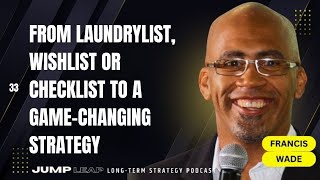
Francis Wade explains why most strategic plans fail: they're laundry lists without an overarching hypothesis. A CEO's 55-item plan got rejected by the board. Wade's Endpoint Method starts with diagnosis linking aspirations to bottlenecks, then picks one outcome and builds initiatives around future obstacles, not today's problems.
Chapters
What makes strategy difficult is— I'm sure you've experienced this— is that everything is moving and changing very rapidly, the external world, but also information is flaky. There is no report from the future to tell you what you should be doing, and you're often dealing with partial information of a dubious nature. That it's not never exactly what you want. You still need to do the strategy even in the absence of great data. And then you're talking about people. People are changing all the time. Markets are changing. Your staff is changing. The board changes. Their units is inherently changing. The world outside is changing and you're trying to figure it out using flaky data. So this is not like you're in a lab and you're saying, oh, let's try this. Let's try that. Let's try this. You get one try to put together your strategic hypothesis. And this is what makes it so hard to do the work that we do. You're trying to get it right, but you only have one, one shot. It's the Jump Leap Long Term Strategy Podcast, Episode 33. Picture two teams in your company, 6 months apart. The first team is drowning. They have 47 strategic initiatives on their list, no clear way to prioritize, and every meeting devolves into debates about resources. Morale is terrible and nobody can articulate what they're really trying to accomplish. Fast forward 6 months, it's the same team, but now they're energized, focused, and they can explain their strategy in 3 minutes. Projects that don't serve their core hypothesis get killed quickly. They're making contingency plans because they understand their strategy is a bet, not a certainty. So what happened in between? Well, They stopped confusing a strategic plan with actual strategy. And today I want to walk you through that transformation because the gap between these two states isn't about working harder. It's about thinking differently. Tune into this episode to join me in tackling this wicked problem. I'm Francis Wade and welcome to the Jump Leap Long-Term Strategy Podcast. And welcome back. Today I want to welcome you and introduce you to the way in which we happen to go about doing these episodes, these solo episodes, uh, so that you understand why I'm spending so much time on particular topics. And in particular, the topic that I spend a good amount of time on is diagnosis. So in each of these solo episodes, all of our episodes actually, we spend a good amount of time trying to understand the problem and the underlying thinking that, um, I'd say the assumptions behind the issue that we're trying to to solve. It's far better than me just telling you in 2 seconds or less, here's what I recommend you should do and just go and do it. Because here you can test the reasoning that I'm applying to see whether it applies to you or not, or if it works, or even if it makes sense. And really, I'm just ripping a page out of Einstein's book. He said if he had an hour to solve a problem, he'd spend 55 minutes thinking about the problem and 5 minutes thinking about the solution. So a bit of an exaggeration for our cases, Um, but once again, I invite you to join me in understanding the nature of the problem before applying a solution. And I invite you to drop your comments at my website, longtermstrategy.info, and just look for this episode, which is number 33. So let's start off with a story. Mike, he's a worried CEO. He's new to the job, and this is his first strategic planning effort for a very demanding board. And their chairperson, Janet. So the first draft of the plan the executives put together was picked apart by Janet and the other board members who saw right through the 55 initiatives that they included in the plan. 47, 55, a lot. They didn't care about the initiatives themselves. They didn't care in the sense that they didn't object to the initiatives because all of them made sense. But the board members kept asking for an overarching strategic hypothesis. One also mentioned the theory of change. You know, they kept pointing them— they kept pointing him, Mike, to watch this video on YouTube produced by Roger Martin where he says a plan is not a strategy. I'll drop it in the show notes. And as a result, Mike listened to the video. He did some research to try and find the terms that they are referring to. Strategic hypothesis, I first heard it from Kaplan and Norton, the inventors of the balanced scorecard. Strategy Map method. Theory of Change has been around the development world for some time, and the more he looks, unfortunately, the more definitions he tries to find, he's ChatGPTing it away, the more confused he becomes. Without an answer, he's likely to return to the board with a plan that has no more strategy than it had before. So he's in a real pickle, and you may Have received criticism around a strategy that you thought was fine, a strategic plan that you thought was a good one, but the kind of criticism you received wasn't the kind where, you know, someone said, I think you should, you know, go into Latin America before you go into Canada or something like that. It wasn't around the specifics. It was around the nature of the plan that you produced. In other words, the person was criticizing the sort of the mode or the way in which it was constructed. They weren't criticizing the ideas themselves. The ideas they didn't have any problem with, but they were criticizing the way in which the strategy was done, or according to them was not done, which left you kind of confused because it's a good plan. It has lots of stuff in it and the stuff in it makes sense. So what are they exactly trying to communicate to you because, you know, their buy-in is important. If you don't solve this problem, you go back and keep falling into the problem that the traps that they have mentioned. And there are 3 traps I thought I would share with you that are very— I find prevalent among the companies I work with, clients that I've worked with. And in case you were meeting me for the first time, I have around 24 years, I guess, for 24 years of strategic planning experience. 60 of those projects were of a long-term, game-changing, preemptive nature with our clients. And by long-term in our world, we mean 15 years and more. It's a bit unusual in the strategy world. But anyway, the 3 major, I would say, traps that we find our clients fall into are seeing strategy as a checklist or wishlist or a laundry list. No one says this to us. No one says, you know, or strategy is more of a wishlist or a lot. They don't say that, but from the years of working with different teams, we see that they're happy if first, and this is a pretty low barrier to be happy. In other words, they shouldn't be happy, but they usually get satisfied as long as they have a plan that satisfies some kind of checklist in their mind. So Mike perhaps entered into this project because why? Well, His boss told him to, because Janet said, "Y'all need a strategy." And he said, "Huh?" And he said, "Well, our focus is more on being agile." She said, "No, you need a strategy. I need a strategic plan. I need it on my desk by, in a few months' time. You guys go figure it out and let us know." And he was like, "Oh my God," because he'd never been in a strategic planning retreat that kind that she seemed to be hinting at. So in other words, the team engaged, maybe engaged in the activity just to basically put a check mark beside strategic plan done. Something that you could say in your performance management, oh yes, I did the strategic plan. I did that part because it's more of a bureaucratic obligation than it is anything else. So he may have entered into the whole activity perhaps just to kind of get Janet off his back, get the board off his case. Second mistake that people make is the wish list mistake. So in a wish list mistake, teams brainstorm all kinds of things that they would like to see. And it perfectly complements the laundry list mistake because the laundry list means that you're looking at random activities, random ideas. You put them all together. Everyone wants the most out of their, you know, random activity, their pet project. So in the end, you end up with a wish list, which started off as a laundry list. It's, yeah, everything's in it and the kitchen sink. Punch laundry list and everyone wants, you know, maximal results and amazing outcomes. So you end up with a wish list. So I recently worked with a group here in Jamaica, not worked with, but I presented to a group of planners. And in Jamaica's government, there is around 16 or 17 ministries, and each ministry has a planner which reports to a central body called the Cabinet Office. And the Cabinet Office Cabinet Office's job, in part, is to manage incoming strategies from the ministries. Below the level of ministries, by the way, are agencies and corporate bodies, bodies corporate, and departments and other units. So there's 200-and-something units which report up into 16, 17 ministries, which report up to the Cabinet Office. So the Cabinet Office reports to Cabinet, which is the, in our government, it's the ministries. In the US, it may be the secretaries, group of secretaries. And part of what they do is they act as traffic cop. They advise Cabinet with respect to what the ministry's proposals are, what their strategies are, and they represent them and say, this one is a top priority, this one is not so much, this one. So they're A triage, a lot of strategic plans, you know, the inputs of hundreds of reports and they coalesce them and boil them down and into just those which are the most important. So what I learned from my time in them was that the three errors that I mentioned are in vogue. People see this as a checklist exercise. They just wanna, especially by the end of it, they're so tired and They're exhausted. They have a deadline which is set by law. So there's a lot of stress there. This is like the worst time of year for many of them. So it's a checklist. They want to just get enough done so that whoever they're handing their report to gives them a check and says, okay, pass. It's good enough. And they go, oh, thank God. Checklist. The second is the wish list. In that the goals that they set are not limited by any kind of resources, or they won't go totally crazy with any one particular project and say they want the moon in terms of funding. But when you put all the projects together, there's no way they're all going to get funded. Wish list. And then laundry list, because the items, the initiatives that are listed together from the Cabinet Office's point of view don't have any coherence. They just seem to be a bunch of stuff you're already doing, a bunch of stuff you wish you were doing, and a bunch of stuff that— where did that come from? Who knows? So there doesn't seem to be any explanation as to why these items are included in the plan, hence the laundry list mistake. So what, you know, when— if you're someone who's handed up, uh, like Mike, you've handed up, uh, plan to, you know, some other group above you in the hierarchy, and you've received feedback that it's not that good and it needs some more work. And then someone may say to you that it doesn't have a strategy, it doesn't have a theory of change, it doesn't have strategic hypothesis. You scratch your head, you do what he did, you go hire a consultant, maybe come figure out what the heck, what does that mean? How do I get it to be that? You, you try some reverse engineering, you, you ask them for an example of one that does have a strategy in it or strategic hypothesis, and you try and see what do they have that you don't have. And the more you look at what they have, it looks a lot like what you have in terms of its tenor and its content. It's talking about doing stuff. So it's hard to figure out, you know, just by looking at documents what the difference is between a strategic plan that has a plan, has a strategy and a plan, and one that has a plan but no strategy. So that doesn't work. And the reason that doesn't work is that the way most strategic documents are written is not to, they're not, they don't write to highlight the strategic hypothesis because that language is, it's pretty technical, but sometimes the authors themselves don't write or don't describe the strategic hypothesis because they've not articulated it themselves. No, I'm not saying they don't have one. Maybe half the time they actually do. But they're unable to convert it into language that an outsider or a first-time reader would understand. Now, someone in the Cabinet Office, for example, probably jumps on a phone and calls the ministry and says, "Well, listen, you sent me a strategy, but what the heck is it? Why are you guys even doing it?" And starts to ask questions. And via the questions, they're probably able to, oh, figure out that A, there is a strategic hypothesis in there somewhere, and B, That's what it is. So it's a very useful kind of dialogue to have. But if you don't have the benefit of that dialogue, um, you're just picking up a, a, a document, it'll look like your document and you won't know what to do or what to do differently in order to have one. What you won't know is that sometimes your diagnosis was too weak, was too shallow, too short, or the diagnosis was built on the expectation that we're just gonna do a checklist or that we're gonna do a plan that's only 3, 4, 5 years in duration. Because the kind of diagnosis you do when you're only thinking about a plan for 3, 4, 5 years is very different than the kind of diagnosis that you do if you're planning for 15, 20, 30, 40, 50. Now, how do I know that? Well, it's just because I've been there and seen enough examples of strong diagnosis and weak diagnosis. And companies or teams that persist in short-term thinking, you just don't need to do that much diagnosis because there's so much, there's so many problems that you need to solve today. And if that's, that those problems fill up your context because you are only looking 3, 4, 5 years out, then what you're gonna do is you're gonna turn the strategic planning session into a problem-solving session. So when you now need to figure out a strategic hypothesis, you don't have the diagnosis to pull it from. Sounds weird, right? You haven't done the depth of thinking that requires a hypothesis. Instead, you've just done enough thinking to figure out how to solve some problems, which is pretty much what you do every week in your weekly meeting. So this pattern that I'm describing is really difficult to solve. And it was interesting when I spoke to the folks at the Cabinet Office because they see hundreds of strategic plans. So they were able to see the patterns that I can see from someone who's trying to work with teams to always have a strategic hypothesis. So I could have a conversation with them and the head of that organization that I couldn't have with others simply because they have the numbers. It's like, you know, if you go up to bat a certain number of times and you're thinking about how can I improve my on-base percentage or number of runs that I score, if you're a cricket fan, after a while with enough practice and enough failures, you'll figure out a few things, right? You'll come to see a couple of things. But if you're only on a cycle of one strategic plan per year, you may not have enough reps to see the pattern. And that's probably the case with Mike. As a result, he could be really frustrated. See the whole thing as a waste of time, a waste of effort, and still make poor decisions with respect to the strategic hypothesis that the board, Janet and company, want to see. So I'm hoping that as you listen to this episode, I'm gonna give you, I'm gonna share with you some prompts that I suggest you bring into your world, into your practice. And use it to diagnose an LLM, or sorry, to diagnose a strategic plan that you already have, to delve into it so that you can deal with and pull out the strategic hypothesis. So having said that, your question may be, okay, so how does this work, Francis? Do you actually, you know, go in and teach people what a strategic hypothesis is? And this is a bit of an irony, okay? This is a bit of a paradox. So in my typical retreat, which runs for 2 intense days, and the pace is important because at each stage they're using the results of the prior stage. So it's a momentum is generated in a short space of time because the ideas are building on each other. So there's not a lot of time spent, you know, just listening to— I've seen people plan their retreats with speeches in the middle of the day and all sorts of stuff, which to me just takes away the momentum. But due to the time crunch and the fact that it's happening in 2 days as opposed to what used to happen in the past, which was 3 days, and basically clients told me they didn't wanna pay for the 3 days, so they wanna pay for 2 days. I had to find a way to make it work. But the time crunch means that I can't spend a lot of time in theory, so I can't go into, okay, well here's the idea behind a strategic hypothesis. Instead, I just need to ask the questions. That would make common sense to them. Now, if you're an observer watching, you would say, oh, this is where Francis is deriving the 3Hypothesis. You would, if you knew what it was, you would see me doing it. But I don't use the term. I don't want to have to give them another concept to have to work with. I do teach some things, but most of what I teach is here's how you do the next step. Now, you don't need to know the name of the next step. You don't need to know the idea, the theory, who came up with it. You don't need to know all of that. Need to know a framework. We do use frameworks, but it seems to be more like common sense frameworks than anything with a particular fancy name. And we do use a couple of fancy names anyway, because we can't get away from it. But the point is to take them through the steps without having them know that they're developing a strategic hypothesis or a theory of change. So that's what we do in the Endpoint Method that we use, that I'm about to share with you in some more detail. So there's that. Also, this is not exactly the way I learned it, but the method I'm sharing with you comes from, I would say, yes, mostly trying to compress the 3 days into the 2 days, but also what the side benefit I learned is that if I use common sense language, then They're able to grasp the common sense nature of what I'm doing, cuz I'm having to explain to them why we're doing it this way. And then they can go and repeat it because they now understand it at this common sense level, as opposed to here's the framework that I'm using and here's the fancy name of it. So it's not this thing outside of them that we're using. It's because we are on a track and the next step in the track, which makes sense for us to do, is the following. Um, so having said that, um, it's important for me to distinguish that this does not work. This will not work the way I'm describing it for a short-term point of view or a limited aspiration or a checklist exercise. And the problem, the reasons why are that in those three approaches, what you end up with are small aspirations. And small aspirations are a killer. So you don't need to have a strategic hypothesis for an ordinary aspiration. Like, let's just keep things the same. That's not hard. That's just business as usual. Let's just keep doing what we've always been doing and let's do some more of it. So it doesn't have a place. You don't have to have a strategic hypothesis or even a strategy for that matter. You just need a plan. And the plan could be what we've been doing all this time and what we did last year, what we did the year before, and what we're always gonna be doing. If in your mind this is a continuation of what you've always been doing, you don't need a strategy. You may call it strategic because it's fancy and because it's nice and because it sounds important and it makes it a high priority. People hear a strategy, they think, oh, this is important. But the truth is, it's not. Plans are not necessarily strategic. Matter of fact, most plans don't really have a strategy inside of them. And a part of the problem is that they're not aspiring too much. Their aspirations are small or aspirations are low. Because their aspirations are low, it's easy to get satisfied with a short time frame. Because the minute you get into the world of big aspirations, you move into longer time frames by definition. So there's a few people who dispute this and say, oh no, I'm a CEO, I want twice the results in half the time. So that used to work back when, you know, the assumption or the belief was that people were just lazy and just cracking the whip behind them would get them going and light a fire under their tails and, you know, this kind of thinking that all I needed to do was to be the bad guy and to pressure them. And that's what would make the difference. So this is not, that's not strategy where that's some kind of operational quirk or preference or style or, but when it comes to strategy, you try to do that and you lose people immediately because they'll know that, you know, when you try to have that baby in 4 months as opposed to 9 months, that some bad things are going to happen. That you can only accelerate by so much and no more. Therefore, if you're talking about game-changing results, you must contend with the time that it takes to produce those results. Hence the reason I have this podcast, because the demand of planning strategy over long periods of time is very different than the usual problem-solving sessions that most are satisfied with. Finally, strategy only makes sense if you're prepared to if you're really committed to produce preemptive action, because the long timeframe means that you can take actions now that disrupt industries or disrupt customers' expectations or disrupt the status quo, which get the attention of people who want to make a difference, maybe above you in a chain if you're in government, or they get the attention of your competitors who are trying to get there before you do, or before all of your beneficiaries or customers, people who are looking to benefit from what you're doing, you start to make big commitments and you get their attention and your preemptive actions are the levers that you would use to make those make a difference and accelerate your progress towards the aspirations. Right? Makes sense, right? Very different than just being reactive on a short term. Basis on a, you know, on a 3, 4, 5 year, you're being, you're mostly being reactive. There's very little you can do to produce game-changing results within 5 years. So again, I used to teach these ideas, but instead I just coach teams now on how to do them. And that's my recommendation. If, you know, you don't have, you know, like a whole buildup before a retreat, you've got to do it on a kind of urgent basis or within the limits of a you don't have 6 months to teach and you're trying to get something done in a very short space of time and you're trying to pull on people's best thinking. One of the examples I use, of course, is strategy mapping, which you've heard me talk about in prior podcasts. So strategy mapping comes from Kaplan and Norton. When, when we used to have 3-day retreats, I would teach that particular technique as an example. I no longer teach it, I just take them right through it and I've found ways that they can be effective anyway. You don't need to know the theory and the background, and he actually would show some version of the picture that was shown in the book and this, and the original thinking from Kaplan and Norton. We've come a long way since that definition of strategy mapping and do something very different than they do, which I'll share in a few minutes' time. I found that I could facilitate them by applying better methods that were more applicable to a retreat setting. Or to making fast decisions quickly and using quick diagnosis. Okay. So having said some, a little bit of preamble on what we do and why we do it, how we came to do it, um, here's what I recommend you do. Um, and again, this is without teaching, taking people through the right questions and the right answers. So the first is that the way you do your diagnosis. So some argue that you don't need diagnosis, you can just jump into problem solving. Which is true if you're talking about today's problems. However, strategic problems, you can't tackle those without diagnosis. Now, you may disagree with that and say, of course you can, but here's what you miss out on is that when you don't do great diagnosis, the first thing is that you leave the team, the individuals in the team in all kinds of different places because they all will see things differently depending on their background, their experience, their area of expertise. Financial guy will see through the lens of finance, HR person through the lens of people, and so on and so forth. So they'll all be in different places, but you get them to diagnose together and what you will produce is, and this is not something that you could just drop into a diagram. It, in my experience so far, it's not something you even want to put into a diagram. A, because diagrams, diagrams take time, but, but also because diagrams get complex as they try to describe too much reality. But what you're trying to do is to create a relationship in people's minds between aspirations and bottlenecks. So here I'm borrowing from Peter Kompo's thinking, and Peter Kompo is the author of The Emergent Approach to Strategy. And essentially he says that as soon as you make any kind of commitment, what arises in the minds of the human mind are all the ways in which it won't happen. In other words, all of the bottlenecks. And when you do a great diagnosis, part of what you do is you own up to the fact or you accept, you embrace prior commitments and the reasons they failed. Now, I won't say that, you know, I do this in a formal way in which we ask you, okay, what was your aspiration? What was the bottleneck and why did it fail? We don't do that. Instead, we have a conversation about the current state of affairs. And as a part of the current state of affairs, what usually comes up is what we tried to do but didn't work. At which point I would ask, oh, well, what happened? Why didn't it work? Which is a conversation, a discussion around bottlenecks. So now we're building preliminary cause and effect relationships and we're storing them for later use, maybe a few minutes or a few hours. Later in the retreat. But what we're doing is we're sharing this knowledge around everyone in the room so that everyone has cause and effect relationships between aspirations and bottlenecks embedded in their psyche. That's a— yeah, I make it sound as if it's like a woo-woo thing, but it's a very different thing to receive a report which describes, here's a project, here's why it failed, or to hear a speech. It's very different than to have a discussion among peers within the same company around prior efforts and where we are today. Now, I can't tell you that there is a surefire way to know when it's ready and it's time, it's time to move on from the diagnosis, but there's a kind of maturity that develops, a single-minded point of view in the sense that everyone in the room now starts to relate to the organization as a unit, as opposed to my silo within the organization, because part of the cause and effect relationship Part of the conversation that happens naturally, organically, is to establish that, oh look, this failure over here in this department was caused by this cause over here in that department. And at that level, it's not about whose fault was it. We don't really care at that point. All we want to know is that there's a, we're now building a nest, a network, uh, virtual diagram, a mental picture of cause and effect, causes and effects. All right. So that's what, that's what happens in the first part of a retreat. The next part is that takes place is to explore particular groups of outcomes within some timeframe or by a timeframe. So we pick a timeframe in the retreats in which I work, it's 15 to 30 years. Normally, some a little more, some a little less, but it's long. And, um, I ask for nominations for different kinds of outcomes. So one outcome set— these are groups of outcomes, these aren't particular outcomes, these are groups of outcomes— one group of outcomes could be we have 75% share of market, we have a new product that's producing 30% of revenue, we have revenue that's, um, 5 times where we are today, or margin remains the same, profit margin remains the same, and this would all happen by the target year of, let's say, for sake of argument, 2040. So that's one group of outcomes. Then someone else suggests a different group of outcomes distinct from that first group. And we keep going, describing these lists of outcomes until we have enough outcomes. Enough in the sense that we've exhausted the ideas of the group. Now, fact is, these outcomes are not just pulled from the sky. They are a result of the conversation that we had on diagnosis. Hence the idea that there's— each step builds on the prior step. So during diagnosis, it often becomes apparent where the real commitments lie and why they've not been achieved to some degree. What the cause and effects may have been. So what comes out in terms of the suggestions, the nominated outcomes, groups of outcomes, are often, they often address the prior problems. They address the prior issues. They are descriptions of the, not remedies, because that's too strong a connection, but they're inspired by, informed by, The diagnosis and the quality of the diagnosis, the depth, because you know, in that, in that diagnosis, you want, you want insights, you want unique understanding. You want to be able to discover things that we as a group discover, but no other group could discover. Our competitors couldn't discover it, or new entrants to the market couldn't discover it. People who want to come up with some new products couldn't discover it, that these discoveries are ours as a team. We, because we're doing diagnosis, we come up with them, these insights, and that these insights are now gonna be the building blocks of the outcomes that we'll create a little further down the pike. Now they, as I said, they won't see all that I'm telling you. I'm telling you the inner workings of what happens afterwards. People have told us, oh, you know, I, I find, you know, after the whole thing was over, I figured out what you guys were doing. Yeah, because then it, you know, makes sense after the fact, but In the moment, it's just questions, answers, discussions, and the momentum is taking you forward, kind of a positive momentum. So after exploring different groups of outcomes, the question is, which is the one outcome that we should coalesce around? And sometimes it's a combination of different outcomes, you know, different possibilities. A lot of times it's, one is a clear winner. The others are outliers or others aren't feasible for whatever reason. So as you get into the one outcome group of outcomes, Peter Kompo's work once again comes back into play. Why? Because those outcomes, once translated into aspirations— so we take a step and go from an outcome, a final outcome described in words, to a final outcome described in numbers. So we make a transition. And then we also include the projects that would drive that particular outcome. Immediately what comes up according to Peter Kompo's thinking is bottlenecks. So no, these are not the same bottlenecks as you could imagine that we were talking about in diagnosis where we're looking at the current state of affairs. Now we're talking about bottlenecks on aspirations some 15 years out. Once again, timeframe is Really important. No, I've been doing some research around Chinese and Japanese companies, Korean also. And I was just reading about 200 and 300-year visions that some companies have put together. And they're serious about that kind of thinking. Singapore, for example, has, I think it's called SG100, 100-year plan. No, I want you to Just apart from the wisdom of thinking that far out, because, you know, in the US, North America, I would think mostly the idea of thinking that far out seems crazy to most business people. But if you can set that aside for just a moment and consider what concerns do you bring to the table and what bottlenecks do you see when you're thinking that far out? And those bottlenecks are going to be different depending on the horizon that you're using. So consider that, that, that, that, that's it, that the bottlenecks go with the length of time the aspiration is meant to be completed by. Now, people sometimes ask, you know, well, Francis, you ask them to set this 15-year 2040, what if that turns out not to be a good one? No problem, you change it. And it's not hard to change 2040 become 20 45, 2035, 2038, whatever. It doesn't, doesn't actually affect the thinking very much because the, the, the small change in the aspiration doesn't change the nature of the bottlenecks that you must now contend with. So we take them through a process, and you could do this too, to start with your long-term aspiration and then figure out the bottlenecks. And for the bottlenecks, you now need initiatives. Like for example, if you want to establish new branch in Africa, for example, and that's going to happen in sort of an 8 to 10 year timeframe. Well, there's a whole bunch of things you need to do now, bottlenecks, in order to make that a reality. And those would go into your long-term plan. So that's a long-term plan, which includes initiatives to tackle long-term bottlenecks. So in the next step, we bring things a lot closer back to reality. And once again, I recommend that you do this too. In the context of your long-term plan, use a short— develop a short-term plan. And here's where we use strategy mapping, but not as described in the book. And, you know, if I were to show you an example of, of kind of popular strategy maps that I've seen on the internet, they don't do very much. And I, I don't fault the authors because the The idea of laying out cause and effect relationships in a diagrammatic way where there's 4 different perspectives all related to each other, that core idea is a powerful one, but it's not enough. In addition, there's a bunch of things you need to add. So the things that we've done, for example, to make it punchy or make it work is to not go from vague descriptions of activities. But instead focus on short-term activities, activities happening on a 3 to 5 year timeframe. And we actually set the timeframe with the client. We maintain 4 perspectives. The process perspective has now become, as of a few weeks ago, the activity perspective. It focuses on stuff that you do, projects, initiatives, programs, plans, anything of a doing nature. Pure perspective remains. The customer or stakeholder perspective, if you're in a nonprofit or if you're in the government, stakeholder versus customer or customer/market, and then the financial perspective pertains. Now, what you want to get from the strategy map is not just something that you may find in the book. So the book has examples which are very vague. You want something specific to your company that could not possibly be mistaken for a different company. In fact, it should have enough detail that you're scared that your competition would ever see it because in that strategy map, is not just cause and effect relationships from, for a for-profit, people to activity to customer to financial. And at the very top, something like the mission of the company. And then there's boxes and arrows all pointing, heading up to the mission. You also want to be clear around where the bottlenecks are showing in the strategy map. So I, uh, I'll include a, if you're watching this on video, I'll include a description of it, but I'm actually going to do a little more than that and share this all in a NotebookLM so that you can go into the NotebookLM and see what I'm talking about. But if you're listening to this, at the end, I'll drop a link to that NotebookLM. In the strategy map, you should be able to pick up the bottlenecks. It should show you the bottlenecks. So a well-crafted strategy map does more than tell you cause and effect. It can also tell you what the bottlenecks are. Now, I'm not saying, I can't say that in every strategy map that we've worked on recently, we've been effective at doing this because the idea of bottlenecks in the way of aspirations, Lapita Campo, is a new idea. Came about, his book was published, I think 2023, 2022, thereabouts. And we've been weaving his idea into our work and weaving it into the way that we do strategy mapping. So it's more likely that the strategy mapping would be done, completed after the retreat, and then we would include the bottleneck. So sometimes we do, sometimes we don't. It's a bit of an art at this point. But the point is that a great strategy map should be able to point out the bottlenecks, exactly the kind of thing you don't want your competitors to know about if you're in a competitive situation. But that's what it should do, because what you're doing is you should be able to communicate to your board the way Mike wants to communicate to Janet and Company. Here's my strategic hypothesis. Here are the cause and effect relationships. Here are the bottlenecks. Here is a diagram that would allow you to understand what we are talking about. And even better, here's a NotebookLM, which will allow you to interrogate our strategy. All right, I'm gonna hold that for just a minute and share more about that in a moment. But the point about what makes diff— what makes strategy difficult is, I'm sure you've experienced this, is that everything is moving and changing very rapidly, external world, but also information is flaky. There is no report from the future to tell you what you should be doing. And you're often dealing with partial information of a dubious nature that it's never exactly what you want. You still need to do the strategy even in the absence of great data. And then you're talking about people. People are changing all the time. Markets are changing, your staff is changing, the board changes. So they're— the unit is inherently changing. The world outside is changing and you're trying to figure it out using flaky data. So this is not like you're in a lab and you're saying, oh, let's try this, let's try that, let's try this. You get one try to put together your strategic hypothesis. And this is what makes it so hard to do the work that we do. You're trying to get it right, but you only have one, one shot. People have multiple experiments. So it's valuable to treat it like the experiment, but it's more like it's an experiment where you get one shot, one try, and that's it. And that's what makes strategy so difficult and strategic hypothesis or theory of change so difficult to derive. So having said that, I just dropped in there something I didn't mean to drop in, but something that we'd actually been using, which is in addition to sharing that strategy map, which shows the short-term bottlenecks, one is that we also share a Merlin chart, and I've shared about the Merlin chart in other podcast episodes or at longtermstrategy.info. It's a 15, 20, 30-year mapping or matrix of projects over time. Laid out and the results that they produce in terms of quantitative results. There's qualitative projects driving quantitative results, all laid out in one matrix. I could drop a copy of one of them in, in the Notebook LM. So our teams, our clients communicate to their, have communicated to their constituents, boards, staff, key stakeholders through those two mechanisms, the strategy map and the Merlin chart. And they can give you an idea of what the strategic hypothesis is or, or, or are both long-term and short-term. But there's a better way, right? Now we have NotebookLM. So what you could do is give same stakeholders, Janet and company, access to a NotebookLM that in which they can discover the strategic hypothesis for themselves. No, this is, this is a bit different than just announcing the strategic hypothesis to them and telling them, well, here's what it is and, and here's how you should be using it. This is a different activity. This actually means that as they discover the strategic hypothesis, they could even add to it because they're seeing angles that maybe you didn't see as you were developing it. Maybe. So the idea of a strategic hypothesis being defined as others interact with it Well, why not? You know, they're bringing different insights to the party and they're bringing different cause and effect relationships that they see. And if your team is open to it, then the Notebok LM could be a way to engage them. Well, why not? So that's a heck of an idea. And we just started experimenting with it just this year and have gotten some really interesting results as people see and explore and play with a strategy using AI and NotebookLM to explore. It's more like a strategic space than it is a strategic plan in the linear document, documented sense. Maybe if, what I will also do is we've actually set up a demo of what it's like to share a strategy through a NotebookLM. I'll drop that in the chat as well. So to leave you at this point, I wanna, I think I mentioned that I would also drop some prompts that you may be interested in using to see whether or not, and to analyze whether or not your strategic plan has a strategy embedded in it. So here are 6 prompts that you could use one after the other. And once again, they're gonna be in the notebook Adam, and maybe that, maybe I can also squeeze them into the show notes. So it starts with this. You may be interested to discover whether your company's planning documents actually contain a true strategic hypothesis. Apply this LLM prompt. Large language model. ChatGPT is a great one. Gemini. I like Claude. But question 1, identify the document's main long-term objective, the game-changing outcome. So you've uploaded the document and you're asking it to find the main objective. Then you say, okay, LLM, list the top 5 proposed actions. Then third, determine the assumed cause and effect chain that links these actions to the final outcome. State this chain explicitly. For example, we believe action X will lead to intermediate result Y, which will, which will solve constraint Z, resulting in outcome W. Wow. And then number 4, identify the implicit strategic hypothesis embedded within this chain. For example, the ultimate constraint preventing outcome W is constraint Z. Number 5, assess whether the proposed actions are primarily business as usual activities or true surgical interventions designed specifically to test the strategic hypothesis and to solve the constraint. That's the fifth question. And then on the sixth, based on the analysis, articulate the document's central strategic hypothesis in a single clear testable sentence. If no clear hypothesis is present, state what the implied hypothesis is. And why the plan is likely to be perceived as merely a wish list. Wow. Love these 6 questions. And if you don't, you know, if you don't have the courage to apply them to your current strategic plan, come on over to the Notebook LM and I'll put a link to the case study. So you'll see a link to the Fictional Credit Union Notebook LM. And in that Notebook LM, it's strictly and solely devoted to the fictional credit union case. And there you can apply these 6 questions. And see what it comes up with. You might find some good strategic hypothesis that might say that you don't have any, that this particular case doesn't have any at all. I've not applied the questions yet, but anyway, you could apply it and have a good time kind of seeing what happens before you gain the courage to apply it to your own strategy. So hope you enjoyed this episode of the Long-Term Jump Leap Long-Term Strategy podcast. It's not finished yet. I want to take a moment to let you know what's coming up in our future episodes. But this is Francis Wade signing out of the official part. But don't click away, keep listening, and let me tell you some more about the next episode and why you should subscribe and keep listening. But then you have situations where it's different and different in terms of you have an event on the one hand, which is causing a major risk on your, on your company, on your business model. And on the other, other hand, you have at the same time a window for, for decision-making, which is pretty small. So you have a window of opportunity or risk avoidance. And when these two things come together, you cannot spend two months with a consulting company to sort it out. You have to be more agile in your decision-making. And then your responsibility as a leader is to augment yourself, to equip yourself with all relevant information and to have the ability to decide fast. In the best possible way. Still, there's a kind of uncertainty in your decision-making, and I sometimes call it the Pareto decision-making, so that you have this 80% confidence, but still you have to make a decision. If you liked what you heard from our podcast episode, go ahead and subscribe or like or recommend us on iTunes, Spotify, or YouTube. More information, log into longtermstrategy.info and subscribe to our newsletter. See you later, and thanks for joining us.
More from Francis


Ep 35 Your Strategic Stagnation Isn't a Framework Problem—It's a Story Problem



The YouTube Strategy School: Why Your MBA Didn’t Teach You Strategic Thinking





