Flexible Long Term Planning Panel Judy Whalen, Chris Hafner, Cecilia Wandiga
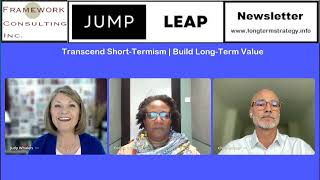
Judy Whalen, Chris Hafner, and Cecilia Wandiga discuss how organizations build long-term strategies that stay flexible. They introduce a W-shaped framework combining top-down vision with bottom-up feedback, distinguish between projects with fixed outcomes and experiments that tolerate risk, and argue that treating competition as a shared problem beats zero-sum thinking.
Chapters
We're back. And just before I bring up the next panel, I want to direct your attention to the leaderboard. So in the top kind of the left-hand— sorry, right-hand corner, you will see something called the leaderboard. If you click on that leaderboard, you'll see that we're actually tracking participation. And why are we doing that? Why? Because there is a bunch of gifts that we plan to give out at the end of the evening, some prizes for participation. So the only rule is that a speaker cannot win a prize. That's the only rule that we have. But if you click up there, you'll see all the different ways to gain points from interacting, asking questions, and doing these things. Okay, let's bring up our panelists. Judy Whalen.
Let's see, Judy.
Okay, up comes Judy.
Cecilia. And I'm seeing Chris.
Chris has logged in a couple of times. Okay, there we go. Chris and Cecilia. Well, this panel is all about flexibility, and we're going to destroy, or at least investigate, this whole point of view that long-term strategic plans are a bad idea because companies become too rigid once they have them. And this is a popular line of argument that I've discovered with people who said long-term, even strategic planning for some people is a bad idea because it leads to companies being too rigid. So it's a strange point of view, but I took that and said, well, what would it be like to have a panel around the flexibility, the agility that John talked about a while ago that would allow for powerful strategic plans that are made, but then can be flexible and change as soon as the circumstances show themselves. So Judy, I'm going to ask you to introduce yourself and your panel, and I'm handing over to you, and I'll be in the background popping things on the screen and doing my thing. Judy, over to you.
Okay, thank you so much, Francis. Well, I'm Judy Whalen, and our panel moderator is actually Chris. I'll just give you a little background though on myself and my business, and then I'll turn it over to Chris. My business is the Center for Strategic Change. I have been in business for 30 years, so I have seen lots of changes regarding strategy and how companies are dealing with it. I— my company focuses basically on obviously strategy, market research, and then communicating their key strategic key strategic initiatives to their key stakeholders because oftentimes that's where things start to break down. I live in the booming metropolis of Brooklyn, Wisconsin, and I'm looking forward to having this conversation and building upon what happened in the first panel because there's a lot of pieces that we can pick up and advance as we continue our discussion in this panel. So Chris, I'm going to turn it over to you as the moderator.
Sure. Well, good morning, uh, good afternoon, good evening, depending on where in the globe you are. My name is Chris Hafner. I'm a strategic advisor. I work for a variety of institutional investors and sovereign wealth funds across the globe and spending most of my time in the Middle East recently. Prior to that, I worked in industry, spent a number of years in process manufacturing, metals and mining in strategic planning and strategy roles. Spent a few years in technology, 5 years in venture capital, and had 2 successful tech startups and exited both of those firms in 2013. I'm really excited to be with you today and to be having this discussion, conversation with both Cecilia and Judy. So Cecilia, can you please introduce yourself to the group?
Hi, Chris. Hi, Judy. Good to see you again. Cecilia Wandiga, Centre for Science and Technology Innovation Executive Director. We are UNESCO-associated center here in Nairobi, Kenya. Most of what we do, we started examining the adaptation to climate change and have now transitioned into assisting both government, academia, and the private sector with circular economy transitions and looking at things like material science and how do we— we have the long-term goals, right? The long-term goal is to not reach that 1.5 degrees Celsius, but then what are the short-term tactics that we have to use to get there? With that, I will hand it over to Chris, and I see a lot of ESG in the discussion ahead of us, so we're on the right track.
Well, great. Thank you, Judy and Cecilia. So our topic today is flexible and confident future planning, two very ambitious adjectives around future planning. But I guess I'd like to start the conversation by just asking a question around what do you see as the key ingredients for that future-proofed or successful strategy? We'll start with you, Judy.
Thanks, Chris. What I see as the key ingredient for sustainability long-term is having a compelling long-term vision. It was so interesting to hear the previous panel begin this discussion on long-term and vision because The long-term vision is really your— I'm going to call it your guiding force, your guiding passion. And then we build the short-term from the long-term. And it— there's so much confusion about all of this. And I'm going to just give you an example of one of my clients. Um, one of my clients is a group of physicians, and their long-term vision is to reduce chronic pain globally. Now, they're already 50 years old. And this is a piece that's so interesting because when they started it, an individual, yes, had the vision, the long-term vision of reducing chronic pain. But then they became an organization and the organization kind of found its own way, not even realizing the value of a long-term vision and short-term strategic planning. But it's that long-term vision that provides the passion for when things get bumpy. If you think about the pandemic, it's the passion of achieving that long-term vision that kept organizations going. It's the passion of that long-term vision that keeps moving organizations to creating that, I'm going to call that good for the world. Because they're not— some of those huge, big, audacious goals you don't achieve in the short term. And in the previous panel, they talked about if you don't have a long-term plan— I'm going to just stick to the long-term vision— you may be out of business before you ever realize you're even in it. For me, the key ingredient is having that long-term compelling vision. I don't mean words that just end up being a slogan. You need to spend time in your thinking, your strategic thinking about what are the compelling words that will motivate people, that will inspire them. I think John Friedman in the previous session called it uspire. It should be an aspiration. It's not something you're going to achieve in 3-5 years. It's that long-term thinking of still being in business 50 years, 100 years down the road. So the long-term compelling vision, Chris, that's my insight for a key ingredient.
Yeah, that's great, Judy. I often give kind of two guidelines for the process of creating a compelling long-term vision. And that is that it should be plausible, but perhaps not possible. And so a real, real stretch goal, and it should take 2 to 3 generations or 100 years to achieve. And a great example of an organization that we probably are all aware of in this conference is Rotary, Rotary International, who has had a singular focus, right, which is to eradicate the poliovirus from planet Earth, right? A long-term vision, you know, over 40 years, and, you know, they're still going at it, still staying strong. So yeah, I would agree. Cecilia, any thoughts or echoes from your perspective?
Yeah, on long-term vision, echoing what you've both said, so we are in more of the nonprofit space, but linking that together in terms of the Brundtland Commission of 1987. And at the time, this word sustainability didn't exist. It was that report report that defines sustainability as the ability to create development without taking away from future generations. And that was a concept, that was a vision, um, which at the time everybody was like, well, what does it mean? And so then you had the Development Goals and now the Sustainable Development Goals, and then you've got the Paris Agreement and coming together every year at the Conference of Parties, what we call COP, and it's like the world's biggest board of directors meeting. And then you have the Convention on Biological Diversity, you have CITES, you have everybody now with those Sustainable Development Goals, the 17 goals, tries to figure out how they're going to meet that end result. It's not just about lowering the emissions so that we don't get a warming planet. It's also how do we not deplete resources and how do we do that, and how do we bring different entities together so that the space is for corporate, for nonprofit, for government. Everybody has a stake in that. Without that one word, sustainability, we would not have any anything to hang. We wouldn't have any vision to be following.
So, Chris, can I follow up on Cecilia? You mentioned— sure, Cecilia, you mentioned a word, nonprofits. And nonprofits are part of my client base. And what I have found is the long-term visioning is easier for some types of organizations in some industries other than others.. And so you've got to be cognizant of who you're serving and what their— I'm going to say what their thinking capability is long term. For instance, many of the nonprofits I serve are more able to think that 50-year, that 100-year than, say, let's just say a local restaurant owner. So there's, there's different pieces to this and how you go about getting them to think from just the short term to the long term based upon what type of business or industry they're serving.
I would agree, and having worked in all three sectors— government, nonprofit, uh, private— and then coming back to nonprofit, um, I think the issue is also it's a vision issue. Um, I tell people there's no difference in terms of nonprofit. You know, there are nonprofits that have multi- billion dollar revenue streams, right? It's, it's what we have, what we do with that revenue that changes the focus. And when you're beholden to stockholders, where, um, it's essentially a system where you have to pay out, right? Um, everybody's looking if you're publicly traded versus privately. Some of the private comp— privately held companies do have better room to maneuver. But if you're, you're sitting there, your job as a security manager depends on whether everybody's happy with their next payout. Uh, you have a very different type of reaction than whether you're sitting as the nonprofit board, same, you know, $10 billion in assets, and you're thinking, how do we reinvest this surplus? Into the next generation of activities.
So I find that companies that are highly, let's say, responsive to shareholders on a quarterly basis have more difficulty thinking the long term than like a nonprofit who has that longer-term vision.
Yeah, certainly, certainly a variety of dynamics and drivers depending on, you know, sector, and even industry you're in and your time horizon. You know, it's interesting when we think about sustainability and certainly some conversations around competition and strategy, because we naturally think strategy, its origins, military origins, right, and competing and competition, which implies winning. And so strategy is often framed in terms of winning. right? And we often hear, you know, with startups being coached, ah, you know, you have to have a common enemy, right, that really binds you together through the tough times. You know, Cecilia, can you share with us your experience around, you know, how do we create a common enemy? Is the narrative around beating the competition, around winning, is that still viable invalid in the construct of sustainable strategy?
I would say yes, if we reframe it and reframe it towards the problem. So if we're looking at ourselves and using this Japanese concept, hero is the same whether it's female or male. They don't change hero to heroine. The battle is against the destination or the problem. So in our case, it would be poverty or it would be the degradation or the lack of resources. I heard Judy mentioning this one company that she's supported where they're talking about chronic pain. That is a very complex problem because first of all, even getting people to articulate, you know, where is that pain? What does it feel like? When is it most acute? How is it? What, what, what alleviates your symptoms? It's no different from trying to get a child to tell you what different types of crying mean when they're hungry, or when you're trying to talk to the species on the planet and say, okay, I don't speak elephant, but something is wrong, you know, how do I help you? How do I help you stay alive? So if, if we can reframe, instead of trying to go from for the buzzwords, like, oh, I want to be hip, I want to be sustainable. What is the problem? And, and looking at this in terms of your strategic capabilities, every company is unique in terms of the people it brings together. What is it? And, and to find that, I think you dig deep into what is it that people in your group, in your organization, are excited to wake up every morning to solve. What problem? When you're doing that, it becomes very easy to focus on the problem and see opportunities for collaboration.
Yeah, I think that's a really good point. And oftentimes we see that in for-profit business. When I think of the technology space and financial services and incumbent banks and challenger neobanks and fintechs, now that you say that, it makes me think it's kind of funny that these fintechs, many of them are railing against these long-established institutions. We've got to topple them. But, but it's kind of like sports. Once you topple that institution, then you become the institution that someone else wants to topple. As opposed to if you reframed and rethought the problem— is the, is the problem incumbent financial services institutions and established banks, or is the problem a lack of financial inclusion? And if the problem is a lack of financial inclusion, ah, now we have something much more compelling. And I think, Judy, that also plays something that's much more long-term in terms of trying to accomplish versus beating a competitor versus solving a problem that's valuable to humanity. So I really appreciate that, Cecilia, because the language we use and the context in which we use it is really, really important when we're trying to get that message out, right? In that previous panel around the clarity and communication around the messaging we're trying to take to the market. Judy, what's been experience relative to this concept of competition?
Well, what I've seen in the years that I've been in business is it's changed. People aren't articulating the word beat or our competitors. They're now focusing on what goal did we set during strategic thinking and strategic planning, and how do we go about achieving that? So first of all, getting the goals articulated in a manner where you're not using the words beat, compete, whatever competitors. We now use words like understanding the marketplace, what's happening in your marketplace, what's your market share? Because companies don't need, let's just say, more necessarily more market share unless they really aren't selling. What the words that we now use and hear are, how can we collaborate with people who do similar things that we do? Because if we collaborate, we might have new synergisms and together we can do something even better. Who can I consider as a strategic alliance? Who can I reach out to? How can we work together because we have different We have different specialties, we have different skill sets, but how could we form a strategic alliance? Or typically it's not a strategic partnership because partnership word starts to convey all kinds of other legal connotations to it, but they're very open to thinking strategic alliance. So that whole, the way they approach what used to be competition, I'm going to just say has, at least from my perspective, has softened and it has not hurt their bottom line. In fact, it's actually made their bottom line increase. So, you know, it's that synergism when two or three people, groups, can bring their specialties, their strengths to the table and use them to advance, whether they're a for-profit company or a nonprofit. It works in both areas.
Yeah, in fact, it's interesting that you say that because in the prerecorded session that I did, I talked about reframing the ABCs of strategy, right? A being, you know, the art of war, you know, versus having more of an abundance mentality, right? B, you know, rather than the blistering speed of short-termism, B being a bold vision. So to your point, you need that really clear, bold, long-term vision. And then the C was shifting our thoughts from competition, beating an enemy, to collaboration. How do we work with others in the ecosystem? To your point, Cecilia, which is how do we solve the problem, which is good for everybody, versus just beating someone else within this this competition. And so when we think about all of that, a lot of this is, you know, this is all well and good, but requires a lot of communication, a lot of stakeholder management. You know, how do each of you, you know, look at communicating to and managing stakeholders, you know, for that long-term vision, but, you know, they may have some short-term objectives or thoughts in their mind. So if you can talk to us a little bit about stakeholder management and how each of you have tackled that in your careers.
Okay, sure. And I think you, you brought up a good point in terms of financial inclusion, because the other problem that happened before with strategy is oversimplification, right? So it's very hard to collaborate if you have a very simple problem, because then you've got the expertise piece, you execute, why do you need others? But if you have a complex problem that is beyond the capabilities of your organization to solve, and let's say you're a financial institution and you say, okay, I want to do financial inclusion, and you might start with saying, all right, uh, we're high net worth money managers, um, what does financial inclusion mean? We obviously can't take people who are depositing, uh, $500 a week, let alone 50 a week. So what does it mean for us to have financial inclusion? But looking at that is also how do your money flows affect those entities, those financial institutions that do serve that lower wealth? Because as you're moving massive amounts of capital at the high end, you have to be aware that there are repercussions at the lower end. And so how do you move your capital so that if you catch a cold, the rest of the financial world is not dying of pneumonia, right? That requires feedback, that requires stakeholder collaboration, that requires being open to listen to why does somebody need a payday loan, and is there any way that as wealth managers, can we offer a risk guarantee so that somebody who already doesn't have money and is taking a payday loan at 200% interest might only have to pay 8%? Because you already know they're doing this because they don't have the money, right? So why charge them interest that they're not going to be able— it's gonna— it's headed towards default. So those are the kind of ways to start thinking about. I think in the previous panel, Francis made a comment of values are not just what we say, it's how do we live what we say we're going to do. If we say we're going to do financial inclusion, that means those— it's not just more of those who have high net worth, it's those who we've never talked to Exactly, exactly.
That's an excellent example.
Judy? Well, you know, involving stakeholders is so critical from the beginning of a process where you're thinking about strategy to the point where— I'm going to call it the endpoint— where you've developed the strategy and now you're ready to start implementing. So So sometimes I'll see organizations that just worry about the endpoint and they don't start in the beginning. Other times I'll see organizations that gather input from stakeholders in the beginning, but they never convey what they've developed back to those stakeholders. So it's a continuous process to involve stakeholders. Now, your stakeholders, you know, make a list. In typical organizations, I'm gonna just say, this is very, typical, but everybody is unique. Obviously, it's your board of directors or your advisory board, however your, your governance structure is. But then it's your leadership team, your directors, and let's call it managers within your organization, and right down to your employees. They all have inputs. So you've got to figure out how do you get input from them before you even start talking strategy. What you figure out, what are their concerns? Where do they see this organization going? What, what makes it motivational for them to even be there? You know, then go through the strategic planning process and come out with your key strategic initiatives, your goals, but then you've got to communicate those back. Now obviously your board has been involved hopefully along the way in the strategic planning, or, or a team, and the board has reviewed the plan and approved it, but then you've got to start communicating What are those key strategic initiatives to the organization? And what does that mean to individuals, those different levels of individuals in the organization? How are they going to be impacted? How are they going to help advance that key strategic initiative? So consistent communication on the back end of strategic planning to the organization individuals. But then it goes even further than that. It needs to be— you need to be communicating those key strategic initiatives to your vendors. Because it impacts how you interact with them and how they interact with the outside world beyond your organization. So vendors, customers, customers, clients need to hear what are you working towards and why. Why is it important that you're working towards that? And even the greater— I'm going to call it community— beyond your customers and clients. So it's, it's a full-blown intertwined communication plan. And frequently I only see pieces of it when I start working with an organization. I'll see the front end or the back end, and they've got to have the infrastructure already built for that ongoing communication. That's the piece. And many of them don't have that yet.
Well, and I would say, so I'll use a little bit of an analogy here. And it's a blind spot I see consistently around this narrative of strategy being inclusive. Right. So we all believe— most of us believe strategy should be inclusive. Most of us believe we should go out and talk to more people in our organization, you know, not just the C-suite or board coming up with that strategy. But let's go talk to people in the organization. But I'm going to use a little bit of analogy. And I would challenge anybody listening to this panel to go try this sometime. And I'd be shocked if you didn't get the same result. That I'll tell in the story, which is I would bet that if you had a group of people in a meeting, right, physically together in a conference room, and you had someone open the meeting room door and just go around the table, right, and say, beef, chicken, or vegetarian. So Cecilia, beef, chicken, or vegetarian? Beef. Beef. Okay. Judy, beef, chicken, vegetarian? Chicken. Okay, right. So we go around the room, right, and that person goes and leaves the room, right? I, I will bet towards the middle of the day, lunch, towards the end of the day, perhaps an expected dinner, people are going to look around wondering, well, where's the food, right? Now, no one walked in, no one walked in and promised a meal. You know what they did? They took a poll. They asked people their opinion about something and walked away. So when we go and include people in the strategy-making process, right, we take their views, and then we walk away and never to be heard from again. Oh, but wait, but wait. Some of you will do it really well. Some of you will communicate your strategy. You'll come up with a brilliant poster. You'll change the carpet in the corporate offices. The red stands for this part of our strategy. The blue stands for that part of our strategy. You'll hold a town hall meeting, right? You'll rinse and repeat it everywhere. But what you— what is always missed— I have yet to find an organization that does this because this is really hard work. And this is going back to those people who contributed to the strategy, because those who gave their thoughts and ideas and can see it reflected in that strategy or in those strategic initiatives, they're fine. They feel heard. But those people who had an idea, who had a thought, who had a contribution, and don't see it reflected in the strategy or any strategic initiatives, they feel marginalized. Why did I even bother talking to anybody? Why did you, why did you ask my opinion? And it's when you take the time to go back and tell them I heard you. We considered this, or perhaps it's fair to say we didn't consider this, and here's why. You're doing two things. One, you're respecting that individual and saying your contribution was heard and valuable. Please continue to contribute. And you're also educating your employees, right, your stakeholders on what aspects of the strategy were included in why. So you're upping the game, right? You're upping the strategic thinking and acumen of the entire organization at the time, but you're also, you know, demonstrating inclusiveness not just by, you know, taglines and buzzwords and shouting from the rooftops, but by doing the hard work of communicating and giving that feedback back to those individuals who contributed.
It's so interesting that you, you mentioned The piece about input, when we ask for input, we think about it from the angle of we're getting information, we're asking for their opinion. But there's that subliminal piece that we are not always aware of, that it creates an expectation. You just explained it so well, Chris, in terms of going back to them and explaining, this is why we did it, or this is why we didn't include something that you suggested. They have an expectation that we've asked for input, so now they have an expectation to see that it's included or to find out why it's not. We often forget that subliminal piece that comes through to them.
I think also challenging the notion of stakeholders because everybody says stakeholders and the question is, why are they here? Right? Every organization attracts a different mix and group of people, even if they have the same quote-unquote box label. You'll have your customers, you'll have your shareholders, you'll have your supply chain or whatever. All those are boxes, but when you call them stakeholders, what they're really supposed to be is your partners. And when you switch the wording from stakeholder to partner and not strategic partner, but sort of life partner concept, you feel now an obligation. They're not a thing that you survey. They're an entity that, you know, it's to your point, if you are married to somebody and in the morning you say, what would make you happy if I brought it? And by evening, and if I'm a woman, man, oh, bring me a beer. Oh, thanks. And then I walk away and I walk home and I don't bring that beer, I know the look that's going to be on his face, right? And there's going to be repercussions at the dinner table, there's going to be repercussions for the next 2 days. So if we looked at our quote-unquote stakeholders as our partners, as our life partners, and we start asking ourselves the question, why are we here? Why are they in this mix? Why are we support? We're working with them. Why are we working together on this journey? Then you get around this notion of just asking questions, I think.
Yeah. I think each of you said something earlier that I think is relevant here. We often hear phrases like, you know, think like an owner, right? We want our employees to think like they're owners of the company, right? They own the vision. And what you've both said in a couple different ways is something that I've seen in the military, particularly in the British military. Having done some defense work a number of years ago, and I'm originally from I'm from the US, but I've spent 10 years in London. In the US, we have who owns this asset, right? We talk about assets, right? Who owns it? So we think of inventory management and those kinds of constructs, whereas in the British military, in the British Army and the Royal Air Force, they don't have owner. I mean, literally, like the tags in their system It's not owner, it's steward, right? It's that it doesn't belong to you. It may be another soldier's tomorrow. So you need to take good care of it because it is only in your temporary care. And I think you both articulate a couple different ways this concept of stewardship over a vision, right? Not ownership of one individual, but this stewardship of, you know, taking care of, you know, performing my role, performing my duties with an understanding that against this long-term vision that Judy talked about, that while I may be a stakeholder, I'm, you know, I'm a steward stakeholder and someone else may step into this role. And so I'm taking care of it while it's in my stewardship. So I think that's a valid point when we think about sustainable strategy. Uh, so we have a question. Uh, can it be said then that a bottom-up approach to planning is very useful, but only to the extent that there is continuous communication with stakeholders and partners? So a question from, uh, Charlene from UWI Cave Hill campus in Bridgetown. Uh, Cecilia or Judy, do you want to cover that?
Well, I would say yes.
Go ahead, Judy. No, go ahead.
Uh, I would— so it's an iterative process, and I think, uh, Sharon brings up a good point, is that it's not a one-off thing, right? When you, when you create— to your point about stewardship, it's, uh, if we're going to pass this down, uh, and, um, I think it's the Iroquois Nation that has 7 generations Talk about planning, right? If you're going to pass this down for 7 generations, the plan that you, you keep that vision, you keep that target, whether it's reducing chronic pain or whether it's eliminating poverty or whether it is bringing joy to the world. There are a lot of technology companies that in the adaptive space that are realizing that those with chronic disabilities are sort of marginalized because nobody thinks of making technology joyful for them. So looking at those kind of things are financial inclusion. So as you have that long-term goal, the daily— and the previous panel said something about like a GPS realigning— life is going to come, you know, like, like U.S. football, you know, that, that, that, that it's gonna hit you And it's going to wallop you, and it's going to knock you, and you have to stand up and go to the next huddle and move back and get back into the game. But to be able to do that, listening to continuous feedback is also what will tell you when you need to realign. And by that, I mean when there's such a large difference between what you're thinking in the boardroom and the feedback that you're listening to on the ground, that gap, you know, you need to sit down and restructure while not abandoning that vision. You have to realign yourself and see what's going on.
Yeah, I think it was Mike Tyson who said, you know, everybody has a plan until they get punched in the face. So to that point, and I would add, you know, so I think, you know, you'll hear people discuss, and we tend to the language we tend to use tends to be very binary, right? On/off, A/B, and even in the way this question was framed, right? Top-down, which implies, well, top-down or bottom-up. And what I would suggest is think about the letter W, OK? So if we start at the left side of the letter W, right, it has to start at the top, right? Strategy cannot start at the bottom.. You can't go and ask 5,000 employees or 40,000 members of a nonprofit organization, what do you think we should do? Right? That's the hard work of leadership, right? To Judy's point, setting that long-term compelling vision, right? You start that at the top, right? And then you start moving down that W, right, into, you know, you take it down into the organization. And now you start getting feedback, right? So you define the what, then you talk organization about how. How do we achieve this? Obtain some ownership, some stewardship on their part around what do we believe are the initiatives that are going to get us there? And then we take it back up to the top, right? Or maybe it's sort of in the middle if we think about a classic W, right? And we have some conversation there. We refine it. We may refine bits of our longer-term thinking.
And then we take it back down to the bottom again.
Where now we're trying to— and I use the term bottom only because of the W, not to be demeaning, but to the fingertips, to the extremities of the organization, to do two things, to perform that closed-loop communication on where we've gotten to, to start to— nobody should be surprised on the day it's revealed. They should feel a part of making it. And then it comes back up to the leadership to be refined, codified, structured, funded, right, resourced— time, talent, and treasure, right, those three components of resourcing your strategy appropriately— and then communicating, communicating it out. Judy?
Well, first of all, Chris, that's a really interesting graphic in my mind. I'm going to keep, keep your W in my mind as I continue to think about this whole strategic planning process. And Cecilia, you mentioned several interesting things in terms of like, I think it was framing, how we frame it. But I wanna go back to the question about, is it bottom up? And I'm gonna just, I just wanna address it from the angle of maybe the intent that it was asked, should it be bottom up? And it can be bottom up, but there's certain challenges that you're going to face as you try to do bottom up, which gets back to Chris's W and Cecilia's points. If you have that, what I'm gonna call that integrated communication process in place, your leadership team will be getting feedback. I'm gonna say on a regular basis, not always continuously, but on a regular basis from people who are in the organization. Problems I see with bottom-up is that even if you have that continuous communication process. You have to look at the feedback. And when you look at the feedback, you've got to really be able to listen objectively. Because oftentimes I'll see leaders who have already a predetermined notion about where the organization should go. And it is hard for them to open their mind to hear something that is different than the preconceived notion they have. So, even though you have feedback coming in, there's challenges with how that feedback is interpreted. And if you really do bottom-up and seek that input from whoever is in your organization or wherever you consider that bottom-up to be, you still have to frame it before you can start asking for their input. And sometimes when you frame it, you can already create biases based upon how you add the words, how you position it. And that can leave out some of the feedback that you might get when you're asking. I'm gonna call it the bottom-up way. And then again, and Chris addressed it, you have the challenges of time. You know, I see it in organizations, especially since the pandemic. Everybody is more busy than they were before the pandemic. Either their staff is short, time is shorter, they're dealing with different issues than they dealt with before, and time is more constricted for almost everybody within an organization these days. I would love to see somebody do a study on all the reasons why. It's just different than it was before the pandemic is how I think about it. So, if you want to get that input and do strategy from the bottom up, then you've got to figure out how to deal with the time element and the— I'm going to just call it basically the lack of the human resource because it's very different these days than it used to be.
Yeah, it's a good point.
Good point. Is it that we have a lack of human resource or if we're looking at countries like Sweden where they're experimenting with a 4-day workweek, right? And the idea that once we hit burnout, we might be operating and doing a lot of things, but we're doing it at such a lower level of productivity that it's not making the desired impact. So if, if the same way, if, you know, if you bought a Ferrari, you're going to keep that engine highly tuned. Do we do the same with our human Do we allow people to have the rest time and the step back from the organization time that they need to come back and be that fine-tuned contributor?
Yeah, I'm going to— I made this statement in my prerecorded talk, and I'll make this statement here, and I make this statement often, right, which is, you know, One of our biggest challenges with strategy and strategic thinking, and I promise I won't stay on this rant very much, is, you know, context is really important. But if you look at our textbook today that we teach in some of the top universities and business schools, our approach to strategy and strategic thinking is still based on white, Western, manufacturing, assembly line, you know, male ways of thinking, and they simply just aren't sufficient in today's highly connected, highly knowledge-driven economy. And we need to let some of those old constructs go and move into some new ones. So with that, I'm going to shift the conversation just slightly. And that is, so when we talk about sustainable and flex— oh, hold on, we have a question here. It says, going back to those who provided input, what about employee expectation of confidentiality? Oh, interesting. And I think when you're taking a poll, you absolutely have to take that confidentiality, right? And it's, you know, when you're going in and you're having these conversations, it's important that the employee— you know, it's a conversation, it's not a deposition. Right. And we do keep their, you know, their input confidential, right? It's anonymized as it goes into the mix. And permission should typically be asked if you want to— I'm going to say interrogate, but investigate, both terrible words. But explore, that's the word. Right. If you want to explore an idea further, with an individual, you know, we should ask for their permission. Are you okay if we have this conversation with you? Because we want to make sure we get it right. Because I think to both Judy and Cecilia's point, we may have heard that idea, but we hear it with, with our bias and the way we've framed up their suggestion, their recommendation. And so I think going back and getting that explicit permission from them is, is important. Judy, Cecilia, any, any quick thoughts there?
This is, this is such an interesting question because it really delves into things that are far deeper than the actual question itself. When I read it, the thing I thought of is what's the level of fear in the organization? What's the culture of the organization? Of course, culture comes from their core values. We had a conversation in the previous panel about core values. Core values are more than the words, they're how we actually live and demonstrate those values when we're in the organization and outside of it. I agree with you, Chris, that when I do focus groups or when I do individual interviews for a strategic planning process, everything they tell me is confidential, period. I don't share any names with a concept. Everything is anonymous. If they get a summary, it's all anonymous. But even at that, in some organizations, people are still fearful to say what really needs to be said.
And the— Judy, I think we may have—
I know it's, it's blipping here. Gotta love the internet. Okay, I hope I'm back. The challenge really is, for strategic planning, the outcomes of strategic planning are only as good as the information and the insights that go into it.
You're froze again there, Judy.
I don't mind being frozen. I think— can you hear me?
Yes. Yes. So Cecilia—
So it's very hot here and things are challenging with, I think, my internet service. But the level of fear, respect in an organization and the culture impacts the kind of information you get from people. And we have to be considerate. First of all, we have to respect whatever policies the organization has. Regarding confidentiality. But as strategic planners, we need to create another environment that helps individuals feel that they can safely say whatever they need to say. There's multiple facets to this question.
Yeah, I think so. Really quickly before we move on to the next topic, I think you're right. What I will say is, and I don't mean this in any self-serving manner to myself or my fellow expert panelists, but this is the role of bringing in a consultant, bringing in a third party. Because when people with even companies with great cultures, right, there are still going to be people the further out you go, they're like, well, I don't know. I don't know if I should say this. Is this going to be too edgy or is this idea— and it doesn't have to be fear. Fear of, you know, retribution. Sometimes just, I just think this idea is too crazy. This is just, just too silly, right? But, but, you know, you got to let those crazy ideas go, right? I mean, we eat eggs. Think about the first person that said, you know, I think I'll crack that open and eat it. Um, you know, so, so, so we need the crazy idea. We may not want to sit next to them on a transatlantic flight, but oftentimes consultants can be that, that, uh, you know, that, that safe harbor between the organization under which that employee is compensated from and getting their voice out into the market. So speaking of—
I wanted to add on that bottom-up, there's also coaching that needs to happen with employees because I've spent a lot of time with the C-suite. And once they know where the pain is, they're open to the questions. But you have, you know, there's always that group of people who are carrying the hurt. And when they answer in that survey, they put stuff that is so revealing you cannot anonymize it, right? And then they're telling you, I want you to convey this. And he said, but you realize if I convey this in this way, it cannot be anonymous because you put in too much personal information. So there's a lot of coaching that also has to go on the employee side about being reflective, about writing that feedback in a way that, yes, you were hurt, and putting it in the context of the organization instead of your individual experience, however excruciating and personal that may be, and maybe calling in for a mediator to solve that issue, because sometimes that also impedes the ability to move forward strategically, I think.
Yeah. So when we think of strategy being sustainable and long-term and adaptive and future-proof, it all implies that you know, it needs to be somewhat flexible, right? We have flexibility and flexible and confident future planning. So flexible. And so then, you know, that kind of implies agile, right? Which we think of oftentimes from, from a project perspective. And, you know, a lot of the narrative around agile is, you know, we love failure, we love to fail. Failure is awesome and it's embracing. And, you know, so we see these memes on LinkedIn and it's always great when you're a billionaire, right? And, and, you know, you've got somebody strapped to your back and you're flying a kite and, you know, you lost a billion but you still have 5 more billion in the bank. And yeah, love failure, take a chance. Um, but for most of us, um, you know, failure is, is not something we want, we want to, to do. So can you talk a little bit about, you know, being agile, which is about taking some risks sometimes, and the failure narrative as it relates to strategy and strategic planning?
Yeah, looking at experiments and the opportunity to learn and asking open-ended questions. Uh, so if, if we lock in— let them— I'll go back to your financial inclusion example. And if we say our goal is to make sure that we onboard, uh, and support 10 organizations that are serving the base of the pyramid, and you're a high net worth manager and you're like, Okay, that's— instead of doing— that's going to be our corporate CSR and we're going to hit those targets. But you've never dealt in that space before. And, and one of the things that, um, I put in, in the download was being the guide, not the expert, because when there's high uncertainty, you cannot be that expert. So if you're going into a territory where you've you've never reached out to a certain population, set in your mind that you're going— you're not, you're not going to meet that goal. But it's not because there's something wrong with you. It's because you don't know what you don't know. And your goal is to learn what you don't know so you can become more effective.
Yeah. And you, you, you use the word experiment, which I love because, uh, you know, my my approach with organizations, with leaders is, you know, let's try to not fail. Right. There's immediate pushback. No, no, no, no, no. We want— I'm like, well, hold on. Let's— let me explain, which is, you know, failure is something that we can deal with in an organization, but we shouldn't embrace or love it. Right. But it's how we frame up the activities or to Judy's point, the strategic initiatives, the things that we're doing, right, the doing, the how. And some of those things are projects, right, and they're funded and they have an expected output, and those projects shouldn't fail. Now, some of them sometimes should be stopped, not because they're bad, but because perhaps the conditions under which we thought it was a good initiative to take on, maybe this initiative is no longer viable. So if we, if we look at projects and say, well, we either need to successfully get them to accomplish their objective, or we stop them because, you know, some of the, the assumptions have changed. That's fine. Will a project fail? Yes, it, it may fail, and you can deal with that appropriately, um, not negatively, but appropriately. But the other piece is, to use your word, Cecilia, to look at some things, some initiatives, as experiments, right? So projects shouldn't fail, and an experiment cannot fail because, to your point, Cecilia, you said it's— you get a learning from it, and that learning might be this works or this doesn't work. But when we start to frame up and use that kind of language, people are freer to take on a little more risk, right? Our risk appetite widens when we think we're part of an experiment versus part of of delivering a project. So, I do really like the word you used, Cecilia, experiment. Judy, your thoughts?
Well, I'm going to just go back to your word though, project, because as most of us are really familiar with, at some point those key strategic initiatives have goals and the goals get translated into objectives and action plans and action steps. One way that, that has worked for me is figure out what that outcome measurement is going to be. How are you going to know whether you've achieved that action step while you're creating the action step? Figure that piece out, how you're going to measure your progress. And then you've got that, that guide as you're implementing to say, are we actually making the progress we expected, or as you mentioned before, Chris, maybe our assumptions were wrong. And whatever the case, if you're not making the progress you expected, you can adjust at that point. You know, as you've often heard, this isn't cast in concrete. This is a living plan that can be adjusted. Um, you just have to be cognizant to give things enough time to possibly work first of all, before you start adjusting. So knowing how you're going to measure the progress before you start implementing is so incredibly valuable that you're not making bad judgments about something without having any kind of a measurement guide. Figure it out while you're developing the action step.
Really good point. Really good point.
Also, as you're talking about that, is as you're measuring the metrics are you measuring the metrics that matter? Like, you can, you can be very successful on a project that increases revenue or turns around a failing part, a department unit in your corporation, and then you survey the employees and they're miserable. But you're meeting all the metrics and the employees are miserable, and then you're stuck there wondering, why are they miserable? We're, we're getting— we're hitting all the targets. And you start asking them, and, oh, we're hitting all the targets, but we can see in the long run this is going to collapse, and nobody's listening to me. You know, we're having a short-term win and nobody's listening to me when I'm talking about the long-term risks. And, and, and so having that continuous loop that we were asked about before, you know, keep going back on those metrics and say, does it are we measuring the metrics that matter?
Cecilia, that's such an important point that Cecilia brought up. I often run into it, especially in healthcare, because they measure everything and they've got all these numbers. But there's a little saying that I came across that really seems to have resonated with my clients. It's not how many worms a fledgling bird eats. It's how well the fledgling bird flies. And that seems to resonate with my clients who are really focused on those metrics. Are we measuring the right thing?
So, so, so two things. I just noticed in the comments from Amy Devereaux, Amy says KPIs aren't enough. Inevitably, everyone forgets that strategy is a theory and may be wrong. So you need to be measuring both the execution KPIs and the strategy's validity, which is quite different. And I think that's a really good point because one of the very simple things I teach boards and a value independent non-executive director can provide to an organization because they're typically not experts in that industry is they ask the naive questions, right? They ask the stupid questions, right? You can measure the KPIs, right? So are you advancing, you know, against all the initiatives you set out? However, if the rules of the game have changed in some way, shape, or form, right, we have to constantly be thinking, is this strategy still valid, right? When COVID hit, your strategy of acquiring, you know, as much commercial real estate as possible in proximity to certain industries so you could lease fractional workspace space, you know, suddenly that was no longer valid. Now, their KPIs would look fantastic, but ultimately the strategy is wrong. And I think it was Michael Hammer who said, you know, you can— or no, it was actually Michael Porter who said, you know, you can have the KPIs all you want for your strategy around making life jackets out of concrete. And your KPIs for production can be wonderful, but is that really the right strategy to serve the market? So I realize we are just about at the hour mark. I wanted to check with our host first before we did a little round robin wrap-up to see if we had another question or anything from our host before we wrap up. I didn't get that. Well, there's Siri. Siri has no questions on my watch. So with that, any closing comments, Cecilia or Francis? You have about 13, 12 minutes left, so you can take more questions and keep going. Great. Okay, Judy, I think I'm going to wrap up we'll probably hit about 10 minutes worth of wrap-up comments or conversations, and we'll keep an eye out for any questions that anyone has because as a panel of strategists, we are flexible and adaptable. So Cecilia, you know, any closing comments from you relative to flexible and confident future planning?
Yeah, I think to your— that the point that you were bringing up at the end in terms of being— does it matter and how to assess the validity of the strategic plan. And I wanted to put that in the context of also cross-generational, right? We have now after COVID, what is it, generation— I think we've run out of letters in the alphabet but we have Gen Z doing the great walkout and refusing to come back to work. And you have CEOs saying, if you don't come back to work, you're fired. And Gen Z is like, we hate that job, we don't care, we're not coming back. The great walkout, and at least in the US. And you start wondering, why? What is the tension here? The tension is that we believe that the only way to achieve workplace production and keep our assets confidential and make sure the employee in the cog is doing the optimal work is if we confine people to our finite building space. But, uh, one of the things that we're learning, uh, as an organization here, uh, CSDI, we're in this co-working space and just to experiment and see what it's like. And co-working space means that, you know, somebody has set up a really nice facility, an office, and you don't necessarily take a fixed room. You come in and you pay by the month or the hour. And it really was previously the— where you had global consultants were used to this kind of arrangement, but now it's becoming, at least here in Kenya, more open to the general public. And you're realizing that it's so much more dynamic to have to be in a space like this because, um, there's also in the tech world what they call probability of collision, which is the probability that you'll bump into somebody that happens to overhear or have the information that you actually need to solve that problem. And It's— and, and we have access to like 4 different locations, and it's something that is a lot more aligned with what I hear Gen Z asking for. It's like, why do I have to force myself to come to this one location that you picked 20 years ago as to where you're going to be, instead of letting me be in Bali and have the high probability of collision with somebody who I believe will really solve that problem. And it requires a shift in thinking about how we manage our workforce, I think.
Yeah. In the UK post-COVID, when the return to work was starting, it's a bit counterintuitive. But then when you think about it, it's like, oh, that does make sense. And if you go out and you talk to some folks you'll find, and again, this, you know, my research is limited to the UK, not broader markets, was that it was actually Gen Z that wanted to go to the office. It was the, you know, 30 and unders roughly that wanted to go to the office. And it was people my age, right? Okay, I'm much older, but I'll say, you know, 40 and over. Give me some, give me a little break, that was fine not going to an office. And when you start digging into that, you find that, look, my relationships are established. I have a network. I don't need to go to a physical place as much as others. And then when you talk to some of the Gen Zs, the younger folks, or less experienced folks, because it doesn't have to be necessarily age, but less experienced within an industry. They wanted to be around that ability for serendipity, knowledge sharing, gaining, developing relationships, meeting people, broadening their networks. So I think it can go a variety of ways. But I think to your point, Cecilia, organizations need to figure out how to strike a balance. Because it's no longer necessary. In some cases, it is necessary to bring the people to the work, right? You can't manufacture automobiles from your home, right? As much as we'd like to, right?
Or do surgery.
Yeah, or do surgery. But there's a lot of knowledge work that can be done remotely. So, you know, I think it's to an employer's advantage to be thinking about, you know, what work can I take to the people and if I hire well, right, if they have all these rigorous hiring processes. If you're so worried about these people, go fix your hiring process, right? The last I check, it's— they're pretty rigorous and take a long time. So, you know, trust your people, that people want to do a good job for the most part. Judy?
Well, that just gets back to core values and respect obviously being one of them. And I was just thinking that this is such a comprehensive, complicated problem because there's so many pieces. There's moving pieces in all of this and there's systems that are set up and how do we adapt to different ways of working. But if we open our minds and move into that whole innovation space and focus on how do we just get our people to be productive. That's all we need is let's talk productivity. If it's in their own space, if it's in a building, if it's those younger folks who need the— I'm going to call it the social interaction, of a group. Let's figure out how to make it happen. This isn't, this isn't unsolvable. We have solved greater problems. We can do this. So it's a matter of just opening our minds and saying, let's experiment. Back to Cecilia's point, because some pieces of it will work, some pieces won't. Let's experiment for a bit because we've never had this opportunity. The, you know, this is one of the great opportunities opportunities out of the pandemic is that it enabled us, forced us, gave us the kick in the pants to do things differently. And we can do things differently and still be focused on our core competency and be successful.
Yeah, and I think, you know, looking at some of the comments around, you know, contact, right? It's not necessarily just knowledge or network, but when you think, you know, Look, you know, we're human beings, right? So we are organic and many things happen organically. So, you know, we work in our silos. We work— I work in finance or I work in accounting or I work in procurement or, you know, I work in engineering and we work in our silos and we talk to people in our silos, but in a physical world, you know, perhaps that corporate yoga session is where I meet people from different departments. And, you know, or lunch or a corporate-sponsored event or a charity day out in the field, giving back to the community is where we can start to meet people from other parts of the organization. And so I think whether it's physical, whether it's technological, I think what you're both saying is, you know, we need to create a sense of community and collaboration amongst our people with intent. And it doesn't necessarily have to be all one or all the other, but, you know, what's right for that particular organization. So I think if I were to try to summarize what we've heard today around, you know, this this particular topic of flexible and confident future planning, some of the key takeaways I wrote down were, you know, vision, right? Have a really compelling long-term vision and take the time, you know, to ensure that it's long and it's a sustainable vision in the long term. Thank you, Judy. And Cecilia, kind of really, I think, very well articulated, um, you know, the concept of, you know, rally around the problem, not beating the competition, right? And, and when we rally around the problem, you know, there's an inherent, there's an inherent greater amount of inclusiveness and collaboration that can happen because we're trying to solve something that is for, in most cases, right, for the, for the good of, of people. And/or society. And the third piece was really around communications, ensuring that, that all sorts of communications, whether it's in the planning process or communicating the outputs of a strategy, whether it's talking about the strategic initiatives that Judy was mentioning, or measuring the progress around how we're performing against these strategic initiatives, the inclusiveness of communications and then closing the loop on those communications. And then, you know, the importance of projects and experiments, right? And kind of differentiating between those two and measuring those projects and initiatives, but giving some, some room for risk-taking in experiments. And so I'd like to thank our panelists, Judy, Cecilia, I've learned a lot. I hope, you know, those listening in to the live session and/or the recording, I'm sure they will find it valuable as well. And thank you, Francis, for having us.
Folks, excellent, excellent job. Thanks so much. As I was listening, I was taking notes because I'm in a project right now where we're doing some of these things, and there's some angles that we hadn't considered. Considered. I'm now thinking, oh boy, I have to watch out for that. Because everything we do goes to whether or not it's going to be useful in the long term. And if it's not flexible, it's going to end up being on the shelf. If it's not agile and nimble, then everyone's going to look around and say, well, what happened to that 3 years later? And they won't know why. Matter of fact, there's an organization that we're working with now where they're looking back at their prior plan, which they never implemented, and they're like, what happened What happened to that? I don't know. Well, obviously couldn't— it was done before COVID and then COVID came, and then people just basically forgot that it existed. So folks, thanks so much for your time and energy, and thanks for putting together pre-recorded videos. They take a lot to do and to assemble, and we really appreciate your input on that front and also here on our panel. So folks, Please join me in thanking our panelists in the chat. Make sure that they know that—
Thank you for bringing us together. We are fully appreciative. This has been fun.
Thanks for the opportunity.
You're welcome. You all have showed up on my radar from different parts of the world, and it's just great to have you. All right, so if you turn off your cameras and your microphones, I'll take you down, and then we'll do a little switch, folks, to our next panel. Let me do the switch by closing out this session and then opening up another one.
More from Francis


Ep 35 Your Strategic Stagnation Isn't a Framework Problem—It's a Story Problem



The YouTube Strategy School: Why Your MBA Didn’t Teach You Strategic Thinking





