Francis Wade Dale Pilgrim Wade Turning Your Next Retreat into a Complete Success
Francis Wade and Dale Pilgrim Wade share what ruins retreats: unclear purpose, CEO-only strategy writing, wrong group size, and outdated thinking. They've led over 100 retreats across the Caribbean and outline their framework: real-time co-creation, 15-30 year vision, and post-retreat project ownership to sustain momentum.
Chapters
Hello everyone, good Good afternoon, it's 12 o'clock and it's time to start our webinar. We're gonna be starting right on time. My name is Francis Wade and I'm here with my colleague Dale Pilgrim Wade, happens to be my wife, and you could— she's gonna poke her head in just a bit so you can see who she is. No, you can't see it. So you can hear her.
I can't see it. Oh, here I am. Hello, good afternoon everybody.
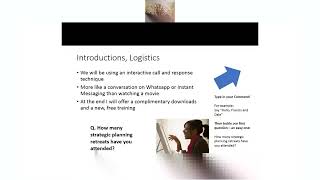
We'll be leading your webinar today and welcome. And if you could just type in the chat, can you hear me? Just want to make sure that I'm being heard. If you could just type in, yes, I'm hearing you loud and clear, that'll be our cue to get going to the next step. Wesley, yes. Barbara, yes. We're being heard, so we're going to go ahead. So welcome to the webinar, and a couple of logistics. One is that we'll be using an interactive sort of call and response technique. So this is not going to be like going to the movies, and this is not going to be like— I'm just getting a note here that you're not seeing the video, the visual. So you're not seeing my screen, is that correct? I'm just waiting for an answer.
Is anybody not seeing the screen?
Are you not seeing my screen?
We saw one.
Is it Tamika said it is frozen?
Frozen.
Okay, so what I'm going to do is I'm going to turn off the webcam because that's probably what's doing the freezing, and I'm going to see, can you see my screen at this point? Very bloody blurry video, right? Right, so we just turned off the video. Can you see the screen that says introductions and logistics? Yes, great. Okay, we can work with that. So we'll limit the live Barbara's not seeing it. It might take a moment, Barbara. Let us know if it comes back in, but we'll turn off the live, the live video, and we'll just focus on the screen because that's what's most important for this particular presentation. Okay, so some introductions and logistics. So like I said, we're going to be using the chat room that you are currently in, the back and forth, uh, quite a few times, and it's going to be more like a conversation on WhatsApp than anything else. And at the very end of the presentation or, or conversation, we're going to give you opportunity to download a free compilation of articles on strategy and also the opportunity to register in a new training that we've just developed. It's brand new and it goes for about 8 sessions and it's all around having an awesome strategic planning retreat. But anyway, Let's start off. I know you've already said hello, so we're past that point. Or if you haven't said hello, you can also do so. But let's ask the first question. How many strategic planning retreats have you attended? We want to get an idea of what kind of experience you have, prior experience you have in and around strategic planning retreats. You could just put a range if you don't know the exact number. Let's see. Many strategic One, okay. Thanks, Deidra. Wesley, a few. Have you attended? Great. Two internal from Tamika. 10+ from Barbara, great. Great, so that'll give us an idea of how to tailor our presentation so that it sort of matches your expectation and experience. So let's go ahead and move on to the next. In our effort to sort of help you be an awesome sponsor or host of a strategic planning retreat, or even a facilitator, today we're going to focus on the 4 biggest mistakes that we found here in our work in the Caribbean. So as you may know from our prior information or from the sign-up screen, we've led programs in Trinidad, Jamaica, and Barbados in strategic planning. We've trained over 100 people in how to facilitate Strategic Planning retreats. We've also led retreats outside of the region. But how can you accomplish the result that you want, given that budgets are being limited? And in particular, we're going to focus on the 4 mistakes that we see people make sometimes when they try to match a limited budget. So let's just start off by looking at what the cost might be of a wasted retreat. That there's some pretty bad things that happen when a retreat does not go as planned. So one is that there's an awful loss of confidence. Right. And that loss of confidence can be in, you know, God forbid, you're the one who is hosting the retreat. And, you know, the CEO has maybe turned to you and asked you to be the one who's on the spot. And unfortunately, it doesn't go well. And it has an impact on your reputation as a host of planning retreats, and it could even have a reputation, you know, a reputational effect in terms of your career overall if it goes really badly. And why? Because it's a high-stakes event. There's executives and managers and board members probably present. All the movers and shakers are there, and you're out to make a good impression. So you don't want to have that happen. That's the first That's the first sort of awful outcome that can happen. The second is less personal. There's a lost opportunity. So we're going to describe the kind of retreat in our presentation today that clearly shows that there's an opportunity to be gained from having a great retreat. Right. That, you know, if you don't do it well, you're actually missing out on a great sort of chance. To make a profound difference to the way your company is run in every respect.
Audio inconsistent. So is it slipping in and out? Is that what you're trying to say, Tamika?
Sounds like it's being choppy a little bit.
Is everybody experiencing that?
Just an audio check to see how occasionally.
Hmm.
Not sure how we're— it's fine for some, it's not so good for others. It might be a bandwidth issue on your end. Oh, the good news is that I believe that the recording should be successfully made, so we'll give you the link to the recording at the end, but hopefully it'll work out so that there is a clean recording. We'll see. Okay, sounds as if it's fine for most, right? But some are experiencing difficulty. Thanks for letting us know, Tamika. So, in addition to the lost opportunity that a retreat is, and we're really gonna be hammering this home in this webinar, there's also the impact on the business of unmade decisions. So, I guess I won't have to explain what an unmade decision is. I think you may know what that means, but let me check. So, what happens when key decisions are unmade in— maybe it's in the retreat or it's in the day-to-day of your business. What are some of the effects that occur when key decisions are not made? Go ahead and type your answer into the chat room. See fingers going. I think. So, the business goes stagnant.
Stagnant. Yeah, that's a good one.
That's a great one. You know, we've seen companies where they've gone out of business, basically, because they didn't make the decisions that needed to be made in time. They didn't anticipate the impact of new technology, or, you know, an example that we all experience across the region, the entrance of Cable and Wireless— I'm sorry, the entrance of Digicel into the mobile phone market in the early 2000s in Jamaica and later on in Trinidad. So Cable and Wireless didn't anticipate that Digicel would be so popular. The strategic plan didn't cover properly the entrance of a new competitor. It certainly didn't estimate the impact. In the first weekend, it brought down the entire network. There were lines around the the corner at every store, they just ran out of handsets. And the fallout was just terrible in terms of loss of market share, people lost jobs. I've interviewed a couple of them who were let go as a result, just awful. So Sheldon says unsatisfactory results, absolutely. Tracy says a lack of clarity, no execution. Yeah, when there's a decisions that need to be— that can't be made, it's funny. You may think that people would go ahead and do business as usual, but our experience is that even business as usual suffers because individuals, executives, managers, they're unwilling to even continue in business as usual because even that starts to look like a risk when they don't know what the strategy is. When you have multiple executives, they all have to do their own thing to some degree. But if they don't know the overall strategy, they become afraid of working at cross purposes, and they become stagnant or stale. So, they actually shrink. They shrink from business as usual and actually do less than business as usual, if you can imagine it.
Thanks, Rhonda. We see your post here. Wrong decision at the operational level is made. That's actually very true because there's no decision whatsoever of where next to go. Pat, we see waste of resources moving without direction. That is also very true. And with limited resources as we already have, it makes life a little challenging. Okay, great.
Thanks, guys, for typing in. So the next year in which you decide to have a retreat, the failure actually makes it harder, because now it's lodged in people's minds. You called the retreat the last time, it didn't go well, and when they get their invitation, they are wincing, because they don't want a repeat of what happened the last time, a waste of time and money. So some companies have reacted, and this is prevalent across the region, by not having a retreat at all. So they just cancel it. That's the worst option possible. Others have decided to kind of scale them down, you know, instead of having it be this big and important activity, they say, "Well, let's try to get by," and there's two ways in which they try to get by. One is what we call Cop-out Number 1, and this one has become Boy, it's become almost a practice. So, what cop-out number 1 is, is when a CEO or a managing director or a chairman decides, "I'm gonna write the strategy. I'm gonna decide what it should be." And they sit down by themselves one weekend and they flesh it all out. And for them, the problem in their mind is, "Okay, I just need to give people their marching orders." So they call it a retreat, but it's not a real retreat. It's really just an opportunity to tell people what their marching orders are. So it's a huge cop-out, but many, many companies are doing it. Sometimes the CEO would take the strategy from the year before and just kind of tweak it, call a meeting and say, "Hey guys, I've tweaked last year's strategy. Here's a new one. Everybody agree?" Okay, let's go ahead. So we call that a cop-out. It's budgetary. Of course, it costs less than having a real retreat, but it doesn't work. The second is to turn the retreat into a LAN. So here's where you actually do have people at the retreat, and sometimes a lot of people, 60, 70 are some of the numbers that we've heard. And What it really is, is a feel-good event where it's really more about getting us all to feel good about something. And the way to do that is to engage in sort of superficial exercises, including, of course, a long time for lunch. Oh, let's have it on the North Coast if you're in Jamaica, or let's have it in Tobago if you're in Trinidad, and let's have the families come also, and let's bring entertainment, and let's have a games night, and So, it turns into this, you know, sort of a remarkable social event. But what's missing are the difficult conversations needed to have a new strategy emerge. So, we'll share with you a bit later that that's a necessary requirement to having a great strategy retreat. So, it's a second cop-out. And one of the ways in which we see this done is by having sort of superficial little brainstorming sessions. That don't really add up to too much, where everybody sort of gets an opportunity to talk. You put the ideas up on the board. You sort of group them in different ways. You send out a report afterwards, and you say, "Here is where all the questions came in." The SWOT analysis, in particular, are popular because they don't actually do anything other than just collect opinions. Those are all different ways to engage in couple number 2. So, I'd like to hear Tough question, no? Have you seen either of these cop-outs in action? One where the CEO or chairman or the big boss writes the strategy and then reports it to everyone else? Or the second one where at the end of the event, everyone likes each other, but you kind of wonder, "Did we actually do anything or was that just for fun? More of a social event?" Let me know in the chat. Marching orders, says Tamika. I won't ask you where you saw that, Tamika. Okay, uh, Wesley says both. Wesley, can you give us any, any details on either one? Love to hear that because we've seen a lot of them right across the region.
And the marching orders, usually only you only get low-hanging fruit from that because you're not looking at the company from say 3 years, 5 years, 15 years down the road. You're just focusing. And we're seeing a lot of companies here saying that have had a, Barbara is saying, have had a GM write the strategy correct. And they just kind of tell you what to do. And there's no buy-in from the company. People are like, oh my God, here we go again. And nothing gets done.
Top dog. Top dog is a know-it-all. Do not put the name of your company, Pat.
Right, please don't share it now. We're gonna just talk about instances. Don't put the name of the companies.
But we have seen that over and over again. And usually, the fact is the CEO is pretty smart. So I've seen both, Tracy, at both organizations, and both are truly ineffective. It feels like something is happening, and I guess it's better than not having a retreat at all. But they are really just a sort of a safe way to try to get something done. And they don't actually deliver the goods. Okay. So we're gonna move on to the next. Let's see. Oh, here's one more. Tamika says, "Employees feel like they have no voice." Correct.
We see that all the time as well. We often try to go in about 4 to 6 weeks before the actual retreat if we can get them to agree and do some sort of a survey. And we run focus groups trying to get the employees' voices in and try to kind of steer the strategy during the retreat to address some of their voices. We don't know if they actually implemented, but we try very hard to do this. Is audio being used also? Michael, yes, we are, but we're having some bandwidth issues. So we're gonna have, it's why we switched over, but we'll have the link at the very end to share with people. Yes, Francis? Okay, does that answer your question, Michael?
Oh, good. And then Pat says, top dog brings example that is not relevant but worked in other organizations. Yeah, and everybody sort of says to themselves or to each other, that's not quite right, is it?
Is it just me or is it— they say, no, that's not right. This isn't— that won't work here. That's what they did over there.
And then Rhonda says, discussions with the senior team but there's no drill down. So it's as if the senior team has a discussion, but what's lacking is the communication to anyone else in the company. And we're going to address that in a few minutes, but sometimes companies go into COP-out 1 or COP-out 2 just because of fear. They are afraid of raising the stakes for the strategic planning activity. So they take the low road, which is safe. Cop-out number 1 is extremely safe, and so is cop-out number 2. In that way, you don't take too many risks, but the downfall of that is that it's really hard to communicate the strategy to employees in the organization who don't interface with the CEO every day and who weren't at the retreat. All right, so I'm going to pass on to the next slide. Rhonda says it's a handoff to the operational team. And then, unfortunately, what happens is that over time, people, for example, as Rhonda says, in the operational team, they stop challenging the new norm. A new inertia sets in, as everybody comes to believe that this is the way it's done. They don't even know or are aware that there are other ways to get it done. They just feel as if initially that something is wrong, but after a while, they stop feeling that something is wrong, and it becomes the new defensible status quo. So who are you in, in this situation? So we're assuming that if you signed up for this webinar and you're listening in, that you are curious, you want to know, how can I make a difference in what we have just described? You're not interested in being stuck. You actually want to come up with practices that make sure that every retreat you're engaged with is a success, that it's not just a matter of one or two successes here or there. And unfortunately, we know that you probably aren't leading 4, 5, 6 retreats per year, and you haven't been doing it maybe for 10, 15 years. We've been doing the strategy mapping and balanced scorecard approach ever since the strategy map article was written in 2001. We picked it up and it was sort of a revelation to us and we started leading retreats. And we do a number of them per year. So what we're sharing is sort of our underground experience from doing them here in the region. And there are a bunch of things that we want to pass on to you in terms of mistakes that people make that we want you to be able to avoid.
To be aware of, yeah.
So it comes from, as I said, our experience. So I want to share with you a couple of ways in which I hope these never happen to you, but we've had them happen in our retreats. So, one retreat we were in, the board members, surprising move to everyone who isn't on the board, decided to fire the managing director. And you can imagine what that was like. And it happened right in the middle of the retreat during one of the breaks. He decided to leave, and they had to come back and explain, "Oh, by the way, we just let go of the managing director." And as a facilitator, and if you're someone who sponsors Strategic Planning Retreats, you can imagine that it's like letting off a bomb in the middle of the room. And as you can imagine, it had a huge effect on the outcome. The second is that sometimes the person that you think is in charge doesn't actually act as if they're in charge. So if the chairperson, for example, shows up and either doesn't participate the way you imagine or is disruptive, or they're disruptive.
They're on their smartphones. One case we had was, was a chairperson, a chairperson who was very strong personality, and she was on the phone the entire time. She was walking in and out. She's disruptive, and it was impossible trying to get her to leave. Now, if she's doing that, her people are going to follow her. So as facilitators, I have to admit, I think that was one of the most challenging ones we've ever done. But it's not a good idea to have a chairperson who was just unruly.
Yeah, we tried to lay down ground rules at the very beginning, and she said no. So she was in and out. It was terrible. That's one of the worst cases. And then there's a trend that we've seen over time. With CEOs, MDs who want the same retreat that they used to have for maybe 10 years ago, which used to last 4 days. And over time, 4 became 3. That was the first thing we noticed. And then 3 became 2. And we had to revamp the way we do our retreat so that we could get the activity into 2 days so that they could halve the budget but get the same result. So, as you can imagine, the challenge was how do we accomplish the same result in a shorter space of time even though the number of people is exactly the same? So, we had to rejiggle the way we come up with our— deliver our strategy retreats. It took a whole lot of work on our part, but it's— what we'll share with you is some of the mistakes that you can avoid so that you can benefit from what we've learned in having to do this compression.
Tracy, I see you wrote, how did we handle the in and out of the chairperson? Well, what she was trying to do, she apparently was a consultant herself and she was trying to dominate the entire space. So what I did, my background's in counseling. So what I did is I let her come up front with us and whenever we would say something, I would kind of get her involved and try to get her opinion, but then still go back and kind of say what we needed to say. So I think she was shocked most of the times because I just listened to her, let her say what she needed to say, and then I kind of reiterated. So I think between Frances and I, even though it was challenging, we handled her just because we worked together and we kind of tried to outwit her. But every time we see her name to this day, we go, oh no, we're not going near that woman. But anyway, does that answer your question? So we just, I just use my skills to kind of let her think she was getting her way, but you know, she didn't in the end. Okay, we just had to. She was a wild card.
Never again. So here are the 4 mistakes we want to address in the 20 minutes that we have remaining. We're going to take questions after we finish the 4 mistakes. So, one major mistake, the first one is to have an unclear purpose for the retreat. So, as you know by now, the retreat is not about producing a document. Although there are some companies who measure the value of the retreat by how pretty the graphical output is, how many pictures are in it, how glossy the PDF looks, and how professional it looks, and even though it might not have much content, how thick it is. We just ran into one the other day that had over 100 pages. So, the document is not the point.
Right.
That is not the purpose. Consultants may focus on that because that's the part that they can control and that's the part that they can emphasize, but that's just a byproduct. It's just an artifact of something that needed to come long before they started writing up the final report, the final document. And it's also the purpose of retreat is not to do the rubber stamp kind of technique that we mentioned before, where the CEO rolls out his thinking. Both of these approaches are limited. Sometimes the time frame is limited. Sometimes, as Dale said, they focus on low-hanging fruit because you don't have enough people looking at it from different angles. They would often be limited by the background of the CEO. The CEO happened to be a financial person, which is often, then the strategy they write looks very financial and very weak in other areas. But let's talk about what a retreat is actually for, apart from the development of a corporate strategy.
Yeah, but sometimes what happens is they're having results, but they're having short-term results. So while they're rolling out the strategy, they're only focusing on 1 year. And 4 years down the road, 5 years down the road, the company's in real trouble, almost kind of getting ready to close its doors because the rubber stamp issue was just so short-term. So we try to get them to go beyond that.
Absolutely. And we talk about that in— actually, it's actually in the training program. But the business of the long horizon is very, very important.
It's really important.
Yeah. So what's a retreat for? We'll mention it in a minute, our point of view. But apart from the production of a new strategy, from our point of view, there is no, just no activity that builds a team better than a strategic planning retreat. And that includes the best ropes courses that you could go on, the best football games and family days that you can organize, the best riverlines, we've seen the best balls and hoops and games and going out for dinners, meals. A strategic planning retreat is the best team-building activity that exists, and the reason is simple. During the retreat, you are practicing behaviors that you need every day on the job, as opposed to all those other approaches that I just mentioned, where you're engaging in behaviors that you don't use on the job. So balls and hoops, they're fun, and they're fine, and I've done them before. I don't— we don't offer that, but practicing throwing the ball and throwing it through the hoop, those behaviors don't translate readily into behaviors that you use on the job. It takes a jump. And the facilitators, you've probably seen them work really hard to try and make a connection between what we're doing and your real life back on the job.
Going back into the office after the retreat's done. What we try to do a lot is in the very beginning, we state, you know, we don't need you to get along and suppress each other, dominate each other, bully each other, but we would like you to agree on alignment. We talk about alignment a lot the first 15 minutes, and then we watch the space and, you know, people are kind of talking down to each other. I'm constantly saying, no, let's listen to this. So during the entire 2 days, we're training them, we think, to kind of at least work to get along. And we could see it at the end of the first day that a lot of people are kind of moving in that way. Tamika, you just wrote something. It should be for each person to understand their individual and as a member of the work team, collective role in the strategy. Trust. That's true.
That's absolutely true.
If you come from a workforce environment where you don't trust each other every day and the boss is disrespecting, it's really hard. And we can't guarantee they don't go back to that. But we try during the retreat to bring them together in a new way.
Yeah, right, right. So the next reason to have a retreat is that it's an opportunity to do what we call co-creation. So we lead our retreat starting with blank pieces of paper, and there are lots of people who don't recommend that you do that, but that's how we do it. And we actually create documents during the retreat, and we'll actually type at the computer starting with a blank multimedia screen behind us, the outputs that reflect the conversation and the decision that's being made in the room. So, we encourage them to have these tough conversations. And as they have them, they produce answers or make decisions that we know we put up in real time in a document. So, the benefit of co-creation is not just a fancy technique. It's to bring everyone on board from the very beginning.
Right. And they're all sharing as we type it up and were getting their support. And you can see the little light bulbs going on. And oftentimes, you have some board members there. You have senior managers. And sometimes, we even, if we can, say, why don't you bring 3 of your line supervisors in? And so, they're all kind of working together and sharing while this is going on. We think that works.
Right. And of course, you could imagine that does wonders for the end product. Because they own it. So if everyone walks away and they know they created a part of it, then it's easy to own. Dale mentioned before that we use alignment as a technique for consensus. It's different than agreement. So we don't vote in our retreats. We don't force everyone to agree on everything. We actually use alignment, which is a lower form of consensus than complete agreement. And the reason is simple. That there is a deadline. Everyone needs to go home by 5:00 PM at the end of the retreat. This is not an infinite activity that goes on forever.
And we keep reminding them of that. And everybody's so tired that they know the minute they start arguing and not getting along, it means we're going to be there half an hour later.
Right.
So, by 2 o'clock.
So, we teach them this technique called alignment and we emphasize it over and over again during the retreat. And we ask them, can you align? Can you align? So, we define it and then we use it during the retreat., and it's the only way that we can guarantee that they'll be out by a particular time. And then there's inspiration. So Dale mentioned that we sometimes, we often, always, not often, we always encourage our clients to pick 15 to 30-year horizons. Now that's not just to torture them to think about a future that they can barely imagine. The reason, one reason, is to create a result that's big enough that inspires them. We could imagine asking a little kid, "What do you want to be when you grow up?" "I want to be a doctor." So, the child who imagines this result that won't happen for another 20 years can be inspired by it. But corporations are more complex than individuals. And 1-year and 2-year goals are often, they just don't cut the mustard in terms of being big enough, scary enough, and inspiring enough. So we stretch their thinking and say, we want you to go past your current generation, past your tenure in office, past you. So have this not be about you and look out into the future 15 to 30 years' time.
And we prob— we usually get a lot of pushback. We, within the first 10 or 15 minutes on suggesting, let's push out to say 20 year, 2040, 2030, you know, we, Francis and I noticed a room and they're pushing back and we let them push back. And then we say, you know, okay, so look at a company who was at a retreat in 2005 or 2009 and didn't implement the strategy. What's happening in the company now? And they all scratch their head. And then I say, you know, think about 2005 and we're in 2017. That's not very much time. So by the time we're done kind of talking them through it, everybody is now on board. To let's do 2040 or 2030. And then we say, we're going to bring it into 3 years after you do that. So, we kind of work with them.
Right. So that they end up with a long-term strategy and a short-term strategy.
Thanks, Wesley. We see that. Yep.
Okay. So, one of the other results of having a great retreat is that everyone gets practice in speaking about the strategy. Right. So, when you're part of creating it from scratch, not only do you own it, but you can explain it. When you receive a strategy from your CEO or a board, for example, and we've seen cases where a board would come up with a strategy and then sort of throw it over the wall at the executives and say, "Okay, you guys implement it," is that if you haven't been there from the initial creation, you haven't gotten practice in talking about the elements of the strategy and thinking through what's called the strategic hypotheses and thinking through the assumptions and being able to explain the cause and effect logic, which is so important. And as Wesley said, that's a great reason for participation. And Tamika is also chiming in. We see your comments. Great. So this is another way that we get a reason to get people involved in the way that we do, so that when they come out of the retreat, everybody who was in the retreat can call someone up or go walk into an office or call a departmental meeting and say, guys, 'We have a new strategy. Let me tell you about it.
I was there.' And they're often excited, but we make sure that they're well fed, they're not hungry, there's chocolate around. We keep them going, and they do participate.
Right. All right. So moving on to the next, and the final one is that it sparks a behavior change. And this behavior change is the end result, the hardest thing to accomplish from a strategy. Which is that people adopt new behaviors, habits, practices, new techniques, tools, software as a result of the strategy. So, the hardest to implement aspects of the strategy is to implement the ones that require behavior changes. When you engage your executives in the way that we described and have a great retreat, it comes much easier to make these behavior changes permanent because they own the result and they have a picture in their mind of what the new behaviors would look like. So let me throw a question open to you. Which of these purposes really resonates with you? The ones that we've mentioned. Is it team building? Do you like that one? Or is it the consensus that is drawn during the retreat? Is it the inspiration of going out a few years? Is it the training? Is it the behavior change that you particularly like? Or are there any others that we haven't addressed? So Wesley has already chipped in. He said if they're touched, moved, and inspired. A lot of time these strategies fall flat because they're boring.
Right. Or they're never— they leave and it's never implemented. So the very last half an hour, we talk about the importance of implementing and actually going through and giving ownership to who's going to do what. And we talk about timelines and getting a project manager in. So we're hoping by the— after each retreat, they've all learned that this needs to happen to make things, you know, keep going.
All right, so we're seeing other answers. Inspiration, engagement. Awesome.
Oh, Leotis, sorry.
Leotis says she can't, can't get, get on. I'm gonna write a note that says, Leotis, reboot. If you're hearing me, reboot your computer. We're sorry again. Sometimes there are problems on your side that we can't do anything about, but rebooting sometimes fixes them, right?
The vision thing, true. We get them to look at the vision and mission as well, Wesley.
All right, so we're going to ask another question. This is related to mistake number 2. Whose retreat is it? So it could be your retreat because you're the sponsor. Is it the chairman's retreat? What has your experience been? Should it be the CEO's or managing director's retreat? How about the VPL strategy? Should it be their retreat? How about the guy who owns the most of the company or has the biggest shareholding? Is it their retreat? Board members? Executive team? So, Barbara has chipped in. She said it's the collective. What are some of the other answers? By the way, we're looking for one answer, as if there is one answer. Executive team. Okay.
Okay.
The company. Let's get one more up. Let's see. Okay, we're going to go ahead. So we're going to cope it. We're going to suggest sort of a radical point of view that the owner. So Wesley comes closest to our answer in this case, that there is someone and we don't often know who the person is even until the retreat starts. But usually, we're able to find the person before the retreat, the person who owns the outcome. And it could be the chairman. It could be the owner. It could even be an executive if the MD or CEO doesn't step up. Because sometimes, we've met CEOs who try to hand off the strategy stuff and have it not be their problem. Right. It's a problem when they do that because strategy requires leadership. And here's why. It's because strategy is about disrupting the status quo, and a strategy retreat is a leader's tool to take people to a place they otherwise wouldn't go on their own. So the answer varies depending on the company, but what we look for is a particular quality to say, okay, who's ready and who's gonna take these people to a place they would not go there on their own? And sometimes the answers surprise us, but we're always looking for that person because that person is going to be the one who really sort of guides the change that's about to come. So the fact is, top executives spend more time thinking about strategy than anyone else. So we're also looking for the individual, most often it's the top executive, who spends more time thinking about strategy than anyone else and any of their peers. They live in an entirely different world. They sometimes, which is why they think they can write the strategic plan on their own, because they think about this every day. But that's not enough. That's just a starting point. Okay. So it's that person who thinks about strategy all the time, and we don't allow them to step away from the leadership they have to portray before the retreat, during, and after.
Yeah. And the more excited they are about owning it, it makes us the facilitators really happy because we feel we have we're supported and we know it's going to go back to the organization and something's going to happen. The worst types of retreats are the ones where the CEO doesn't want to have any responsibility. I said to Frances, "Oh my God, I don't know if I want to do this." Because we know it's going to be fight, fight, fight the entire way. Or if you have a strong board who dominates the general manager or something, you're just not going to have that connectivity and that flow of working. So usually, it's the general manager or the CEO or the CFO, whoever is in charge, just has to have an ownership.
Great. So remember, we're gonna take questions at the very end. So Michael, if you could put that question until the very end.
Great.
Great, Gladys. And Wesley said, somebody must embody the strategy. All right, so here's another common mistake, the third of four. How many people should attend? So we've been invited to lead 60- and 70-person strategic planning retreats, and we have a point of view about this. I'm going to share it in just a minute, but before I give you our answer, I'm not going to go much into the reason why we have that answer, because the answer is actually embodied in a training that I want to share with you. And I mentioned this before, at the end of the webinar today, I'm going to be sharing with you how to register in a brand new program that we have. It is absolutely free. It is complimentary and it's called Dynamic Objectives. It goes for 8 sessions. It has a lot of video interactives, um, uh, games. It has quizzes. It has interactivity with me via a private Facebook group. All sorts of different ways in which you can further your training. But in the training, we actually explain why the right answer for us is 15 to 20 people.
Right. Anything more than that gets really complicated.
But why? So what's your answer? Why do you think we would say restrict to 15 and 20, the number of participants? We think that you have enough experience to answer this question to some degree. Oops, that's me clicking too. Great. So Wesley says to encourage participation and ownership, right? Yeah. So when the numbers are too few, correct, Barbara, full engagement, yes, are too many, nobody can hide out.
Right. Yes, Jermaine, that's true. We had one with 30, or it was actually 38 or something, with the same crazy chairperson, and it was really horrible. And it's hard to keep them focused, and they're distracted, and they're walking in and out. So we try hard to contain it. Yep, agree, Rhonda. Too many cooks spoil the broth. Exactly.
And also not enough cooks. So executive team that says, "We only want to restrict it to the CEO and his two direct reports," we say, "Mm, chances are if you do that, it's a little bit like the CEO doing it on his own because there's not enough variation in thinking." What makes a strategic planning retreat work is the fact that you have multiple competing points of view and getting them to work together. So you guys have already figured it out. Great. I'm going to move on. Great job. Okay, so here's the last mistake we want to tell you about today, and it's the fourth, which is that there's some old mental models floating around about strategic planning retreats. So let me share with you a current mental model and the new mental model that we're going to introduce. Remember, we're going to be answering questions at the very end.
Tamika, we'll grab your question at the end. We're just going to wrap up and then we'll come back to that one. Okay, I'm going to jot it down.
So the current mental model is that the retreat is this event that has a little bit of prep before and a recovery afterwards. So the retreat is a stressful, stressful event for those who are— especially those who are in your shoes, who are the sponsors or the planners of the retreat, the ones who are conducting it. And Usually it's left to the last minute to do the preparation, and you do just enough so that you don't get into trouble. You bust, bust yourself out during the retreat, the few days, and afterwards you don't want him to think about anything that it can be spelled with R and ending with T, because now is the time that you get to rest and recover from the arduous, painful whatever it was that happened for the last few days. So we offer a different mental model to our clients, which is that a retreat is just one part of a kickoff of a transformational activity. So what do I mean by that? Well, the retreat is actually an important part, but it's the shortest part. There's a part that happens, a piece that happens before the retreat, where you're actually introducing catalysts for change. You can do things like understand people's thinking, do root cause analysis using an issue tree, and we will share with you how we use issue trees to come up with breakthrough ideas and actually to shape the thinking of the people who are going to be in the retreat. So a successful retreat starts, as Dale said, 6 weeks, a month before the actual activity, when you interact with the people who are going to be in the retreat.
And it's good because facilitators are actually getting to know the company. So they're not just coming in with a cookie-cutter approach. I think that's the worst approach. So if you're coming in for meetings, say, one day out of the week, or you're doing focus groups, by the time you have the retreat, there's actually a personal relationship with the client, which is what we often try to do.
Right, which is appropriate for the way you wish, which you want them to engage. In the questions at hand. Because what you want is for the team to confront the most difficult questions during the retreat. And they'll only do that if they feel comfortable, and if they've met the facilitator before, even better.
Right. Because there's trust. They now trust that we have an understanding of their organization, and they're less apt sometimes to dominate because between Francis and I, We just don't allow them to dominate. We let them talk and then we kind of work with them. But then by the time we're done, we find the bullies back down. They really do.
So once the retreat is over, having them having backed down, we tell them that this is actually just the beginning. Right. This is an opportunity to go share the key messages, grab and implement low-hanging fruit. It's actually not a problem of project managing. The projects that you created during the retreat. And you need to keep your eye on building momentum. So the big chunk of activity comes afterwards. So you should define a post-retreat period. And this entire cycle could take 2 months, 3 months, until it takes time to gather some momentum and say, "Okay, the projects are now self-sustaining." So I mentioned this idea of an issue tree and how we use it. So this is one of our hidden sort of secrets borrowed from some of the major consulting firms. So what we do in the build-up to a retreat is to build an issue tree. And this is a very simple— the simplest possible issue tree is to have one key issue. And in this case, the key issue is that the actions being taken to increase market share are not effective. That's the one. And why are they not being taken? There's three possible causes in this particular company. One is that the customer's true feelings are not being understood. Second is lack of engagement, and the third is lack of leadership. So, that's how we build a tree based on what they tell us the major issues are, and there's never more than a handful. We turn that into a hypothesis, and hypothesis is used as a foundation that, okay, it sounds as if, based on what we've heard, that the true feelings are not being understood. Okay, so we form a hypothesis. If you've ever done any kind of statistical analysis, analysis is that you assume the opposite and you gather data to disprove the opposite. So then we would say, okay, customers believe they are being heard and believe they're being understood, and now we look for evidence that that's not true. So in the example, uh, that I share here, we would say, okay, we need to do a quick market survey. We ask the question first, "Do you have survey data? Does the industry that you're in have survey data that shows, reflects customers being heard or not? How old is it? Can we use it in the retreat?" So we go searching for data that disproves the hypotheses that I have listed here, and that data can come from all sorts of strange sources. They can come from focus groups, interviews, surveys, polls, anywhere where we can get it from. Because during the retreat, can't underline this enough, this is where decisions have to be made with the data that you currently have. So some teams fall into the mistake of putting off the retreats, their retreat, until they have the data. That's a huge mistake. It's better for them to decide, okay, let's decide to gather more data and then make another decision. But that by itself is a decision. It's better for them to say, okay, let's improve advertising quality, and that's the decision that we're making, and let's put in an investment into how we do that. And the third and fourth point are the same. They're all decisions that we drive teams to make. During the retreat with their current data, even though it may not be the best data in the world. The fact is, the retreat is for making decisions based on the best data that you currently have. So that's a big tough point that we drive home, and we don't leave until the decisions that need to be made are made. And we often pick up on them, as we say, during the initial buildup, build up issue trees, share the issue trees with a top executive, and make sure that the conversations in the retreat address each of the leaves in the issue tree. Okay, all right, so those are the 4 big mistakes. I want to, just before we get into the questions, invite you to access a couple of downloads. The first is a compilation of articles that I've written for The Gleaner, and although I've written them, they We actually go through a process where both of us think through the ideas before I put pen to paper or put my fingers on the keyboard. So it's actually a product of the both of us. If you want access to this download, just go to the URL that's on the left. And on the right, there is a cutoff date for registration into Dynamic Objectives. The cutoff date is October 6th. After that, we're going to— shut it down and then just focus on taking care of and training and interacting with the people who are in the training. And as I mentioned, it's a complimentary program. It's absolutely free, and you're free, of course. I welcome you to share this with any and anybody in your community or in your company or any of your colleagues.
And feel free to contact us if you have any, any problems downloading it. Francis's email is at the bottom, the contact email. Or you probably have it. Just let us know if you have any problems. Sometimes these links get broken, and we're not aware unless you let us know.
Alrighty, so let's go for questions.
Yep. Do we have the first? We have about 9 minutes. We had one written in the— I forget who wrote it, but it said, what if the executive alone exceeds 15 to 20? I think it was Tamika wrote, what if the executive team alone? Well, I mean, if it's 25, fine. If it's 30, maybe. But we would suggest 15 to 20 and let them see who they'd want to bring and who they don't necessarily need there. 15 to 20 is max. Like I said, we would go with 25, but if you— or 30, but 30 is pushing it. So we would stick with the 15 to 20.
Yeah. And I would fight against the 30 if it ever came up again.
Oh yeah, it was Tamika that wrote it. What if the executive alone exceeds that? Right. Yeah, just, you know, it's an executive call of who could come and who can't come.
Sometimes what we do to get the numbers down is to do a focus group with the team, for example, of executives. We could do, for example, an executive-only focus group, right, with the knowledge that there will be delegates who would leave that group and they would actually be in the retreat themselves. Right. And there's other factors also, like for the dynamic of the group. Why does they have that many executives? Who reports to whom? Because if it's a flat organization with 15 or 30 or 20 people reporting to one, then we'd have to take a look at that and say, "Okay, who would absolutely have to be there? And can we get their input in other ways?" Right. As opposed to having them all be there during the retreat. Tracy asks, "What do you do if the lead CEO does not demonstrate ownership of the retreat?" So, I imagine this is a before question, not an interim question, not what happens if it happens during the retreat. So, there's a conversation to have with the CEO. So usually, CEOs want something. So what might that something be? So that something could be, for example, employee engagement. So they might say, Oh, we don't need a retreat. We need employee engagement. So, what they're not understanding is that the retreat is their tool to accomplish whatever issue they decide is important, plus others, yes. But their issue, if they're a CEO, is going to be one of the ones that comes up during the retreat. So, there's a conversation to have with them and say, what's the issue that you want? Well, I really want employee engagement. Okay, and what kind of things have you tried so far? Well, we tried this, we tried this and tried that. And how's it going for you so far? Well, it's not really working because I have to be doing all of it. And my direct reports, they don't really get it and they don't really understand it. They don't see the bigger picture. I say, oh, okay.
So we listen hard for what they're saying.
So they're not seeing the strategy. And then we get really quiet. And we hope that the light bulb goes off and the CEO says, "Oh, they're not seeing the big picture." So we could use the retreat to have them see the big picture. And the reason why I keep talking about engagement. And we say, "Yeah, that's a good idea. Yeah, yeah, we could do that." So we're probing the entire way.
Just because when we're listening, we're listening for what they're not saying. Listening for the blind spots. And then if we can't get— pin them down, if there's a board, we try to have meetings with the board. We let the CEO know we're doing that because the board will have a better feeling of why the CEO could be resistant. So we're listening the entire time to try to win over the CEO with the support of the board. So it varies from company to company.
Great. Great. So Barbara said, what should be the end result? So the end of the, the Planning retreat, there should be a plan that everyone has agreed on. It should be developed in a long term and the short term. And we go into those details in the training, the dynamic objectives. But also, the team should be functioning in terms of its alignment at a whole different level. They should be thinking from the same page by the end of the retreat. So, we do different— have different ways of testing to make sure that they actually are totally aligned and totally agreed on whatever it is that they came up with during the retreat. So, go ahead, Edwina, you want to add something?
So, one thing we didn't mention when we were talking about who should be in the retreat, I think sometimes it's really good to have a full complement from every department that's there. So I've seen retreats where there's marketing, there's HR, there's, um, you know, and there's no IT. And now IT drives so many companies, so you almost need your IT people, you need your HR people, you need your marketing people. So if you can, when you're looking at executives who to bring and you need to narrow down the numbers, just make sure, because if you don't have people from IT, I trust you there's not going to be a strategy up there or anything to talk about IT to drive what you need to drive. So, everybody sort of looks out for their department. So, you don't need 4 from each department. But if you can have managers from most of the different departments at the retreat, it's a win-win for each organization. Do you think you agree with that?
Right, right. Absolutely.
Because then we're the ones that are saying, well, what about this? And where's your HR person? And where's Do you have training? Who's going to train the person? Do you have a project manager? So, we try to lead them that way.
Wesley asked a great question about blind spots. The reason you're having— one of the reasons you're having a retreat is because there's no one person who does not have a blind spot. Right. So, in a way, a retreat is a compensation for the blind spots that all individuals have. You put everyone together, and because they're together communicating in an authentic way, you're trying to cover all of the blind spots. Now, if the blind spot shows up just before the retreat, if there's not enough time to address it, then you have an issue. This is why it's a good idea to start early and see the entire transformation cycle so that you can begin addressing critical blind spots before.
Right.
Barbara wrote something— Barbara says, "What happens if personnel changes?" How is momentum maintained? Very difficult. So one of the last things that we do at the end of a retreat is assign projects to individuals. So their job is to define the project in greater detail and at a later date explain how the project is going to be rolled out. So they basically become the de facto project manager of the individual initiative and the one who reports on its progress over time. So if a key person changes, what should happen ideally is that if they're coming to take the role of someone who owned an initiative, is that there should be a handover before the person leaves. So they should be able to sit down with them and say, okay, here's the project that you are taking over that this person had as a part of the strategic planning project. There should also be refreshed for the person. Maybe with the CEO, even better with the entire team. So during the executive team, if there's a new member, there should be a walkthrough of the strategy map in particular. The Merlin chart that I'm using, terms that are explained in Dynamic Objectives, but the Merlin chart explains the long-term strategy. The short-term strategy is explained by the strategy map. There should be a briefing, a training of this new person in the elements of the strategy as it shows up in the strategy map. So the strategy map should be robust enough that it shows the cause and effect relationships, the assumptions, the initiatives. It should explain the reason why we have engaged in the following initiatives in order to accomplish the end results that we say we want. So I've said a lot, but really the best answer is to take Dynamic Objectives, and it's completely explained there as opposed to Where am I?
I wouldn't mind adding to that. I think it's Barbara. Yeah. What good managers do or good executive team leaders do, if somebody is, say, leaving and this is, you know, they're leaving. I've had bosses in the past say to me in my middle management career, listen, can you jot down some of the major projects you were working on with your team? Kind of like a handover. Can you write up a little handbook of what you're doing? And at the time, I was like, boy, she's just giving me extra work. But then she explained to me, you know, the next person coming in wasn't at the Strat Retreat. And, you know, I'm relocating to another country. And could I do that? So, good managers look out for things like that. Now, you're going to have times that somebody just quits and they don't come to work. But if you're running your team as efficiently as you can, you always know what's going on, to hand it over. Hopefully that answers your question. Leonis, you wrote something there. Francis, you want to have a look at that?
I'm gonna try and turn on the video just for the last few minutes. I'll take the last question, which is from Leonis. You're welcome, Barbara. Why do some CEOs think strategic planning is the responsibility of the HR department? So this is one of those cases where the CEO has— it sounds like the CEO has abandoned the effort completely and thinks that it's someone else's job. So there's a conversation to have with the CEO about what they want to accomplish and why they're not seeing the strategic planning retreat as the vehicle to accomplish it. So there's a whole conversation and interaction to have so they can see that accomplishing their goals is a function of effectively Planning, using the issue tree approach, blowing up the issue tree into its different components, translating the components into activities, and then turning those activities into conversations to have during the retreat. So they're missing that connection. Once again, it's an opportunity to ask the CEO, "What do you really want to accomplish in the next year?" And then have the strategic planning activity be the launch of whatever plan it is that they have or objectives they have for the next year. And I think that's it. We've run over time. I hate that the image became pixelated at the very end. Apparently it doesn't like the live video.
Right, it eats up bandwidth.
It eats up bandwidth. So we're gonna thank you for listening in. It's been great. Thanks for the interaction and for the questions. And we look forward to seeing you in Dynamic Objectives, and also remember that download, and please share, share, share. We'd love to have other people get the benefit of what you just received.
Right.
Hopefully the recording came out. If the recording came out, I'll send you email with the link so that you can share that and watch that at will. Just be sure that we have your email address. If we don't have your email address, and you don't get our email from us, send us an email.
Send us an email.
Sign up for the— sign up to get the download at the very least, and you'll be on our email list, right?
And definitely get back to us if you have any questions, you know, or you want to share anything, or a topic you may want to talk about. We'd be willing to kind of get on board another Friday and do this. Barbara, I see you said Zoom. Um, we'll try, we'll check it out, and I appreciate that you sharing that with us. This is the first time we've done this, so it was kind of together. Together. So, okay, thank you.
Take care. All the best. Bye now. Thank you.
Okay, well.
More from Francis


Ep 35 Your Strategic Stagnation Isn't a Framework Problem—It's a Story Problem



The YouTube Strategy School: Why Your MBA Didn’t Teach You Strategic Thinking





