Futures Platform Interactive Session - Joren Kruip
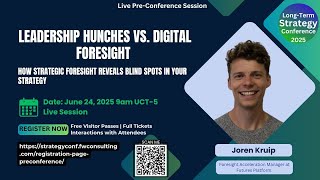
Joren Kruip explains how organisations miss disruptive events by relying on gut instinct and static reports, and how systematic foresight can detect weak signals before they become crises. His Futures Platform aggregates 1,500+ expert analyses and lets teams collaboratively scan for emerging trends using customisable radars and AI-assisted queries.
Chapters
Welcome to the Long-Term Strategy Conference 2025 with my guest Jorin Krijp. So let's imagine that you are looking at all the changes and volatility in the world today and shaking your head. You wonder, could any of this have been anticipated? What if my company had invested some time in understanding all the futures which could have resulted Perhaps if you had some critical insights, you could have acted differently and crafted a different strategy. With the advent of AI tools, you think there must be a structured way to investigate trends which could turn into black swans, the most unlikely events. I am Francis Wade, your conference host, and here today to tackle this thorny problem is Jürgen Kreipe. We'll be looking at systematic ways to explore the future of weak trends using digital solutions. So let me introduce Joran, and I'll make sure that you guys are hearing me.
Joran, welcome. Thank you, Francis. Can you all hear me? Very good to be here.
Yep. Yeah, we're hearing you fine. So who is Joran? Joran Krijp works as a Foresight Acceleration Manager at Futures Platform. In this role, he helps organizations identify disruptive trends and signals. So folks, before I go any further, let me just make sure that I'm hearing you and you're here, or I'm seeing you and I'm— you're hearing us in the chat. So you just drop a note in the chat, so let us know that we are indeed in communication and we're not just talking to each other. Go ahead, drop a note in that chat. I can see people I know. This is going to be an intimate session, it seems. Kelly McIntosh, loud and clear. Excellent, Kelly, great to see you. All right, so let's move on. So let me start off with a story, but before I do that, folks, you should— you do know that this is a pre-conference session for the Long-Term Strategy Conference, and that tomorrow we start in full. Tomorrow is really day 1 of the conference, following day is day 2, and this is a special session to run through the Futures platform. So, a struggling moment. Mike is an executive in a Canadian company, and it's 6 months before the U.S. presidential election. He just got a call from a U.S. customer who is predicting some adverse impacts on the Canadian economy as a result of the election. Mike has heard rumblings on social media and in the press but he really didn't believe the worst until he had this conversation. Now it's all he can talk about. He takes a look at McKinsey's website and wonders if he should be hiring a big-name consulting firm to tell his company what to do. Ha! But they certainly don't have a million-dollar budget to throw at this issue. His chairman who is American, is convinced that only great things will happen in America, and he hopes they happen in Canada as well. You can read between the lines there a little bit. So Mike has tried to do some reading, but there is too much to read and just not enough time. ChatGPT, which he has tried somehow to use, in this case is just useless. So has buying some marketing data from the past 50 years, but nothing, none of it that he bought seems to apply. Matter of fact, the last time tariffs were raised was in 1920s. So those stories and that data that goes with it just seems outdated. How should he proceed? So, Joran, tell me, how have you seen, or how have you witnessed companies, executives, managers, uh, do or cope as they start to detect that there's something on the horizon that's a little bit worrying? I imagine these are the kind of folks you talk with every day, perhaps?
Uh, yeah, actually, thanks, Francis, for, for setting the scene, but this is actually something that we see on, on a daily basis, actually. So, you know, imagine your, uh, Well, a person like Mike, you're working in a company and you're in charge of strategic planning for your business or your government agency, and you know, you work hard, you keep track of the developments in your sector, trying to keep an eye out for things that you think will happen, and then still all of a sudden something happens, something you didn't expect, a new technology, or suddenly a new business model comes in, disrupts the entire market, and suddenly your business is at well, is that pressure. And you feel like, how could I have been missing this? How should I, you know, it seemed to appear out from nowhere. So how should I have reacted to this? You know, it's impacting my business. I want to respond, but how to do that? Why wasn't it not warned? I checked the data that was available. I used my tools, but still, you know, I wasn't prepared. So that is stuff that we hear on a daily basis from from organizations actually, yeah.
Well, and have you gotten all kinds of calls this year related to what's been happening in the US? Has this been like panic, the most panicky time you've ever noticed? I imagine because that's kind of, well, you tell me.
Yeah, well, I think the thing is that nowadays, not just US, we work globally. So there have been many events causing uncertainty, volatility, complexity all around the world. Increasing geopolitical tensions, new technologies on the rise, transitions in energy, stuff like that. So yeah, people, uncertainty is scary, you know, and most, well, I would say most people and most organizations when they face something that is challenging, their tendency is to control. So focus on what we can control, focus on the short term. Well, actually, you know, you can't control everything, you can't predict the future. Well, nowadays you can't even predict what will happen next day in terms of, for example, trade tariffs, so let alone the foreseeable future. So to deal, yeah, actually with that growing uncertainty, well, embracing that uncertainty and think of the long term is very important, but it's not easy. But on a daily basis we see that, we see that happening and that those requests coming in like, how do we start with this, right?
Because companies, you know, people don't really like to hang out in pessimistic futures. They don't. That space is not a welcome, happy space. It, you know, if you're looking at trends, and, and especially if those are negative— positive, sure. Negative, well, you know, there's a glass half empty, glass half full, bring me prob— bring me solutions, not problems mindset that many many managers and executives have, and that tends to squash the exploration of the future, doesn't it?
Yeah, it is. It's so, so, so looking at stuff like that, so the thing is that, that, well, people obviously like a lot of the things, you know, when we talk about disruption and stuff like that, it's, it's, it's often, uh, seen as something negative, but it could also be something positive. But the issue is that disruption is often not caught in the traditional way of looking the way businesses are operating right now. It's not often caught in traditional data models. It's not just something you figure out when extrapolating data or economic data. It's beyond the data. So, but that's the issue because nowadays there's a large trust in quantitative data. There's abundance of data, but yeah, And people, because of that, people assume that things remain the same, especially when they're positive. So for example, our business is growing. Well, if we just extrapolate that data, in 10 years we will be growing and things will go even better. I mean, that's great. And that's the positive sound everyone wants to hear. But at the end of the day, something can happen, something perhaps from outside your sector, because you know what's most of the time what's happening within your industry, the new developments, the people working there, the skills required. But sometimes Trends can spill over from different industries, hitting you by surprise. And if you don't broaden your scope, that's, that's the biggest risk for organizations these days, right?
Right. So for example, just this past— last week, the— or the week before, but in the last few days, in the last month, bombing, bombing has broken out in the Middle East, and there are bombs landing in, in Israel and Iran, and I think Qatar as well now as well. Yeah, and there could be others. And I, I imagine if you're one of the others, or if you're one of the ones in the country, you are, you're very keen to understand and explore futures that— because now it's right on your doorstep. So it's a bit late in the day. They really should have done an exploration a long time ago to say, okay, well, here's what could happen. And done it in just not just a— and here's the thing, you know, people, people think they talk about the future because they had a, a chat over drinks. But, you know, or they had a nice lunch with someone and it, you know, kind of, oh, do you think the future might be— and it, you know, it's sort of very speculative and very loose and very random. But I imagine— I know, but I imagine that that kind of unstructured talk and unstructured is not a substitute for something more rigorous.
True? No, no, you're completely right there. So foresight is actually something, and that's what we advocate, and that should be done on a continuous basis. It should actually be built in in every organization to be done just, well, like all the time, not just when times are tough or when times are going well, just all the time. Because the difficulty is, and that's the difficulty with foresight, because people always, you know, for example, over lunch, or even if they look at trends for the next 5 years, they look at their own industry, people, well, also because that positivity tendency have the tendency to look at the most realistic outcomes, the most realistic future scenarios, and they think about that. But those are also the scenarios they can imagine, you know, there are perhaps a change in economy, maybe some new technological developments, but nothing too major because they can still grasp it, they can still understand it. But the whole thing about foresight is to, you know, to broaden your scope and to also start thinking today about future scenarios that are maybe not as realistic as the other ones you had in mind, but are still probable, can still be plausible if certain events and trends fall into place. Because the future— futures are not just a result of one trend. They're, uh, it's an interaction of interrelated trends, events, uh, things that strengthen each other, accelerate each other. And seeing that interrelatedness, that's the key thing of foresight. So you mentioned the Middle East bombings going on. It's not just about the countries that live very nearby. It's also, for example, countries around the world that because of this, if they have been doing foresight and other stuff, they would know how a conflict in the Middle East would impact them, for example, in oil prices, inflation, stuff like that. Also with other conflicts, it could impact food markets, stuff like that. So if you do foresight, you are always aware like how the world works, how different events are interrelated with each other.. And then you can prepare. You cannot predict, no one can predict, but you can prepare. And that's where it's all about future preparedness, right?
Because, you know, here in Jamaica, we're, you know, we're pretty far away from the action happening in the Middle East, but I imagine that there could be futures that add— I was gonna say add to each other, but I guess they could combine. So bring not just bombs. I don't imagine that we're going to be in the firing line, fingers crossed, but there could be a knock-on effect of the kind of business that we do and whether people choose to purchase our products or services or to participate. Like, you know, I imagine so for our conference, for example, if you were, if you're living in Israel or Iran or Qatar or in other parts of the Middle East and you were interested in attending our conference online, may just have lost internet and have no access to it because there's, there's some disruption happening, which then would translate into an effect on potentially my bottom line or our bottom line here at the conference. So there's a way in which these, these trends intersect with each other. And I think what you're saying is that the real power of foresight is that it allows you to see what's not, what's not in front of you, but what's in your blind spot. Because for sure, you know, operating from here in Jamaica, we have huge blind spots about certain things happening in the world, let alone— everybody does, we're not special— but let alone when you put together trends and futures, and as, as they combine to to have a potential impact, a black swan, deep in your blind spot where you're not looking and you can't see. And doing the kind of work that you're talking about, could it potentially allow you to see what's in your blind spot before it comes right in front of you? Is that possible?
Yeah. Yes, exactly. And that's what we aim to do with Foresight. If you do it, if you organize it in a structured way, different kinds of activities for that and different ways of doing it, but if you do it in a structured and continuous way, you will see that doing these activities, you will— well, we primarily believe in collaborative foresight with multiple people, multiple stakeholders— will always find new potential angles and new trends that you haven't been thinking about, and also maybe what your team hasn't been thinking about or what your organization hasn't been thinking about. But doing collaborative foresight, whether it's horizon scanning or whether you do it to stress test your strategy or to build scenarios, eventually, you know, you reduce the chance that that black swan will actually surprise you. It's not saying that you know everything what could possibly happen, because again, we can't predict anything, everything, but if you have thought about multiple future scenarios, alternatives, There could be one more realistic than another one. That doesn't matter. But when elements of it happen, you have, okay, you're still surprised maybe, but still you have been thinking about it and you'd be like, hey, okay, we have been thinking about it. We see this aspect of it become reality. In our exercise, what have we been doing? Okay, we could actually maybe try this policy or we could now move to a different market or something like that. So you have been, the fact that you have been discussing it before using a lot of other insights, it's preparing you and will make the impact less severe.
Yeah, it sounds as if there's a— it— you're talking about a systematic move, evolution from just gut instinct and what we in the Caribbean call old talk, which is— so old talk is a bit like, uh, casual everyday conversation that doesn't really— isn't really meant to do anything other than entertain the ones who are having it. So to move it from the realm of old talk in a systematic way so that you can actually make long-term strategic plans, for example, around your findings, because you, you'd want— like, for example, Mike, you know, the Canadian company Mike, if he had had the foresight and if he had the insights that we're talking about wouldn't be surprised at what's happening, because a year ago they would have picked up the trend, they would have seriously gone into what's the possibility of tariffs coming, coming to our doorstep, they would have planned for the contingency, and they would have looked at their long-term strategy, and then they would have adjusted it. So there's a whole process that follows the insight. That doesn't come if, you know, you and I are just having drinks and shooting the breeze or old talk. And you're talking about a systematic way, it sounds like.
Yes, yeah, you're completely right there. And I like how you outlined it and how you explained it, but it's indeed making it— the challenge with foresight is not that people don't want to talk about futures. Everyone likes to talk about the future, you know, especially over drinks. You can go crazy. But, you know, the thing about it is to make it continuous, to make, to make sure that on a weekly basis, even make it a monthly basis, people within the organization do horizon scanning, see what's happening globally, even through subscribing to sources, to using tools, and seeing what are trends, technologies, events. Hey, filter out what could be relevant for us, and then making sure, you know, invite other people to talk about it. Hey, on this topic, let's say quantum computing, What if it's there in the next 2 years? How will it impact us? Just having these conversations like, what if, you know? And from those conversations, let's start to make it tangible. So first of all, create combined trends in, for example, a scenario vision. But then also the challenge is to make it tangible, not just like a future story and that people always like to read, but then, okay, so how would it impact the business and how How do we get there? What needs to happen to be prepared? So break it down into smaller pieces, key steps, milestones, stuff like that. Make sure that there are actual tangible products, reports, maybe like an actual workshop internally so that people can actually see what happens from those future-focused conversations, because that's often a challenge that we face in practice. Everyone loves to talk about futures in the long term, but at the end of the day, when something happens in the market, management is often focused on, okay, and now we go back to priorities, which is the short term. But by only focusing, by only prioritizing the short term, eventually you will get, well, you will face the impacts of not looking at the long term. So there's still, there needs to be a continuous foundation for foresight and foresight activities, even though I understand that that's not always easy within organizations.
Right, right. And as you say the word organizations, so there's a— it strikes me there's a big difference between an individual doing foresight and an organization doing foresight. So let's imagine, for example, that— so, you know, I mentioned the chairman of the board of Mike's company, Imagine he's one of these guys who says, I know all about— I know exactly what's going to happen in the future. You know, a bit of an ego, right? Yeah, he, he smart guy, but, and, but he, he, he surely doesn't know everything, but he, he speaks as if he does and he acts as if he does. And he would say, oh, we don't need to do that, we don't need to do all that foresight, I know what's going to happen in the future. And I imagine that you run into that, those types as well, who think that Foresight is a, is an individual job, but when you said organization, it made me think that when the team explores a future, then something very different and very new becomes possible because it's the team. It, it enters the consciousness of a group as opposed to an individual. Um, can you speak to the difference between an individual like the chairman and an executive team that collectively explores and then plans a strategy, a long-term strategy as a result of what they find. Can you speak to that difference?
Yeah, sure. I think to summarize it, I think it's very, well, the key thing here is that one person, even though the person is maybe very smart, very knowledgeable, yeah, can't, see all the perspectives, all the views, probably has way more, you know, blind spots than a group of people who look— even though they might be in the same team, but they could have different backgrounds, different diversities, different views, they have done different studies. So the key benefit of collaborative foresight is that you do it with as many— you invite as many people as possible into the foresight activity to make sure that, well, let's say you have a team of 10. If you do foresight activities together, you already will have covered way more grounds than just that one. Even if you're CEO, you will cover way more blind spots, angles, stuff to look into, and even make it— we would always advise make it bigger. So even if you with the team, you're responsible for foresight, invite others, invite other teams within the organization, or even better, invite externals, experts on the field, but also people from different industries, and let them challenge what you think. And often that will lead to very interesting insights. People with— let's say you work in the energy industry, and one moment you invite someone, an expert in futures from the water sector, just someone completely different. It could be that that person points you towards changes in human behavior, or probably technologies that you haven't been thinking about because you're focused on your own industry, that could be very interesting for the energy sector or could change the way you are looking at things in your work. So yes, my advice would be make it as collaborative as possible invite as many people as possible, because then not only you will get most of the support for foresight because everyone feels like, hey, we have contributed to this, but also you will significantly reduce the risk that you will face blind spots in your thinking.
Yeah, because the, the, the, the, the, the reason that's so important is because I I work with teams when they're making the decisions based on whatever foresight they have. And so I've seen some flaky decisions because they've not done the work before, or just because they're, they're limited. You know, they've been talking to each other for a long time. They don't, they don't do all the things that you just said. They're, they, you know, they're used to a certain kind of conversation, and they, they're even a little afraid to take it outside of the realm of just the things they always talk about. So they're not equipped with the insights that you described. They're not equipped with the, the group. It's almost like the group mind is really small, it's really limited. So when they— when I then try to take them into strategic planning for the long term, what comes out is a product of their limited insight, and it's, it, it, it's not as great as it could be, you know. And it, it probably leaves them vulnerable to things happening and then being surprised. It might— my job sometimes is to ask the question, probe, what about this, what about that, what about the other? But it's still me just asking one question as opposed to engaging in the discipline of foresight. Is that making any sense what I just said?
No, it makes sense, it makes complete sense. And I think also from workshops that I've been in, either in my current job or also in my previous roles in future-focused workshops, you can see that people also within teams are often limited by the way things currently are. So maybe budgets are, you know, currently the way they are, or they are limited, and they will, in their thinking, they will always be limited. So let's not think about— so imagine that in the future the budgets will also be the same. You need to be more, yeah, thought-provoking in a way, like, you know, throw in some wildcards in a way, like what, you know, let's say what if in 10 years, you know, this whole organization will no longer exist or will we pivoted. Instead of being a shipping company, we then will be a data company, something like that, and shock people in a way. That is something that I found that people at first, they need some time, they need some help or need a little kick in the butt to think, to be forced to think differently. But when you do that, then is when the real magic happens in a way. But yeah, that's also why of course, that needs to be done structured. That's also why we, yeah, I would advise people when they do foresight, think about, you know, use methodologies that are available, widely available on Foresight, and do it in a structured way and follow those approaches, templates, and so on, to make sure that, that it's not just a, a nice future talk, but actually you're getting somewhere and you're challenging each other.
Right, right, right. So maybe let's, let's pivot into solutions a bit. And you could share with us how you went from being a policy guy to being a futures platform guy. How did that transition take place? Imagine you saw the problems we're talking about and then based on the problems that you saw.
You're completely right, Francis. So that's very interesting that you bring that up. So for context, and I know there is some people in New Zealand on the line as well. So a few years ago, I was working in my policy job at the New Zealand government Ministry of Transport, Te Mana Tuwaka. I was sitting there at my desk, it was in the midst of the COVID pandemic actually. For the ones who know, it was actually a pretty tough time in New Zealand as a country because it's an island far, far away. And I was tasked with some colleagues to provide the future outlook for the national supply chain strategy. But it was COVID, and first of all, it was a stressful time because New Zealand as an island, there were no longer tourists coming because there was a lockdown. But no tourists meant, you know, no planes, and no planes meant like a lot of supply chain issues because how did the goods get there? So there was a need to think about, to review the supply chain strategy, and Well, my challenge and with my colleagues was like, okay, how do we come up with future insights to look further than this COVID crisis? How do we— what will the future bring? But also most importantly, how do we get stakeholder input when the whole country is in lockdown and we can't even meet face-to-face or organize on-site workshops? So that was actually, well, my attention was drawn to this, to this platform, Futures Platform, that we were recently subscribed to. Hadn't really used it yet back then, but the great thing about it was that it not only provided like a wide range of expert futures analysis, trend analysis, scenario analysis on various topics, global lens impact assessments, very great, but it also gave us the options to map out these insights and and to invite people to host workshops, to vote, to rate, to rank, to share their thoughts on the platform. And that really helped us to get a lot of stakeholders on board, discussed how they see the future, things that we perhaps were missing. And yeah, that was actually how I got excited, even more excited by Foresight and collaborative Foresight. And back then it was perfect for a use case and I actually never stopped stopped using it. That's the story in a nutshell.
And today you're working for Futures Platform?
Today I'm actually working for Futures Platform since I, uh, we moved back to the Netherlands from New Zealand, so to the other side of the world where I'm originally from. And, uh, yeah, I joined the other side of the table. That was, uh, 3 years ago now.
So Futures Platform is a structured way to coalesce knowledge around important trends. It's not just a bunch of reports and it's not just—
No, no, no, no.
Listening to a podcast.
Yeah, no, no, no. So what we do and what the key difference is between, for example, news monitoring websites, stuff like that, is that we have our own in-house team of futurists certified people with at least a master's degree in future studies, foresight experts from all over the world that publish, that conduct research and then publish their analysis in, in very plain, simple English, uh, uh, and, and explain topics. For example, let's say quantum computing again. I mean, I don't know much about quantum computing, but we have plenty of analysis on our platform that if you search for quantum computing, you will see very short and sharp analysis getting background information, impact assessment videos, some key readings, scientific articles, or just normal news articles from validated sources. But most importantly, it shows you what are other related trends that are, you know, related to this topic. So you're interested in quantum, have you been thinking about, you know, the combination AI and quantum, or perhaps China's aim to become an AI leader? And you just easily can click through and do your horizon scanning all in one platform. And it's all in one place— scenario analysis, news articles, stuff like that. And if you want to take it to the next level, you can just easily, yeah, visualize it and invite others. I'm happy to show it right now. Yeah, sure, if you have time. Yeah, sure.
This is not, this is not ChatGPT, folks, where you No, no, no, it's not— what's the bad stuff that could happen? ChatGPT will provide you a dumb answer! Here's what everyone was talking about.
So let me see if I can share my screen here. So let me go to The Lounge. Hope you can see my screen. Can you see it? Yes, I think you can. Not yet.
Oh, there we go. Yeah. Oh, let me add something, folks. You can, you can expand the screen by, by hovering over the top right-hand corner of the screen he's sharing, and if you click maximize, there's a gray button that pops up inside the screen. It will fill up the Fill up the screen. It actually pushes us off the screen. Might not be a good thing, but go ahead, go ahead.
Okay, so, and I will, you know, later on I can also share with you some information on the company itself, but let's first start with the good stuff. So how Futures Platform works, what the aim is of our company is we try to be a strategic foresight company, or actually a futures intelligence company. And people can subscribe to a platform and use this one-stop shop for foresight and futures intelligence in all kinds of industries. So let me just move directly from our homepage. It will not stay too long here to the content database. So already mentioned that we have an abundance of trend analysis, scenario analysis, and so on, on the platform.
Oh, we have demographic I noticed that one of the trends is demographic shrinkage. We have that in our country happening as well.
Oh yeah, well, happy to, happy to, to, to, to show that. I think many countries across the world experiencing that. So what you see here is our content database and I'm just touching in a high level, but over here we have about 1,500 to 1,600 analysis written by futurists, so by human experts, based on their research, extensive research. It's multiple times peer-reviewed. And like I said, every— we have our own team, and every week, you know, new content is published, existing content is updated, so you never have to worry that stuff is outdated and so on. And we provide a global lens. So sometimes yeah, even though you are, for example, in Jamaica, you could stay up to date of stuff that's happening in the Netherlands, for example. But first of all, before I open analysis, what do you see here? Very briefly, you see in the middle under the Phenomena tab, you see different kinds of analysis. I will click one shortly. Um, well, we call them phenomena, but you call them trends, signals. We also have scenarios as well, and you can search here by keywords. You can also search filter by tag on the left-hand side. We have all kinds of industries, but you may wonder what are the colored dots on the left-hand side. You see gray, you see green, you see red. So these refer to the type of phenomena that our futures have categorized them on there. So for example, green strengthening means that based on their research, they think that this particular trend or signal is strengthening, maybe because it's way more in the news, maybe investments are on the rise, or other data is suggesting that. Light blue means weakening, and the global effect is— impact is the other way around. We also have weak signals, which refer to very early-stage experiments, stuff that's going on globally. People are experimenting with it. We don't know yet if it becomes an actual trend, but especially if you're interested in R&D technology, I would suggest keep an eye out for it. And then we have the wildcards, the red ones. I mentioned it earlier. For example, we have one here, let's say the data center bubble burst. It's— with wildcards, it's still uncertain if they will happen, but when they happen, they will have a massive global impact. So there's a lot of talking right now about data centers, investments in it, how much energy they consume. But what if it's a big bubble, for example? So you click on the content card— we call them content cards— and they open up in here. And what you see here is what I tried to describe. Even though if you have no prior understanding of the topic, you can see here, first of all, what is the topic, when is the estimated global impact between 2027 and 2033 based on our research, There's background information, you can translate any language of choice, you can download it, there are videos here. From here we also have opportunity to go to one of our sister platforms that's providing you with quantitative data, because sometimes people need quantitative data to support their foresight analysis, for example, to convince that CEO. You can see here and some data on that. There is latest news. It's always, it's using an AI tool, but from validated fact-check sources. And I see it's not completely loading here yet. Ah, it's coming out. So we have background information, impact assessment, a few key readings that you can access through here, scientific articles or from news items. And more importantly, from here you can go to other related phenomena. So you have been interested in data center bubble burst. Let's say, what about China's aim to become the world leader in AI? So you click on it and very easily the next content card will open and you will be very easily getting to the rabbit hole of Horizon scanning. And I can talk all day about this. We'll move on to other parts of the, the platform as well. But what you can do here, you can also create your own content cards, for example, within your own closed group. If you think like, hey, we want something that has specific content for Jamaica just to use within the team or with our audience, that is possible. People can switch, search for news articles only if that's their interest. You could upload PDFs if you wish. But that's where people usually start the horizon scanning. But then if we move to the radars, that's where you can map out and visualize your horizon scanning work and test it with others. So how would you do that? So at Futures Platform, we have the possibility to create your own radars, fully customize and personalize them as you wish. But you can also download pre-filled radars based on, created on various topics varying from all the key topics in the world: geopolitics, AI, climate change, stuff like that. And you can go from there. So imagine you just have an interest in what we're talking about, our tension in the world already, or select pre-filled, and we say, well, geopolitics, What does Futures Platform have? Oh, well, already they have a few radars that I could use and I could show to, to my colleagues. Well, let's say, what about this one, Future of Geopolitics, for example? And if you wish, you can easily download it, you can select it, and you can create a radar. For the sake of the exercise, we just briefly move to a demo radar that I have open. Um, and what it is with this radar People use these as often for workshop purposes as well. And you can easily— again, everything is customizable here. So what you see here, these colored dots are the type of trend signals that I mentioned earlier: strengthening, wildcards, and so on. But you also see there is a time horizon here.
So in the middle you see 25 We're still seeing the screen with the 3 boxes that you had before.
Oh, sorry. Can you see it now?
Yes, great.
Thank you. Yeah, sorry, I didn't notice that Airmeet, you had to click another tab to switch, but I'm back. Great. So this is the radar, and the goal of the radar is to map out, to visualize the trends and signals against the time horizon that you can see in the middle. So you can see 25 to 45, for example. This can all be customized. So the closer you place the trends to the inner circle, the nearer in time they might happen. The more to the outsides, the further ahead of time they will happen. And people, organizations that work with us, they tailor the Radar for their own use cases. So the white text around the Radar could serve as a framework. So people change this, for example, to the PESTEL framework or to their own company's strategic objectives, and they use that to place the signals underneath to make it easier for an audience to understand where the trends and signals relate to or how they could interpret it against a wider, wider framework. You could add stuff. Again, everything is customizable. So for example, you were talking about demographic shrinkage. Imagine you see this radar and say, hey, I want to add something, for example, adapting to demographic thinking. You can just add it, place it wherever you think it suits best. And if you want to get rid of stuff, you just drag and drop to the dark side. And oh, one thing I would show you here is how we have been using it, for example, in a New Zealand context. So Inviting stakeholders, stuff like that. So imagine you and the team have created this Radar, put in a lot of trends in here, or you just download it and that's it. What you could then do is you could, hey, say, hey, I want to first of all switch on collaboration tools. So I say I switch on voting, I switch on rating. You could select or customize what you would like to rate for. For example, would you like people to ask the probability of happening? When does it happen, and the impact, the fit for strategy, and so on, whatever floats your boat, commenting. But more importantly, once you've done that, you can share your radar, and you can share it, and you can switch this on, and you can share with an unlimited number of people. That's free of charge for all users of Futures Platform. So you can just copy the link, and people that click the link can access the radar. Doesn't matter if it's 5 extra people, 500, 5,000, and you can just ask like, hey, for example, Francis, imagine you're an expert on demographic shrinkage. I have created this radar on that topic. Please vote for the top 10 trends that you think are most important for Jamaica to address related to, well, this overall trend radar. And you just, you know, click the link and you click on the content, and not only will you be able to read the content, but you can see you can upvote as an external person. You can rate here, you can say it's a long-term, it's the near-term threat, it's a threat, it's an opportunity. And all this feedback is captured, and you as an organizer, as a facilitator, you can view this in real life, the collaboration dashboard. And you can see here, hey, what are all the votes, or more importantly, what is all the— what are all the rating results? For example, everything is displayed in the 2x2 matrix. You can see an individual level, you can see that, hey, what is the average rating, what are individual ratings. So you can very easily, in a fun way, you can start doing collaborative foresight. Everything is easily to be shared to be downloaded. And this is how many people use our Radar. And if I have a little bit of time, I will actually show you nowadays also how we leverage the power of AI on our platform to actually do these things even quicker, because we know time nowadays is scarce. And every day there are, there is stuff that you, well, need to follow up on. So if you can do things a bit more efficiently, then that's always, uh, I'll actually go to the lounge, right?
If I could comment just really quickly on what, what I'm getting from, from what you're saying, because you could, in a, in an expensive, or in a, in a world with a lot of revenue, you could hire a bunch of experts to do all of these studies and pay them And even after they've done their studies, their information is going to be static. It's going to be written. It's going to be on a shelf somewhere. Um, somebody's going to have to read it because not everybody can read it. So you don't get the, you don't get the team effect if you have 50 studies and you, you, you run the risk of it going stale really quickly. So this, this, this, this strikes me as a a super cost-effective way to arrive at a hell of a lot of insight. Am I catching the drift?
You're definitely catching the drift. Yeah, that is also what we hear a lot, that if you use Fujitsu's platform, you can tap into all these insights, do it collaboratively so you get the team benefits, so people are actually upscaling their own capabilities and you don't have to spend well, like Mike in the story, and you don't have to spend a billion dollars on expensive consultancy companies who are, no offense for consultancy companies, but from our experience, sometimes in, let's say, in the countries where I've worked, they don't have much more experience on foresight usually than the people in the organizations themselves, or definitely not the people working for Futures Platform, as we were founded by academics and futurists. So on the platform, you will also find a lot of methods, articles, e-learning to upskill yourself in doing it yourself, because we really believe in the power of collective foresight. That's also something that we really want to facilitate.
You're empowering the employees, the staff of the company.
Yes, yes.
Do your own foresight with respect to these trends. Exactly.
Yeah, exactly. And we see more and more organizations actually doing that nowadays. So that's a great shift. That doesn't mean that people don't use AI nowadays. I'm not saying we're not, you know, against AI and stuff. We really think that, you know, at the end of the day, humans should have an important role in foresight. But this still doesn't mean that AI could be a great partner in the foresight process, in ideating, for example, or quickly, for example, on our platform quickly navigating and finding trends and signals based on your research questions. So like I said, we have an abundance of analysis on the platform, but sometimes just your manager stands at your desk or your CEO, Francis, and you say, hey Francis, I've read this or listened to this podcast on quantum computing. I need to know by this afternoon what the possible impacts could be for Jamaica. And you're like, okay, where do I start? Yeah, I don't have the time for this. So then you go to Futures Platform and you use our AI Futurist. And for example, you say something like, well, what are the key disruptors shaping the future of, well, let's say, well, let's make it to international trade by 2035, provide detailed analysis on the role of AI and quantum technology. She can make it very specific and their impact. So something like that. Maybe if your CEO is asking this, you can use our AI Futurist. And what it does, the difference with ChatGPT is that our AI component is restricted to our platform. So you also don't have to worry that you are uploading your prompts or training any models that you don't want to that you don't want to train. So it's restricted and it's using only information you have uploaded yourself and/or content. So if you don't have the time to go through this 1600-word analysis, you just prompt it based on what you want to learn, what your question is, and it actually provides you with a big response. And not just the response, it also shows you, hey, we based our answer on the following trends or analysis on the platform. So for example, well, quantum computers and post-quantum cryptography. So instead of you having to search, AI suggests and you can come up and say, okay, this is actually, this is interesting for me, this is what I want. More importantly, you could say, hey, features platform, convert this into a radar for me. So you click on the show radar sketch button you could actually say convert this to a radar. And when you do that, you will create something like this, what I showed you earlier. You could easily switch on collaboration tools, switch on the shared, the public access link, and within no time, within 15 minutes, even before the afternoon that your CEO requested it, you have set up a very nice engaging futures roundtable. And that is the biggest, one of the biggest wins of AI for us and also what we hear from, well, from clients lately. Like now they can actually do foresight in a very efficient way and that really helps them to produce tangible insights, which makes it easier to get buy-in for stuff and to, well, to play more on the ball. When something happens, they can, hey, we have stuff on that, let's use AI to pull up the most efficient analysis or to create scenarios on this and so on. So being cautious of the time, how many minutes do I have actually, Francis? Do I have 9 more minutes?
We have about 10.
I have about 10. So, okay, so one thing I want to quickly show you as well is how you can also use it for other Foresight activities for scenarios. For example, I would actually share, switch tabs again, and then I would briefly talk about, you know, lastly how to reach out to us, who are current clients, and then any questions if possible. So one more thing, just to show you the different use cases, you can also say like, hey, I would actually create, you know, create me 4 scenarios on the Well, let's say the future of AI in Jamaica with technological advancements and let's say rise in geopolitical tension or political tensions as the key drivers of change. So if you want scenarios, again, you could easily do this and search for scenarios. You probably have seen the PDF button here. It's also possible to upload within your own secure group, upload relevant documents, especially helpful for clients.
Yep. We're not seeing the, we're not seeing the screen again. Were you still sharing?
Are you, are you sharing? Oh wait, I was—
no, were you, were you sharing?
Or— I am sharing the lounge now. It says that I'm sharing this. The tab.
Are you seeing it? Oh, I'm seeing it now.
Right. Okay, maybe there was a little delay, a little glitch. Okay, no worries. So I actually asked for scenarios, just for sake of the exercise, future of AI in Jamaica. But you can see, you know, what it does as well. You say, okay, I've asked for technological advancements and geopolitical tensions as key drivers of change, and it comes up with scenarios. Tech Island Prosperity, Hub of AI Innovation, Digital divide deepens. Oh, that's probably the other way. Cyber Caribbean chaos. Okay, well, that's, that's something. Hey, you could say, hey, please expand, create a development path. What should the Jamaican government do to— what should, uh, what should my company do to, to, you know, capitalize on these developments or, or to prepare for this? And that's the kind of stuff how people use it, not because they think that AI has all the answers ready, but just to challenge their own thinking. Sometimes people upload documents and say, hey, find me the blind spots in my own strategic document, you know, just to testing and see if you can, can break stuff. That's what AI could be, could be helpful for. Um, now just very briefly, uh, showing like the, the, um, who we are working with nowadays, and I'm not sure if I can share my— I might not be able to share a PowerPoint slide. Is that also possible?
Sure, just open up the— pick a different window.
Yeah, I'm just seeing if it should be a different tab screen. Yeah, it says a browser window or tab. Let's see, I have it open in PowerPoint. Not sure if that's possible to switch from here, but otherwise I can always share it with— oh yeah, got it here. Awesome. So can you— I think you should be able to see it. Can you see it?
Yep.
Okay, that's awesome. So very briefly, uh, I know my time is about to end and touched most of it. We are the trusted partner in digital Digital Solutions in Strategic Foresight, talked about this. We support each step of the foresight process: horizon scanning, collaborative foresight, stress testing scenarios, and staying up to date. That's most important, making continuous and monitor the latest developments. A few of the slides, we have a lot of clients all over the world, not all of them we can disclose, in all kinds of industries. It's 50/50 public and private. We work— well, you can see, you probably remember a few names— also in the US, Asia, Europe, of course, Latin, and Africa as well. So yeah, every industry is very well represented, and if people have any questions on, on what kind of clients do you have, case studies, stuff like that, happy to share more information on that. Also, after this session, I will move to one of the tables. If people have questions, feel free to ask any. And I mentioned already briefly earlier, but Futures Platform originally founded as a foresight-only platform. We nowadays also have a partnership with Statson, a quantitative market intelligence company that now falls under the Futures Platform umbrella. So we can also tap in their abundance of quantitative data. So combining foresight and market intelligence to enable futures intelligence, the next era, I would say. So, oh, interested to learn more? Contact me. I will share my contact details in the chat as well. And also check out our Foresight Radar on the, um, the platform website on the futures of decision-making, where you can leave your votes, comments, and so on. We will read it all. So, um, Yeah, happy to discuss further and feel free to reach out to me.
Is there a demo link, Joren, that you recommend, or is the conference— I know you have a conference page on your website. Is that—
yes, there is actually. That is a good next step. I actually don't have it here, but I can share it probably.
I have it.
Oh, you have it. Okay, that's great. Yeah, people could access it there as well. That's probably best. You could share, that would be amazing.
And, uh, is it okay if I drop you your email?
Yes, email, LinkedIn, the whole shebang. You can drop it.
I think I have them here as well, because that's the best about Foresight.
Everyone loves to talk about the futures. Now is the case to make it more structured and continuous, and we could all do great stuff.
Cool. Any other comments or questions, folks? If not, okay, so what's gonna happen next? If I know people might be typing a question, but what's gonna happen next is that we're gonna close the stage and the screen will immediately revert to tables as Joren mentioned. So he'll join a table. I imagine table 1, 'cause makes sense. And then if you have questions of him, or if you want to discuss the platform or anything that he mentioned in more detail, just click on the table and you'll be able to have a semi-private conversation. It'll be whoever is at the table. You can share videos, share audio, and ask him some more about what— anything he's talked about, or anything that's related to the conversation that we've had so far. Um, also the video is going to be available at Strat Cinema. So that's stratcinema.fwconsulting.com. Um, let me type that in. It is— it should be available by tomorrow for your viewing pleasure. stratcinema.fwconsulting.com. It'll be available on demand for both days of the conference. So we're creating content that we're going to be using Great. Okay, questions or comments? If not, I want to thank you, Oren, as we close out the stage portion of this event. Thank you, Oren, for, um, well, first of all, for your company being willing to come and share its product with us.
Sure.
And thanks for you to also personally because I know that you almost didn't make it, but here you are. We're really happy to have you.
No worries. Happy to be here. It's a pleasure to be here and to talk about Foresight and Futures. That's always great. It was a pleasure.
Great. Please thank your team for all the fun that we've had going back and forth and trying to figure out how to do this because these demos aren't easy to do in a conference setting. I appreciate you guys being flexible and you putting up with the torture that, you know, I put my speakers through. So great that you survived and came out the other end.
Yeah, no worries. Happy to, you know, facilitate any future occasion as well. So pretty much enjoyed it.
Fantastic. All right, folks, so I'm going to stop the pause, stop this session, close it, and then you can meet Joran in just a minute over at the tables. So see you later. Okay.
Thank you.
See you in a few.
Thanks for coming.
More from Francis


Ep 35 Your Strategic Stagnation Isn't a Framework Problem—It's a Story Problem



The YouTube Strategy School: Why Your MBA Didn’t Teach You Strategic Thinking





