Hard to engage staff on vision/strategy? Do it in your sleep with AI w/Amie Devero
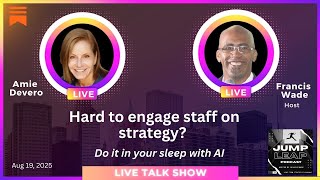
In this informal podcast episode, host Francis Wade and guest Amie Devero explore why traditional one‑way communication of corporate strategy (town halls, slides, KPIs) fails to activate employees. They argue that the core issue is not a lack of information but a lack of activation – the strategy must become a lived decision‑making context for every employee. The conversation distinguishes between communication (broadcasting) and activation (embedding strategy in daily choices) and highlights the pivotal role of managers as the bridge. Both participants present AI‑driven solutions they are building: Amie’s prototype "Contextuum" that lets a strategy owner dialog with an AI to distill principles, map competitive matrices, and generate an interactive onboarding experience for staff; and Francis’s approach using shared‑language models like NotebookLM to create searchable, multimodal strategy repositories that employees can query, listen to as podcasts, or watch as video summaries. They discuss how AI can provide moment‑by‑moment decision support, surface relevant principles, and anonymously aggregate employee‑AI interactions into dashboards that surface recurring pain points and strategic gaps, creating a feedback loop for continuous strategy refinement. Technical challenges (slow UI rendering, AI hallucinations in competitor analysis, need for editable data) and practical considerations (ensuring usage, integrating into performance reviews, handling time‑zone differences) are also covered. The episode ends with a call to iterate on these tools, schedule future discussions, and invite listeners to follow their work on Substack.
Chapters
And if you're joining us here at the JumpStreet Long-Term Strategy Podcast, I'm here, I'm Francis Wade, your host, and I'm joined today by Ami Devoro. Ami, welcome.
Hey, good to see you, Francis. I'm having more technical difficulties, so I'm trying— I'm not used to doing anything media related on a phone, so I don't really know what I'm doing here. So I'm trying to adjust the volume so I can hear you better, but No problem.
I'm also having a bunch of technical issues. But anyway, let's jump into our challenge of the day or problem of the day. And the title, as folks may have seen, is How to Communicate Strategy and Vision to Staff. Do it in your sleep with AI.
I think that might be a gross overstatement.
It took me, but it's a real problem, isn't it? That, coming from a platform, a section, or a series, or a project, a CEO or a chairman or an executive wants to communicate the strategy and the vision to their staff and they want to engage with them and they want to get stuff going because it's not enough just to have burn it in the paper. Now they have a real talent and maybe they tried it in the past, they thought it would go well because they were very charming or, you know, lookish or good looking and it went really bad and now they're burnt, you know, they realize that they're not Tony Robbins combined with Les Brown combined with Zig Ziglar. They don't have that magic touch when it comes to inspiring others. They have to do it again because it's a part of their job and they are reluctant to even start thinking about it. And so does that capture the problem that we're looking to solve?
All right, hang on. I need to adjust something. Of course, I don't know how to adjust it, so just give me a second because it's really weird. How it's here, how I'm hearing this. Oh boy. All right. I don't know how to adjust what I'm trying to adjust. So, all right. That's, I'm not gonna waste time doing that. I'm just gonna try to decipher what you're saying, even though it's coming out sort of exceptionally muffled. Um, I actually think that that whole context is a little off, so I don't know that communicating strategy is, that it's necessary to be inspiring. I think it's necessary to inspire people with a vision, but it's not necessary to inspire people with a strategy. And I also don't think that communication tells the whole story because what I see a lot, and maybe you do too, and, and not just like in my own practice, but also I, I mean, you see this in case histories, you see this if you follow the stock market, if you, you know, go to earnings calls and all that kind of thing, is that a new strategy is developed and then the CEO and/or executive team go on an evangelistic tour. So they do a bunch of town halls and they put out a bunch of PowerPoints and they have meetings with their teams and they build balanced scorecards and they cascade KPIs and There's all this stuff they do, but it's a finite, it's like a finite tour, kind of like a, like a campaign, right? And so they spend a month doing that, or they spend 6 months doing it. It doesn't really matter whatever the timeframe is. At a certain point that stops. And then what the entire employee body is left with is the metrics and they, they no longer have. Any reinforcement for the strategy. And they never really had the strategy translated into their own job. They only ever had this kind of big picture version of the strategy, and maybe they got some kind of departmental version from their VP, but they never got, they never got to address the question of like, what does this mean for me? What does this mean in my choices? Between, you know, doing X and doing Y. And nor is it an employee's job to even ask that question. So that whole thing takes place. They're left with metrics and KPIs. Their job now is dictated, the success in their job is dictated by fulfilling performance metrics that hopefully are somehow connected to the strategy, but maybe they are and maybe they aren't, and maybe they are, but they contradict each other. Or maybe they drive the wrong behavior. Who knows? Because the strategy is now a memory. It's not present. And so when I look at that, I don't see a communication problem. It's not that it wasn't communicated. What I see is an activation problem, that it's not active for for employees in the way that it may be very active for the CEO. It's almost certainly very active for the board of directors. It's not activated within the employees, any of them probably. And that lack of aliveness is where the strategy goes to die. It's like that gap between communication and activation is where strategy dies.
All right, let me, let me, let me— because I agree, of course, or I wouldn't have you on the program, right?
But, uh, well, I don't know about that. I mean, we can have a great argument about things we disagree about.
Oh yeah, um, but someone who is listening— and I do see that we have a listener— who's one? Thank God. That, what are you talking about? Because every CEO and every chairman has this as a communication problem. And I've been reading, you know, reading about, you know, the solutions that people are positing on LinkedIn and podcasts, and their solutions always make it sound like it's easy, like it's just a matter of telling people Like, it's not hard. It's, it's, all you have to do is to make it simple. And all you need to do is to simply communicate. The word simple is often attached to the communication as the solution. And I think that's the trap, because then the thought, the thought of a CEO is, oh, I need to communicate better, or I need to communicate more, or I need to do more town halls, like you said, or I need to I need to send out more resources, like more reports, or I need to get my managers to have more communication with their staff. It's all a more, more, more, more, more type phenomenon because what they've done in the past hasn't worked and what they're doing now, as far as they can tell, their part to play is to keep talking or to get someone to keep talking or keep spending or get people reading. Or somehow, but it has to do with more communication. That's the, that's basically the response I'm proposing.
And I think, I think the really telling thing is that in everything you just said, you could substitute the word talking for communicating. And communication is not, first of all, about talking. So there's no amount of talking. And by talking, you could substitute typing, emailing, measuring. None of those things are communicating, right? They're just, they're a one-way delivery of information. And then of course, these LinkedIn posts and so forth that say, just, you know, it's easy, just whatever, just talk more, just do a PowerPoint, just dumb it down, just turn it into a single rule. All this stuff. Again, that is all just delivering information and none of that becomes activated in day-to-day activity unless you have an exceptional manager who does have the capacity to take the strategy and employ it in their day-to-day management of their team as they make decisions on an ongoing basis about, do we do this or do we do that? Do we put resources into this and take them away from that? Or do we not do that? Do we close this deal even though we're not going to deliver the thing we promised the client, or don't we close that deal? Are you taking a break from listening, or I mean, are you still with me while you're changing technology?
My technology is giving me—
can you hear me?
I hear you fine. I'm just making sure that you're not like left out in the cold while I'm yammering on.
So—
My technology disconnected in the middle of what you were saying.
Special feature.
Special feature.
Could you just do a recap for me just so that I have it right?
So, a couple things. One is that just saying more is not the same thing as activating it in the mind of the employee. And so, no amount of just doing more as a CEO delivers the activation piece because the activation piece has to live inside the employee's experience. And so the, the probably the one case in which that happens is if you have an extremely strategic manager who in his day or her day-to-day management of her team actually brings the strategy to the decision-making table. We're trying to decide, should we put this clause in that contract even though we can't deliver this and we're gonna possibly impact our retention rates, or should we over-communicate with the customer and reset expectations even though we might lose the deal? That's more real, like where the rubber meets the road, right? Is in these like moment-by-moment decisions about like, do we screw the customer later or now? You know, like, because that's really what happens, right? So, and then the manager says, well, let's look at our strategy. How would our strategy decide that? Well, maybe they go blank, or maybe because they have such a killer manager, they are with her, right? Because it's been an ongoing subject of conversation. And it is the context inside of which decision-making gets done, which is what activation is. Strategy as context. And that's the piece that can't be delivered with more one-directional blah, blah, blah, blah, blah. This doesn't do that.
And I think the point is you have to have a manager. I've met a handful who can do what you're talking about and who are willing for many reasons that won't necessarily get into, but the manager has an even harder problem than the CEO, I would say, because now you have people who are looking at you with black faces if you haven't communicated it however.
Your new technology is much worse than your old technology. It sounds like you're swallowing every word. I can make it out, but it's taking a tremendous amount of energy that I will put in because I'm your friend and our listeners may not. Talk amongst myself? All right, I will talk amongst myself. No, but I think that points to exactly the problem, which is that if you have the sensational, amazingly strategic and gifted manager who can bring strategy to the moment-by-moment life of the employee, then you're lucky. But again, I don't know that executing strategy ought to be a matter of luck. You really want a way to do this that is effective, that is consistent, that is reliable, and that doesn't depend upon the, you know, the good fortune of having a brilliant manager who both has functional skill and that skill. So, in the absence of the brilliant, you know, one-in-a-million manager, the question we wanted to ask is not only is there a way to do this, at all, right? But is there a way to do this that could be assisted by AI, which is just interestingly something both of us have been both together and independently working on? And I think the answer is yes. And there's a lot of ways to crack that. But let's talk about what it would look like for— what does it look like for strategy to be activated at the level of the employee? And by the level of the employee, I mean everyone from the receptionist to the janitor to the customer service rep, you know, to the guy writing code. What does that look like?
And, well, let me, let me test to see if you're hearing me.
Oh my God. So good. So much better, Francis.
So good. Okay. No more Bluetooth. Okay. So, so activation then. This business of someone acting on behalf of the strategy where they're doing the kind of things that you mentioned, where they're making trade-offs, where they're discovering, they know the nuances, the—
Or they're creating the nuances.
They're creating nuances every day. They're engaging, they're seeing holes in the strategy and they're communicating those holes because they're, you know, the problem that people have been trying to solve with open strategy is that the people on the front lines know the day-to-day, and the people who develop the strategy don't. But you can fix that if your employees are activated because they will communicate the holes in the strategy upwards to the executive team. So it fixes all of these problems that you really want to have fixed.
I think you're, I think you've gone a step beyond what activation fixes. And, and let me say why. So I think that if strategy is active for employees, it becomes the context for decision-making.
Yes.
And that's really the goal of what we're talking about here. I think the next step you go to, which is this kind of feedback mechanism, does not happen automatically by virtue of that. Because that's a process problem. And just because an employee can make decisions that are contextualized within the strategy or can discern principles that may not be implicit in the strategy, may not be explicit in the strategy, but turn out to be implicit. Doesn't mean that they can identify strategic problems. What they will identify are things that for them are complaints. And, and that's fine because complaints are often symptoms of strategic problems. So I don't think it follows that activated employees provide feedback that goes up. They may, they may not. They may just complain. They may just fail at executing the strategy. But one thing's for sure, step 1 is you need the strategy activated. You need them acting with the strategy as context, and you can't do that by talking to them.
Right. Well, let's, let's, let, let me, let me put off the, the explanation of why I said the upward feedback would happen for when we discuss the different approaches that we're taking to solve this problem. So, let's pivot to how can AI be used to crack the activation problem? And I know we've been coming at it from different angles and collaborating. So, can you— would you like to go first and share what you've been doing?
Sure.
Working on?
So, I'm actually— this is such perfect timing because I actually finally have a prototype I can share with you. I finally got— I mean, I've been— Yeah, I have been fighting with a vibe coding platform now for, um, I don't know, what is it, a month and a half, 2 months, 3 months? It seems like forever. I apologize to my subscribers. I have literally not published a word because this is all I have been doing. Um, and vibe coding is a very tedious process because something as simple as rendering a matrix can take 3 weeks to tweak. And I can't go away and write a paragraph because the AI iterates really fast. Not fast enough for me to get into a flow, but too fast for me to write a paragraph. So anyway, what I've been creating and what I think is one way to craft this is a way for an organization's strategy owner, whoever that is, to give enough information to an AI that the AI can understand the strategy and through an entire dialogue, take that strategy, map it against a competitive matrix, discern principles. This is all through an interactive process with the CEO or strategy owner. Come up with a, a version of the strategy that the CEO says, yes, that's it. You got it. This is without any particular documents, any particular format. This, this process walks you through with whatever you have or don't have. He can then have his colleagues, the rest of the leadership team, vet it and come back and say, no, actually this is a little bit off and that's a little bit off. I need to change this. And that's not really how it works in product. It works like this. They get it all wrapped up and they have the strategy and then they can disseminate that to all the employees, and the employees themselves go through an interactive onboarding to the strategy and can then utilize that AI to make real decisions. So, I mean, the, the onboarding involves, again, an interactive process where the employees learn the strategy and then answer questions or gives solutions to dilemmas based on their read of the strategy and the AI helps them internalize that and, and get the nuances. And then as they have day-to-day dilemmas, if their manager's not the one they talk to, they can go to the AI and say, look, I've got this problem. This contract's about to go. This, the, the customer is expecting this feature. The team's not really gonna have the feature until next year, even though they're saying they're gonna have a beta in 6 months. Do I run the risk of closing the deal? And the AI can take the principles that have been discerned from the strategy, take the scenarios that the CEO already sort of did the process with and gave the AI what the answer was, and help the employee make a decision that's consistent with the strategy. So that process answers part 1, which is activate the strategy. And this use of this tool can become part of the performance review process so that you can actually enforce that employees do need to use this thing. It's not just left up to them because otherwise they won't, right? Because why add one more thing to do?
Yeah, it's not optional. Especially if you're in a strategically sensitive or, um, you're in a pivotal role. You're in a role which the strategy relies on. That you need to do something different and the strategy needs to help you to do that different thing, especially for those people. Cause there's some people like the gardener, you know, people who do customer service who may not be engaged directly in the new strategy. They may just be doing business as usual.
Right.
Like the accounting team. Yeah. I think like maybe the accounting team is doing maintenance. They're not like strategically, but I think anybody who interfaces with customers or service or product creation or product delivery, unless the strategy is like a back office financial shenanigans strategy, which there is, are such things, but most strategies rely on a particular positioning with respect to customers and product. And that means that everybody who touches those areas has strategic importance because there's a big difference between how you sell a deal if our goal is retention and long-term customer trust versus our goal is lots and lots of sales and we don't care about churn because we're just trying to show revenue growth. Like, those are different strategies, whatever our opinion might be of them.
But the availability of the tool makes it more— and this is a way— what you're talking about is literally, you could be sleeping. And your employees may be taking a nap in the middle of the day, and your employees are accessing—
Well, you could be in a different time zone. I mean, you know, you could be, you could be on the other end of the world and your employees are utilizing the AI to parse decisions and to think through how to deal with what is truly a dilemma. Like both things are advised and both things are ill-advised, and how do you choose between them?
Right. We need to do a whole podcast on just this thing you're working on, of course. So coming to come, right? So let me share a little bit of what I've been doing with the time we have left. So I've been focusing on the first part of that problem, which is the initial communication to staff, kind of like the onboarding. So, Abhi mentioned before that the options have been pretty crappy, which is you have a town hall, and you get no answers, usually. You send out a document that nobody reads because it's too long, it's too awful. You rely on your middle managers who themselves don't really understand what they're communicating and will, you know, pick off some little small piece and decide that that's the piece they're going to focus on because the parts outside of their understanding are just too mysterious, so they don't even get into it. So, I've been focusing on that first communication to say, how do you introduce a strategy to a group of people, to an audience who wasn't there in the development of it? And so far, the techniques that I've used, I've used with using with a couple of clients so far, is it's pretty simple, actually.
It's pretty cool, though. I mean, I think it's very cool.
Well, thanks. The first part has to do with, you know, where's the company? In the terms of its past and its present. It's sort of a, what's the background? What brings us to today? And what are the salient facts? What are the known challenges? What are the scary trends? It sort of packages them into one very simple display. And then the second part is a look to the future, which is what's the target year?? And in my case, target year is usually 15 to 30 years old. And then what does that target year look like in terms of metrics, in terms of experiences, or different ways that you could describe it? And that's a separate, that's a separate, that's a part 2, which is sort of a standalone. And then the third part is a variation of a shared language model like NotebookLM. Which, in which the strategy documents, and when I say strategy documents, it could look like a traditional report, for example, but nowadays we can also include things like transcripts, videos, audios, results of surveys, results of interviews. If you want to get fancy, you can pull in stuff from industry if you really want to go to town. I I think that's not as important, but all of the materials that were a part of developing the strategy, if you capture them, can be converted into content sources for a NotebookLM. Folks, if you're familiar with NotebookLM, it allows you to enter into a closed environment and query the contents of the environment. So some using natural language, so someone can enter a—
Okay. I think, yeah, you made that, you made that more obtuse than it needed to be. I mean, NotebookLM is an AI that lets you upload a bunch of documents. They can be links, they can be documents, they can be books, they can be anything. You put as many of them as you want up there. So that's like your source list. And then you can ask questions about any or all of them, and you can ask it to tell you more about things or explain something to you or ask it what the inference is that it would make based on any one or all of those sources. So it's just an interactive interrogation of source material.
Right. And you can ask it to cross-reference and compare and contrast between, and you could say, what are all the mentions of this phrase in all the conversations that were had to develop the strategy? And it'll faithfully tell you. Someone said it's a bit like getting a junior assistant to read everything and then remember everything so that when you ask the junior assistant, they're not going to be smart about, you know, what the contents are, but they will remember everything and they'll faithfully, you know, tell you what is in the everything in a way that a human, human beings really can't, you know, or don't.
And even if they could, we're not going to.
Yeah.
And the other thing that it'll do is if you really don't like charts and graphs and whatever introductory materials Frances gives you to explain the strategy, you can have it make a podcast of all those sources and listen to it. And NotebookLM's claim to fame is that it will turn anything into a podcast, which is with, with AI hosts, which, so Frances and I don't have to do it for you. Which is fine with me because I hate being on camera. And you can just like listen to the podcast.
And then they also, there's a new video. I haven't tried this yet. There's a new video. I forget what it calls it, a video summary, but there's a video version that it can even do. And again, I'm not trying it, so I can't tell you how well it works.
Oh, I'm trying, I'm trying that today. So we're thinking what, like, like AI avatars or?
No, no, no, no. It does a voiceover over like a PowerPoint presentation. It puts together slides. Not that exciting. I know that would be exciting.
Not there yet.
But anyway, point is that someone who wasn't at the retreat and any staff member could spend 10 minutes, 10 hours interrogating the heck out of the strategy. In other words, What does this mean for my job? Is there any application for this? Was this considered? Is there any, any, any thought that this new technology would have an impact? They can ask all of these questions in excruciating detail. And here's why I said the bit about the feedback is that ideally their questions, if they're pertinent, and there are probably a bunch of them that are going to be pertinent, are going to be about the assumptions that were made when the strategy was done. So I'm working with a client now that's actually rolling out this system. The problem is that it was done 2 years ago. The strategy was done 2 years ago. I don't think we mentioned AI other than just in passing. It's this weird thing. What's this AI thing, huh? We're all kind of looking at each other and, you know, I was facilitating and I can't remember the phrase even came up once. And I could be wrong, but I AI, it was not a big deal. Today, it's a huge deal for this organization. So they actually need the employees who are most familiar with AI, which are going to be the younger employees on average. They need them to say, well, the assumptions that went into that strategy 2 years ago are no longer valid because here's the new technology that's emerged, and it needs to totally reshape. So there needs to be this upward, not necessarily upward, but at least this rejiggering of the strategy because this new technology, this new disruptive technology is now available. So possibility exists is that if you allow people to engage, that they will have something to say and it might be, might be important.
Well, and to that point, I mean, I just wanted to distinguish those two, not because they're not both incredibly important and ideal, But because I just don't think one necessarily engenders the other at a process level. I will say that the thing that I'm building, which if for any of you who are, any of you one who are interested, Anne, thank you for being here, Anne. We love that you're here. You are currently both of our favorite, I don't know if you're a subscriber, but favorite person. The tool I'm building called Contextuum will actually provide that feedback. So what it does is it anonymizes the content of every every engagement, every conversation that an employee has with the AI, but it will infer implications from trends. So let's say like multiple salespeople are complaining about features not having been released on time and they're having trouble renewing clients and they go to the AI to ask like how to renew in the face of that we didn't deliver this thing. If that happens more than a few times, that will be a point of interest that the CEO or the strategy owner would eventually get back on a dashboard. And the dashboard also allows the CEO to see what are recurring issues, what are recurring principles that are being questioned, what are points of contention, what are frequent types of complaints. And since the AI is based on anonymizing all of that, it's going to provide that feedback in a way that really does cloak the identity of the people involved, but that provides really important iterative insights that can potentially inform tweaks to the strategy or rethinking of assumptions or rethinking even of entire strategic themes. And I do think that, that, you know, why build a tool that activates strategy if it doesn't provide an ongoing feedback mechanism? Because strategy is dynamic. And even the tool I built itself, every piece of the strategy can be revised at any time by the people with permission to do so.
So, right, right, right, right. I think the thing that we discovered, folks, and this is all in the last 3 weeks, Ami, that we started this.
I don't know, a month, maybe a month.
Maybe a month. We couldn't have done this 6 weeks ago for sure, because we hadn't even had the initial conversation. The thing that's different about what we are trying or doing, as opposed to what I'm hearing about, is that this involves people. This is driven by stakeholders. In this case, staff is what we've talked about, but it could be any stakeholder. It's not driven by AI searching out the corners of the internet to try to find where your strategy may have gone stale. That has its place, but compared to the activation of every single stakeholder or employee, board member, you could even get customers involved.
Oh yeah.
Doing it in a systematic way, using a dashboard, using an SLM, is through people using AI. It's not instead of AI. And I think that's where authentic-euphonium—
And what's really—
Anybody see what we're talking about?
What's been so interesting as I've been building this, because I'm not an engineer, and so like I'm actually having, I'm sort of learning a lot about coding because of all the bugs that keep getting created. And I am the only thought partner the AI has. And I, half the time I get annoyed with it and I'm like, no, stop doing that same thing. Let's try it this way. And the AI's like, oh yeah, we could do that.
Brother, it's very, it's very obedient.
I mean, like, Holy cow. Like, yeah, we could do that. I mean, like really simple things like stop forcing it to be a container that's all lateral, wrap the text. I mean, honestly, this has been like a thing like 3 weeks working on a matrix rendering. But anyway, I digress. But what's really been interesting is that the few things that I've asked the AI to do within the program, that is to like, I ask it to go out and find competitors, right? So you have this initial developmental document or whatever the CEO has given you. Now populate some competitors. It's terrible at it. It's terrible at doing that piece. I mean, it can find the competitors, but since I'm having every competitor, including the user organization, is rating itself on these competitive axes, like, you know, expensive budget or, you know, different axes, the AI rates everything dead center. Like it literally can make no determination as to, yeah, it has no distinctions at all. And so I stopped having it rate anything. I said, yeah, populate it with competitors, but it's gotta be completely editable so that the user can delete all the competitors if they're stupid, you know, or irrelevant and add their own. And, um, so like almost everything that I had the AI populate through its own research, has had to become either, either be dispensed with or become entirely deletable and editable. But everything I've asked it to do in terms of discerning and inferring and crafting or extracting principles from the truth that it's been given, it does expertly. And that's the piece that you can't replace without humans, except Humans can't do it as fast or as consistently or for every employee in every instance and all the myriad use cases there are.
Right, right. So, I mean, we're just at that point. We need to wrap up.
Yeah. To be continued.
Thank you for showing up. We have 4 people and me.
Of course.
Thank you. Thank you for jumping on. We talked this morning, and here you are. Thanks for jumping on at short notice. And folks, you can follow both of us on Substack. And if you think we should do another one like this, let us know.
And we'll, and we will make sure to let you know when we're going to do it and give you some notice since we only decided an hour before, so we didn't have any notice, but we could actually schedule it.
I think we can schedule it. I was trying to figure out how to do it before this. I couldn't figure it out. What can I do?
Well, I don't know if we can schedule it on here, but we can schedule it and then tell our subscribers when it is.
Right, we can do that, right, manually. Great. Folks, thanks for joining us. Take care.
Thanks, Francis.
Thanks, Aimee.
Bye.
More from Francis


Ep 35 Your Strategic Stagnation Isn't a Framework Problem—It's a Story Problem



The YouTube Strategy School: Why Your MBA Didn’t Teach You Strategic Thinking





