In this episode of the Chronicles From a Caribbean Cubicle podcast, host Francis Wade reads and expands on his Jamaica Gleaner article “The Power of Keeping Your Word.” He argues that the business world is losing its commitment to promise‑keeping, which undermines trust, reliability, and ultimately the bottom line. Wade uses analogies such as a deteriorating childhood bridge to illustrate why consistent delivery matters, and he points to public figures like Donald Trump to show how broken promises can go unpunished yet still damage organizational culture. He then presents three numbered reasons why keeping one’s word is essential: (1) most people are not sociopaths and care about the impact of their actions, so organizations must foster awareness of the consequences of unmet promises; (2) habitually ignoring one’s word erodes personal power and mental well‑being; (3) when indifferent employees rise, they spread a dysfunctional service culture, whereas exceptional companies embed integrity into their service model. Wade concludes that while finding consistently reliable individuals is hard, companies that invest in an internal culture of integrity reap lasting customer loyalty and become memorable. The episode ends with a brief call‑to‑action directing listeners to Wade’s blog and a searchable archive of his articles for further business‑strategy insights.
Chapters
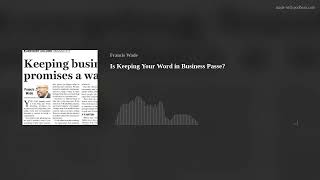
Hello and welcome back to Chronicles From a Caribbean Cubicle Podcast. This is Francis Wade, and here's an article I wrote for the Jamaica Gleaner. It's entitled "The Power of Keeping Your Word." In the past, the business world held a strong emphasis on keeping promises. Unfortunately, today it seems that commitments are easily broken at the slightest inconvenience. Many of us have witnessed this trend, even though there are occasional benefits when someone lets us off the hook. However, there is a valid reason for concern. A corporate culture where trust in one's word is waning can spell doom for the bottom line. Consider the phrase, "I'll do it because I said I would." These words are rarely spoken in our modern times. Instead, we find ourselves in a world that prizes authenticity and the bravery to share our innermost emotions. These qualities are essential for building trust on a personal level in the business world. But there's another equally important kind of trust, one rooted in reliability, integrity, and trustworthiness. Think about a bridge from your childhood that holds sentimental value. You like to visit to kindle fond memories. However, driving across it becomes a different story if the structure has deteriorated. All this comes back to the requirement to keep promises in a "no matter what" frame of mind. An organization responsible for maintaining and certifying bridges essentially promises a safe experience. But this notion extends beyond bridges. Every company has its own set of standards that its audience relies upon. Down at an individual level, we actually want employees to follow through on their commitments just because they said they would. Why? Because when they do, the organization operates effectively. However, this character trait is becoming increasingly rare in this symbol discussed. Nevertheless, we all know individuals who embody unwavering reliability. They show up on time, seldom forget their promises, and treat any lapses as grave execution errors. When mishaps occur, they immediately apologize and implement measures to prevent future repeats. Where does this level of commitment come from? Unlike most, they take their word seriously, as if it truly matters. But they may not always be seen as nice people. Instead, they often expect those around them to uphold similarly high standards, which can be somewhat annoying. Regrettably, they mistakenly assume that everyone is striving to keep their word. They're mistaken. Even though Donald Trump, for example, frequently makes unfulfilled promises without facing consequences, it doesn't seem to harm his popularity. Some even like him more for it, rewarding him with a growing follower count and lots of likes. Here are some reasons why following his lead might not be wise. Number 1: The majority of people are not sociopaths. They care about others and are mindful of how their actions affect them. In your organization, it's crucial to cultivate an awareness of the consequences of unfulfilled promises, both at the individual and corporate levels. Support your staff in comprehending and sensing the impact of their unmet obligations on all stakeholders, and take action with those who struggle in this regard. Number 2: Habitually disregarding the importance of one's word weakens personal power. It makes you feel like your fate is entirely determined by circumstances, leaving you feeling powerless. Over time, you may forget what it means to be a strong, dependable individual, which can negatively affect your mental well-being. Number 3: When disinterested employees rise through the ranks, they propagate a dysfunctional service culture. Why? Because prioritizing others over oneself requires effort. Customers, are often strangers, making service quality unpredictable. In most organizations, service levels depend on whether a customer encounters the right person on the right day. In contrast, exceptional companies prioritize their customers' welfare and go the extra mile. For them, service is a matter of personal and collective integrity, a facet of character worth nurturing and defending at all costs. While finding individuals who consistently deliver at this level is challenging, the benefits experienced by customers far outweigh the cost of attracting them. In 2023, only a select few organizations can be trusted to consistently uphold their promises, but they become memorable. They've invested in building an internal culture of integrity, which serves as the foundation for Exceptional service.
Thanks for listening. Do you have an unsolved problem in your Caribbean company related to strategy, productivity, engagement, or business process improvement? Just visit a searchable listing of all my prior articles and you may be able to help yourself to a fresh line of thinking. Go to blog.fwconsulting.com or see the show notes.