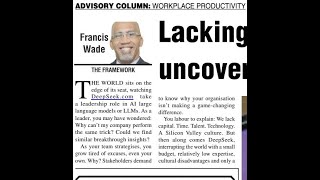
Francis Wade argues that companies fail to generate breakthrough insights like DeepSeek's because they rely on single leaders and conventional methods. He recommends three fixes: pursue small, powerful insights; distribute leadership intelligence across the team; and run a focused C-suite workshop with sharp prompts, internal data, and AI tools to surface disruptive strategy.
Chapters
Hello and welcome back to Chronicles from a Caribbean Cubicle podcast. This is Francis Wade, and here's an article I wrote for the Jamaica Gleaner. This is a version of the article that was published. This one is entitled Lacking Deep Seek Impact: Why Uncovering Strategic Insights Defeats CEOs. The world watches with anticipation as Deepseek.com takes the lead in AI large language models, LLMs. As a leader, you may wonder, why can't my company achieve a similar breakthrough? What's stopping us from uncovering game-changing insights? As your team strategizes, you grow weary of the same old excuses. Yours included. Stakeholders demand answers. Why isn't your organization making a significant impact à la Deepseek? You try to explain: we lack capital, time, talent, cutting-edge technology, and a Silicon Valley-style culture. But then along comes Deepseek, achieving disruptive success with limited funding, relatively low expertise, cultural disadvantages, and only a few years of effort. What sets them apart? More importantly, how can your organization, whether for-profit or non-for-profit, create revolutionary strategies consistently? Here are 3 critical insights. Number 1: Prioritize powerful insights. A closer look at Deepseek reveals that they overcame significant obstacles through superior strategy. To outsiders, it may seem like magic. Before their recent breakthrough, prevailing wisdom suggested that such an achievement was impossible. However, a deeper examination shows that the Chinese team pieced together a set of unique features Each individual element may have seemed ordinary, but together they formed a disruptive force. This suggests that other teams, perhaps even yours, could have done the same. A crucial factor in their success appears to be their ability to harness the smallest unit of innovation, a single insight. These insights, while seemingly minor on their own, can combine to create transformative change. But the key question remains: can your team do the same? Let's examine how your corporate strategy is built. Insights should drive your company forward, but if you are not achieving game-changing results, something needs to shift. Number 2: Let go of big man or boss lady thinking. Many CEOs assume they don't have a strategy problem. They believe they already, already possess all the insights necessary. Derived from their own expertise. To justify this, they point to their colleagues' lack of strategic contributions. "Not one of them has ever come up with a truly strategic insight," they argue, frustrated by a team that focuses solely on immediate problems. However, they fail to acknowledge that the company itself rewards this behavior, and so do they. But in some cases, their criticism may be correct. As the CEO, MD, Managing Director, or Chairman/Chairperson, you're one of the few people with a comprehensive view of the business. Naturally, strategy falls under your responsibility. But this could also explain why groundbreaking strategies are so rare. Think of your company as an intricate system, too complex for any single person to generate all the insights it needs. No outsider, even with extensive reports, can fully grasp its nuances. Outsiders like consultants. Instead, your leadership team must collectively produce deep-seek level strategy. But they can't do this while stuck in the usual mindset and corporate culture. If you want breakthrough thinking, take a fresh look at your management team. Then take action to unlock the insights you need. Number 3: Run a workshop to unlock your C-suite's potential. If you have a generous budget and a lot of time to spare, long-term training and coaching are excellent investments. But if, like most, you need results sooner, organize a face-to-face workshop designed to tap into your leadership team's best thinking. Why? You won't extract transformative insights through surveys, bonuses, or one-on-one interviews. Nor will you uncover them in your usual weekly problem-solving meetings. Instead, take a lesson from crafting a great ChatGPT prompt. To get quality responses, you feed an AI model relevant data, structure your question carefully, and then hit enter. The chatbot delivers, most times, an insightful answer, often one you haven't considered. Now imagine doing the same within your C-suite. Through multiple experiments, I've found that leadership teams can be prompted to generate their own breakthrough insights. How? By structuring an insight-oriented workshop. Here's how to do it. Create a high-impact session. Number 1: Craft sharp prompts. Formulate precise questions that challenge conventional thinking and address the root cause of strategic roadblocks. Number 2, supply relevant data. Provide internal company information and credible local market insights. Number 3, introduce external trends. Share macro trends that neither you nor your competitors can control but must adapt to. Number 4, leverage consulting shortcuts. Introduce fresh analytical frameworks used by top consulting firms to accelerate their strategic thinking so that you can accelerate yours. And number 5, encourage AI integration. Use LLMs in this exercise to help your team think beyond its usual constraints so that it can generate breakthrough ideas. By combining the insights from this session into your next strategic plan, you'll position your company for game-changing success. Breakthrough strategy isn't reserved for Silicon Valley startups or billion-dollar enterprises. With the right approach, any organization, including yours, can generate innovative insights that lead to transformational success. The key is fostering a culture that prioritizes insights, moves beyond individual genius, and taps into the collective intelligence of your leadership team. Do this, and your company might just be the next DeepThink. Thanks for listening. Do you have an unsolved problem in your Caribbean company related to strategy, productivity, engagement, or business process improvement? Just visit a searchable listing of all my prior articles and you may be able to help yourself to a fresh line of thinking. Go to blog.fwconsulting.com or see the show notes.