Southwest's Strategic SNAFU! How Neglecting This One Thing Made a Legend Ordinary
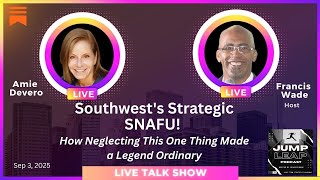
In this interview‑style discussion, host SPEAKER A talks with Francis Wade of Jump Leap about Southwest Airlines’ rise, its distinctive low‑cost operating model, and the strategic missteps that turned a legendary carrier into a struggling one. They trace Southwest’s original competitive advantages—using secondary airports, transparent tiered pricing, a culture of employee cross‑functionality, aggressive fuel‑hedging, and ultra‑fast turnarounds—back to the napkin‑sized strategy devised by Herb Kelleher and his partner. The conversation then details how those advantages were eroded over time: the company’s scheduling software became a decade‑old technical debt that was never refreshed, leading to the 2022 cascade of cancellations triggered by ice on wings and amplified by an inflexible IT stack. The fallout included massive passenger disruptions, FAA fines, and the arrival of activist investors (Elliott Management, Blackstone) demanding board and management changes. The hosts examine the short‑term fixes proposed (reserved seating, extra fees) versus the need for a deeper strategic renewal—a new “flywheel” that would leverage technology, green energy, and a disciplined, scientific approach to constantly test and discard outdated assumptions. Throughout, they argue that Southwest’s failure was less about a single event and more about a culture of short‑term thinking, neglect of infrastructure investment, and a lack of mechanisms to regularly reinvent its core strategy.
Chapters
So we are talking today about Southwest Airlines' strategic snafu. And I am so delighted that Francis Wade of Jump Leap is here with me. And if you don't know who he is, um, he is my former business partner, or I am his former business partner. And we have been very, very dear friends and thought partners for 20, 25 years now, something crazy.
Too long to list for the public.
Yeah. And he's still the guy I go to when I really want to talk through something that matters. I think I fill that role for him a little bit. He's also got a super smart wife who probably does that just as well. Anyway, Francis, welcome. Thank you for joining me and for letting me host this. And I know you hosted last time. I have a puppy that's like trying to get on my lap. So that's why I look confused.
I'm happy to give the burden over to you because this stuff is tricky. Tricky as all heck.
I think burden is the right word, starting with that there's no way to do this on a computer. You have to do it on a phone. And being a Gen Xer, I do not do everything on my phone. I really like a keyboard. So there you go. All right. So we had looked at this video, which is in the notes, and you explained to me that she had technical problems in the middle, which is why it's only 15 minutes. I thought she just got to the end and got fed up. Really? What more was there to say? But let's go back to the beginning. So back in the late '60s, early '70s, is that when when, uh, Kelleher founded Southwest.
Yeah, I read, I read a founding story. He sat down with a fella named King, uh, over drinks, and they mapped out this strategy for serving San Antonio, Houston, and Dallas with a new kind of airline. They did it on a napkin.
I think it was Austin. I think it was Austin, Houston, Dallas.
Okay.
Anyway, they're trying.
It was all done on a cocktail napkin. That was the, that was the venue. That was the— and it was done over drinks. It wasn't planned. They didn't sit down or hire consultants. They just said, we should fix this. And they were trying to fix that problem of traveling around Texas.
Well, and they already knew the competitive advantage they would have. I mean, they weren't just solving their problem. They felt like these were distances that were long enough to justify flying, but short enough that they could do it cheaply because at that point airlines had not been deregulated in the US. They were very expensive. And so you were essentially paying, you know, $700, $800, $900 to go from Dallas to Houston via American Airlines or Delta. And they thought, we can do this more cheaply by keeping these sort of pseudo-regional flights and using— they had a whole— there was a whole cacophony of very specific operational strategic themes they had, all of which added up to a brilliant, completely game-changing strategy that would inexorably alter the airline industry in the US. And so the rest of their strategy, even in those early days, was use second airports. So not the main hub airports. So they didn't use, um, the main, you know, DFW Airport in Dallas, they used Love Field, which is where the love, um, the love imprimatur came from.
Came from. Okay.
In Southwest. Yes. Which is from Love Field, which was a secondary airport in Texas. And they used secondary airports everywhere. And I grew up in Miami and I can remember, I mean, Southwest. From a Florida standpoint, as soon as it expanded to Florida, it became our airline. Like, that was how you went across the state, north, south, whatever. If you wanted to go to Tampa or Orlando or fly to Jacksonville, you went Southwest because it was like taking a bus. You just got on, you got off, that was that.
Right. And the pricing was friendly and it was easy and you could do it online. And, you know, just doing business with them. I remember, I think I flew to you a few times when I was in, I was in Fort Lauderdale and then flew to Tampa a few times on Southwest.
And those were the secondary airports, actually. Tampa was a secondary airport to Orlando. Fort Lauderdale was a secondary airport to Miami. So you would fly, now, of course, neither of those are really secondary airports anymore, but they were at the time. And then the other thing, of course, was that Southwest I mean, they're, the pricing was special for a lot of reasons. For one thing, it was entirely transparent. There were 3 tiers and they were clearly delineated. One was budget, essentially the cheapest fare you could get. The other was a little bit better. So you, I think, got to get on a bit earlier and you could take, I don't know, 2 bags instead of 1 or something like that. And the third was. You get on first and I don't know what else you got, 'cause it, there wasn't much to give you, right? Oh, you could change the fare as many times as you wanted and get a refund. So that was it. That was the pricing. And all tickets included free checked bags. Right. And no tickets included reserved seats. And they didn't even have meals initially, but that was the whole model. And from the first class, there was no premium seating, meaning no first class. Yeah, there was no first class, so it was just those 3 tickets. Everybody sat wherever they got a seat. In fact, in the old days, they had, um, they had banks of seats that faced each other in each cabin. I loved that because you could fly backwards. You could actually feel your force going forward. Anyway, I digress, but there was some other things that were strategically important. So from a customer standpoint, what mattered is what we just described. That the pricing was transparent, the seating was open, or at least, you know, by just sort of, you know, this group, then that group, but everybody just found a seat and bags flew free. That's what, that was actually how they said it. Bags fly free. And that was it. Oh, and they did not utilize travel agents. So you had to go straight to their website. They would never be included even now in Google Flight Search or Travelocity or any of those, um, you know, the automated systems or the travel agency systems, which was one of the ways they kept pricing low. Now, so customer perspective in the back, sort of behind the scenes, there were several other things that made this economically an advantageous strategy for them. One of them was that, um, they, from the very beginning, did not have adversarial union relationships. So while they embraced the union, they did not go along with having highly delineated division of labor. So you would often see on a Southwest flight, the pilots helping to get the bags in the bay in order to get off on time. So the theory was we all make money only when the flights are in the air. So everybody does everything to turn the planes fast.
Right? And it was quick. It was, you know, they would land, it would feel like a bit of a race against the clock because they would start boarding and before you knew it, you were on. And because it was all open seating, so it all happened very quickly and very fluidly. And if you're traveling a short distance, this was great. Didn't have to go through all the usual friction.
Exactly. And of course, before 9/11, you know, when security wasn't quite such a giant kind of juggernaut, You could race to the airport, get there 10 minutes before the flight, jump on a Southwest flight and be off. And it really was much faster than any other way of going 500 miles. Right. You know, so, um, the other thing that they did in the back that, um, was not obvious was that they arbitrage their oil purchase or rather their fuel purchase. So this wasn't mentioned in the video, but this was a really important part of Southwest's economic strategy. While other airlines were subject to the volatility of the fuel market, which is why sometimes airlines make money and sometimes they don't, because when fuel costs are high, they can't all change their pricing on a dime, so they have to eat it. Southwest actually arbitrage all of their fuel purchases, purchasing fuel as futures, so they knew exactly what they were going to pay because they had pre sort of negotiated it. And while that pre-negotiation might mean that at times they had paid more than market today, the fact that it added that much predictability to their model meant that they didn't have the volatility in their profitability. And that was a huge advantage. And they continued to do that right through COVID, which was why when in 2022, '21, they started to have all of these weird technical problems, it was so shocking, right?
Right. And but, but the truth is, this was no, no, this was no accidental, um, or no, no serendipitous kind of put together, you know. It sounds, it sounds a little bit like shoestring, you know, that they've coupled together some half this thing was profitable all the way through 2022. It was the only airline that was profitable every year. So this was not a gamble in the sense that they were sort of experimenting and trying. They were making real money when others were losing a ton of money.
For 40 years. I mean, not for 1 year or 1 quarter or 2 years. No, they always outperformed the market. They always were profitable, even when fuel prices dropped and other airlines had the same You know, advantage and margin. They always filled their flights and it only started to fall apart. Now, this is the thing we don't know. And I mentioned this in one of my articles and I'm going to put this in as an aside, because we really don't know this. I believe, and what I wrote in the articles is that I believe they, at some point in the last 10 years, stopped investing. And I've spoken to people who worked at Southwest about this. Their scheduling software had been obsolete for at least a decade, and they knew it. And this was an area where by virtue of being a publicly traded company, they opted not to invest in their capital, not to, not to take on the CapEx it would take to reinvest in updating their infrastructure because what they had was working okay. But it was working okay only from the customer perspective. It wasn't working okay on the backend for the flight attendants or the pilots. And that's the piece that only came to the public's knowledge later when they had that gigantic sort of failure and they had to cancel like every flight for a day. I don't remember the numbers of flights that got canceled, but it was thousands.
Right, right, right. I, I, I, I, This was the first— actually, the first time I thought about Southwest in years, because they're not— they flew to Montego Bay here in Jamaica but not Kingston, so they weren't really on my radar. So I never— didn't know anything. But when they had all those cancellations and they brought down, you know, major other airlines were also impacted, um, during— was during this Christmas rush. And the, the, the supposed reason it happened was because It was a cascade, but supposedly the trigger was that some planes had ice on the wings. And so they tried to play it off at first, but right, I read the same thing you read, and, and from a, from a strategic point of view, it sounded to me they did, they did, as if they did what many companies do, which is they kick the can down the road, right? Which is that a series, a sequence of, of executive teams decided not to bite the bullet. But instead decided to, you know, in a surplus of short-term thinking, or just what most companies do, they look 5 years out and they say, is this going to be a problem in the next 5 years? And the IT guy goes, well, you know, probably not. Okay, well, and they paid attention to the short term and didn't deal with the long-term consequences of this poor infrastructure, this poor scheduling software. And by any measure, this was reckless on their part.
It was reckless. And it's a, and it's a mistake that, that smaller, younger companies make as well, which is allowing themselves to amass technical debt, which writ on a large scale is essentially shooting yourself in the foot. This is your ceiling is leaking. And instead of getting a new roof, you just get more buckets. And getting more buckets doesn't address the fundamental issue that is at the heart of the longevity of your, of your operating model. And by not fixing the scheduling software, even though they were getting massive numbers of complaints from their own employees. And by the way, Southwest had a culture that truly embraced and held close to their employees. So it was not typical for them to sort of, you know, give their employees a cold shoulder and ignore them. But in this particular case, they just sort of shrugged it off and did not take the recommendation of many industry insiders who knew that they needed to invest CapEx in this, and that was going to affect short-term earnings in the market. They chose not to do that. None of us were in the boardrooms when they chose not to do that, but that set a cascade of technical errors when they had the one failure and then they had 3 more. And by have 3, 2 or 3 more, I may be wrong on the number. I'm really bad at this kind of thing. They had more. Okay. They had several more. Oh yeah.
They had several more. Similar breakdowns.
Yeah. They had very similar breakdowns where thousands of customers were left stranded. And remember these breakdowns because of how complex the network of airlines is in any given airport. Every time one plane doesn't leave a gate, another plane can't get to that gate. So it's not like any one airline has a problem and it's isolated to that airline. It's never isolated. It always causes all kinds of fat tail effects for other travelers, other airlines, other airports, even in other countries, because it goes all the way down the line of this schedule, whatever plane is meant to come to that gate next, whatever baggage is meant to come off that plane next, and so forth. You can't just park airplanes and hope they don't get hit by other planes taxiing in. And you can't just leave them sitting, thousands of airplanes at gates, cuz those gates need to be used. Remember, Southwest is typically at a gate only 20 minutes, right?
So they're operating within a very tight timeframe. With probably no slack built in because they consistently did this for 30, 40 years. So why should they, why should one believe that they should not be able to keep doing it?
Well, and even if they have slack, let's say they have 20 minutes of slack built in, it's still only 40 minutes. Right. You know, there's no amount of slack you can build in to literally put the brakes on an entire fleet of airplanes in major airports. They're not all in secondary airports now. They're in every airport. So this caused a massive, massive nationwide, in some respects worldwide airline cascading failure, all of which fell at the feet of Southwest Airlines and the, the, the detrimental effects of which fell on the shoulders of their passengers. And the FAA did not look kindly on that. And it fined them a ton of money.
It was $100 million.
It was something, it was a big number, but the really big problem was not any of that because Southwest probably could have weathered all of that had it not been that sharks were circling in the water.
And that's what, what's the second?
In the form of activist investors. And when activist investors, a hedge fund. So we had a hedge fund, Elliott Management, which was a major investor. By major, I mean at the most 14%, but never had 60%. But Southwest and Blackstone between them, I think had 32%, something like that of the stock. And they began, particularly Elliott began making noise. There's an individual, it's not the individual's name, but anyway, they began making noise about changing out management, changing out systems and regaining profitability. And they had the perfect opening. Because Southwest had dropped the ball so, so badly and made its first loss.
That was the— that was the sort of the door that sort of opened the door to the hedge fund deciding that they knew better, that they had a better strategy. That obviously is what the thinking was, and that they needed to take control of the management team, the executive, the board, and implement this better strategy.
Well, it didn't even start with taking control of the management. It started with just wanting to get rid of the CEO and have Southwest take on their remedies. Now, understand that their remedies were not based on how can we have strategic advantage for the next 40 years? That is not the question they were asking. The question they were asking themselves, and by them, I mean Elliott Management, was how can we get profitability back up so that our stock doesn't drop like a bomb? That's basically what they were asking. And so the remedies that they came up with were very familiar to every traveler in the world. What were some of those remedies?
No, they charged for, charge for upgrades, create an upgrade path.
Brilliant, a brilliant and unique and game-changing strategy, isn't that?
Charge for bags, the bane of sort of every, you know, traveling nowadays is a game of how much can I stuff into the bags that I'm allowed without having to upgrade, take a bigger bag, check a bag, um, that whole nonsense. So they bought right into that.
They're selling, they have no meals Which, well, so, no, they were, so, wait, let's, let's, let's, let's just back up a little bit. So they didn't go for the jugular right immediately, right? They said, well, let's add reserved seating. So they did a bunch of customer surveys and customers said, yeah, we'd really like to have assigned seats.
I saw that. I saw that was really interesting.
Well, and the truth is, if you had flown Southwest lately, you would understand why, cuz they had gone to this weird method. Where you checked in and you were given a number in the order in which you had checked in and, or you got preferential numbers if you had purchased the higher level ticket. So the only way you could be in the top 30 people who board, remember everybody gets to choose their seats. So you need to get on Southwest first. If you want a seat near the front or on an aisle or whatever, then the only way you could do that was either by having a, uh, higher, a more expensive ticket, or by being awake at 12:01 when you could check in and checking in first. So then you're just like in a race, like you're buying tickets to see Taylor Swift or something, right? And that gets pretty tedious. So reserved seating was pretty popular and customers said, yeah, we want reserved seating. So they, they did away with open seating. And I think at that point, people like me and other customers, even people like me, like strategists were going, well, You know, that's not so bad. That's not so bad. Actually, they are listening to the customer and that improves the customer's life. And that was like that for about 6 months, but Elliott was still pushing. And so they wanted premium seating because premium seating accounts for most of the profits that most airlines make. All these extra fees do. And Southwest resisted, resisted, resisted, but then Finally, they were threatened with a proxy vote because Elliott got Blackstone to come in with them and say, if you don't make these changes, we're going to have a proxy vote. And Southwest had an opportunity. They could— now remember, these two management, these two finance, um, hedge funds between them only had less than 30% of the stock. They could have come up with a game-changing strategy. And by them, I mean the management of Southwest could have said, you know what? We took our foot off the gas. We took our eye off the ball and we took our everything off of everything, every other cliché you can think of. And it's time for us to sit down and craft a game-changing disruptive strategy.
Again, again, because they did it, they did it at the very beginning. Again.
Well, absolutely. But this is 40 years later. So. You know, so what are we going to do now, right? Yeah.
And they didn't. And what's happened since then is that they've just basically become more and more and more like a regular airline. They've changed the features that used to make it somewhat special and one by one just converted them to what would be business as usual in other companies. They changed the board. They brought on a bunch of board members who had worked in other low-cost airlines. So the board was split at one point. They got rid of those who they didn't really like and brought on a whole bunch who they thought they would like. And now Southwest, for all intents and purposes, looks like everyone else.
It's so, it's identical. But the thing that I can't let go of is the degree to which they frittered the opportunity they had because there is a counterfactual in which they come up with an extraordinary game-changing strategy, the second in 50 years. And there is one there to be invented, one that leverages technology, one that leverages transformation happening in flight, one that utilizes green energy. I don't know what it is, right? I don't know what the thing is, but there is another game-changing strategy to be had. And they could have done that. And if they had done that, if they had a story to tell, as good as the story that Teller had to tell in the '70s, they would have won a proxy battle. They only needed 50% to win. They didn't need 51%. They didn't need— in fact, they needed less than that. They really only needed 40%. To win because Blackstone and Elliott were not going to get the employees. They were not going to get the mom-and-pop stock owners. They weren't going to get, you know, they were going to get these two hedge funds. I'll bet that if the strategy had even been compelling enough, they would, they would have gotten the votes of institutional investors because institutional investors are long-term investors.
Right.
And their new strategy could have been one that would take 2 years to bring profit back. It didn't have to be instantly profitable, right?
But, but, you know, they, they— the fact that they didn't create a strategy to, to change their infrastructure, to change their backend, the scheduling software, fast enough tells me that they were, they were in a short-term mindset, mindset or frame of mind, and that, that persevered, or it, it it kept going and it kept—
it infected them. It was like a virus, right?
And it probably happened early on because they didn't renew— let's say they had 10 good years of Kellerhals and King's original set of insights.
They had more than that. They probably had 25 or 30 good years of that.
But that was a good run, right, for an original set of insights. But what they didn't build in was the capacity to renew that strategy. In other words, to critically, critically say, is this going to last us the next 20 years? If they did that, they would have fixed the infrastructure. So an element of their organizational design or their ethos was missing. And when the time came, sharks started circling, they didn't have an ethos that said, hold on, hold on, we're a long-term strategy company. This is how we do things around here. We don't care about short-term returns, like what our stock price is doing immediately. We're in it for the— they didn't have that ethos. And ultimately they succumbed because it wasn't there.
Succumbed. Is that a Jamaican pronunciation?
Succumb? Succumb? Probably.
I thought I'd love that, actually. I think it's great. We need more words that sound like that anyway.
What do you think of that analysis? What do you think of that take?
I partially agree. I mean, like most Monday morning quarterbacking, we don't really know. And I'm not sure that they needed it. See, I think that had they bitten the bullet, invested the CapEx in infrastructure, they might not have needed a new strategy. They might actually have just needed to fix the damn scheduling software. I mean, this might have been a case of we don't need to lose the house in a hurricane, we just need to invest in a new roof.
Right. But if they had the foresight to fix the software, they would have had the foresight to see the end of other features that weren't playing that well with their audience, with their fans, their customers. They would have seen that, okay, there is going to be a squeeze on profits because they would have played it all the way out and said, we can't continue the same strategy that King and Keller came up with because the world has changed on us. So here are the ways in which we need to be Southwest 2050. And they would have done that kind of thinking.
I don't, I don't know that one follows from the other. I mean, I do think that they didn't do that kind of thinking. I don't know how connected that is to the technology investment issue. They have, if you go back over the last 10 years, Southwest has consistently made adaptations to their customer-facing infrastructure. They have changed the boarding process. They're constantly surveying customers and finding out what works and what doesn't. They've changed many of the meal offerings and the food offerings. And they did all kinds of things. But somewhere in the back office, they allowed the CFO to start running the company. Instead of a visionary leader. And that is problematic because there is a reason why CFOs are not CEOs. Because CFOs are, and you need them, they're doing that, looking out for reducing cost. But CEOs are meant to be looking out for increasing strategic advantage. And that's the piece that wasn't clearly just, it wasn't like crystal clear, like our entire, our entire competitive advantage is at stake if we cannot schedule with like the kind of alacrity and sharpness more than even our competitors, because our agility is at the heart of our strategy. And by having this old outdated software, they were stuck in an old, outdated level of speed and agility as well. Right.
I would, I would add to that, that they were stuck in an outdated software that would require 5 years to fix.
Perhaps.
This was not like you plug in new software and then all of a sudden the whole system adjusts to it. The system was built around, and part of the reason why it was so agile was that they were able to make these patches, essentially. And that allowed them to do these changes on the fly, which meant that they were very nimble, which was good up to a point, because nimble doesn't always scale, right? Right. So now they put— by the time the problem happened, or the 2022 rolled around, the time it took to invest to change the software and to bring it up to speed was now going to be at least 5 years. So I think the genius of King and Kelleher was that they imagined an end state where everything could work profitably together, you know, like a target operating model, you know. They imagined the whole thing, all of the elements together. They had enough background in the industry and enough insights to be able to assemble a complete package of visionary ideal Like a flywheel. Authentic-euphonium.
I mean, it really is. A flywheel. Exactly.
It's a flywheel. It's a flywheel. They imagined a flywheel that nobody else in the industry imagined.
And then they compounded it later. I mean, like, they didn't start arbitraging fuel until 20 years later.
Okay.
Like these little things that they added as they went, but they added to the robustness of the strategy so that the flywheel was enhanced and the And the sort of velocity was compounded. It was only when they allowed technical debt to amass that everything was going to grind to a halt. I mean, I go back to the roof analogy. It's such a simple analogy, but that really is what happened. And it was a function of a lack of— I mean, if the CEO's job is to maintain competitive advantage, then he not only has to be looking out to see if the roof has holes, he or she also has to be looking out to see, is our strategy still valid? Is it still optimized? Is it going to convey to us competitive advantage for the next 50 years like it did for the last? And to your point, they were not asking that question. They were asking, how can we make sure next quarter's stock value either stays good or goes up? And that is the wrong question.
I would, I would, I would add some juice to your question. Not, Not is it the right strategy at the moment, but I would say assume that your current strategy has a shelf life and that it's dying and it's gonna be dead. Now, do you wait till it's dead to actually reinvent? Because this is what I see with clients that I have is that they're successful because sometime in the past, a founder or a visionary person came up with an innovation or a target operating model or a visionary endpoint, whatever you wanna call it. Someone very, very, um, innovative came up with it, and it made them— it gave them a huge advantage in the beginning. And then they kind of fall into the innovator's dilemma that Christensen talked about. They kind of just relaxed into it, and they didn't— once something works, it's hard to change it, and it's profitable, and it keeps giving you profit, and there's more profit to get if all you need to do is make some incremental changes. Exactly. But ultimately, if you think of it instead of that this strategy has a shelf life, and we're crazy to think that it's gonna last forever. So what's the shelf life? Okay, the shelf life is this year. We need to put in place something that's gonna replace that strategy, which means we gotta start 5 years before to do the replacement, which means we gotta do 10 years before, before, by doing the imagining necessary. We've gotta be so far ahead of it that we, when the death of the strategy comes about, we don't even feel it because we're actually onto the next. This is kind of what Fujifilm did, right?
Well, I mean, and I, but I think you could, I think there's a more incremental way to think about it, which is, does, which doesn't, which doesn't, um, rebut anything you just said. But if you start from the premise, the minute you execute your strategy with the question in mind, My strategy is invalid in some way. How? How? It's, it's really working great in a lot of different dimensions. Where are its points of invalidity? Where are its descriptions of the world that have turned out not to be true? Where is our assertion of competitive differentiation that is not working? And That tends not to be what we do. We tend to look for confirmation that what we're doing is the right thing rather than assuming that we are fallible and our strategy, like us, is, is flawed. Let's find the flaws. And you don't necessarily need an entirely new strategy. What you need is a strategy that is constantly being reinvented by virtue of critically assessing its validity, and the degree to which it confers advantage and whether or not it's game-changing. Because at a certain point, if you change the game, everybody's now playing the same game. You need a new game.
Yeah, you create a whole brand new game and a brand new way for yourself to play in it. I think you might agree that the difficulty, the challenge that you and I have as we talk to CEOs is to get them to accept that their strategy will become invalid in some way. Because this is like saying you have an ugly baby.
Yeah. I mean, that's exactly— it was so funny. I was talking to, um, I have this friend I know from the pool. He's this lovely guy and he swims next to me and he's just the worst swimmer ever. And I mean, I don't mean like he's slow. I mean, everything about his swimming form is terrible. Like other people comment on, comment on it. I won't swim right next to him because he splashes so hard that it's like swimming next to a tidal wave. And this guy swims like an hour and a half a day. He is serious about his workouts. And I've never had an opportunity to really talk to him about it before. And so he'd been in Europe all summer and I saw him at the gym, not at the pool. And he said, oh yeah, well, I'll be right next to you there swimming and splashing. And I went, hmm, maybe You want to work on your form so you don't do that so much. And he was telling me his shoulder hurt. And I said, well, you know, your shoulder is not going to stop hurting as long as your form is so bad. And he went, what do you mean my form is bad?
And I went, whoops.
But when I said like, like, I don't mean it like to be offensive, but like your form is terrible. Have you ever had anybody give you any feedback or coaching or videotaped you or anything? And he said, no. And I went, well, I'd be happy to do it. I said to him, listen, I'm not a brilliant swimmer, but I'm a brilliant analyst. I can analyze your stroke. And he was like, bring it on. And I went, you know what? I've been for 6 years, I've been holding my tongue and I should have said that 6 years ago, but it is so different than what we get from our prospective clients who have so much more at stake. Right? When we say, you know, your strategy is obsoleting from the moment you create it because the world continues progressing, you know?
And they give us proof as to why we're wrong. You know, they say, oh, you have no idea. Right. In essence, how much money I'm making. You have no idea how successful we are. You have no idea. You don't understand. You don't appreciate how much—
Yeah, you don't understand our industry. You don't under— and I'm like, This is not an industry-specific comment. I don't understand how to build a search engine either, but I know that Google's search engine is obsoleting as we speak. So does Google.
I guess that's the big takeaway from the Southwest case is that if a senior management team can be convinced, just as a matter of principle, that its brightest, most brilliant strategy is obsolete in some way, is defective in some way, that it's obsoleting in some way. And there are things that are going to happen that are going to, like AI, that are going to accelerate that obsolescence. And the faster you pick up on these things, the better you are. That this is not a game of a one-time win that you defend.
Right.
This is a game of rigorously examining the holes in your thinking.
Rigorously looking for. You are literally on a constant basis looking for the rebuttal to your hypothesis. It is the scientific method in action, right? If you're a scientist and you're looking to, you know, do an experiment to prove your hypothesis, you are not looking to confirm it. You are looking to disconfirm it so that you can try the next thing. Right. You need to be looking for the nonconforming evidence that your strategy is perfect, because if you think it's perfect, you are both blind and dumb. You know, it's like, it's, he asks you how you are and you say, I'm dying. It's true. We are dying from the minute we're born and your strategy is dying from the minute you give birth to it.
I had an aunt, 106-year-old aunt, that was in my passing coverage, that when asked, "How are you doing, Aunt Beryl?" she would look at you with a look of like, "You idiot," and she would say, "I'm dying." She literally said that.
But it's true, right?
It's a call to arms, right?
But you know what? The correct answer back is, "Me too." Yeah, yeah.
Let's make the most of it. This is like I take that away as the message that she's just trying to send us. She wasn't being rude. She just was a matter of fact. She says, "I'm dying." It's like, yeah, you know, well, and you're alive right now. And this is, if I could give prospective clients that message, I wish I could find a way to do it.
Francis, as always, we went too long, too delightful to talk to you. This has been completely great. Those of you who are watching, if you are not a subscriber to the Junk Beat, Jump Leap newsletter, get right on it. And Frances subscribers, if you are not a subscriber to the Beyond Better blog, get right on it. We would love to talk to you again and write to you again and hear from you. So please let us know what you thought of our video, whether you want us to do more, if you have ideas for us about what to do next time, because if you give us a topic, I guarantee you the two of us can tear it apart and even make it entertaining.
Thanks everybody. Thanks for listening.
Alrighty. Bye.
Bye-bye.
More from Francis


Ep 35 Your Strategic Stagnation Isn't a Framework Problem—It's a Story Problem



The YouTube Strategy School: Why Your MBA Didn’t Teach You Strategic Thinking





