Francis Wade argues that one-way communication of strategy fails because it's too abstract for most employees. He proposes using AI tools like Google's NotebookLM to let staff ask questions at their own level, with gamified challenges to spark ownership and deeper understanding of the plan.
Chapters
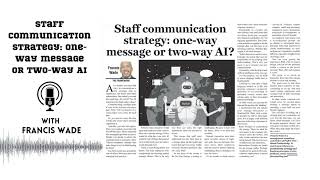
Hello and welcome back to Chronicles from a Caribbean Cubicle podcast. This is Francis Wade and here's an article I wrote for the Jamaica Gleaner. This is a version of the original and this one is entitled Strategic Communication to Staff: One Way Message or Two Way AI? As a senior executive, one of your most crucial and delicate responsibilities is the communication of strategic plans to employees, board members, and key stakeholders. But how should you do it? Is it enough to share a dense one-off report, or can AI offer a way to transform this traditionally frustrating task into something more interactive and engaging. Most leaders dread this stage of the strategy cycle. The excitement of a successful offsite retreat or board strategy session has passed. Now the hard part begins: conveying the essence of the plan to those who weren't in the room yet are expected to bring it to life. The conventional approach hasn't changed much in decades. First, circulate a written document filled with bullet points, jargon, and long-term goals. Next, convene a town hall meeting supported by a string of PowerPoint slides. Questions are few, attention drifts. Finally, you pass the baton to middle managers to cascade the strategy to their teams, hoping they convey the message with clarity and enthusiasm. Often they don't. Miscommunication spreads. Employees receive mixed signals. Strategic alignment becomes a fantasy. The result? Well, it's predictable: confusion, disengagement, and inertia. The Communication Gap. Why does this happen? Even in well-managed companies. Because strategy is inherently difficult to explain. Unlike routine business matters, it deals with the future—a future that is unpredictable and unknowable. Strategic thinking requires executives to rely on incomplete data, make educated bets, and reason through complex interdependencies. Most employees, however, are trained to execute, not theorize. They want certainty. But strategy rarely offers it. It requires abstract thinking, conceptual frameworks, and trust in leadership judgment. To compound the problem, many employees have no idea what the company's strategy is. Surveys routinely show that a significant portion of the workforce cannot articulate their organization's strategic direction. That's not because they lack intelligence. But because the way strategy is usually communicated makes it inaccessible. The old approach, a top-down one-way message, no longer suffices in a world where you are hiring for brains, not brawn. If your employees are going to make smart real-time decisions that support the strategy, they need to understand the why behind the what. From monologue to dialogue. Today's leaders must embrace a new mindset. Communication is not just about broadcasting; it's about engagement. The onus is no longer on the employee to decipher a static report or passively sit through a presentation. Instead, it is the executive's responsibility to foster understanding, to create conditions in which meaningful dialogue can occur. Fortunately, Advances in artificial intelligence offer new pathways. Specifically, large language models, LLMs, such as NotebookLM, a source language model or SLM, can help transform strategic communication from a passive event into an interactive personalized experience. What makes NotebookLM different? Unlike general purpose AI tools that respond based on pre-trained knowledge, NotebookLM grounds its responses entirely in documents you upload. This means your actual strategy files, slide decks, board reports, workshop reports become the exclusive source of truth. The app processes your data, then allows users to interact with it intelligently. Here's how to use it. Number 1, upload your strategic materials. This could include the formal plan, background analyses, executive summaries, transcripts, or even FAQs. 2. Design prompt sets for different levels of strategic maturity. Basic prompts: for new hires or employees unfamiliar with strategic planning. These focus on summaries, definitions, and the background story. Ideal for onboarding or setting context. Intermediate prompts: for general staff. These might explore implications, comparisons, and potential challenges in execution. Advanced prompts: for experienced team members or high potentials. These require synthesis across documents, evaluation of assumptions, or the generation of novel ideas based on strategic intent. The goal is to provide each employee with an opportunity to interrogate the strategy at their own level. Because the responses are personalized and context-aware, employees engage with the material in a way that suits their curiosity, experience, and role. Make it playful and challenging. To increase engagement, you can even add a layer of gamification. Frame the interaction around a scenario. For example, play the devil's advocate. Ask staff— to identify potential flaws, contradictions, or unspoken assumptions.— Give their input scores or feedback.— Celebrate insightful critiques. This simple, low-cost exercise can breathe life into a strategy document that would otherwise be skimmed or ignored. It empowers employees to participate in shaping strategic thinking rather than being passive recipients of edicts from above. A new area of strategic engagement. We are entering an era where employees expect more than a memo or slide deck. They want to understand the company's direction, contribute ideas, and be involved in shaping the future. AI tools like NotebookLM don't just allow this, they encourage it. For the first time, executives can enable a genuine two-way dialogue about strategy at scale. They can foster a sense of ownership among staff who would otherwise feel excluded or overwhelmed. The days of rolling out the strategic plan as a one-way dialogue are over. Embrace a model that invites curiosity, fosters understanding, and deepens engagement. With the right tools and mindset, your strategy won't just be communicated; it will be understood, internalized, and acted upon. Thanks for listening. Do you have an unsolved problem in your Caribbean company related to strategy, productivity, engagement, or business process improvement? Just visit a searchable listing of all my prior articles and you may be able to help yourself to a fresh line of thinking. Go to blog.fwconsulting.com or see the show notes.