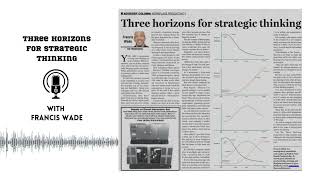
The Three Horizons framework helps organizations balance short-term operations, transitional projects, and future opportunities. Horizon 1 manages current products as they decline, Horizon 3 spots emerging signals, and Horizon 2 bridges the gap. Use the combined visual in meetings to convince skeptical colleagues that long-term planning matters.
Chapters
Hello and welcome back to Chronicles from a Caribbean Cubicle podcast. Here's an article I wrote that was inspired by a column that was published in the Jamaica Gleaner. This is entitled "Three Horizons for Strategic Thinking: A Guide for Long-Term Planning Advocates." As a proponent of long-term thinking in your company, you've likely encountered resistance. You may feel isolated, struggling to articulate the value of strategic foresight to colleagues focused on immediate concerns. This guide aims to provide you with a framework to effectively communicate the importance of Long-Term Strategic Planning and engage others in this crucial mindset. The Challenge of Long-Term Thinking. You've probably experienced this scenario: in a meeting, you highlight a future your colleagues just can't see. The potential long-term consequences seem obvious to you. Unfortunately, your team, preoccupied with urgent problems, lacks the energy to consider your strategic viewpoint. They opt for the quick satisfaction of immediate resolutions. Afterwards, you realize that fundamental issues remain unaddressed. It feels like you're only discussing surface-level solutions without questioning the underlying approach. If this resonates with you, you're not alone. Many forward-thinking professionals struggle to convey the importance of LTSP . But there's a way to bridge this gap and bring others into long-term thinking. The Three Horizons Framework by Currie, Hodson, and Sharp. Horizon 1: Understanding the Decay of Current Offerings. Every organization provides value through its products or services. However, it's crucial to recognize that these offerings have a limited lifespan. Each day brings you closer to the point where your current solutions become obsolete. Consider the photography industry. Until the 2000s, companies like Kodak and Fuji thrived selling film. Today, the average consumer has no interest in this product. This decay in demand is a universal truth in business illustrated by the following curve. So this is the first of four graphics that are presented in this article. Uh, this graphic shows how the strategic fit of a product— in other words, the degree to which it meets unmet needs— may be high at the moment but then decays over time. So, uh, the graph has a 10-15 year time frame during which a product goes from its peak and then decays into there being no demand whatsoever. The key question is, how long will your current strategic fit last? As an LTSP advocate, you have already considered this. Now you have a visual representation to share with your colleagues, helping them grasp this concept more easily. Horizon 3: Recognizing Future Opportunities. While managing current operations is crucial, it's equally important to look for signs of future trends. These faint signals can be found in emerging technologies, evolving customer needs, new regulations, environmental changes, and various other areas. By paying attention to these signals, your team can craft narratives about potential futures. This foresight defines the third horizon. And here's another diagram, and in this diagram it starts off with a very low degree of strategic fit. Very few unmet needs are being met by this early technology or early offering, and then this offering increases over time until it becomes the predominant offering. So the graph starts off low on the left with today, where it is today, and in the next 10-15 years it increases and rises up like an S-curve to the right, um, over the years. Many companies overlook these disruptors by failing to plan far enough ahead. As an LTSP proponent, you can encourage your team to do more than passively observe these changes. Instead, position your organization to influence and shape these future scenarios. Horizon 2: Bridging Present and Future. To transition from current offerings to future opportunities, your organization needs a bridge. This is Horizon 2. So Horizon 2 looks like a normal distribution where it starts off low in the early years, increases in the middle years to a peak, and then dies off in the latter years. So in other words, it, it starts off low, grows to a height, and then falls off. These are initiatives that may not represent your ultimate vision but serve as stepping stones towards it. Developing these transition strategies is best done in strategic planning retreats where all departments can contribute their insights. Integrating the Three Horizons. When effectively implemented, the Three Horizons framework allows your organization to manage current operations, develop transition strategies, and prepare for future scenarios simultaneously. So this fourth and final diagram looks like a combination of the first three, where all three horizons are, are basically, uh, combined into one. You can imagine that based on what I've told you so far. This integrated approach demonstrates how long-term imperatives can and should inform immediate actions. Conclusion: Empowering Long-Term Strategic Planning. By using the Three Horizons framework, you now have a powerful tool to illustrate the importance of long-term thinking to your colleagues. This approach allows you to: 1. Visually represent the lifecycle of current offerings. 2. Highlight the importance of future-focused initiatives. 3. Demonstrate how to bridge present operations with future opportunities. 4. Show how all these elements work together in a cohesive strategy. Remember, you're not alone in advocating for LTSP. Many successful organizations embrace this approach, recognizing that preparation for the future is key to long-term success. Use this framework to spark meaningful discussions about your company's future. By doing so, you're not just planning for tomorrow; you're shaping it. Thanks for listening. Do you have an unsolved problem in your Caribbean company related to strategy? Strategy, productivity, engagement, or business process improvement? Just visit a searchable listing of all my prior articles and you may be able to help yourself to a fresh line of thinking. Go to blog.fwconsulting.com or see the show notes.