The EU's Corporate Sustainability Reporting Directive will soon require Caribbean companies supplying European customers to disclose ESG performance. Many firms still operate on five-year plans, a habit that CSRD will expose. Companies can either add superficial ESG reporting or integrate long-term planning through 2050 into their strategy now.
Chapters
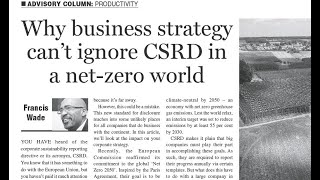
Hello and welcome back to Chronicles from a Caribbean Cubicle podcast. Here's an article I wrote for the Jamaica Gleaner. It's entitled: Why your business strategy can't ignore CSRD. You've heard of the Corporate Sustainability Reporting Directive, or its acronym, CSRD. You know that it has something to do with the EU, which means that you haven't paid it much attention. It's far away. However, this could be a mistake. This new standard for disclosure reaches into some unlikely places for all companies who do business with the continent. In this article, we'll look at the impact on your corporate strategy. Recently, the European Commission reaffirmed its commitment to "net zero 2050." Inspired by the Paris Agreement, their goal is to be climate neutral by 2050—an economy with net zero greenhouse gas emissions. Lest the world relax, an interim target was set to reduce emissions by at least 55% by 2030. CSRD makes it plain that big companies must play their part in accomplishing these goals. As such, they are required to report their progress annually via certain templates. But what does this have to do with a large company in Jamaica? Well, your firm may not have a European subsidiary, and it might never reach the €40 million turnover or 250-employee lower limit for inclusion. However, it may have wholesale customers on the continent. If so, you will probably be required by them to report on your conduct as a member of its supply chain. But this is already happening. Last week I browsed Booking.com for a holiday stay in Ocho Ríos. Now there's a new badge for each property to earn, a "Travel Sustainable" level. According to the website, the program was introduced in 2021 to provide travelers with transparent and credible information to make more mindful choices for their trips. In other words, the intent of CSRD is already being realized. It seeks to give stakeholders knowledge about each large company's progress on goals such as net zero 2050. This new standard is likely to be seen by some as a nuisance, but for others, particularly in the area of strategic planning, there lies an opportunity. How CSRD can help shape your strategy. Essentially, the new standard mandates your company to tell the world how its strategy for topics related to environment, social, and governance are faring. It expects you to address this explicitly in your short-, mid-, and long-term strategic plans. However, if you are like most companies, you don't have anything more than a 5-year list of tactics. But you aren't alone. As a result of upheaval since the 9/11 terrorist attack, Firms have argued that they don't have time for long-term thinking. Instead, their energies are focused on basic survival—short-termism. CSRD says that if you continue to indulge in this dangerous practice, you will be required to highlight this fact to your stakeholders in your ESG disclosures. While this sounds like a threat, some are seeing it as an opportunity, or at least an excuse to do the right thing. The optimal response. In essence, your company has two choices to meet the directive. One, the compliant low road consists of sticking to an approach of only keeping short-term business tactics. This means that you will need a separate strategic plan for all matters ESG related. While some firms have hired sustainability professionals to do this very task, some are calling it a out as a form of greenwashing. Said differently, it's probably just a way to be compliant without making fundamental changes. Two, the transformational high road means crafting mid- and long-term strategic plans for your business, if they don't currently exist. Ideally, they should reach as far as 2050 to be completely aligned with the net-zero aspiration. If your company already has a written long-term strategic plan, then this may just be an exercise in adding a few different dimensions. The CSRD is actually developed for companies like yours. The adjustment should be easy. However, if it's never had an interwoven short- and long-term strategic plan, this might be the perfect moment to begin. You do have some time before this becomes a requirement by virtue of your business dealings. But your free paper is being burned up. The SEC in the United States and the IFRS are expected to recommend similar reporting standards, in line with existing requirements for financial disclosure. It's not too late to start getting your company ready. Schedule time to prepare the kind of interwoven short- and long-term strategic plans that address both ends of the spectrum. As you do so, be prepared to answer the ESG questions raised by CSRD. If the process you follow is sound, these may not be central concerns to your business. But they will fit in with the thinking the EU Commission wants you to be doing. When the time comes to complete the forms required for your CSRD reporting, you'll be more than ready. Thanks for listening. Do you have an unsolved problem in your Caribbean company related to strategy, productivity, engagement, or business process improvement? Just visit a searchable listing of all my prior articles and you may be able to help yourself to a fresh line of thinking. Go to blog.fwconsulting.com or see the show notes.