Webinar: Chaos! Has Strategy Been Put on Hold? How Strategists are Still Creating Opportunities
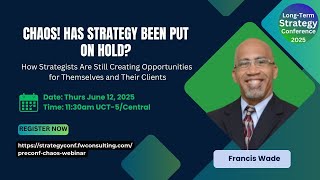
Francis Wade walks through 25 obstacles that block long-term strategy, from legacy mission statements to the "double-results-in-half-time" mindset. He teaches the ABT storytelling formula and future-back thinking to help leaders escape reactive firefighting and champion bold plans even in chaos.
Chapters
So you want to be someone who champions game-changing strategy. It could be a CEO, a consultant, a strategic foresighter, just a member of staff, a manager. You could even be a board member. But you want to be someone who creates or causes a game-changing strategy to take place either in your company or in a company that you work with. However, today's chaos puts your commitment to the threat. Companies since the beginning of the year, thrown about there, have fallen into survival in which all they can do is barely look after their well-being and perhaps make it through the latest drama. So if you ask them, what about strategy? They say, our strategy is to survive. What kind of strategy is that? Well, my friends, if you're here to answer that question and to delve into the challenge of championing game-changing strategy, you're in the right place. Who am I? I'm Francis Wade, if we've not met, and I'm the president of Framework Consulting, and I'm the host of the Long-Term Strategy Conference. And joining me alongside us in the chat is my colleague and wife, Dale Pilgrim-Wade. But I want to make sure, as I always do, that I'm actually talking to you and I'm not talking to myself. Are you hearing me in the chat? Just drop a note and let me know. Also, let us know where you're coming from. Hate talking to myself. Abby says yes. I think that's yes, I can hear you. Derek says hearing you loud and clear. Becky from Denver, welcome. Delton from Jamaica, Delton Phillips, welcome. All right, so let's get a deeper sense of who we have in the room. I'm going to drop a poll on the screen. So you should be able to see the poll on the screen. Question is, how has the goal of game-changing strategy shifted in the last 12 months? Has it become easier, harder, or downright impossible? So just drop an answer in the chat. How has the goal of game-changing strategy shifted? Okay, I see some answers coming in there. How has the goal of Game Changing Strategy shifted? Go ahead and drop an answer. It looks like we have a winner, winning. Nobody is saying much easier. Nobody is saying easier, neutral. Thankfully, nobody is saying it's become impossible. This is a good thing. We have a neutral in the group. So I just want to make sure that the reason why we do these polls is to make sure that the mindset that we think we're speaking to is in fact the mindset of folks who are attending. Great. All right, so, all right, so let me close the poll there. The winner is harder. Second place— well, no, the winners are either harder or much harder, but it's not— that's not— I don't think it was showing on the stage. Let me see. Okay, it's now showing on the stage. Take a look and you'll see the results. And in case you haven't answered the poll, go ahead if you want to make sure that we're actually polling you, we're not just trying to fake things out. All right, great. So I'm gonna take the poll down from the stage. I can see that the, the winners are Much Harder and Harder. And let's hide that from the stage. It's a great result. And I'll close the poll in a few minutes. But so if you're here to answer that question, you're in the right place. And happy to tell you that you may be in one of several places, given the harder and much harder responses. I imagine that one of the things you may be feeling is, I've been trying, scrambling to try and change people's minds. I've been asking them, what about strategy? And they say, Like I said, our strategy is to survive, and you're trying to change people's minds, and it's difficult. Part of what we look at today is what can you say? What are some of the things that— the requirements of game-changing strategy? Perhaps you may be even further down the road and feeling as if this is a bit of a lost cause, as if, oh my goodness, I don't even know if I'm going to make it. Maybe this is a permanent state of affairs, that chaos is going to be ruling from now until the indefinite future, and strategy will permanently take a hiatus, maybe. Perhaps you've also been talking with people who are— let's not call them your enemies per se, but they're people who have a different point of view. And in that point of view, they're committed to the short term. They are— they won't say that necessarily. You may ask them and they say, oh, of course not. But all their actions are correlated with knee-jerk responses to the latest drama, the latest disruption, the latest surprise. And your meetings, their meetings are pretty much based on, or committed to chasing down the latest, the newest answer to the latest question, this week's drama. At the same time, you're here because maybe you imagine that there's something you can learn from others who are veterans in game-changing and therefore long-term strategy. And you still have not lost the dream of being a champion. It's kind of cool to be a champion of long-term strategy. You know, you really can make a profound difference that you can experience and feel for the rest of your life. So I'm going to share my screen. Share screen. There we go. And take us through an agenda. So in our agenda, as you can see, we are going to be in an interactive presentation for most of today. I warned you that you'd be using your brain as well as your fingers, or in other words, your keyboard. There will be a giveaway at the end. There will be a prize, and you'll have the fortune of answering a question, so pay good attention. Oh, let me just change the way this looks to you, one second. That's— I think this is a little bit better view. Yes. Um, after the presentation, the formal part of the evening or the morning depending on where you are in the world, will be a table chat. You'll be able to use your microphone and your camera to chat with all the people who are— who have stayed behind after a few minutes. I'll be there also if you have any questions of me personally. And there should be an on-demand replay at this link, same space that we're in, available in about a couple hours' time. And I'd like to encourage you to use the Q&A tab. So you see that little arrow and that Q&A, it's kind of in the left of that panel to the right. Drop your questions there just because they're much easier to find in that context. So some good news. Today's conference and webinar— today's webinar conference coming up in 2 weeks' time, one of our great partners is Futures Platform. And what does Futures Platform do? Well, take a look. So they help you put together a radar of all the incipient threats taking place in your environment. Now, this is not just a matter of them, you know, getting an AI to just pump up, pump up the content of, you know, grab stuff from all over the internet randomly. No, they actually contract with experts from around the world to give experts' opinions about these trends. So it's a powerful tool, and I'll drop a link at the end where you could— oh, there's a link on the screen, actually. I'll ask Dale to drop the link, or maybe I could— I think I have it saved somewhere. Just drop the link if you want to go and check out what they're doing. They have a free— sorry, I did that twice. They have a complimentary radar that you could test and try and use, a bit of a demo to uncover the power of what they do. Futures Platform, futuresplatform.com. Okay, so today I mentioned that you're in a webinar, which you know, and there's a conference coming up in 2 weeks' time. The Long-Term Strategy Conference. So this is a prelude to something special. I'll tell you all about it in a while. So this is not only a for-profit, a place for for-profits, and we may, I may speak in a way that makes you think or lead you to believe that for-profits are the most important, you know, kind of our area of focus. Not even true anymore. We've done a lot of government work lately, but whether you're a nonprofit, or, or an NGO, or like I said, in government, or if you're a leader of some kind, any of these kinds of roles, you may be asking, should I be about game-changing strategy? And the answer is yes. In particular, given the role that you're in, if you're in one of these roles, and the truth is, you can champion game-changing strategy from anywhere, even from just being a stockholder. So I want you to imagine for a minute just being a game-changing strategist, a credible champion of game-changing strategy. What would it be like if you could explain, especially to those people who are naysayers, you know, the people who say that we should be just trying to be agile and that there is no such thing as long-term anymore? Life has changed. You want to be someone who could also convince leaders, you know, in— if you get a chance to present to your A board or your board, most boards I've met are itching to get into long-term strategy and game-changing decision-making, and they usually don't have the opportunity. It's my experience. You want to inspire also. So there's an emotional component to what we're talking about here where you perhaps could inspire stakeholders to become champions of game-changing strategy? And what would it be like if you could accomplish all three? So take a moment. Let me know, you know, what would it be like if you could accomplish those three objectives as a champion? Drop a note in the chat. Let me once again make sure that your fingers are working and that you are not off checking Instagram or reading your email or doing some other activity that should not be approved under the current circumstances. You can also drop an emoji also, if that'll give me a sense of what you're thinking is about the, the slide. So what would it be like? It takes a moment for the fingers to work and the brain to engage. People to say, oh, he's asking a real question this time. Drop a note in the chat. Becky says, fulfilling. Derek says, very applicable to my organization's current work on the circular economy transition. Denson says, it would be amazing. And I like the word amazing. The notion that you know that you made that kind of difference. So today, if we had a topic, the topic would be how to create game-changing strategy without being stopped by chaotic events. And let's look at the case of Marcia. So Marcia, it's a little bit small on the screen, but she's a new CEO of a company which has just been hit by tariffs. Unfortunately, these could not be predicted. As a result, her colleagues at the board and executive levels have been scrambling. Each person is now in emergency mode trying to fix one fire after another, and unfortunately, she's far from being satisfied. They were just about to engage in a fresh round of strategic planning, which she intended to be game-changing in her industry. For example, they would be the first to implement a cutting-edge technology that's never been included in the strategy before. This would put the company at least 2 years ahead of its competition. But now that advantage is slipping away. In fact, their investment in the new technology has been cut by 25% this year. She's worried that they have become super busy, maybe even mega agile, but they are making a huge mistake. So if you can resonate, if this means anything to you, just show me with an emoji because In our hyper-chaotic world, there is a human tendency to put strategy off until— and whereas that was maybe a decent strategy before 2025, I submit to you maybe that's a bad idea. Why? Putting off and the putting off and the putting off and the putting off and the putting off may leave you at risk. Why? Because Your executives then become trapped in small thinking and short thinking. Small, it's not game-changing. Short, it's not long-term. And it's also not preemptive. It's all reactive. Let's call those the three deadly sins of strategy in a chaotic world, the three temptations, the three things that could go wrong. And the result over time is that an executive team becomes blindsided. Like a Kodak or a Blockbuster Video or any company in your country that used to be a leader and used to be a pace-setter and now has simply just fallen apart and disappeared. Maybe it's a result of bad strategy. So I have always been committed and thought myself someone who wants companies to think big and to do big things in the world and to make a big difference. Companies, organizations, governments, NGOs, it's rare for me to find an organization that I don't want big things for. However, in spite of my one-on-one conversations with CEOs and board members, my observation is that they find it really difficult, extremely hard to commit big. It sounds as if they end up just being all talk. In other words, and no action, all aspiration and no implementation. And I've wondered, you know, how is it that I'm not able to convince organizations at scale to take on game-changing commitments and then fulfill on them? I don't just mean lip service. I don't just mean talking about stuff and actually not doing it. I mean actually doing it, like, for real, using long-term strategy kind of techniques. And I sat with the question for a while. And finally, I had a bit of a breakthrough when I was exposed to the work of Alex Hormozi. So Alex is an influencer, well, not so much. He's a marketing coach, more a marketing coach who has a big following, hence my use of the word influencer. But he also points out this particular equation that's on the board in the top right-hand corner. So in the top right-hand corner, he says that customers perceive value is a function of the dream outcome times the likelihood of achievement divided by the waiting time and divided by the effort and sacrifice. So this is a, this is a good one, right? I'm not going to go into all of it because it's a bit complex, but I'm going to focus on the likelihood of achievement. Because when I used his process to analyze the work I do in organizations, in companies, I realized that there's all these areas of friction that my organ— my clients experience. In other words, there are obstacles. Ooh, there's a bit of rain coming in at the moment, because it's raining here in Jamaica. Huh, I may have to get up to close the window. But these likelihood of achievement, the obstacles to the likelihood of achievement, his method is to have you focus on each of them, and to sort of relieve the friction. And I did this exercise. And it's interesting because none of the points of friction were big. But I could see that on a given project, maybe 10 out of the 30 could randomly show up and therefore lead the client to experience more friction than they needed to. Well, in the process that he led, we figured out ways to attack each of the points of friction. Again, in the, in the frame of mind that An individual point of friction isn't bad. It's the collective points of friction, the groups of friction that cause a major problem. And we had a lot of success with this. All kinds of spreadsheets and checklists and things that the client wouldn't even notice or even think were substantial we put into the process because sometimes they prevented a problem from happening. Other times they anticipated a problem that could happen. But it really, really worked. A different kind of mindset to think that way. Well, I thought about the organizations that try to implement or think about implementing game-changing strategy and why they don't, or why they stop short. And the reason I came up with is that, well, they have obstacles along the lines of what Alex's theory or his school of thought advocates is that, and again, there's a wide range of them. My screen just jumped. Okay. There's a wide range of them. But however, they don't show up all at once. So you can't tackle them all at once. Instead, you have to tackle them one by one. So I said, well, I think I do that when I, we do the work of long-term game-changing strategy. And What are the obstacles? And I think I've been using them all along, but never actually wrote them down. So I actually wrote them down following his kind of inspiration. I came up with 25 of them. And this 25 set of obstacles was further, further sort of amplified when I picked up This Is Strategy by Seth Godin. So I don't know if you caught the of the podcast that I did with him, but it all started with my reading his book. It had 290 chapters. And the parts that I focused on most of all, the parts that I use NotebookLM to dig into deeply had to do with the application of systems thinking to strategy. So it's been really interesting, right? Intellectually interesting. So he picked up these obstacles to systematic systems thinking in strategy. He did a bunch of research. He laid them out in his book in the different chapters. The book wasn't only about that, but it covered it. So when I used NotebookLM, I went into the sources, found the sources that he used, and saw that he had followed a process of becoming fluent in this sort of language. And I said, huh, it was interesting. During the actual interview, I said, hmm, he has a lot of stories. So if you saw the podcast I did with him, he said he has a lot of stories. Yeah. So anyway, the 25 obstacles that we came up with are, I'm going to share them with you and you're going to say, Francis, that's too many for me to absorb all at once. But a couple of them had to do with, for example, vision and purpose statements and why they are not useful for game-changing strategy. Now, if you do a search on ChatGPT or a Google search, you'll see that every reference to game-changing and long-term strategy starts with, oh, come up with your vision and your purpose. So one of the obstacles is that in the work of game-changing strategy, vision, purpose, values, and mission are all up for grabs. In other words, you don't start with them because they limit you to a prior strategy and a prior vision of the future. Instead, you do the equivalent of zero-based budgeting. Zero-based strategy says all of that goes on the shelf, and you may come up with a brand new mission, vision, purpose, value statement because you're doing a rethink. You have the time because you're doing game-changing long-term, and you have the space to do that. So that's one of the obstacles. Another one is CEOs who say, I want double the results in half the time. And the result that that has on people's well-being is that it drives them crazy. So the 3 secrets I'm going to share with you today have to do with how do you master these 25 obstacles? How do you tell stories like a Seth Godin? And how do you fight with a proxy? That third one sounds mysterious to me. So how do you master 25 obstacles? All right, so let me ask you to drop your notes in the chat. A note in the chat. What are some of the obstacles to game-changing strategy? So here's the part, the part where you actually Think and type. So what are some of the obstacles to game-changing strategy? Mindset. Great, thanks, Iona. Uncertainty of the future. Delton is— I— oops, going too fast. Is— says commitment of leadership. Haley says fear of the unknown. Candice says limiting beliefs. Adam says resources. Great. Who else? What are some of the other obstacles to game-changing strategy? Short-termism is a status quo. Yep. All right, great start. Lack of creativity, afraid to bet on the wrong approach. Political interference, sure. Corporate culture. All right, so you're in the right zone. Let me show you what we came up with. We came up with 3 groups. I'll show you 3 groups of obstacles. So we grouped the 25 into 3 groups. And, um, I'll— as I said, I can't share them all with you, but I can share with you the format that we use to define these 3. 3 groups. So just a reminder that all this happened when I interviewed Seth and Stuck in Stale Strategy was the title of the podcast. His book is called This Is Strategy. And during the podcast, as I said, I realized that he had this library of books as I was talking to him. You can actually see if you watch the podcast that there was this moment where I was like, a minute, as I'm asking him a question, he's like riffling through a mental list of 20 stories, and then he chooses one to share. And I said, you know, having these stories at your fingertips is this power, superpower that he has that I don't have. And I came away, and I think I mentioned it on the podcast, that I want to have the stories that he has. So how do you develop these obstacles first? And then we'll talk about the stories. So the obstacles. So he did a bunch of research to find the obstacles to systems thinking in strategy, and that's, that made up the body of his book. But here are some sources that you may use, that I use. So past personal experience, there is colleagues, surveys, there's content, formal content like research, published papers. There is informal content like articles on LinkedIn. But it's interesting when you narrow down the search for just obstacles to one thing. I could see the process he went through and encouraged me to go through the same process to come up with the 25. So thank goodness he did his research when there were LLMs., but we certainly can do the same. Okay, Maurice says one of his favorite authors, and I put it to you that the process of Obstacles to Stories is what he uses. But here's an LLM prompt that you may— if you're into— if you're using LLMs, take a screenshot and see. But this is the format of the obstacles. So we asked the LLM to come back with this format. It didn't do all that well, to be honest, but it confirmed some of the ideas that we had, and it altered some of the others. It recommended we change some of the wording. So if you want to take a screenshot, go ahead. But the format of the obstacle is— turns out to be important. So it starts with a contrasting headline, something that's not business as usual, language. It continues with a brief explanation of the obstacle, and then the benefit of using that obstacle. So the obstacle is more like a lesson, or a distinction, or a principle that the most experienced people use when they engage in game-changing strategy. And they, like me up to that point, a few months, a year ago maybe, they tend to be hidden from view because they're used without thinking. All right, so here's a scary list and you're about to complain. Group 1, I know you can't read it. I could not imagine going through each of them with you. And I know there's a way to expand the screen, but I'm pretty sure even if you expand the screen, you will be able to read it. But anyway, I'm gonna, I'm gonna share with you how you're gonna be able to delve into each one of these at scale. Group 2 has to do with organizational alignment and the mindset. So Becky says you can read it better if you roll over the screen share and hit that double arrow. Oh, if I were to— oh, she's, she's telling me how to zoom in on each one. Okay, maybe I can— I think I can do that. So if I zoom in— better? But then you only see part of the screen. I know, I know, I know, I know, I know. So zoom back out, that's a bit tough. And then the third group. But here's the good news, this is not the moment to delve into 25 obstacles. Instead, I want to share with you the process that we used to find the speakers for our conference. So, Ami Devereaux, who's actually in our audience, and Dale, my colleague and wife, and I sat down in a bunch of different conversations and said, how can we find speakers who can speak to these 25 obstacles to game-changing strategy? With a proviso that these 25 are not conventional wisdom, that they are, they're secret stuff. They're not the things that people talk about every day. So they go deeper than the level of the answers that we would say in just coffee conversation or over drinks. So we sent the list out of 25 to potential speakers, and if you were at last year's conference, you may notice that we have half as many speakers, and the answer is that we didn't get Responses from everybody. Some saw the list of 25 and said, what? But the ones who responded, responded with a certain kind of force and effort that I just really admire them for stepping up. And the way that I described each of them, I didn't just give them the text. I actually created a 5-minute video for each of the 25 principles, obstacles, distinctions, lessons. And I said, you know, go through, find the one that you resonate the most with, and come and let me know. And then, like I said, some didn't come back to let me know. Figure that they saw the list and, and I imagine that some just plain old disagreed. Because these do take— I'll share this later. But so that's 25. Now the good news is that you register for the conference and you'll have 48 hours to delve into these 25. Yep, the 25 videos are going to be available. And I'll share some more later about how to register, but this is the page that they're on. Kind of looks like this: 1, 2, 3, all the way to 25. And for example, vision versus purpose, double the results in half the time, obstacles. These are the errors that companies make as they try to accomplish game-changing strategy. All right, so I'm gonna pause right there, and I'm gonna take questions or comments. So questions or comments in the chat, remember to use the Q&A button if you have a question. Becky gave some good— aha, so here is a, there is a question here. I'm going to do something fancy. So Becky asked a question. It's an easy question. Of course I don't have the answer. Becky, if you, if you go to the, if you go to the conference website, we'll give you a link to it, strategyconf.fwconsulting.com, and you search, and in the posts it was published in about February, I believe, February, March. You can go back and find it that way, the interview with Seth Godin. Don't have the link here, should have come prepared for that, didn't. Okay, so other questions in the chat? Let's see what else we have here. Other questions or comments in the chat? What's my favorite of the 25? Becky, Becky, Becky, Becky, boy, I haven't met, I don't think, but boy, you're coming to mind now as someone who is definitely a thinker and a provocative one. So my favorite, um, I don't have a favorite, but I love the vision. Throw out your vision, mission, and purpose and values. Because when you're doing game-changing strategy, you're assuming none of them to be true. I love that one. Because it signals, the organization sends a signal to itself that this is really game-changing. That just because we had a prior view of where we wanted to go, prior mission, just because we had these things doesn't mean that the wording of those statements is going to make it through a game-changing process. You know, in matter of fact, if you imagine if Kodak sat down and came up with a game-changing strategy for itself when it was still alive and it had the opportunity to do it, the time, space, the money, the people, and it didn't do it. Probably what they were doing, actually, the research says that they held on to their prior view of the world, their prior vision. They actually hired a game-changing CEO. He lasted 2 years, perhaps. It's about 2001, 2002. And they fired him and they hired an old-school CEO to replace that guy. The old-school CEO threw out everything the game-changing guy did and took them back to the past. So in the context of game-changing strategy, game-changing outcomes, prior commitments such as the ones I'm talking about get in the way. Now you're free, of course, after the retreat is over, after decisions have been made, after the game-changing strategy has been forged, to go back and reclaim the prior vision, mission, core values, and purpose. Refashion, reword, or you can toss them out altogether and say, you know what, where we're headed is so dramatically different that the one— these statements that the prior leaders Chip came up with, no longer apply. Okay, Kelly asks, how does one balance— it's a different question. Okay, how does one balance a naturally conservative outlook with the bigger picture and uncertainty that seems to be the default position these days? I'll share, I'll share a conversation I have Kelly, with companies in, I think, the next— sorry, the third secret. I'll share one exercise that I do, but the, the exercise will be about shifting the mindset from present forward to future back. There's a great book by Mark Johnson that outlines this shift. And in the work that I do, and I'm sure several of— if you're a consultant, you may know what I'm talking about. What we're trying to do is to make that shift happen in real time, where 20 people who are in front of us go from one mindset, present forward, to another mindset, future back. Now, typically, the old present forward mindset is the one that is the default. They're used to it. They're comfortable with it. They don't want to leave it. That's why they were promoted. That's why they get paid. That's why they get their bonuses. The present forward mindset pays off. However, the present forward mindset is inimical to game-changing strategy. Game-changing strategy, we need a future back mindset. And later on, I'll share an exercise that I use to cause that shift to happen in real time. So exercises work really well, better than trying to explain or cajole or force or And there are other things that folks sometimes try. Yeah, I've tried all of those. They don't work. Okay, so how do you tell stories like Seth Godin? So you've gotten the obstacles and now you want to convert them into stories. So I want to share with you a framework that I use. I just gave it a name, called it the Storyteller's Assistant. You start with the obstacle, then you move to distinguishing firsthand stories from illustrative stories. So there's some stories in which you feature, you're the protagonist. And then there are other stories in which you don't feature, which are just made up. You use a storytelling framework, you don't just wing it. Storytelling frameworks make things much easier. And of course, it allows you to ask an LLM to write the story for you. Next step, and then you rinse and repeat. But telling a story is very different than trying to explain. Stories have a multi-sensory kind of impact. They move things along in the way that an explanation doesn't. And I, so I'm not someone who's ever told a lot of stories, not until recently. I only used to tell stories when the occasion called for it. And I'm not a joke teller, so I'm not someone who stores jokes. You know, I don't remember these things like that. But I wrote a book called Bill's Imperfect Time Management Adventure, and it was a story, an allegory. I based the structure on Eliyahu Goldratt's book The Goal, which is a book about improving factory performance primarily. I'm an industrial engineer by background, so that one came in very handy, um, and I learned or discovered to my shock that there is a structure to telling stories, telling good stories and impactful stories. And I struggled to write the book because I had never heard it before. And I had to learn the structure and write the book at the same time. Imagine the first draft when I hadn't learned that there was a structure, what that looked like. Anyway, that was back in 2012, thereabouts. Fast forward to just maybe 4 years ago, and I ran into the ABT Formula by Randy Olson. So the ABT Formula is a handy way to encapsulate any story, and it was a game changer for me. I thought I knew what a story was. Now I write a story like the one I wrote about Marsha in every podcast, in every presentation, In every opportunity, I use the ABT formula. He made it so easy and so portable that once I kind of figured it out after some mishaps and errors, it's now become a part of what I do on a regular basis. So the Seth interview led me to see that obstacles need stories. And I would never have thought of it that way until I saw him do it live in front of me. That the stories and having a lot of stories and having the right stories, that doesn't happen by accident. That happens by preparation. So in addition to ABT, here is a different framework called the StoryBrand framework. ABT is very simple— and, but, therefore— but the StoryBrand framework requires a bit more time. You may have detected that I use this framework in the Marshall story, and I've used it a couple other times in our time together. Whenever I've told a story, I've used this framework. You can go ahead and take a screenshot, but as you know, you're going to see the— going to have these afterwards. You're going to have the slides. And as you can imagine, LLMs are really great for writing stories. Boy. So here are some of the other obstacles it picked up. When I asked the LLM to write the prompt that I could share with my audience today. So present forward versus future back, which I mentioned already. Implementation failure is another, another one that's, that has to do with that, that, that twice the results in half the time, where a strategy is a failure from the moment it's put together. Wish list strategy is just a bucket of all kinds of odds and ends that don't really fit together except that they're on the same piece of paper. A wishlist strategy. I could go into that, but the LLMs allow you to tell great stories and they're great prompts, they're great shortcuts. There is a question here from Maurice. Two questions. Question from Becky. Okay, let me get those up on stage. Maurice's question is on stage, I believe. I find it difficult to communicate with people who like one-line information, then one by one they ask you all the questions in the story you would have told. Yes, sir. I don't have a solution to that one. Although over time I noticed that I tell a story, a long story the first time, I can shorten it the second time, the third time, the fourth time. I'll share an example of a story that I use in the next step. But as you practice the story, you can become more, more expert at delivering it. And as you shorten your delivery, and you kind of notice the impact on the person, then you can get better. I truly— these 25 obstacles are not— I'm not advocating that you read them once and then you're done. I'm advocating more like a long period of study. In which you develop understanding and stories. Becky wants to know if I'll develop a GPT for this. Becky, shame to say, I've not developed a GPT for anything. Answer is no. I haven't— my own learning has not taken me that far. But if you see an opportunity, drop me a line. So the third secret, if there are no other questions, let me check the chat to see if I'm Great, someone found the— is that Becky? Yes, Becky, thank you for the, for the link to the podcast with Seth. Okay, great. Any other comments or questions? Drop it in the chat. No, because this one is a, this one is a doozy. The third secret is a doozy. What's a doozy? I got that from a movie that I watched, and I don't use that term in my everyday life and probably shouldn't have used it, but here we go. It's a doozy. Oh, it was from Back to the Future. Maurice says, I love how informative and thought-provoking this is. Thank you, Maurice. Thank you. Appreciate that. Folks, if you agree, just drop an emoji. It's not that I'm trolling for likes or anything, but you know how it is. Okay. So this concept is, it comes from the reality that as you advocate a new point of view, you're more effective if you throw an old point of view under the bus. So in the description of the 25 obstacles, you'll detect that there's a thumbs up to something and then a thumbs down to something else. So you're promoting and you're demoting at the same time in the same paragraph or story. And if you have a client or, um, a boss or a CEO or a board, you don't really want to provoke a fight. Now we are talking about a fight. But you don't want to provoke the kind of fight that would turn into a cat fight where someone said, well, I think very differently from that, and 3 hours later there's an argument that's broken out with the board members, and half the board thinks one way and other half thinks the other way. So the 25 are— they do have this up or down kind of feature. What do I mean? Let me give you an example. The point of my mentioning this is that instead of trying to debate, what you can do is offer exercises that have stories built into them. So here's an example of an exercise that you could— that can be a proxy as you're having a conversation with a group of people, for example. So this doesn't really have a name, but I put one there because I'm doing slides. So this, this one is about promoting legacy and demoting blame. So it takes part in, in 3 steps. And let me actually have the steps written out so that you can see. Okay, this makes it easy for you. So in part 1, so imagine you're standing in front of a group of 20 executives, board members, managers, They are considering game-changing thinking, and they're having a difficulty thinking about the future, primarily because, as I said before, they are good at present-forward. That mindset is theirs. They are expert at that, and that's why they are where they are in life. And now you're asking them to consider the future-back mindset. You're asking them to shift. But instead of just asking them to shift, because you can't just say to people, oh, by the way, guys, can you shift? No. So I tell the following story. I say, so folks, consider leadership teams from years gone by. I imagine that you, as you look around your business, you realize that there are decisions that they should have made. And you probably complain to each other that they didn't make these decisions. So what are some of the decisions you blame them for not making? And what do you blame them for not doing? So how many of you know what I'm talking about? And then the hands go up. And then I say, what are some of the things that in this organization you say, you know, they should have done this 10 years ago, 20 years ago, 30 years ago when they had a chance, and now we're here left having to fight it over? And they tell me. So we get it very real that, okay, this is not a— this is serious business. This is the cause of much heartache in the company. So in the next part, I say, okay, let's shift gears a bit. Who's the youngest person in the room? And sometimes it's not a board member or executive or manager. Sometimes it's the guy who's the IT guy. Sometimes it's someone who's servicing, you know, servicing the food and the drink, or they're an employee of the company. Someone who's in the secretariat, you know, they're managing the activities of the retreat. And they're 22 years old. And I say, so let's imagine that in 30 years' time, that Mike is in, he's still in the organization. And guess what? He's like the CEO or the vice president. And he's in a retreat just like this one in 20 55, and he's looking around the room and people are, you know, they see him as the elder who was there back in 2025, 35, 45, been there 30 years. So people ask him, you know, what was it like to be in that retreat 30 years ago, 2025? In other words, the one that we're in today. So Mike could have one or two responses. So Mike could say, you know, they should have solved this problem, problems that we have today, because they discussed them, but they didn't. And I'll tell you the truth, when I walked out of that meeting, I wasn't even a participant, I just watched them, but I paid attention to everything. I was so disappointed, I was upset. That they didn't make the decisions that they needed to make. They didn't have the hard conversations and take them all the way to the end where a decision could be made. They just didn't have the courage. You know, they were, they were, some of them were selfish. They just wanted to focus on themselves and what they could get from being an executive. That they, they didn't put the organization first and they weren't thinking long term. Kind of thing we say about politicians, right? So that's one response, response A. And then there's response B. And I say, so imagine response B, the alternative, that Mike, when he's asked the question, he actually does this, and he wipes a tear from his eyes, and he says, They were so selfless. They put us before their own. They knew that by following this strategy, they were going to put themselves at risk. And they, they, they realized that this could be bad for their careers to champion this, this game-changing solution. And they knew that it could end badly. But you know what they said? Forget about us for a moment. Let's do it for the good of the organization, our customers, and of generations to come. And you know, they made some tough choices, and I'll tell you, I saw them have some of the— I thought people were gonna not leave there alive because it was so contentious. And frankly, That work that they did is the reason why we can live on top of their shoulders. So, no, I'm not kidding when I say that that kind of championing moves— can move people to tears. I was just in a retreat this year where someone who was a champion in a different organization was also moved to tears in the same way. But anyway, that's the second part of the exercise. And sometimes it works, sometimes it doesn't. But by considering, you know, which are you? Are you A team or a B team? Which one do you want to be? I asked them that question. And I say, and I mentioned it throughout the retreat, is this the A or the B? Which one is this? So the exercise is one way to A proxy is someone who stands in for you so that you don't have to engage in contentious conversations. And exercise can cause this shift for you when trying to convince people doesn't work. So we applied that philosophy to our conference and said, okay, there's two fights you want to have. The conference is the proxy. The conference is our middleman. So I just want to share them with you because you may, you may get a chuckle and you may disagree vociferously and vehemently. So one fight that we want to instigate during our conference is that a strategy ain't game-changing, that ain't game-changing ain't strategy. My wife is looking at the screen and she's complaining because she says you shouldn't be using the word ain't, this is a formal setting. But the essence of it is that Don't bother with strategy if it's not going to be game-changing. Call it something else. Matter of fact, if it's just short-term 5-year, that ain't strategy either. Some of you are shaking your heads disagreeing. But the reason I say that is that a 5-year strategy in isolation is really a continuation of the past. It's going to have the same vision, same mission, same values, same purpose that you had before. And it's not going to be game-changing. It's a continuation of what existed before, unknown to you. And that's a point of view that's contentious, no? Welcome to the conference and you'll get to engage in that one. Also, there's no such thing as a survival strategy. That's not a strategy. That's a tactic. Strategy That ain't game-changing, ain't strategy. It's something else. But we like to use the word strategy for any and everything and apply it all over the place. Come to the conference and I guarantee you that in the materials you will be at least provoked and maybe challenged. Maurice says, I picked that fight before. The aftermath was not easy. Maurice, kudos to you. It takes courage to put yourself at risk and to make a difference. So kudos. So the second bit, second fight that we want to instigate is that the notion that chaos means the end of game-changing strategy. So there are folks out there who are saying there is no room for game-changing strategy as long as there is chaos, the level of chaos that we see today. No, I don't know about you, but I think that's a really bad idea. Because if you were to look at two different companies, some companies are using chaos to propel themselves and give themselves additional fuel and inspiration to relook at their true north, to recommit to it, to notice where everyone else is focused on survival where if they focus on game-changing long-term outcomes, they could separate themselves from the crowd and be the ones who define an industry or a category while others are merely knee-jerking, reacting, responding. Another team could just be caught up in the disruptions of it and convince themselves that all they have the bandwidth to do is to react. To what's happening as a result of the chaos. Same chaos, different response. As you could imagine, our conference is about the first response. So I tried to get an LLM to figure out proxies. I tried to prompt an LLM to come up with proxies, failed miserably. So the next slide is actually blank. I wanted to say that this seems more difficult than an LLM can handle with just so far. I could be wrong, but don't know how to do it. But anyway, that's it. There's that blank screen. All right, so let me take questions, comments about where we are right now. Maurice says, I'm definitely an engineer. Maurice, I think you must be an engineer also, because Maurice says, I'm cutting through the rhetoric to share the truth. Maurice, that check that I promised you is available. I'm joking. I don't know Maurice. Claudio, sorry, sorry you have to dash. Denson says Mike must have become a great leader after seeing that. All right, if there are no other comments, I'm going to move on. Are you ready to hear about the best way to learn more about the 25 obstacles? If you're ready, you don't have any questions or comments— Maurice wants his check— uh, let me know in the chat if you're ready by typing ready. Dave is endorsing my use of the word ain't. Thank you very much. If it ain't game-changing, it ain't strategy. Okay, let's move on to the next step and share with you how you can take some next steps. So I mentioned before that today's webinar is followed by our conference in 2 weeks' time, a little bit less than 2 weeks. And who you'll be hearing from are a wonderful cast of characters. So there's at least one who's with us today, me, and I imagine she might want to stay around afterwards and join us at the tables for our chat, so she'd be available. But these are the brave, the proud, the few who stepped up to the challenge of the 25 obstacles. What are they going to be doing? Well, here's the agenda, the actual agenda of the conference. On day 1, we're having a pre-conference, uh, with session with the 1-hour with the Futures Platform people. Come and get your hands dirty on a new technology that does incorporate AI, but it also uses more heavily uses expert, expert knowledge. And, um, That's the only thing for that day. It's only for an hour. Second day starts at midnight with the release of the first set of on-demand videos. We have two sets of on-demand videos. They're available for 24 hours each. So anywhere in the world that you are, you can access them. You can binge watch them if you have an appetite for that. Um, if, um, you only want to watch a few because you have a life, then I'll talk about the full ticket a little bit later and what that allows you to do at the leisure of watching it, sort of watching it on your own time. We also have on demand— sorry, we also have live sessions. And the live sessions are made up of 4 panels. And those 4 panels, I don't have the details of what, but there's one that's focused mostly on the definition of a true north, and 3 of them are focused on the use of AI in strategy. Really a deep dive. So that will be 2 days. Each of the on-demand videos has a particular format. We start off by defining a problem, then we diagnose it. The speaker and I, the 2 of us go at it together, and then finally we come up with solutions. And the reason that we do this diagnosis is to give anyone who wants to understand the problem a view of what it might look like. Also this year, we're rolling out something called Strategy Cinema. Now let's see where the time is. I don't quite have time to show you there, show you the full deal, but here are 3 snapshots from Strategy Cinema. Basically, we're trying to Netflix the viewing experience this year, and this website has— it already has a bunch of videos from prior conferences, and our hope is to create a bingeable experience. And we have, we have in our library a few hundred slides— 300 videos, sorry— and they're all going to be available all at the same time so that you you get overload and then can't watch any of them. But that's Strategy Cinema. It's going to be a feature of this year's conference. Okay, so what you can expect from the conference itself is a focus on game-changing strategic planning. Duh. We'll have 16+ speakers. So I already saw that. You already know about the pre-conference session. With Futures Platform, you know that on day 1 there's going to be 24 hours of pre-recorded on-demand videos plus live sessions. It doesn't mention the live sessions, my bad. Both days have live sessions, I just forgot to put that in the slide. And that there'll be full tickets available, and the full tickets cost $179. The full tickets give you 1 year access to all of the replays, the live videos, the on-demand videos. So for a year you can watch them at your leisure. We also have visitors passes and those are free. So for those of you who can binge watch or you just like a passing interest in the topic, you can take a visitor's pass and just watch an hour or two throughout the 48 hours, and that's fine also. Those are available. So today we're offering a bonus, and the bonus is that if you register by midnight on June 15th— so June 15th is Sunday. I don't know why we picked Sunday, but we picked Sunday. And by Sunday, if you use that code, you get, uh, discount, which $99 actually. Sorry folks, it was on the slide. Apologies for that, it didn't quite make it to the— quite make it to the slide, or it was there and I cut it off. But it's a $99, almost a 50%, a little bit less than a 50% discount, and that's available through June 15th, which is Sunday night. So don't miss it. It's gonna— price is gonna go up, um, and it's not gonna go back down. So don't miss the opportunity. Um, and here are the different links that you may use. This is the link to register at the— for a full ticket. You can get either the full or the discounted ticket using this link, but my link is— will take you directly to the landing page that you could immediately get that full ticket for $99 right away. So use that, use that discounted ticket. All right, it's time for the free giveaway. I have a question for you. First person to answer the question gets a full ticket. So I have blocked out the title of the podcast with Seth Gordon. What was that title covered up in red? What was that title? Someone is clicking furiously on a link. And the winner is, by a nose, is Kelly McIntosh. Kelly McIntosh, congratulations, you've won a ticket to our— a full ticket to our conference. So folks, thanks for joining me. The next step is to register. Actually, if you register for today's webinar, which means that you're there in the audience, you've already gotten a free visitor's pass. So everyone who registers for a webinar gets a free webinar, a free visitor's pass. So you don't need to take an extra step if that's all you're interested in. However, if you do want the discounted offer before June 15th, go ahead and grab that. So what's going to happen next is that I recommend that you go make that purchase if that's right for you, and you want access to game-changing strategy from all the folks that we've we brought to the conference. I myself, between my wife and I, we have experience with 60 long-term strategy projects over a 24-year period, but that's a small drop in the bucket compared to the other experts that we have.
More from Francis


Ep 35 Your Strategic Stagnation Isn't a Framework Problem—It's a Story Problem



The YouTube Strategy School: Why Your MBA Didn’t Teach You Strategic Thinking





