Welcome and Tanja Schindler APF Session Fusion of Minds Strategy Meets Foresight
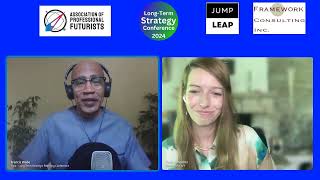
Tanja Schindler, chair of the Association of Professional Futurists, and host Francis Wade explore why organizations stay stuck in short-term planning cycles despite knowing they need long-term foresight. They use a fictional strategist named Andrew to show the clash between CEOs who resist long-term thinking and practitioners who've learned to blend both skills. Concrete fixes include embedding foresight in leadership, using fear and hope-based scenarios, and back-casting from preferred futures.
Chapters
You know that your client or your company needs a game-changing long-term strategic plan. Matter of fact, your CEO says as much. He or she would say, yeah, we need one of those, absolutely, we should have one. But— and after the but comes a reason why they don't have anything written, anything documented, or any real plan. How can we get the leaders of our companies or organizations or NGOs or for-profits or governments or nations and our world to get past that point, get past the point where we know we need to do this activity and we need to think about the future, but we don't? If you're here to answer that question, my friends, you're in the right place. My name is Francis Wade, and I'm the co-host of Long-Term Strategy Conference 2024. And in the chat, you can see that you're getting comments from my wife and colleague Dale Pilgrim-Wade. And I want to make sure that I can actually— I'm actually talking to somebody. It's not just me. Could you drop a note in the chat if you're hearing me loud and clear so that I know that Airmeet, our platform, is actually working the way it's supposed to work? Go ahead and drop a note in the chat so I can know that I'm not just talking to me. And somebody is hearing me, please go ahead, drop a note in that chat. I know that there are people who are coming in and people who are trying to figure out where they are, but let me make sure. Hi, Patty Lustig from the UK. Good afternoon. We got a note from you this morning. Glad to see you here. And folks, I'm going to actually start off with a poll. And with this poll, I'm going to ask you how much conference you've had so far. So just go ahead and answer that poll so we can get going, so we can have a sense of whether you've been active in the conference or kind of what your, your experience has been. Okay, some viewed some. Okay. Folks are making their way in bit by bit. But folks, if you're just coming in, you're seeing a poll that's on the stage. Looks like most people are here at the conference for the very first time. Couple— oh, we still have people coming in. Okay, I'm going to close this poll and open another one. And the next one Most people are brand new. Let's see, what kind of profession do we have represented this morning, this morning here in Jamaica? So let's put this on stage as well. Where are you from in terms of your background? Futurists, okay. Okay, so we have a split. That's interesting because we haven't done a formal poll of everyone who's attended our conference, but I have a sense that there's a mix and a combination of different kinds of backgrounds. Yep, we're at the beginning of a long day. It looks like there's a split, a split actually between all four. How interesting. Because the topic of the day, long-term strategic planning and breakthrough game-changing thinking, uh, kind of doesn't belong to one profession, right? Belongs to all. Okay, I'm gonna close that poll and let me share my stage with a presentation. Let's get rid of this. Okay, move right along. I'm seeing some activity in the chat. Let me just see. Hi, Vanessa. And I know there's some others there who are, uh, just trying to figure out where they're at. Okay, so let me share my screen and don't pass the point where we just finished. And if you're here, you may be, you know, under here, under, uh, let's say one of three different situations. One could be that you're visiting, which is that you're just sort of picking up different options as you go along. Another one could be that you're binging. So we've identified a few people spent all of yesterday watching videos, and as you may know, there's probably some 10 hours of video yesterday. There'll be another 10 hours of downloadable videos today, and there'll be another 5 hours of live action. And there's some who brought a full ticket, so they're not, they're not in any big rush because they have, they have a full year of access to all conference content, including the content that we're creating right now in this session. And they're going to have a full year of being able to see it. And if you are envying their position or their privilege of being able to sit back and basically not have to binge watch and get the full value, you may want to know that there— we're still running an in-conference discount. The discount is $449. And that goes up at midnight tonight to 199. So just go back to the, the conference website. Um, I'll ask Dale to drop a link to that, and you can change your status from being a visitor to being— having a full ticket. Alrighty, so you've walked into an interactive discussion that's going to run for several hours, okay, between us and different speakers. There'll be a giveaway at the end, and that giveaway will be based in part on some of gamification I'll introduce you to. We're going to take a lunch break. I'll show you the schedule in a minute, but let me tell you right— ask you right now, if you have a question, just drop that question in the Q&A. And that Q&A, use that button. I see that Craig has dropped a question in, but that will not quite a question, more of a comment. So that's really reserved for, for questions. Okay, that way you'll know that the question— your question can be seen by us. During lunch and after the session today, we're going to be found in lounges. We're going to be visiting a lounge. So the lounge is built by the platform. It's an opportunity for us to have one-on-one conversations or one-to-group, small group conversations with video and camera. So it'll be on during lunchtime and on at the end of the day. Uh, I won't be here during lunchtime. I've got to eat and get a little bit of downtime. But I'll be back at the end of the day, and I'll be, I'll be answering questions, having conversations and chats, and encouraging folks to go watch the rest of the downloads because they will expire tonight at about midnight our time, which is Central Time. Okay, so today is a gamified experience. Now, what does that mean? Well, if you look at the very top here and you see On your screen, it may look like this. I'm hoping it looks similar to what my screen looks like. I know it's a few differences, but you should see a cup, and I've highlighted the cup in yellow. So if you click on that cup, you'll see that there's already— should already be a leaderboard. And right now, Tanya is at the head of that leaderboard, and we're going to be giving away a full ticket to whoever ends up at the top of that leaderboard and is not a speaker. So this is a non-speaker competition, but we don't have a way to not include our speakers. So the winner right now actually is Patricia Lustig. Okay, so don't forget that, uh, today is a Gimme Five experience, and that's how you find out more about them. So today's schedule is— has all kinds of interesting value. Hold on a second. I'm just moving so I can see the chat. So today we're starting with a conversation between myself and Tanya Schindler. We're going to be talking about the tug of war that I just highlighted, differences of approach and opinion between futurists, strategic foresighters, and strategic foresight professionals and strategists. That will be followed by a conversation about national development planning. There's a Kenya 2030, the South Africa 2030, Jamaica Vision 2030 with Geshi Kururi Sabini. Then they will be followed by a panel which is all about creating game-changing visions and the challenge of doing that. It's a good match between these national development plans which are all about creating national visions, and the panel will be talking about the create the, the challenge of creating big visions, big outcomes, big hairy audacious goals. Then we're going to take a break for about an hour and 15 minutes, come back, and there'll be another panel. And both panels have futurists and strategists in them. Second one will be all about long-term strategic planning to connect the future with the present. And then to close out the day, we'll have a conversation, a chat with the inventor, one of the inventors of category design. That's Eddie Youn. You may have seen this video yesterday in our stacks or downloadables. And to completely end the day, we'll be having a sort of a thank you and farewell session from my co-host and myself. Any questions about these, just put, drop them in the chat. You may not have seen a picture like this before, which has all of our speakers all in one place, but Here they are. Big thank you to all of them, because as you can imagine, they've put in a great deal of work to make this happen. And as you may know, if you've looked at our lineup in any detail, they're from all over the world. It's really, really been inspiring to see who's responded to the call. And I'll tell you, it's not easy to find people who could speak to the topic of long-term strategy. This is not, this is not a trivial business. A lot of people in my profession, the strategic planning world, will tell you that, yeah, I know my clients should do it, but all they want is 2 or 3 years. And really what the clients are saying is some variation of that opening statement I, I gave, because none of them would say we shouldn't have a game-changing long-term strategy. They all agree that they should, but very few do. And the strategists have responded by working on shorter time frames. So part of what we hope to accomplish here is to expand that conversation. Now, I know that that's not a problem for futurists and those involved in strategic foresight. At the same time, every company— not every, but most companies have a strategic plan. So the mainstream activity is where the contraction has happened, and that's what's challenging all of us. Hence the reason why it's so difficult to find people who speak to this topic from around the world. So you may have completed our pre-conference survey. Let me drop you the link to that really quickly. I'm gonna invite you to complete it once again. We're gathering information We had intended to share it during, during the session, this session. Unfortunately, it actually worked out a little bit differently. So we're going to be sharing it after the session. Just find that link. Okay, so here's the link to the pre-conference session— pre-conference survey, sorry. Okay, and as you may know, our main collaborator for our conference is the Association of Professional Futurists. Just a wonderful and awesome group of people, uh, just, just a pleasure to work with them. And they're offering a 20% discount on the— any memberships that come from our conference. So if you've not grabbed your membership, you can— easy way to find it is to go to our home page and click on the link for Association of Professional Futurists. It has a diagram looking like this, a graphic, and you can click on that. It'll take you to their signup page. I'm gonna save that until later. And that's a great way to introduce our next session. So I'm gonna bring Tanya right up onto stage. And I will start actually just read from the script. Let's see, I need to stop sharing. Morning, Tanya.
Hello. Good afternoon from Europe.
Great. Folks, Tanya is here under duress. She just overcame a cold, so thanks to her for being here.
Yeah, yeah, I still sound probably a bit nasal. But it's okay.
We're very, very, very happy to have you. Okay, so let's get going. So folks, welcome to the conference with our guest Tanya Shenlow. You, maybe you're someone who lives a double life. At times you talk like a futurist or foresight practitioner, but in other moments, you sound like a strategic planner. The truth is, you have expertise in both areas, but you're aware that the mindsets are very different, even if the tools that are used frequently overlap. I'm Francis Wade, your conference host, and Tanya Schindler from the Association of Professional Futurists is here to discuss this issue with me, of being two-headed, those of us who are in this kind of long-term work. So she has a remarkable career spanning over a decade. She, as the chair of the APF, she plays a pivotal role in advancing the field of professional futurism globally. She's also the founder and managing director of Futures to All, dedicated to guiding businesses through sustainable and future-oriented transformations. And she happens to hold a distinguished double degree as an MBA and a Master of Strategic Foresight. And let me tell you a quick story, and both of us will start to work on the issue via a little sort of a narrative. So Andrew is a veteran strategic planning professional who has a new certification in strategic foresight. He's itching, can't wait to apply what he's learned, but his company expects him to guide them through the usual 4-year strategic plan. He wants to combine both approaches. Into one, and he thinks it should work. But his boss, the CEO, isn't interested in doing anything that will disrupt the strategic planning process for the worst. Ultimately, he thinks he'll have to leave the job to pursue his passion. But what kinds of careers could he pursue, he wonders. He doesn't want to end up in another corporate cubicle where he's being paid to basically rinse and repeat some old thinking. Instead, he wants his employer, current employer or new employer, to make a difference in the world, not just make profits. Tanya, so this is a, this is a kind of a tricky one. I'm going to change our layout a bit so that we can have you fill up the screen. Is this a, is this an issue that you come across with people who are two-headed, double-skilled kind of people who would come to a conference like this.
Definitely. I feel that especially once you've got introduced to foresight and this long-term thinking and the consequences of it, it's hard to stop that and just go back to say, okay, what's the 3-year planning? Although most of us come from this field, I myself started as a product manager, so it was really about bringing and launching the products in a cycle of 6 months to a year, and then also being in the strategic department to really go through those strategic planning of a 3-year cycle where you go deeply into what are the market values and really in a kind of quantitative approach of the market, what lies ahead. And in strategic foresight, we go way beyond. We go into the qualitatively and we open the horizon to say, but what else is out there that we need to start now so we can actually achieve that as an organization within the next 5, 10, or even 20 years? And this is a kind of hard thinking to stop once you get introduced to that. I'm sure you have a similar experience to that once you got introduced to the terms of foresight.
Yeah, I, I, I, so I discovered that, that I, I discovered that I found out about strategic, sorry, scenario planning back in 1992 or '93. Um, I attended a, uh, for those of us who are who are from that era. I know a lot of folks here are younger than that. But back then, I did a training with the folks who came up with the book, The Fifth Discipline, Peter Senge folks. And a part of their book was devoted to this idea of scenario planning. And I remember the idea, forgot about it, didn't use it much at all until I started doing strategic planning retreats in 2001. And then I used the idea again and used the idea of multiple scenarios. Now, I had no idea that what I was doing— because I wasn't doing scenario planning, I was using and generating different alternatives for a company. So I found myself sort of using something, and I couldn't find anything written on what I was doing. I just knew that the principle of having alternate futures or alternate scenarios worked, and I was kind of experimenting and making it up as I, as I go along. And I suspect that those of us who started using these tools, you know, before there was sort of any formal training, and even today, once you cross over into both fields, you're into a world of experimentation. Is that accurate? Is that what Andrew is dealing with, Tanja?
Yeah, definitely. Because in strategic foresight, we really try to get away from traditional forecasting or prediction, really say what will be the numbers and how can we prepare for that, and rather see what are the alternatives that might occur that we can prepare for, but also what is the future that we want to create? So what are the things, the decisions that we need to take today to create our preferred future? So it's a way more active part to do strategic foresight than just, I would say, maybe strategic planning where you try to prepare for it. And then of course react with your actions and your strategy. But interesting part with people doing foresight is also that they're coming from all different kind of disciplines. So like, I think Andrew is his name, coming from strategy, I think he has the advantage of speaking the language of the CEOs and of the strategists who in the end doing the decisions. So for him, it's very beneficial to bring back his experience or knowledge of strategic foresight into the world of strategic planning or strategic decision-making to say, okay, how can we translate this to make better decisions today? So it doesn't just stay ahead of the future. But also we have people from different engineering backgrounds, from arts, from creativity. And I think this is what makes futurists or foresight practitioners special because we have those different perspectives due to our first career, which most people never— don't start as a futurist. Most people do this as a third or second kind of career path where they stumbled across it and really got fascinated by it. Similar like me, I have an engineering background. And on the other hand, it's very natural for us all to think about scenarios. While I was sick, I was kind of watching a documentary about firefighters, and firefighters are the same. They have all different backgrounds. They kind of sometimes come from the military, sometimes they're engineers, sometimes they're being a firefighter for so long, but they think in all kinds of possible scenarios that could happen and train for those different scenarios. And in the end, this is what we do as foresight or foresight futurists, just in a more abstract way. But we try to prepare our brain for those different scenarios that might seem more likely or really unlikely. And we really actually don't make a difference to say, this is the likeliest one, we prepare for that. We really say, no, how can we train our brain to even be prepared for the preposterous future? The crazy thing, because we've seen in a pandemic, we've seen with the geopolitical tensions at the moment, there are always things in the future that surprise us. So we need to get our brain there to really train to make better decisions.
Right. For someone like Andrew, who has to convince others who don't know what he's talking about, essentially. So he's been through an epiphany, and he's committed to using these tools. So his first tact is to try to speak to others around him. What kind of challenges do they have? Because they understand what they used to do. 4-year planning. And now he has a job of trying to create a different paradigm. What's that like for someone like him who's sort of in the middle of this transition? Because he's not all the way baked yet, but he's inspired and energized enough that he wants to do something. What kind of challenge does he have?
Well, the challenges are that we all have our daily businesses, right? And to speak again in the firefighter metaphor, there's always loads of fires to solve with, either it's a product launch or a competitor that came across the market or something else. So it's very hard for us to take time away and to think of those 10 years timeframe when we have things that need to be solved maybe next week, maybe next month, or within a year. And there's more attention to things that seem to be closer to us than longer. But in many industries, for example, the automotive, medicine, pharma, it takes sometimes 10 years to develop something. Even in the beauty industry is something else. So if you don't think ahead, how do we know about the needs of our future customers that we need to start kind of solving now? Because in 10 years we already need to have the product, but you have kind of product development of 10 years. So I would think to really get this in is to bring the urgency to say, we can't always chase the most current fires. We need to step ahead. So we are better prepared. And we know already what lies ahead in terms of what we want to create.
Yeah, I, I wonder, you know, because we, we find ourselves in this weird situation where we are about the future and everyone about around us is about the short term. And there's multiple reasons why companies are so short-term oriented, all the way ranging from CEO tenure to CEOs are compensated in the short term. Politicians are compensated, or they win elections, and that's their compensation. And an election is never more than 5 years away, I guess, 4 years. So there's a pull from the outside to be short-term. And then there's COVID, which has convinced many companies, many organizations, many countries that it doesn't pay to think long-term. There's a whole argument that says that, look, so much change in such a short time, it doesn't even make to think that way any longer. And there's a whole stream of, you know, stream of consciousness or thought that says that, or we should be reactive and try to be nimble and agile and forget about trying to make things happen, make big things happen. So that, you know, he's in this environment where there's no support for what he's all about. If there were a set of conversations that he could begin to have Who do you think the person— should he go straight to the CEO? And I spoke to— and I actually spoke to— interviewed Timothy Joyebo from Nigeria in our conference. And he went to 3 or 4 CEOs once he discovered foresight and went to try to convince them that long-term thinking was important. And here are some tools. And they didn't bite. Folks, that video is in our stack today. You can listen to it. But so you went straight to the top. Where, where should I— where should Andrew start, given he's kind of so young? You know, should he bet all of it on a high-level interaction, or should he work with the people? What kinds of things have you seen people do?
Well, that's exactly, um, what the problem is. What you said is that CEOs are mostly measured on kind of the dividends that comes out in the end for the shareholders or other stakeholders within maybe the next 3 years and they get kind of stay in their job. So that's why it's sometimes, especially in Germany, it's nicer. The way the future is to work a family-owned business or mid-sized business who also existed for a very long time, maybe even 100 years, but they sometimes still have this need for legacy and think like, we want to create and we want to keep this organization also from our employees for the next 100 years. And sometimes this we lost in corporate to think about the next generations, but also our employees and to create an environment that goes for that. And the other misconception is that we think foresight is something that you do once and then you kind of prepare for it and then you stick with it. And that's the future that may approach us, but it's not this at all. It's a kind of a brain or thought experiment where we train our brain, almost a tongue twister, to think about those multiple options. I always really bold go in and say in foresight, all scenarios are wrong and false. And that's Good, because it's not about getting the most accurate scenario. It's about training your brain to combine things and to see signals that occur and to know what kind of maybe a long-term consequence of that. So you can take actions in the immediate. Another metaphor I use for this is like you need to dance, how to, you need to learn how to dance with uncertainty. So it doesn't help if I give you the steps to a dance, and for example, or the technique of scenario planning, but you don't have the feeling for the music or the feeling for the future. So the right futures mindset in knowing how to deal with it. If you're a good dancer, you can improvise and you can feel the music and maybe when it drops or when you need to react. And that's kind of a feeling that you need to get as a strategist, as a futurist, and as a CEO. You need to get to a feeling, you know, okay, I'm confident with this uncertainty and whatever kind of gets thrown at me from the future, I'm able to react. And the best case is, I mean, we can be proactive and see that some of those trends that I really see, they're more leading towards a future that I prefer, that I can strengthen them so that you really know on which pathway to the future you are. I sometimes comment, say, we're futurists, we have the crystal ball. People think we look at it and we have this one future you can prepare for. And it's really more smashing that crystal ball and having multiple mosaics or creating a map with multiple pathways into multiple possible futures. And with Foresight, you know better on which pathway we're currently at and what you need to do to change the pathways into different futures. So we are providing the compass, and that's why that's also the name of one of our magazines at the APF, that helps you to navigate this uncertainty so that you know not for sure what comes, but you're comfortable to make still the right decisions. And that's, I think, the misconception that we think we need to either prepare for, or that we have this black box and we can't prepare for it at all. But how do you make any decision today if you don't know the long-term consequences or to which future it feeds in on that? And that's kind of, for me, one of the key arguments to talk to CEOs and to say, you need to make better decisions today. Because we've seen, for example, what bringing in plastic bottles in the '90s, except for really selling more water to people, abroad. We have no idea, like, how to do it, and we're doing all the plastic in the oceans. And we really should have thought about long-term consequences of introducing certain product services or market mechanisms, right?
I, I, I wonder about— I've wondered about that approach because I, I use it myself, you know. The, the— it's not— I wouldn't call it doomsday, but it's like saying that, guess what, there's a trend that we're not paying attention to, and if we don't appear to pay attention to it, it's going to have a huge impact. So, I remember working with a client once, and it was a money transfer company, and they, you know, I asked them, you know, when do you think people will want to move to a mobile solution? This is about 6, 7 years ago, and they said, oh, one day, but, you know, not today. And I said, well, what year do you think that that's going to happen in? And they said, uh, we don't know. So there was a 1-hour discussion for them to arrive at a year, and based on that year, we could backcast and then include it in the strategic plan. A couple years later, COVID came, and when COVID came, it turns out they already had a plan for going online, and they, you know, pulled off the plan that was supposed to happen in, let's say, 8 years. And instead, we'd have it happen in 6 months. But they already had the plan. So in a way, it's kind of a doomsday, what happens if you don't pay attention to— do you think that Andrew could gain some purchase, some traction by emphasizing finding a trend that either is impacting the industry or the company that the organization is not paying attention to? Is this profit, nonprofit? It could be a government. But is that Have you seen that work?
Certainly. I mean, there are different ways to approach from, we call also the push and the pull of the future. So the push would be to look at current trends and where they lead to. And I sometimes go into and bring scenarios and then basically asking organizations, what scenario must happen to bring you out of business? So that's kind of the doomsday thing. So what must happen that you have competitors, you have startups, you have maybe even natural disasters or other things. What must happen to bring you out of business? But on the other hand, sometimes if you only lead by fear, I feel some people get really paralyzed. And we've seen that in a pandemic, that people get frozen and they don't want to act at all. They say, oh, we doomed. And it happens because we got surrounded by kind of more dystopian futures. We see in the news how the world is bad. There's rarely good news. It's all about bad news because we are more attracted to the risk and avoiding risk. Hollywood movies, we've seen like 100 million ways how to destroy Earth. And if I ask people like, how do you destroy Earth? There's so many answers from meteorite showers till just climate change or the zombie apocalypse in the worst case. And on the other hand, if I ask like, how do we save the Earth? Like, how do we want to live in 10 or 20 years? How do you want to have Earth for your children or grandchildren? It's so much harder for us to think specifically what we want. And especially if we throw it back, not not just on technology, but on social values and how we want to live. But I think we need this as well to make the better decisions. Because what happens if we only see the current trends, which is the push of the future, they all feeding mostly into the narratives and images that we already known, which are mostly negative because our brain cannot gain so much information. So it's filtering and it's filtering information that matches images that we've seen before. So we almost need to force ourselves to come up with better images or positive image of the future. So we identify those seeds of hope, those pockets of hope in the present and see, see, there was a little sign. And if we nurture that, this is what leads into the better future that we want. And this is why we need the pull of the future, which is what are the futures that we want to have? And organizations really need to come back and take responsibilities of their action and saying, what are the future that we feeding into? What are our services doing in futures challenges in solving hunger, in solving water, in solving climate? Climate change and others. And by this, you also stay into business because if you solve one of those big issues, you certainly will have— there is a big demand for it and you will have enough business for it. And you have by that employees who are super engaged because they're showing up in the morning knowing that they're doing something good and they're facing a challenge. So I think it's really about changing the narratives and maybe stick away a little bit from the present, which brings us in the end to, I think, what we started in our pre-discussion, what is exactly the gap between futurists or strategic foresight practitioners and strategic planners? And I think sometimes as futurists, we're really good at opening the world, right? We're exploring and bringing it back. But for decision makers, we really need to narrow it down. So we need to bring it back and see what is the impact today and what does it mean for my decisions today? And I think here strategists and strategic planners are necessarily good to say, okay, based on this, and if this is in 10 years, let's bring it back to 5 years and then backcasting, which is both toolboxes to say, okay, what are maybe our quantitative futures in the next 3 years that we need to do in order to support this better future that we want to create? And this is, I think, still a little of a gap on where we need to build more bridges between the strategic planners and the foresight practitioners.
Right. I agree. And, you know, to pivot to solutions for Andrew himself, So Andrew, Andrew is facing this gap. He's crossing, he's in the middle of it. Bad place to be, but he's in the middle of it. And I know you made this transition. And you had to, you know, from product management to being a futurist and strategic foresight professional. Is there anything from your transition that you could advise him on? Because maybe tell a little bit of your own story? Because he's asking, should I stay in this company? Or should I seek a career in a different company where I can really be closer to my dream of combining both professions? Did you have a moment like that in your own career?
Yes, certainly, because you need at the end to do foresight. And once I said you get introduced and you're super excited about those 10-year futures, you need to find managers, CEOs who seeing this too, who give you space to think in that space. And it can be very frustrating demonstrating if you are in a business where they only really lock into the next few years and you want to do strategic foresight, or you even came into using foresight for innovation and you came up with brand new ideas, but there's no way or pathway to implement it. And it's harder for us to show the effects of foresight because it's sometimes 10 years where the, until the product kind of launches and that, and probably some of the staff and the management have changed. So there's a lot of this gap on where to go. But the issue is still, if you don't have a supporting management, you can destroy almost all of the foresight processes because the data we are thinking about does not exist. So of course we're making it up in some way, but we're making it up, and that's why we think in multiple ways so that they're coherent in the worlds, the little worlds that we are creating. So we really can use this for decision making. And then we need to bring this back. But we need to have CEOs and leaders. And I think foresight is a specific leadership skill who see this and who see the needs to stop the short-term thinking and short-term planning because we are in a treadmill and we just kind of chasing or renewing the company for one or for two years. But in the long term, we could be out of business because the whole ecosystem changed. And to think of those ecosystems, we need to think bigger and we need futurists in that. But it's really hard if you don't have that support or not, because then you can really get drained or run out of it. I think that could be a solution if we build that gap and we really bring foresight practitioners and strategists together and really see them as a team. And it is like one exercise to say, we don't do any 3-year plan if we don't have done the 10-year exercise and bring that back. And so showing the values that kind of those fears more qualitative scenarios can be better once we thought in the long term. And this ultimately should be seen in the CEO. And lastly, there has been some studies who've shown that decisions and companies are running much better if especially CEOs have a department who runs strategic foresight and to build decisions on that. So the advice for him is probably either to see if he can partner up with his old department and to really establish and anchor it in so we can create value, and to really find a company who sees already the benefits and value from it so that we also get more and more use cases of companies who do foresight and who do it well embedded in the strategy and innovation so that other companies will follow.
And so, so let's, let's say Andrew is listening and he's, he's getting inspired once again, you know, he's, he's right getting right back in touch with, with all that he learned when he did his training. If the— so the gap, let's say we do our part and we close this gap over time, say, say, you and I keep talking and we keep making sure that, you know, all the people that who are involved in the work that we do are closing the gap and using more of each other's tools. Let's say imagine that that's happening. For his career in 2024, what would you recommend him do with respect to, does he leave? Does he stay? Does he find a company that's more progressive? What does someone in the gap do right now?
I mean, you know, I'm also a really big fan of a concept that's called a futurist in residence, just to say that somehow if you're too long with an organization, it really feels hard to think in this long term because you always get the strong back, oh, we've tried that, we've done that. I had a boss like that when I was in corporate because he was there for 20 years and he's like, oh, we already done that. And I feel sometimes with the concept of a futures in residence, which means you have one foot into the organization and you're kind of sprouting there with the strategists or the innovation managers, but you also do other client projects and mingle across startups, especially others, to see what else is out there in the market and to bring that in. And by that, even to say that you may work as a futurist in an ecosystem of mobility, So we're saying you don't work for competitors, but you rather work to complementary organizations. You can help them building the bridges that they may can't because they're too narrowed on, oh, we're a car manufacturer, we need to be producing cars. Maybe not. Maybe they really need to go into mobility. Maybe they really need to go into communications because at the end people are moving to communicate. So it's really what are the ecosystems that we can build around that and bringing then the futurists in. So this could be one advice to really see if, to strengthen the role. And that's what we're trying the APF as well to say, how you can work with a futurist is really to have, because we are sometimes a bit crazy and out of the box because you need that to have this futurist in residence who works across different organizations and therefore brings inspiration. Or as I said, probably shifting, especially in the start into an organization who acknowledge that there is a big transition, that they need help and they're willing to change. Because in the end, all foresight, all change, all transformation really is a cultural change in the organization. It's not just a strategic change. And you need to have the leadership willing, applying to that. Otherwise, you're just running out of your fuel.
So, I know there's no— I've never seen it. I shouldn't say I know, but I've never seen job advertised for futurist in residence. I'm sure they exist for some mega companies around the world, but not seen it. So, so I think you're suggesting that Andrew play that role in his next job. So maybe if he responds, I'm wondering, to a more traditional looking strategy job in a different company, and in the interview he says, I'm not only bringing strategy, guess what, I'm bringing this other thing that you may have heard of called strategic foresight. And they're like, huh? And he says, yeah, it'll inform what I do. And, and so he'll add this whole dimension to it in the interview and say, that's what the kind of job I'm really looking for. Is this the kind of place that cares about that? And if he gets a green light, then could he then create his own job from something looking more traditional? Are there folks who do that in the world?
I mean, I think this is in general where role or job description should go through, right? It should not be that you're looking for a person to fill a job, but you're hiring a person looking at their specific skills and competencies and create a job for them, maybe mix in a team. So I would never say that in future organizations should actually hire for jobs. They should hire for maybe teams and requirements and then get different people with different qualities to fulfill this. Because we all have different backgrounds, we all have different needs, and it's a shame if you actually don't use those strengths and you try to press press a person into a form instead of using all the competencies you have. So organizations in general really need to know more the strength and the competencies of all of their employees to get there. And I'm pretty sure that if you look in current strategy positions, there's almost likely always the word foresight, futures, trends, scenario planning in it, and not just the traditional, traditionally strategic planning of scenarios, but on that. So I organizations seeing the need for it. I think what is missing is the complete engagement to say, okay, we did the scenarios, we really backcast that, that's the thing, and we're tracking that. And that becomes a cycle in the strategic planning cycle, and not just like one exercise once a year, and then we have nice scenarios that we put out there. So I see that this is the benefit for any strategist to apply in the future, to have those skills, and maybe don't even to say that he has to become a full futurist or strategist, but applying futures thinking into the strategy and then the other way around. More futurists really need to do that step further to go into strategy and to bring that down for organizations so they see the benefits of foresight in their immediate actions. And we don't stop saying, oh yeah, but it's in 10 years when you see the impacts. We need to bring it down so that organizations see the impact today in their decision-making of the exercises we've done for 10 years or 20 years ahead.
I hope he's listening, because that's practical advice. Uh, so Tanya, you know, this, this, we're really touching on the surface of something that's way more profound than we have the time to get into. And not just profound in the sense that it's intellectually interesting, but folks, there is not a major challenge our planet faces that does not need our combined efforts. We are desperately important to the way the world is going right now, and companies, even though they don't ask for it necessarily, are absolutely in need of what we're, we're up to. So Tanya, how can folks hear more from you and your organization? How, how can folks learn more about the, the sort of how the world is going to be hopefully converging between the disciplines as we described?
Yeah, feel free to go first to apf.org and learn more about what the Association of Professional Futurists is doing. And if you're a strategist, we're willing at the moment transitioning and opening up to really build those bridges and to also think in ecosystem of how we can connect with those interaction and other disciplines. And otherwise, feel free to follow me on LinkedIn. It's Tanya Schindler. If you add futurist, there's only one. There is another one building small tiny houses. That's not me, but I'm the futurist. I wrote a few blog posts, I have a few videos out there and podcasts. Feel free to listen to that, then feel free to reach out. I'm always up for conversations and events like this where we can really foster those interdisciplinary exchange.
Excellent, excellent. Well, Tanja Schindler, thanks so much to you and the APF. Thanks to the APF for giving you up for up for half an hour to spend time with us. We, we love what you folks are doing, and we appreciate your leadership. And thanks for speaking here at the conference. This is a global audience, and a lot of us strategists— I'm going to be honest— never heard of the APF and, and are grappling with this new term that's sort of introduced to us, futurist and strategic foresight. And when there's a face to the profession, it sort of makes it easier for us to say, well, maybe I could collaborate, I could give Tanya a call, ask where do I start to really get, you know, some hard knowledge? And where are the people that I could speak with that I could understand and join communities? So, Tanya Schindler, thanks again for joining us.
Oh, thanks so much for having me.
Great, folks, we're at the end of this particular session. And the session coming up is going to be all about national development planning, setting of goals like South Africa 2030 that happens on a national basis, which of course requires all kinds of futurists, strategists, and folks who have expertise in strategic foresight. So I'm going to close out this session, and then we'll come back in just a moment. So in less than a minute, I'm just going to basically refresh the screen, refresh
More from Francis


Ep 35 Your Strategic Stagnation Isn't a Framework Problem—It's a Story Problem



The YouTube Strategy School: Why Your MBA Didn’t Teach You Strategic Thinking





