Inside $180B Co-Founder's AI Agent System
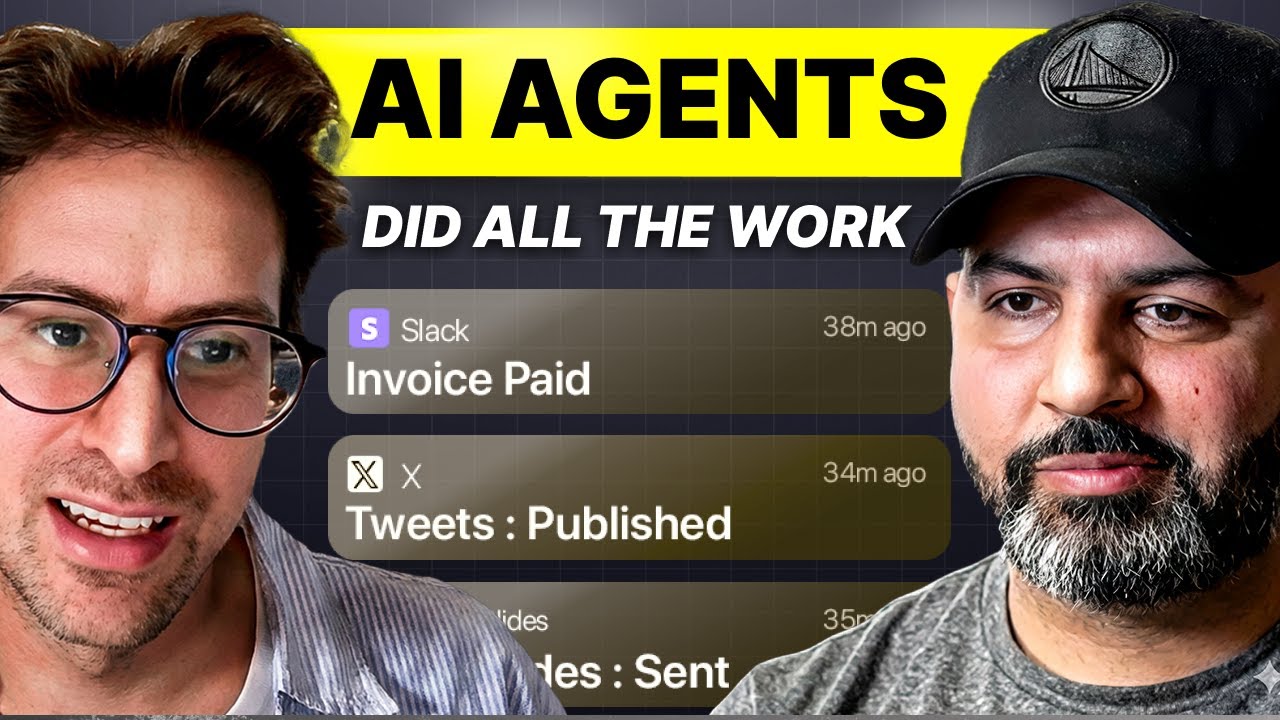
Furqan R, former AppLovin co-founder, built Nebula, an AI agent platform where each Slack-style channel is an autonomous agent that can code, browse the web, and integrate with Google Slides and Zapier. The agents create slide decks and publish blog posts automatically, letting one person run entire businesses while humans focus on strategy and creativity.
Chapters
Sam Altman predicted the one-person, $1 billion startup powered by AI, and I think we're starting to see a glimpse of it. My friend Furqan, he used to be the co-founder of AppLovin. AppLovin is like a $175 billion company. And what's cool about Furqan is he is always tinkering. And today he's doing a little bit of a show and tell. He hasn't done this anywhere, but he's working on this agent platform called Nebula. And And he wanted to show it to me and he wants to show it to you because it's a platform for you to take your ideas and build a one-person business powered by agents. So think about creating a blog that creates content for you 3 times a day based on X trends. I think that's a glimpse into where the future of building a one-person business powered by AI looks like. So today I'm excited that Furqan came. He shared his product. He shows how it works, and what I hope is it gets your creative juices flowing for how you can create a one-person business powered by AI agents. Let's get right into it. You are in for a special treat, everyone, because Furkan, he really is my go-to. guy when it comes to tinkering with new technologies. He's, um, I've known him now for, you know, over 10 years, and this is a guy who when he speaks, I listen. So thank you, Furqan, for coming on the show today. Um, Furqan, by the end of this episode, what are people going to learn?
Uh, like you said, I'm a tinkerer, so my nights and weekends are really just playing with new technologies. Uh, you know, the last few years AI and agents can't pull away from it. So I'm going to show you like some of the power that's already there in the world and how you can leverage it and how you can use it to just accomplish more, get things done that are in your mind and you don't know how to do them. And I feel like capability-wise, we're in the age of abundance. So hopefully I'm gonna show you a bit of abundance.
That's what I want to hear. All right, let's get into it.
Sweet. So I'm going to show you, like, basically, like I was saying, I've been tinkering for, you know, many years now around AI systems, LLMs, agents. The last few months, though, it kind of did become more obsession than just tinkering, you know, and mostly because I had built up all of these agents to do very, very useful things for me. Like, you know, like you, like I do a lot of stuff. There's a lot of Slack, there's a lot of people, there's a lot of like activity going on. You can't keep up with it. So you let it go, you delegate, you move on. But then there's just like things that I do want to get my hands in and how do I do more of that? And so I built up a bunch of agents myself. I had kind of like an opinion on how I wanted them to work and what kinds of things they wanted to accomplish. Like, where should you just go full send and where should you dial back and ask me? And then I was like, wait a minute, as I'm telling people, this is pretty useful. And The obsession was just like, maybe I'm just going to make it a product that I can use. So I'm customer one, but I also think other people can use it and it's very useful. It is rough. So this is, you know, one of those I'm showing you something that's— we're going to see some breaking points, but I do think I can show you kind of some of the cool ways that I'm approaching the problem. But I'm going to screen share right here. So yeah, this is Nebula. That's kind of what I've been calling it. And You'll notice first that it looks a little bit like Slack, and it's got these channels here. And I think my goal was like a lot of work happens in Slack in this kind of messaging experience. And I wanted to just mimic that, except everybody in here is an agent and can help me get work done. And I'm an engineer, I spend a lot of time in the technical side. I got things like Cloud Code and Cursor and Codex that I leveraged to make my coding so much more powerful and so much more impactful. And, you know, I wanted to make all the other work feel the same. And, you know, a lot of it to me lives in the cloud. It's services that we use like GitHub, Slack, Linear, Notion, Google stuff. And like a lot of work just happens there. And I think flow-wise, it feels similar to how I engineer things when I'm developing. But there aren't the tools in the same way, at least on the AI front, at least what I felt, that were solving that. And so to me, in many ways, this is like Claude Code for everything else, like for the non-engineering tasks, for all the other work that I want to get done. And so we mimic Slack. You have these kind of channels, you can kind of create things. We'll do some sort of a test where we can connect to Google Slides test, kind of show you how you could kind of do that. And so if I was just going into a channel and I'm like, I want to connect to Google Slides. Uh, can you create a new slide for— Um, and you know, this idea is Nebula is this agent. It, you ask it to do stuff, it will do things. It will try to figure out however to do it. And, uh, it has all the knowledge of the internet. It can search. It has a browser. It can find things, it can look up documentation, and then we gave it the ability to write code. So it will write code for you that it can help accomplish tasks. So even if you don't know how to write code, it knows how to do that, it can execute it. And so in this case, it did make this presentation that's a brand new one, and I'll kind of pull it up here as we're editing it. And so it now made this presentation. I am not going to touch the presentation directly, and I'm just going to have it like start modifying and doing things. And so if I was like, you know, I'm on a podcast with Greg and I'm showing him Nebula, this podcast is for startup/founders/team leads that focus on building and producing great companies. I want to do to create a 3-slide deck outline on Nebula and what it's useful for. And so this part is— yeah, go for it.
Yeah, I was gonna say, like, this is sort of a glimpse into the future of how we're going to interact with apps, I think, right?
I think so. You know, obviously text is a modality that we're very comfortable with. I'm very, very interested in audio and screen share and live synchronous. That's kind of To me, the next part of stuff that's gonna come here is like, I not only wanna type asynchronously, maybe from my phone, but I also want to just get on a call and spend 3 minutes explaining my entire thought process, and then Nebula can go off and work. And, you know, we built an engine behind the scenes. That's kinda like the main thing. The text is the input to the engine. But, you know, I do think here, and, and so you can kind of see that it's taken control of this presentation. It's now— starting to edit it. It's saying that it's going to create and update slide 1. There's a bunch of hidden stuff here, like it created its own to-do list. It told Google, like, hey, replace all the text with this for this slide. These are things that if you're writing a program for, it's actually doing all this stuff. It's doing API requests for you. It's kind of making all of these things happen that an engineer would do. And we're here and now kind of at all of these.
And Great.
And so now this is kind of like a basic slide deck. And so let's make a 4th slide and add an image that shows the power of Nebula. Make that image the entire slide. So now it gets a little bit more complex, right? It's got to go and understand the context of what we've been talking about here. It's going to make a 4th slide. It's going to generate an image. You know, it comes up with the prompt that needs to be done. In this case, it said a powerful visualization of AI agent network. It's a glowing node. It kind of took some direction. It had an aesthetic. If I was very specific with how I wanted it to look, it would just listen to me, right? Like, and try to generate that. And, you know, the idea here is like, cool, like a lot of this you can kind of do with Claude. And ChatGPT, you could do some of the research. There's maybe web search. Okay, now we're connecting it to services, and that's kind of step one of an area that it can kind of operate. Okay, like it could manipulate these things. It can do it. It can connect to image or video generation things. It has Python. So it'll get a little bit more advanced if I push it a bit more. So it did kind of create an image in here. You can see a file was created. It has its own file system, so you don't have to be on a computer somewhere. It generated this image, you know, style-wise, don't love it, but I could tell it, hey, I don't love this style, like go do something else. And, you know, we're going to see it create the 4th slide here and then kind of go from there. And, you know, you can see it's actually writing Python right now. So Again, we're not engineering, but this thing is. It wrote some code to, you know, take these files and upload them to Google Slides. There's, you know, an engineer somewhere that would be writing this integration for you, or you'd be connecting some no-code service. Just live, it'll kind of figure out how to do it all and take care of it. And, you know, in a second here, we'll see this kind of image pop up here. Yeah, a little failure here, and it'll correct itself. It'll say, hey, let me try something else. Uh, let me try a different way to do it. Um, and, you know, this is part of that AI system is like AI is not perfect, but could you just tell it to keep trying until it works? It, it, it kind of can, and it will keep trying to do things over and over again until it finds a pathway to accomplish it. Or at some point it's like, hey, I have no way to do it. And, you know, okay, so like we're, we're trying for a 3rd time. Let's see if it gets it. And I think we'll see an image pop up, hopefully here.
Yeah, it says created a file. Something's happening.
Stuff's happening, right? It's got some files in here, right? It wrote this Python script. Again, this is code that Nebula wrote for itself. Like, hey, this is the file that we have. here's the presentation and I want to kind of create this image and go do it. This is code that somebody would write, 16 by 9, roughly this, you know, kind of all the requirements that you would have. It's complaining about the size of it. Cool. We have an image here. It wasn't the image that's there, but it tried. I could push it more, by the way. I just tell it to kind of keep doing it and that'll be there. I think some of the power happens Work is not synchronous like this, right? And so one of the biggest things I wanted was, you know, I can get a lot of this in other places. I can write scripts, but now I'm like, okay, cool. Now let's add a new slide every day with more information about Nebula. We want to get this presentation to 15 page— 15 slides. in a week. And so it has scheduling, right? It will actually go and say, cool, what is the thing that you were doing here? What was the context? Let me pull all of that out of this piece of work. Let me create a recipe for that so that we could reproduce this dish over and over again. And then write the, you know, the trigger. You know, it wrote a cron. If you're technical, you know what a cron is. And, you know, we can go over here to the triggers and see there's a daily Nebula presentation update. And so every day it's going to add a new slide. Goal is to reach 15 slides in a week by adding 2 slides a day from current slide 4. And here's the execution steps. And it'll just run every day at 9:00 AM. And now this is hands-off. And, you know, maybe a slide deck is not the approach for it. But for example, if we wanted to make a blog, that's what I would do. I would, you know, go and edit the style, and I can actually show you that workflow as well, where, you know, we can kind of quickly create a blog, and every single day it can kind of produce those results. I can dictate where to get the information from, search it from Twitter, search it from the internet. Here's how you think about the analysis. Here's the visual style of the images of the blog, and how we want the tech to work. And then you connect your post hoc to it, and every day you tell it to optimize itself. And we could do that now, you know.
I mean, that's sort of the dream for a lot of people, I think, is they create a business in a box. You know, maybe it's content, but, you know, it could be like an email newsletter every single day. You know, you search on X, you search on you know, press releases, Google News, things like that. You have a style guide around how you write, and then every single day you, you know, you're pushing out content and you sell, you sell, you know, make money via affiliate ads, or maybe you sell ads and stuff like that. But I think this is, you know, an interesting— like, when I see this, I'm— that's kind of like where my head goes.
100%. And, and that was actually one of my starting points is like Okay, why do I want to create these scripts and agents that are quote unquote intelligent? Well, I want to automate my work. Well, if I just extrapolate that to the end, it's like I want an automated company, probably. Like, I want to create some direction or guidance, and I want to work with intelligent systems to kind of go do that. You know, and like, Great. And so I started thinking, I'm like, okay, what's like the smallest company project that I could do? And, uh, a blog is kind of one of the things I landed on. You know, I can think of a con— you know, content direction. I could think of source of information. I could come up with visual style, editing style, as well as, you know, the ability to connect to my system. In this case, I'm using Ghost. And then, you know, from there I'm telling it to run every day. And then what am I going to do? I'm going to look at the Search Console and PostHog and optimize keywords and just do that every day. Right. And, and, and I think that was one of the north stars that I actually started from was, can I just have it run a company, a project just on its own, like autonomously? And I do have a blog that I use as my kind of like testing ground for building this. And it's now 15 days in a row, been doing 3 posts a day. I think the blog has gotten to about 100 hits a day. I just set it up like I spent less than 30 minutes on the setup and then, you know, kind of from there it was good, you know, to go. And if I spent more time, it would do that.
Someone in the comments section, I can just hear it so we can just address it. Someone in the comments section is going to be like, Well, if everyone's going and creating these business-in-a-box blogs and stuff like that, you know, is there still opportunity or is it going to get commoditized? Or what does the world look like in a few years when anyone has the power of something like Nebula?
For sure. I think as we get more advanced, we— there are things that are no longer that interesting. You know, there was a time period where just having a website was a competitive advantage, right? Like having a dot-com. I'm a little, you know, I got the gray hairs, you know, dot-com era. Like literally being a dot-com was an advantage because you created this accessibility. And then yeah, like being a content creator or a blog, you know, blogger was an advantage maybe 5 or 10 years ago. And yes, what's going to happen is, you know, everybody gets access to these things. Now we flood it. Well, the basic version of it is not going to be useful. I'm going to have to apply this same logic to kind of the next level of things. My content is going to have to be superior. My delivery is going to have to be superior. Maybe I'm going video, maybe I'm going more advanced, you know, and I'm going to build agents to help me do that. I can make a blog critic agent that this loops against every time it produces a post. I can say, hey, ask the critic. Make sure this is a 9 out of 10 on these metrics, and here's how we determine that. And then test your thing and learn the next week. And so I think we're just gonna go more and more advanced, um, you know, in terms of, you know, what, what's kind of there. And so I connected to this like Nebula demo Ghost blog. Here's my Ghost admin site. I told it to make a test draft post, and it's, it's there. It's connected to the system.
Mm-hmm.
Now it's up to me to create creativity, you know, like, okay, cool, this blog will be VR themed, specifically about new apps and games coming out in VR. Can you do the research from the top VR influencers to find the latest and greatest? Games produce a post and an image. So again, if I get much more advanced with the instruction, like this is not advanced, I'm just typing this very quickly. If I got like very fine-grained, I gave it a paragraph of stuff that I care about. If I'm kind of going to go and do a lot more, then it will be better. And you can kind of see it starts working in parallel, like multiple things start happening. It created these to-dos of things to do. It now has like 5 different searches going on at the same time. It's, you know, dumping all the info for now. Again, this is UX that I think will improve over time and on what it should look like right now. It's just verbose. Great. I can see all of the work that's happening, but this is like real work, right? Like, and I can give it significant specificity around my focus area. You know, I could tell it to design my blog differently. I could tell it, hey, I don't want it to be looking like a blog. I want to integrate it into my website and connect my GitHub, and it can take these parts and connect them together. I think that's the power that I wanted, is this system that can live in the cloud. It has the code execution, the file systems, all these things that I have in my cloud code on my computer, but it just lives on the internet. I start connecting it to different services. I get more advanced with the system. It starts managing multiple schedules, multiple things, multiple optimizations. I feel like we're still— like I said at the start, this is an age of abundance. And so we're not taking advantage of the abundance yet. I do believe that once we get and we're taking advantage of it, maybe it'll be too much and we'll go back into the age of, you know, organic or the age of, you know, taste. So I don't think that, you know, this never ends, this cycle of like A lot of stuff, go to the kind of top, more popular things, or, you know, crafted better. Maybe we go more human-centric. Tons of stuff this helps me get done. I can manage my calendar. It has an email address, so it could just reach out to people on my behalf and manage conversations. So if I'm doing lead gen, if I'm doing a trip and I want to reach out to hotels or something like that, we just wanted to give it the right package of things that you normally hire somebody to do. And Then I think you're just figuring out like, how do I get it to do more? And, you know, I think if you spent $1,000 a month and had an AI team, it sounds a lot, but I do believe you'll produce $5,000 or $10,000 of value for yourself if you just point it in the right directions. That part, we've always had to do that. We have to point the thing at the right direction. And I think that creativity will never get lost. That's where humans come in. All the other mundane stuff in between, like this research, writing the posts, generating these images, going and scheduling all of these things, like, I think that's what kind of goes away and that's already capable now. And I think that's what— that's why I ended up building this was like, I'm like, dude, I got this power in my hands. How does everyone get that?
So I agree with you. I think it's really about, you know, how do you point it to the right thing? And that is often the hard part. One-person business, I think a blog, a newsletter, those are— there's a huge opportunity now for the next 12 to 18 months. What else comes top of mind if you're trying to build a one-person business in the age of AI? Like, what are you brainstorming and how are you thinking about that?
Yeah, so in a company, You know, a blog might be less than 2% of the entire company of work, right? Like, it might be like, hey, we have a blog, but we have 99 other things that we do. And I think about all of those workflows, like, where, where is the, like, creativity needed? This is where I got to put the most talented humans in charge of and arm them with tools. And then what are the things that they produce? And so, you know, the reason I wanted to make this feel like Slack was, cool, I got my blog, you know, now I'm going to be like, you know, making my lead gen channel and starting to kick off like lead gen work, right? Like go and research these, do it every day, go craft emails, go send things. And then I'm going to be like, well, we have our product. analytics work that we need to do. So I'm going to connect my PostHog, right? I'm going to be like, connect to my PostHog, create an agent that can analyze my web traffic. I'm just like, how do I just spawn up many of these agents and in different channels? Here it says, cool, Like, let me connect your PostHog. But that's what I'm thinking about. Like, I think a lot of work is not— it does get more complicated, right? You know, and it does become a thing where it's like, there's many, many more things to do. But I think a lot of them do come down to directive and workflow. You know, the whole no-code movement. I was super fascinated with. I was always the engineer that I'm working with every team in the organization, marketing, business, sales, whatever, to like help them get the power of what engineering had. It was a lot of work. It was hard to commit resources and do these things. No-code and SaaS kind of came out and, you know, really unlocked that. And we saw that. And I just think that the next thing with AI is is that it will elevate that to every corner of the company. I just feel like it's kind of getting to the stage where, you know, there's no longer a limit here. It's just like, what, what work do we want to put them through? You know, like, you know, kind of like, like that. That's the experience that, that I'm thinking about. So, you know, I got my blog. It's coming up with all these things. The reviews are actually— while we were talking and doing something else, the reviews should be in here. You know, it made an image, it came up with something. We didn't give it any direction. We can definitely increase the, you know, editorial quality here by just being much more fine-grained with our directive. It actually went and did research, you know, for me. It produced this. I could just be like, hey, go publish this, right? Like, you know, looks good. Let's publish, make 3 posts a day. Now our blog worker's going. We're going to go work on the analytics worker. This agent's going to have stuff. You'll see different agents show up in the chat here. There's an agent creator. It's just going and making this thing. Now it's building custom stuff. So I think I see a lot of inside of companies how work happens, what's going on, what does it take to go do this? I mean, how many times have you asked somebody on your team, Greg, to go connect and add analytics to our website or, you know, then, then it's like, cool, go make the dashboards and then go do this. And at the end, what are you trying to do? It's like, I want to see how many people came, how many new people, what's the retention? It's like, what if we can get to that level? What's the unlock of our creativity?
I also think there's, you know, when you think of agencies and service businesses, like a lot of the time they're delivering this service, right? So there's tons of content agencies that churn out blog posts for a monthly fee. There's tons of analytics agencies that'll set up your post hoc and give you reports and do research. So I also think that, you know, for people listening, there's an opportunity to use something like this and basically do client work. But the service is, instead of having literal humans do it, you have I mean, you're gonna have some humans manage it, but a lot less humans, maybe a 20th of the amount of humans. And then you have these agents go and actually create the, the, the service, right?
100%. Like, I mean, you know, a lot of people are like, oh, well, humans will be gone then, right? It's like, no, like, I think we still decide what we want to do, right? Like, at some point, somebody has to direct things. And I, I think people Like, you know, notice I know the word post hoc. There's a lot of people out there that might not know that. So, okay, like, like somebody is still going to like have some knowledge and direction and directive. And I don't think AI replaces how we go and get our results. I think what it does is it allows us to take a direction we want to go and progress us towards that.
faster.
Like, we are creating the circumstance of where we want to be, you know. And, you know, while the analytics agent was being set up, it published the post. I think we should be able to see it at this URL now. Right. We got one. It still looks like a demo blog. Cool. We're live. And it now set up the trigger. So it's going to do it 3 times a day. Right? It's going to run in an hour. It says it's going to run at 6:00 AM, 2:00 PM, and 10:00 PM. And it has an agent attached to it that it knows all the knowledge of everything. You know, like, I'll move on to the next thing and, you know, I'll come back and add more to it. And, you know, I think the experience of continually upgrading and iterating my processes to get more advanced— I'm showing you very— this is like day one of your company. You might set up the blog. You might set up the content thing or, you know, your internal kind of like workflows, but then your company gets more advanced and you're gonna add more things and you'll end up with like 20 or 30 channels. Like, you know, a lot of the stuff to even build Nebula, like I'm using Nebula itself, the changelogs that get produced, the images that are kind of in different places, like styles like that we want to kind of focus on when we're trying landing page tests and the analysis. Like every day there's like an experiment analysis agent that, you know, tried 3 different variants for our landing page and just told us the results. And then we tell it like, hey, these attempts suck, do something better, go like this, these sites are great over here, go look at these sites and research those and then try that. And then the next day it's very, very different. Um, and, and, and so I just found that like a lot of time gets spent in creating the workflow, like I love N8N, don't get me wrong. I have many self-hosted instances of that over the years. I like tools like Zapier. They're very instrumental in, you know, a lot of work being much easier. It was still pretty tedious to do. I kind of, you know, I just landed on, can I just tell it? Can I just tell it what I want? Because that's what I want to get to. And, uh, I just scratched my own itch here and, uh, you know, wanted to, you know, wanted to go from there.
Well, I love it. I think it's, um, It's a glimpse of where— how work is going to be worked on, and it's a glimpse of like the opportunities in these one-person businesses and, and then optimizing your internal company. So I think this is really cool. Um, dude, that's why I had you on. I knew you were always tinkering, and, and thanks for this. Is this, is this live yet?
This is live. You can just go to nebula.gg, um, and use it. Uh, I have not hooked up billing yet. I won't until The costs are significant, and so go use it. Go burn tokens. Tell me what's wrong. I'm happy. Like I want I want all the feedback because you know like I scratched my own itch. I I know what I can do with this. The question is like can I take the UX that's useful for me and get it to other people? And that that's fun. This you know there's a lot of people that tinker, and then that that's kind of the hobby. And and I always tinker to like. I want, like, I want a lot of people to use the thing that I tinker with. That would be the net end outcome, is a lot of people find this exceptionally useful. And I think you're gonna find bugs, you're gonna find things you don't find useful. Just tell me, I'm happy to iterate here.
I appreciate you, Furqan. Thanks for, for sharing the product, your thinking, firing people up about some of these, uh, ideas they can do. And, um, I hope you come back on and share more more projects that you're working on and tinkering on in the future.
Anytime. Let me know. I mean, you know, I'm always down to share, you know, happy to share what I'm up to in the evenings.
You're the best. All right.
Take care, man.
Bye. See ya.
More from Furqan

AI Agents, USDC, and the Programmable Economy | thirdweb (Furqan Rydhan) | Builder Series


Fireside Chat With Thirdweb CEO Furqan Rydhan & Kartik Talwar I Pragma San Francisco 2024


Furqan Rydhan on What It's Like Co-founding a $20B Company | My First Million #180
