Esther Perel Invites Us to Imagine Our Preferred Future: Where Should We Begin? Live from SXSW 2025
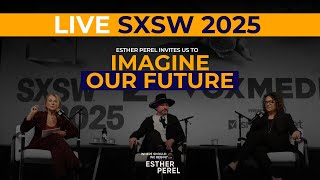
Therapist Esther Perel moderates futurist Amy Webb and former Google innovation evangelist Frederik Pferdt on imagining preferred futures. They argue that rehearsing what-if scenarios and cultivating empathy for your future self moves imagination into action. AI and algorithmic perfection are eroding human empathy and creating social atrophy, making the quality of relationships more crucial than ever.
Chapters
Good morning. Welcome to the live recording from the Vox Media stage at South by Southwest of another episode of Where Should We Begin? Familiar with Where Should We Begin, anyone? So, here is the story that I need to tell you. This session was supposed to be a session between me and Dr. Peter Attia, And we titled the session, "Why would you want to live longer if you're so unhappy?" It's a question that I asked him a few years ago when he was writing his book Outlive. And it prompted him to rethink some of his definition of longevity and to add a chapter on the importance of emotional health in his thinking about overall health. And then I thought, basically, Dr. Attia had a family emergency. His father is very ill and he had to cancel right after his presentation here, actually. So I had to rethink, what will I do and with whom would I like to be in conversation? And I also thought, you know, here's this conversation on longevity that is that we typically think of within the world that we're living in. But then I went to listen to Amy Webb, and she was, you were, I'm gonna talk to you, you were presenting a whole other world in which one, I had to project myself in, and I had a range of emotions as I was listening to this presentation. Highs and lows and attractions and disgust and pulls and pushes. And it was like a whole range of experiences of the world in which I hope to live in longer. So it was all coming together. And then I met Frederik G. Pferdt, who is explicitly a non-futurist. And I thought that would be an amazing conversation between a futurist and a non-futurist, between someone who makes predictions and someone who helps us imagine. And then I thought of the painter Magritte, the Belgian painter, who would do a painting where he would put a glass on top of an umbrella, and he would call it The Vacations of Hegel. And I thought, that kind of associative thinking, A Pipe Is Not a Pipe, if you remember that painting, which is really what you see isn't necessarily what it is, because if you see it on a painting, then it's not really a pipe. And how do we create that separation between our internal experience, the subjective, and the factual? So I want to welcome you both. Amy Webb, you are the CEO of Future Today Strategy Group. And Frederik G. Pferdt, you were the evangelist of Google innovation and the founder of the Google Garage, the lab for creativity. It's a treat. And first of all, thank you. We are all three on a threesome blind date. None of us have ever met before, you know. So just to say yes like that is for me a real special thing. Amy, we should start by what is a futurist? If you could share with us your definition, your working definition of what is a futurist. Futurist?
Sure, I could give you a technical explanation of what I do, but I think it might be more interesting to hear a quick story.
Yes.
So in post— just as the Cold War was heating up, there was a man named Herman Kahn who had been hired by the Air Force to help predict the aftermath of a full-blown nuclear war, because at that point the United States was building up a gigantic stockpile. Of warheads, as was the Soviet Union. So it was a very dangerous, horrific time. At that point, Herman Kahn was trying to explain, look, there are probably many different futures depending on the decisions that get made. But military strategists only saw two. We continue to build— everybody's continuing to feel anxious because we have all of these warheads, or total annihilation. There was no in-between. Herman Kahn did not want total annihilation, but also couldn't get these people to change their minds. So instead, he borrowed from Hollywood. He knew that the data alone you could use to predict, but it wasn't enough to influence the decisions that a leader might make. So instead, he came up with the idea of a scenario, a scene, and started telling stories about what might happen in the aftermath of an attack. And these stories were so visceral. They weren't emotional, but they evoked emotion. They were visceral. They were detailed. He described a milk— every child's lunch, their milk containers would explain exactly how much radiation was in it and what that might be like. And his approach was to describe not total annihilation,, but a world in which we all survived. So the way that I like to describe what I do, because there is a predictive piece of it and there is a heavy amount of quantitative and qualitative research, but none of that matters if we don't influence how people make their decisions. The future is not aspirational. It's not optimistic or dystopian. You have to take a pragmatic approach because the future arrives through the decisions that we make in the present. And oftentimes those decisions are the result of how people feel in a moment, which could be influenced by 100 things that have nothing at all to do with the decision that they're actually making.
I'm going to hold back first. And how would you define a non-futurist?
It's incredible because you just gave me that title. And congratulations for making that up. Yes, what a non-futurist actually is. So I never considered that title. I actually don't like job titles at all. I think we should not label people in a way that they are this or that or that whatever they might do. What I care about, and I think that's what most of us care about, is the future. And not just care about it, but take care of it. And so what I want to help people to do is see the future differently. See it in a way that they own it, that they see it as something that is not the future. I think we need to change one word. We need to change it to see my future, because that's the only thing that's going to happen for you, right? The future is not something that happens to you, it's something that you make happen. And the future is also not out there, right, on the horizon. I think the future is happening right now in this moment. And I absolutely agree, Amy, it's decided by our choices we make in every moment, right? If I choose to be kind to someone, that determines my future, and hopefully for someone else as well. And the future is also something where we don't have to look outside. We have to start to look inside first, to try to imagine, as we human beings have that ability to imagine, imagine a future that we want to see happening. And we mostly go to 3 places when we imagine the future. It's a place, right? So we imagine ourselves in a year from today being at the beach or being in a house or being in some place on this planet. Then we're trying to imagine who we're going to be surrounded by, our coworkers or the people that are in our community or the families. And then we're trying to imagine what we actually engage in. What are we doing? But I think there's missing an incredible piece in that picture, and that is how do we want to feel in the future? That is the most critical question you need to ask yourself, because imagining how you want to feel in the future helps you to actually make progress towards that.
So I had this moment when you were talking that I was in a session with a couple in which one person is pragmatic, talks about decision-making. Both of you agree that decisions made in the present influence very much the future, but you are experiencing reality very differently. And then you began to talk, and then, as I do in the session, you talk, but I'm watching you. So what was your experience? How was this landing on you? Sure. And what were you holding back on?
Sure. How uncomfortable do we— I could not disagree more with everything that you just said.
This is—
welcome to couples therapy. Tip of the hat to Esther. Look, 99% of my time is spent with the chief executives of the world's largest companies. And government leaders. The problem with how you are describing we can all make a better future is that it is 100% inward facing. And we are living in challenging times right now because people followed their bliss. And their bliss was, I have a single authoritarian viewpoint on how the world ought to look. So the stark reality is feelings matter. But at the end of the day, nobody is inherently incentivized to make better decisions for everybody. Most people, to some degree, are selfish. So if we want to create the best— they are. You can disagree, but the data point to the fact that in most circumstances, people are going to make choices that benefit themselves rather than the public good. I wish it wasn't that way, but that's That's the world we live in.
Would you say that across the world?
So I've lived in several countries. Most of my experience has been in Asia. I lived in Japan for a long time. I lived in China. And I spent a lot of time in Europe. Yeah, I would say in every case so far, with the exception of Kenya, where I've spent some time, and I think that there's a little bit more of an emphasis on the collective, that people are still very much We are incentivized and wired to make decisions that preserve our own best interests. So if that's the case, we want to achieve a better future, we have to think of how, you know, what's going to cause somebody to make that better decision. It's not enough to say, imagine yourself in the future and hope it all works out and create a vision, and that's great, because there are plenty of people doing that in a way that is detrimental for the whole.
So I just want to take a quick pulse check. How many of you had a sudden rise of stress hormones?
That happens. I do stress people out.
No, it wasn't you. It was the fact that we are becoming less and less accustomed to seeing people who are experiencing things deeply, that they care about deeply, and that they also disagree about. In front of others. Because part of what's happening to us is that we are living in a technological world that is basically removing every friction possible and giving us algorithmic perfections to the point where when things don't go as we had imagined, we are stumped and we don't know how to experience confrontation, frustration, conflict, or disagreement. But this is part— I mean, for all of you who listen to the couple session, these are difficult conversations. I'm, I'm, I'm, my nervousness also can go up, but I just understand that the piece I've added here is that they actually both really care about what they're talking about. There is not one person, and they, they enter it through a very different door. And interestingly, when you were talking about We are incentivized to do what serves us. I was actually thinking that from a relationship point of view, we do have two primary models. We have one model that is very much represented in this room as well, and that is a model that looks at relationships as organized around loyalty and community and duty and obligation. And that's very different from the model that you, I think, highlight more, that is that things wants to think about others, but from a place of choice, not of duty, not of obligation. It's choice, it's options, it's freedom, it's self-determination. So if I was to, so far so good, or do you now need to answer her? Or respond, not answer.
I could, yes, respond. You always can choose your response, right?
Yes, you always choose your response.
Not really reactions. So I fully agree, Amy. We are all selfish. But I'm also reminded of Anais Nin, who said, "We don't see the world as it is, we see the world as we are." And so if people are selfish, that's wonderful, because if people want to make themselves happy, If people want to see that they feel loved and connected, great, do it. Because if you want to make yourself happy, research shows that if you're grateful for something, right, and if you tell somebody, "Thank you for being in my life," or, "Thank you for your contributions," or whatever it is, it not just makes that person more happy, the research shows it also makes you happy. So if you selfishly say thank you to everyone and be grateful for the things you have in your life, that increases your happiness.
So when I listen to you, it reminds me of a sentence that I say very often, which is that it's the quality of our relationships that determines the quality of our lives. But I am less— and yes, the Good Life is the project that you're alluding to, It's the Harvard longitudinal study that really looked at, on an individual level, the most important factor is the quality of your connections that helps you with longevity and with happiness. But I don't think that you are concerned with happiness, if I understood what you say. You are concerned with what is the world that we are living in and what is our propensity for hubris, grandiosity, and self-destruction.
Sure. Look, context matters. And my definition of happiness and your definition of happiness, Esther, may be very different.
I'm not sure. I live somewhere between both.
You know, I mean, but maybe I should refine that by saying the qualities, the characteristics, the emotions, the events, the things that make you happy are probably not the same exact things that would make me happy. And again, look, the future to some degree is built through feeling because ultimately, you know, we arrive in the world that is shaped by the decisions that we got made. And if you want to tie decisions to happiness and self-fulfillment, then I think we have to consider the fact that not everybody is coming from the same place.
Me personally, I spend much more time thinking about meaning than happiness.
But— You're evolved.
I try. And this is what I was experiencing. Actually, when you were speaking, maybe before we go into me, what would be two predictions? Because the listeners of the podcast may not know you. What are two predictions at this moment that stand out for you?
So we don't really make predictions as futurists. We do a lot of research to try to build out scenarios that are more— show different possibilities in the future, but they're predictive in nature. A couple of things, or maybe two, I guess, are You're gonna see more robots, all different types of robots in the next few years. There's a bunch of reasons for why, but I think people in their minds are imagining the Terminator, walking, talking robots that take all your jobs and then murder you in your sleep. That's actually not what's on the horizon, and that has, that opens up a lot of opportunities and poses a lot of new threats. The robots that are being created are biohybrids, so they fuse, in some cases, human brains and neurons with hardware. There's a lot of reasons for why, and I don't think people are fully prepared for what's on the horizon and the implications of that. I think the other thing has to do with how AI systems make decisions. I know everybody's— look, I've got an 80-year-old, 81-year-old father with Parkinson's, who's having a hard time, 81-year-old father with Parkinson's who's having a hard time communicating at this point, but even he has an understanding of artificial intelligence, which is saying a lot. The thing that's coming are not individual systems that do things for you, but systems of systems that act together and make decisions. We're not entirely sure sometimes how or why, Or importantly, who trained those and whether they reflect your ideas, your values, your culture. And again, lots of opportunity in terms of productivity, economic growth, lots of challenge in terms of the other side of it and whether or not we're happy with the decisions that got made.
These two sides, I was experiencing anticipatory reward and anticipatory grief. You know, some moments I had an experience when you were talking, but in general when I hear some of these descriptions, because you're describing a lot of facts, even this, sometimes when you sit in therapy with people who are describing very hard circumstances with flat affect, you feel like all the affect is in your belly. They're telling you horror stories, and you are— but they're telling it to you without any emotion, and you are experiencing the range of emotion that they're not feeling. This is a little bit what I was experiencing in parts of what is described is basically somebody who's telling you how people are at this point planning their disappearance. And everybody was cheering you. They were. And I thought, this is really— do you actually hear what is being said? It's like if somebody says, I'm leaving you, and the other person says, do you want coffee? And I'm thinking, this is not—
I don't understand why. I was at a party last summer in the Hamptons. I'm not a Hamptons person, but I had to be there.
It's okay. You're welcome in the Hamptons.
It's not my scene. But I'm sure everybody's like shocked to hear that I'm not a Hamptons lady. But there were two bankers who cornered me separate times, and they were so excited to talk about how artificial intelligence was going to take everybody's jobs. And they were really— they really wanted to go full blown. Including theirs. Yeah, full blown Black Mirror. And they got like a rise out of it. And I think it's so— for me, I'm sort of emotionally detached. From the work. I have to be, but I find it— but it's like people who like to floss, and they like that pain, but they— and they kind of keep doing it. It's like the best analogy that I can think of for the way that people like to inflict these like moments of pain. It's like an enjoyment thing, not in a sexual way, just in a some other way, thinking about the dystopian futures. You probably know why. I don't.
I mean, honestly, I think this is where this may connect to me for why I need to listen to you, but I also need to listen to Frederik. I need Frederik or I won't be able to listen to you. You understand? If I cannot have some sense of imagination—
Esther, I can be a fun person too. I promise. But you should get a little sprinkle of him.
No, but it's not you. It's— you are a voice that grounds us in a reality that is highly necessary. I don't at all want you to not be there because you are a voice of reality, period. So it's not Amy. It's what Amy is trying to make us see. I just was amazed that people were clapping Well, you were telling this can be done without people. This, no people involved.
I was quoting Lenin, not John, Vlad. Yes. And they enjoyed that. So I don't know.
Are we just like, what, have we gone mad that we are like clapping about the fact that we are going to basically annihilate ourselves? What is going on here? And so then when I met him at night for dinner, it was like a bomb 'Oh, I can think about my happiness and imagine my future.' Of course, we live in all of these realities combined, are we not? I mean, seriously, people. Yes. It's like, so—
Can I say just a quick thank you, Amy? And I mean it deeply from my heart, like every thank you I say to people, because thank you for helping us to have a clearer picture of the future, right? That's what you're painting for us. And what I like that you're doing is you're helping people see that picture, right? And they have an emotional reaction to it. What I want to argue for is that we should go beyond predictions towards participating in that future. Right? When we see robots in a picture of the future, right, we can participate and say like, okay, I'm going to experiment, I'm going to be open, I'm going to try out what that might create as an opportunity in my life.
Just to clarify, right, so we're not making scenarios and then go away. The end part of this process is rehearsal. You have to have conversations and challenge cherished beliefs. And from that comes strategy and decisions. So it's not just making a decision and then that's the end of it.
Same for me. I'm not just sitting here and imagining.
Just imagine couples.
That's a great picture.
So when I began to think about this conversation, I called my husband, Jack Sol, and Jack is psychologist who works in collective trauma and collective resilience worldwide. And basically he said, I just came out of this presentation and I'm really going through this roller coaster and I'm wondering, does she actually think about the emotional response of the people who are listening to what she's saying? She's taking us on the— I thought it was brilliant, let's be really clear. And then he said, look, When people are traumatized or when they experience threat, their imagination is constricted. And so instead of just talking about future, try to think about the preferred future, which I think is what you are actually aiming for, and I think is what Frederik is also alluding to. And a preferred future is a future in which you participate. But in your scenarios, If you work with people who are themselves numb and not allowing themselves to experience the consequences of their actions, how can they actually make decisions?
So in my world, the concept of a preferred future came from Herman Kahn. So that was the man that I mentioned at the beginning. This is not necessarily optimistic, it is again a little bit more pragmatic. So given what we can know to be true today, the data that we have access to, we can't just imagine a total optimistic utopian future that is very likely implausible. So while it may feel good to do that, in practical terms, we're not going to get there. So preferred future is given what we know to be true, what we can control, acknowledging what we can't, What is our best possible outcome at this moment? I think that's the piece of this that people, certainly in business and government, but I think everyday people get wrong. There's an enormous difference between aspiration and action. It's good to create a vision for what you want the future to become, but it has to be rooted in reality. Rooting things in reality sometimes means acknowledging pain or discomfort or the facts as they exist that may not align with your worldview. That's a very tough thing to do. And when we advise people to rehearse futures, by which I mean almost, you know, play out a movie of how things— the many, many different ways things could turn out. That starts with asking the question, what if? And it may seem like a simple thing to do, to ask what if, but asking what if for real is a rational act. It's a radical act. Doing that on your own is difficult. Doing that in a team of your peers, or if you're, you know, with a lot of other people asking what if and having a real conversation, that is a hard, hard thing to do. But it is necessary if you want to get to your preferred version of the future, given where we all are. And that's true whether that's your personal life, or your business or your government, you're working together as a group, whatever it might be.
Can I ask you just turn for a moment to the person next to you and just make contact for a sec. You may know each other, you may not. You can talk. It's not a problem. You can make noise. And I want you for a moment as you're talking with them to just describe to them one image of a preferred future. Go ahead. One image of a preferred future. And think about what Frederik asked before. Where are you? Who's in it? What are you doing?
Okay.
Shh. Switch, switch, switch. Make sure that the other person has a chance. Okay. All right. Come back, come back, come back. Just a quick sense. How many of you had other people in your images? The presence of others. And how many of you were alone? Okay.
Okay.
So I'm gonna repeat. The quality of our relationships determines the quality of our lives. And I think that one of the things that I would love to exchange with both of you is what I consider a growing social atrophy. Basically, I often think that we have come to have such algorithmic perfections that in our relationship with machines and AI, and I'm not so interested in that relationship, but how this relationship with the algorithmic perfection is changing our expectations to other people. We now approach people with expectations that are being developed in our relationships with machines. And that is making it very complicated. Add to that that we are in a world in the West where we have never had more freedom to negotiate most aspects of relationships of life, and we are losing the very skills that are necessary for these negotiations. One of these skills is something you talk about a lot. In order to negotiate freedom, you need to be able to tolerate uncertainty. You need to be able to tolerate experimentation, unknown, difference of opinions. And if you don't have that, then it becomes very difficult to manage your freedom. And if you can't tolerate that uncertainty, you will look for other people who provide you that certainty, and that's called autocracy. So this is what I am grappling with. What are the consequences of all of this for our human existence, for our existential angst, for our— to me, there is no aspirations without— if you have existential angst, then you just go into a survival mode. And then you become more selfish, and then you don't think about others, and then you can go into la-la land. You know, psychedelics will help, you know. But this is, you know, the trajectory that I am looking at. How are we going to deal with the messiness of human life? Your dad's Parkinson's, the bumps, the smells, the caregiving, the less shiny aspects of intimacy when we become accustomed to always on, on delivery of every delight. That's my existential reality of the moment. How many of you relate to this? Okay. Because I need this before I leave this conference.
Yes. You're looking for an answer or—
No, no, and I'm not looking for certainty.
I might give you a thought.
I'm looking for people who help me think about these questions. I'm looking for people who have thought about this a lot, that is not me, because every one of us, when our imagination becomes constrained, we become trapped in the dominance of the singular narrative. And so we have one way of telling the story. This is what, you know, the reason I keep saying couples therapy is because it is such a microcosm for looking at some of the most important the challenges of interaction. There is no better ground to learn about polarization than couples therapy. Two people who once liked each other and cannot agree on anything. You use the word reality, you sit with a couple, there is no reality. There are many different pieces to that reality, and they can fight about it. Wasn't Wednesday, it was Thursday. Now that's a very important piece of reality.
You know, I— can I— I'm sorry, go ahead.
I want to just build on what you suggest.
I'm going to let both of you— this is where I need your help, you know.
Happy to help, yes. And building on what you said, Amy, the what-if questions, right? I think they're very powerful because that really unlocks our curiosity. And when you apply that question to what you just experienced when you shared your preferred future with someone else and just imagine for a moment What if that preferred future becomes a reality? What emotion does that actually trigger, right? And it's a beautiful place usually because you imagine a preferred future that's better, right? Maybe that's radically better. And that creates agency, that helps you to move forward and asks, what can I do today to move closer to that vision that I want to see happening. And you mentioned something very important, and that is what is in our control, right, Esther? There's always things that are totally out of our control. We cannot control what is usually in the media, what is communicated to us, even the weather, right? We realize that we have no control over it. But what we're usually trying to do is we're allowing these things to come very close to our heart. And I need to help people, I think, to refocus, to focus on the things that you can actually control. And that is how are you going to build relationships? How are you going to invest in relationships? Because it's not just about the quality of the relationships, it's also the quantity of relationships.
To answer your question, I was in— I would say that my husband's gonna absolutely kill me for saying this in front of everybody, but I would say we were kind of in a throuple for many, many years. So it was him, it was me, and my obsessive-compulsive disorder, which had gone on— well, for real, you can laugh at that, it's funny now. It wasn't funny at the time. I had been living with it for a really, really long time without knowing what it was and then without it being treated.
Have you ever spoken about this in public? I—
Like this? Probably not, so—
So take a minute.
It's exciting for you.
No, it's not exciting. It's just that this is the perfect example of your saying something that is huge, but you just mentioned it like a little—
Well, because—
Yeah, I think— Because that's what happens in your meetings with these big people who make big decisions and they rattle off huge bombastic changes of the world in this kind of en passant way.
Yeah, yeah. Well, I'm telling you, yeah. Is that good? I acknowledge it.
I mean, it's not to out you. It's because I see what people are doing and you are in meetings where this exact same thing is happening too.
Right, which is why I'm bringing this up. When you have the type of OCD that I have been living with most of my life, a lot of that has to do with fear of the unknown. And so when you are living in a deeply—
And you're a futurist.
Well, and that's why I'm bringing this up.
No, no, because— It's beautiful.
It's so beautiful. The part of my brain that is very, very good at making connections and seeing next order outcomes and doing all the pattern recognition is the same reason why it's coming from the same place. So what I had to learn how to do basically was be comfortable, and I was miserable. I had to learn without medication how to be comfortable confronting, or, you know, allowing, allowing myself to not know what was going to happen next, which is ironic given what I do for a living. But part of my adaptation process was inventing rules rules constantly. I didn't even realize I was doing a lot of it. And I was much more comfortable having rules because I knew then what the expectations were and the outcome. And to me, I thought that was happiness. Like, that was my version of happy. And here's how this relates to what you asked originally and what's happening right now. We are living in a period of deep, soul-crushing uncertainty. All of us are. It doesn't matter who you are, No matter where you are, what you're doing, there are an untenable number of unknowns clashing together right now. So everybody is feeling some form of anxious. And when that happens, people tend to seek out therapy. They seek out astrology. And they seek out religion. And it may not be organized religion, but some form of that. And if you look at data in all three, all the numbers are going up. Why? Because we want somebody to tell us everything is going to be okay.
We also seek out longevity.
Longevity. Yeah, that's right. That's absolutely right.
We also seek out longevity.
That's right.
Because then I can control, I can measure, I can track, I can optimize.
And I will tell you, the cognitive behavioral therapy is very, very— it was for me very, very difficult. But on the other side of it, I'm the happiest I've ever been. And it's because I'm deeply comfortable with deep uncertainty now. But it's something you have to learn how to do. And the people that I find who are happiest, they actually don't— they may be strong. Like, I know plenty of people with strong personalities. They don't have strong opinions. They will change their minds. They are receptive. They are open.
This goes directly to Frederik's work. You know, when he talks about I shouldn't quote you, you're sitting next to me. But you do talk about curiosity, openness to uncertainty, fluidity of opinions, openness, that these are criteria that go directly with people who are more optimistic and therefore able to handle the unknown of the future.
I think it's okay to not be optimistic though, right? I don't think optimistic is—
No, but it's not optimistic as in feeling good about it. It's just that they are, Look, there is a response that is a contraction, and that is a response that is a confrontation, and kind of an ability to deal with. Because if you contract, you won't deal, you're just in fear mode, and you will just go into retraction. He is a piece of a response to the things that you are describing. And just before that, just for all of you, I am organizing a conference that is totally on this, what you just said. It's called Mating in the Metacrisis. It's no longer mating in captivity, it's mating in the metacrisis. Connection, polarization, and eroticism in a world on edge. It's online, just find it. But it's this reality that from the point of view of a clinician, I wanted to, you know, what do we do? And okay, now I shut up. And then I have—
I think we all agree that we live in a world that is influenced by a lot of negativity and that we live in a world and in a future that is unknown by definition. And that causes anxiety with everyone of us, right? We all feel that throughout the day. One of the best ways of reducing anxiety, actually switching it off, is engaging in creativity. Trying to do something that is creative work, right? And it doesn't have to be a big piece of art. It can be some writing, it can be producing some music, it can be a great creative conversation, a question storm, a brainstorm, whatever it is. Or just making a sandwich, that's also a creative act. Because that immediately turns off your anxiety if you're turning on your creativity. And absolutely, we don't have to be all optimists.
And there are situations where what we need to feel in order to be able to respond is be anxious. Not all anxiety needs to be transformed into creativity. I don't think you think that, but I want to make sure that when we hear an idea, we don't make it instantly categorical and absolutist. All of these are thoughts that add up to each other. They don't contradict each other.
Yes. And so on this notion of optimism, right? I hear a lot of, you know, mostly pessimists, obviously, You know, it's the glass half empty, right? Or it's the glass half full, the optimist. It's how we view the world. But a radically optimistic person sees the potential to fill the glass even further. And I think that's what we all are capable of doing. We can see potential and we can unleash that potential that we have as human beings in our creativity, in how we engage with each other, in how we interact with each other, and how we mostly and hopefully make this world a better place through the small choices that we make in every moment by making someone a compliment or reaching to someone out or helping someone. I think that's all in our control, right? And if we all do that more, then we see not a world that is so negative, that is full of hate, that is all of those things that we currently experience, but it could be a different world.
I think that the word I want to associate to what you just said is hope, not optimism, but hope. You bring a certain hope in the way that you are looking at our reality at this moment.
Hope is for me very passive, right? It's like waiting in the corner with your fingers crossed it's not just that something is gonna happen.
No, no. That is one definition of it, but hopefulness is also the ability to reframe, to think differently, to change the story, to add different perspective.
It's agency.
Yes, yes. That's right. That's the word. So I actually think of it in, because it was me who threw the word optimism and it kind of took us off. But I would, I wanna ask you, and then, invite all of you as well. What is one prediction that you have about the future of relationships? You know, we listen to the robots, to the steel buildings that now have skin, to the smart cities, and I'm thinking, and how does that influence how I think, how I feel, how I love, how I make love, to my relational life? Where is— I wish you had— I mean, I don't wish, because I have you now.
Our relationships with people, to some degree, are being shaped by our relationship to technology. There is no turning back from that. And knowing that, my husband and I did not give our daughter— she's 14 now, but we didn't give her a phone. We were the only one. Small group of holdouts in school. So it's been interesting to see how her approach to other people is very different from the other kids in her class who all had phones and social media. How? You know, she, I think, is a lot more patient and tolerant, which she certainly didn't get from me. She doesn't say nice things to people. She doesn't say nice things to me. No. She's a good kid, but I think that there is something around empathy. She is a deeply, deeply empathetic person. And I do think that when we have, to your point, Esther, the technology and the algorithmic determinism built to satiate us, we lose that muscle for empathy, which you can be born with some amount of, but then you have to practice. And I think it's important, obviously, between people, but we're also people who have relationships with other types of things like organizations and communities and schools. And I do think all of that is changing a little bit. It's not irrevocable. We just have to remember to practice that and develop that muscle. What do you think?
Yes. Yes, Anne.
Go ahead.
Add? Yes, and I think it's probably one of the most important skills of the future is empathy, right? And as you said, we all have a certain degree of it. And the research is very clear as well. It makes you a better partner, a better teacher, makes you a better politician. It makes you a better human being. So why not invest more in Building that capacity to empathize with each other.
So, yes, and—
and it's so magical.
I'm going to do my yes, and. Empathy is one essential component of human relations, but so is responsibility, accountability. When you are interacting with a device that is basically helping you to be more compassionate towards yourself, but it is all about the self, because they themselves don't have a subjectivity, and relationships are about intersubjectivity, you do not develop the second part of relationships, which is accountability and responsibility for your actions. This goes right back to when you said decisions is actions. And I think that that piece at this moment, and I have a feeling that maybe your reaction to Frederik's original thing about happiness and being good with oneself was exactly coming from that very same place.
I think you're right. I hadn't thought about that until you just said it. But I think that is a big piece of the problem. It's not two-sided, so there's no accountability when your relationship is with the tech versus with the other people. Yeah, I think that makes a lot of sense.
And I think there's more to empathy as well. It's not just having empathy for each other, right? I think it's also about having empathy for your future self. Now that might sound like interesting to a lot of people, right? But just trying to empathize what you might need in the future, right? There's very powerful research that's happening around imagining your future self. They've done at UCLA and at Stanford University, some of my colleagues. Where they're trying to help people to imagine their future selves. And what they found is that as soon as you imagine your future self, you think it's someone else, it's someone foreign. That's why you don't make the smartest choices in the right here right now. That's why you don't always eat healthy. That's why you don't always invest in your relationships. That's why you also don't put that much money in your retirement funds because you think that future self is someone else, it's someone foreign. But as soon as you empathize more with that future self, the research shows that you actually make smarter choices because you can relate to it. For yourself.
Exactly. For yourself. Yes. Okay, then I will have to do another and. Because in the model where relationships are organized around duty and obligation and loyalty and community, you have a lot of certainty and a lot of clarity. Religion is a piece of it, hierarchical structures are a piece of it. You have very little freedom and very little personal expression. But in the model where relationships are about choice and freedom and at the center is this individual in search of a community, you have the burdens of the self that have never been heavier and people are plagued with uncertainty and crippled with self-doubt. Hence, they have to go to courses on imagining your better future, yourself in the future, and all of that. And whenever you have a course that talks about imagining yourself in the future, you wonder where is the second part. You need to have both. You have to have an ability to imagine yourself, but also your relationship to others, and your obligation to others, and your commitment to others, or we get ourselves in a situation where we treat people like we treat commodities and objects, and we can just dispose of them. And this is the reality of what is changing in relationship to people, is the machine has no feelings when you drop it. If you didn't call it, it doesn't care. It may ask you, "You didn't call me yesterday," because it learned that this is a sentence you need to say, but it doesn't have really feelings about that. But if somebody else, and you know, is dumped like that out of the blue from one day to the next, from 250 messages to nothing, that creates a real punch in your gut. That is not just about empathy, it's about understanding that there's another human being with feelings on the other side. And if all you're being done is to be— to talk about your own feelings, like a baby. A baby has no need to understand others, but the whole life of development is about learning that we are not the center of the universe and that we need others to actually survive. And so it's that piece that I— does it come up in the rooms where you talk, both of you? Because both of you talk with companies and executives and people who are shaping the world that we will live in. No. Aye, aye, aye, aye, aye.
It's not the first thing that comes up.
No, no, that's okay. It doesn't have to be the first thing, but These people have children too. These people also have parents who have Alzheimer's. It's not like they're just living in— or do they completely disconnect from all of that when they're making the decisions? And this is all of you potentially too.
Look, it's tough. You know, if you're, if you're the head of a publicly traded company, you've got a fiduciary responsibility to that company. And so sometimes the decisions are made for what's best for the company versus what's best for humanity or whatever else it might be, which is the— look, I don't blame the CEO. This is the nature of the structures that we've created for ourselves. It doesn't— again, conversation for another time. I think that there's a way to do what's good for an organization while also doing good for everybody else. The incentive structures aren't there yet. It's a tough thing to do. It requires an enormous amount of personal courage. And there are people out there who are willing to take that leap, just not everybody.
And this is where we have to end. And so thank you so much for listening to us from live from the Vox Media podcast stage at South by Southwest, presented by Smartsheet. And this is it. Thank you so much, everyone.
See you in the future.
More from Dr

You'll do to your child what was done to you, unless you notice it | Dr. Shefali

How to Stop Passing Your Past On to Your Kids | Conscious Parenting Pioneer Dr. Shefali

How to Stop Passing Your Past On to Your Kids | Conscious Parenting Pioneer Dr. Shefali

The Future Is HOW Season 4 Trailer | How Do You Prepare for a Future You Can't See?




Ruchika Sikri @FrederikGPferdt - The other person may be craving connection just as much



From Doing to Being | Ruchika Sikri on Mindfulness, Connection & Tech That's Good for Humans