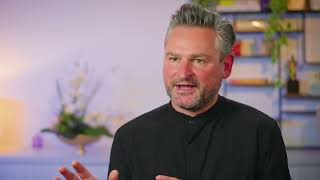
Dr. Frederik G. Pferdt argues for asking "what's the best that can happen" instead of dwelling on worst-case scenarios. He teaches NYU students a "question storm" exercise that builds excitement and measurable improvement, and frames purpose not as a career goal but as a daily feeling you can cultivate through curiosity and care.
Chapters
I think we shouldn't ask ourselves what's the worst thing that can happen, but ask ourselves what's the best thing that can happen. Hi, my name is Frederik G. Pferdt. I'm a visiting fellow at NYU Stern's Initiative on Purpose and Flourishing. I'm also the first and former Chief Innovation Evangelist at Google, and I'm the author of the book What's Next Is Now. Purpose shows up in everything we do. It's probably the most important quest that we are on. If we just ask ask somebody like, what do you want to be in the future, we're trying to put ourselves into like a, a job title or a career or a destination. If we ask ourselves, how do we want to be in the future, it's something that we probably want to discover. It's probably an emotion, it's a feeling, right? If you want to feel more caring, for example, that is something where you can look for moments throughout your day where you can see that kindness. If you want to feel more calm, maybe take that into a meeting or into discussion. Or if you want to feel more curious, maybe ask a better question next time in a conversation you have. My relationship with the future is sometimes a difficult one, because if you look into the media, if you look into the world, if you end up with a lot of anxiety. And so what I want to help people with is that they hopefully fall in love with their future again, because that's something we can actually do. If we see the future as something that is not far out in the distant and out of our control, but seeing the future as something that is very close to the moment right here, and it's something that we can actually control. So working with students, we are moving away from predicting the future and towards more experiential learning. For example, curiosity. When we practice curiosity, we do it in a very specific way. So I give them a chance to actually engage in a question storm. The same rules are applied in question storm than in brainstorm. Build on other people's ideas or build on other people's questions and so forth. But when you do a question storm, something magical happens. As we just did this morning with the students, and I asked the students, so how did that feel? People felt excited. And I asked them, did you see any progress in the questions, in the quality of questions over time? And they all responded with yes. So the questions got actually better, which fascinates me because for me, the best leaders in this world are the leaders that ask the best questions. So what I want to do with students is put them into a position where they become the best leaders in this world. I'm very optimistic, actually radically optimistic about the Initiative on Purpose and Flourishing because I think we're asking the right questions in those times of change and in those times where a lot of people are looking for answers and they're looking for what can we do differently to create a better future for ourselves and for others, right? And for this planet. And I think if we ask those questions on purpose, on flourishing, we can then also give better answers and then help a lot of people to not find purpose, but see purpose as a feeling that they want to experience in the future.