The Future Is How / S1 E4 /w Lisa Kay Solomon
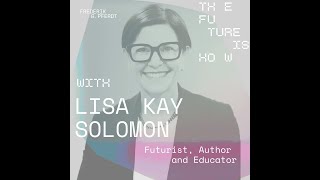
Lisa Kay Solomon, a Stanford designer and futurist, teaches leaders to imagine five-year legacies and embrace ambiguity through tools like the Futures Implication Wheel and the Thing from the Future game. She's built civic programs like Vote by Design and #AllVoteNoPlay to turn student-athletes into voters. Futures thinking isn't about prediction; it's disciplined imagination applied to everyday decisions.
Chapters
Welcome, friends, to What's Next Is How, your podcast where we explore how to actively shape a better future, starting today. I'm your host, Frederik G. Pferdt, and today I'm thrilled to bring you an exciting conversation about futures thinking. Our guest is Lisa Kay Solomon, a futurist, author, and designer in residence at the Stanford D School. Lisa is just a force for good, I have to say. And her work centers on empowering leaders, communities, and organizations to use futures thinking to design a better tomorrow. Currently, she's particularly passionate about civic engagement and how can we reimagine how communities engage with the world around them. So Lisa, it's an absolute pleasure to have you here today. Thanks for joining us.
Dr Frederik G. Pferdt, thank you so much for having me. Congratulations on the book and this podcast. I get up every day thinking about how we can get more people feeling that they can shape better futures. So this is a great place for me to be.
Wonderful. And so to kick things off, I'd love to start with a practice that's really close to my heart, and I think it's close to your heart too. I call it a future bio. So Lisa, I'd like you to imagine it's 5 years from now, and looking back at all that you have accomplished, all the great work that have happened, has happened, what would you say your bio is? And, um, what would you highlight as the work that you've done and the future you've helped create?
Yeah, I love starting with a futures practice, Frederik. That's So thoughtful. I actually think about this a lot. In fact, in the class that I teach at Stanford called Inventing the Future, one of my favorite opening engagement with the students is to have them give us a 6-word memoir. And so similar in that practice. For me, when I think about 5 years, 10 years, what they're going to say about my body of work, many decades in the future, is that I made this approach to thinking boldly about the future, to thinking about the future not as one thing, but as multiple things, to getting comfortable with ambiguity, learning how to sift through the knowns and the unknowns, and to incorporate the idea of dreaming, imagination, learning from others into our everyday work. I made all of that, or I helped make all of that more accessible. I fundamentally believe that we have a broken model right now where we ask our leaders to be experts in shaping the future and futures. And I mean leaders broadly, not just the ones at the top. And we actually don't give them time to practice those skills. So everything that I do, whether it's my classes at Stanford, my writing about breaking down a futures mindset and a couple of different practices and approaches, And these programs that you're talking about, that is actually infusing a futures approach into helping more young voters think like voters, think like hiring managers of the future, which is what they are when they cast their vote. Working with student athletes to help them understand that the same practices that they do every day with intention as competitors in their sport as teammates to one another with a growth mindset and a higher purpose, that's exactly what we need from all citizens. And to help them understand that they can use their positions of influence on their campuses for good, to model that, all of these fit my purpose of helping more people feel agentic in making choices that bring about better futures. And they're doing it in a way that's authentic to them.
Wonderful. Thank you for sharing that, Lisa. You know, it's always so inspiring to hear how someone envisions, you know, the future they want to create for themselves and for others too. So thank you for sharing your future bio. And you've done such incredible work with futures thinking and, as you said, like breaking down that futurist mindset and how literally everyone can be a futurist, right? I think that's what you are really telling everyone, like, hey, you can be a futurist and you can learn all of those skills that are required to think differently about the future. So tell me, why would we actually all become futurists, right? As most of our thinking is probably about the past, right? And we have like history classes, you know, we have conversations that are mostly about the past. And so why would we all become futurists?
Yeah, and I would say just like I hope we all become good communicators, that I hope we all become critical thinkers, right? That doesn't mean that my tagline on my job description is critical thinker, communicator. That's how I think about futures too. And I'm not necessarily advocating that we all become a certified futurist in that way and what that means. I think what I'm trying to advocate for is that we put more intention about how we think about the future. And we put more discipline and rigor, and we get exposed to more frameworks and tools and skill sets that allow us to take a long view when the majority of our organizations are geared towards short-term thinking, right? That we are more comfortable with ambiguity because when we think about where we need to apply our our talents, and our imagination. They're not on simple known tasks, right? Increasingly, the algorithms are doing that for us. So to me, the stance I take around helping more people think of themselves as futurists, and I'm not even sure that that's the best way in, to be honest, Frederik. I think that the word futurist is very off-putting. Listen, you and I have taught for a long time at the Stanford D School. We know the challenge of getting more people to think like designers when in their mind they think design is about making things look beautiful. And we're really thinking about a broader perspective of taking an empathetic view towards solving complex problems in an experimental and feedback-forward way. I don't want to get into the discussion of, no, a futurist is not someone that reads tarot cards and has a crystal ball or knows everything, right? A forecaster. That's not where I want to put my energy. I would rather put my energy in helping unleash everyone's imagination, everyone's creative capacity to think longer term, to think more expansively about the kinds of futures that we want to bring to life, or at the very least, the kinds of futures that we'd like to avoid or inoculate ourselves against. Those to me are foundational practices of resilience that I think are critical for everyone to learn. And I think this idea that we can authentically be hopeful about our future, not in a Pollyanna kind of way, but in a way that feels grounded and connected to our values. Those are the kind of futures-oriented posture or skills that I'd like to infuse. So I don't necessarily think that we all need to be a certified futurist. But I certainly think that all of us need to practice more of these lenses in which we can think about our role and the kinds of engagement that we want to have in a professional and personal capacity.
So before we talk about one of those lenses, as you described it, imagination, which, you know, I love to talk about. In various ways. I want to just bring up that point that you mentioned again, which is that some of us, we just feel stuck with the problems that are around us today that we're facing today, right? So how can you help leaders and everyone to take that step from focusing on today's problems to really actively design for a better future and take that long-term view? What are some of these strategies that you would suggest?
Yeah, it's a great question. Come take my class, Inventing the Future. We do it week by week where we unpack a lot of those tools. But I think honestly, Frederik, the first one is like— and I think you would agree with me on this— is taking some time to actually step away from the day-to-day, the email exchange, the immediate next thing, the quarterly results. That yes, I have a lot of empathy for leaders that need to balance some of these urgent responses. With taking time to say, wait a minute, where is this going and why? How could I imagine the kind of future that I want to be a part of building? What does that look like? What does that feel like beyond what is in plain sight, right? A little bit past that time horizon where we can predict, but we are truly imagining. So I think the number one thing is to take time to really think more broadly about the kind of future that we want to bring to life or the kind of contribution, if you are a leader within an organization or you are a leader within a team, that you want to pull towards and really be able to articulate that in a variety of ways that are tangible and concrete. Too often, those futures exist, but they exist only in spreadsheets and business model projections. They don't exist in terms of stories and narratives that we can talk about in sticky ways that involve real humans. Interacting in a real situation. So I think that that is the foundational thing, is to pause, be able to sort of imagine out, really put some sticky descriptors and some textural understanding of what that is and what that could be. And then you can work backwards and say, well, if that's where I want to be, what would have to be true in order for me to get there? Then you can sort of think about what levers could you work with? What partners? What incentive systems? How would you try to make the best choices in order to get closer towards that preferred future? And what are the measurements that you are going to build along the way? Said a different way, I think that leaders have the opportunity to first see a multiplicity of futures, right? Again, to go beyond what their necessary business plan or what the past has told them. But to really push the boundaries of what they can see using imagination. I think from there, they can take a look at what it might take to shape those futures. How are you going to actually build out that plan, even if it means an exponential jump of some kind, right? Looking at things not just through a linear lens. And then the final one is really how do they share those futures, like I said, in ways that other people can get excited about beyond just presenting a business plan or a PowerPoint. How are they going to tell that story and narrative that pulls people forward?
Great. I like that notion of storytelling and communicating a vision of the future that is sticky, as you said, that it's involving humans, right? And that it's not just a PowerPoint presentation or a spreadsheet that, you know, lists out a couple of elements of how that future could look like. There's this wonderful quote that says, this current moment has not been imagined or was not imaginable back in the days. I remember, I forget how.
I think that's a Stewart Brand quote. This present moment used to be the unimaginable future.
This present moment used to be the unimaginable future. Exactly. And I love that because when you ask people, imagine the 50 or 100 years out, right? They have a really hard time to actually do that. And there's some fascinating research also, not just imagining kind of like the world, which is, you know, something very complex to imagine, but also imagine your future self, right? That when this research project asks Stanford students to imagine their future self just 10 years from today, right, they could articulate that they want to have a faster car or probably a little bit more money. And when they asked the students to imagine themselves 20 years from today, right, they said like they have probably like a house to live in and probably a job or some work they're passionate about and so forth, and they're in a relationship. But when they asked the students to imagine themselves 30, 40, or even 50 years out, right, the picture got very blurry. And they couldn't articulate anything how their future self is going to look like. And so when you ask leaders to imagine, like, you know, how the world is going to look like in 30, 40, or 50 years, I imagine, like, nobody has a good answer for that. So how can we trigger our imagination? How can we really use our imagination to have those bold visions of the future? What's another secret ingredient that you could share that really helps people to do that?
Yeah, well, I love that you bring up that research because it suggests how uncomfortable we are with imagination, even for ourselves. And I think some of that research suggests that when we take a further out future and we try to imagine ourselves, we treat ourselves like a stranger. It's hard to have empathy for a stranger like that. They're so disconnected. And that's what gets me excited about the design component because making choices to make that further out future feel more real is actually a craft. It's a design craft. I'll share a couple techniques that we do in our class and just, you know, would again love to have an exchange on this. One thing that we do in this class that I've been teaching for the last 6 years called Inventing the Future, The premise of the class was to help our Stanford students that are incredibly technically talented answer the question, not can I build this, but should I build this? How do you know? And how do you know when the consequences, second, third order consequences are years away? Now listen, we know we're not going to give them direct answers on that. We don't have facts from the future, but we can ask them to visit the future in a way that stretches their imagination. So, one of the techniques we do is we have them split up into teams after we've given them a number of these trendspotting activities, these second and third order, like the Futures Implication Wheel, as an example. Another— some other more playful ways of bringing back artifacts from the future, again, to get that tangibility. We have them do 50-year utopia/dystopia debates on that emerging tech. And again, we're not looking for PowerPoints that talk about how a trend might unfold and then look at something. We're looking for narratives and stories. And they give us a glimpse from a future that's much more maybe akin to science fiction, but it's based on science fact and how that might unfold. And we have these two competing worldviews of how an emerging technology might play out. Not just in and of itself, like what's the future of VR, but tell me about VR dating. What are the implications for that? Tell me about the future of lab-grown meat and what a society might look like if we really adapt these new mechanisms to enjoy the benefits of meat, but in much more sustainable ways. And we have them play around with what could go right and what could go wrong. And of course, the punchline is not who got it right. You know, again, traditional debate is like, who won? How many points did you win? That's an approach. Our approach is a learning approach. So we're not looking to award someone a winner. We're looking to expand the peripheral vision of what's possible. And so we say to the Utopian team, What did the dystopic team get right that you weren't paying attention to because you were so focused on your Pollyanna vision? And likewise for the dystopic team, what did the utopia team get that you missed? And we bring in an expert in that field who has been steeped in those questions to add their commentary and to get their questions. And inevitably, what's so great about this is that everybody walks away with new questions, and that's what you want. I think having a futures perspective is really about learning differently, learning wider, learning longer, learning from different perspectives, sourcing new questions and new modalities to help you get some information to help inform our present moment and the decisions we make today.
Wonderful. One of the things that you highlighted is that we should make that future tangible, right? When we want to visit that future. And so there's this notion of prototypes of the future, right? That really bring a future vision to life in the right here, right now, so that you can interact with it, that you can look at it and also decide, is that something we should actually build, right? And should design. So recently I spent some time at Omega Mart, which is an installation in Las Vegas from a group called Meow Wolf. And they really had an interesting concept of a supermarket of the future, right? Where there's objects that you could take out and you could interact with and you read the the labels and so forth. And they really had some intriguing kind of like things that you really thought that that could be possible, right, in the very near future. And it really triggered that question for me, like, do I really want that? Or, you know, is that something I would rather not have in a future supermarket? So how do you use kind of like this notion of prototypes of the future in your class and in your work as well?
Yeah, it's a great question. I bet that was really interesting. What I love about that example is, of course, it's grounded in something we know today. We know what a supermarket is. We know what it's like to go to a place to pick up food and look at ingredients and how we do it. So there's something grounded in something that's known versus I think sometimes you can go into a far-off future and nothing is familiar. And so it can be very unsettling and therefore hard to relate back to. To then ask that question, which you asked yourself, which is, wait, do I want this or not? So we spent a lot of time kind of like playing with that accordion of time travel in some ways to make sure it's grounded in something that feels familiar, but it also stretches the imagination so that we can put our energy towards the asking of the, hey, is this actually what I want versus that I'm just getting oriented here. You know, sometimes when we're like, okay, up on Mars and what is it? It's too hard to orient. So we do this in a number of different scaffolded ways, certainly within my class. One is, as I mentioned, every week we introduce a new futures technique, whether it's rapid-fire scenario planning or one of my favorite is Stuart Candy's game, The Thing from the Future. So fun where you get to actually build a new artifact just from game cards to the futures implications wheel. To signal scanning. But then every week we have the students do a futures portfolio assignment where they take the thing that we did and we integrate it on something in their life. Now, what that helps do is it helps them integrate it and further their practices of it in a concrete form. A lot of times we actually make them visualize it as well. The other thing we have them do is reflect on it, reflect on the learning. So again, it's not just a gadget. That goal is just like, wow, by looking at it this way, this is what I learned and why. So we do a lot of different things to help really both make it a compelling and sticky experience, but then also integrate it into their learning. Another thing that we do is that we take some familiar formats and we have them stretch out in imagination. So the final assignment is an op-ed from the future. And this was just to give full attribution to The New York Times. They did a series of these a while ago. I don't think they've done it recently. But so you're taking a format that's familiar of an opinion piece, but you're putting it into the future and you're asking them to submerge themselves into that future. So again, it's not a prediction of the future, it's a commentary of a different future state, which has, again, a different lens on perspective taking, which is the psychologist's perspective of a description of how to take empathy for one another. We're just adding this timescale to it. So all those are examples. More recently, I've started teaching a new class at the D School, which I'm so excited about. It's called View from the Future. And here what we are doing is we're helping expose students to career paths of the future. So I talk about it as we are having conversations with people living in the future. And what we do is we invite a variety of different designers, pioneers, innovators, researchers that are on the edge. So, you know, another quote that people often say about the future is— comes from William Gibson, who says the future is already here. It's just unevenly distributed. So we bring the future here. So we had, for example, a week on living systems. And there we had Philip Ross, Phil Gross from MicroWorks and Julia Marsh from Sway that are both using living materials to replace things in our lives that are not good for the planet. So Sway is about taking algae materials and turning them into what essentially people use plastic for. So we can no longer use plastic. Phil Gross has been pioneering the use of mushrooms in making everyday objects like our clothing, soon-to-be surfboards, maybe we'll be living in buildings that are made out of mushrooms. So by hearing people that are doing the work today that have broad implications for imagining the future, I think that's another way to make the future feel more concrete. And those are just a couple examples of the kinds of people that we held in. And of course, what we're trying to do is expand our students' imagination of the types of careers that might be available to them by getting a design degree. And Frederik, certainly, as you know, we have been evolving our design degree at Stanford to move beyond product design, which was very powerful but had a certain, many ways more narrow definition, to design more broadly, so that we can invite students to learn how to make in these different mediums like mushrooms, at algorithms, you know, like sparking creativity on really looking beyond the status quo. Hey, maybe I don't necessarily need to get the product development job or the product management job at this tech company, but I want to actually go into climate tech or ocean tech and what that could mean because I'm passionate about sustainability. Helping students learn how to adapt, you know, to changing context and mediums and helping them to learn how to create value beyond profit for people on the planet. So, so I'm really excited that this new design degree offers an opportunity to bring in a futures lens and also help our students get much more expansive in how they're thinking about their own careers and the kind of impact they can have in the world.
Yes, this evolution, I think, of the program and expanding just that notion of design, right, is so valuable. And I, yeah, I love the work that you're doing also on civic design, right, and bringing that whole notion of how can we reimagine communities and how they engage with one another. And how they shape the future to really the next level. So can you talk a little bit about that work and how you were trying to really, you know, combine this futures thinking with civic design and the work that you're doing there as well?
Yeah.
To really create what I think is more an inclusive and also participatory future, right?
Absolutely, Frederik. Thank you so much for the question. One of the things I feel very lucky about in my work at the D School because of the D School's DNA of having it be experiential and applied, I accidentally got into the civic futurist work about 5 years ago when I created a class called Designing the President that later became morphed into Vote by Design when I took it out of the D School and made it freely available. Via Creative Commons, but that set me off on a series of different initiatives that really all center on a core concept of futures, which is the image of the future, which we know comes from Fred Polak, who is a Dutch sociologist who is a Holocaust survivor saved in his 20s by a Dutch family and then later actually went to write what has become a tomb of futures thinking, The Image of the Future, actually at Stanford. He was a fellow at the CASBS, the Center for Advanced Behavioral Studies. And one of the core premises of that important work was realizing the impact that all of our views of the future had on our beliefs and our choices that we make. And so as a futurist, I started to get very worried about the image of the future around our state of democracy. And I don't mean structural democracy, right? There are a lot of elements that are under assault and are very problematic around having a multiracial, pluralistic self-governance system. I mean, what do we believe to be true about what democracy means for us and our individual role in shaping that? And increasingly, the image of the future coming at us was one of negativity. I mean, you can hear, How often do we go about our day and we hear, "Oh, we're so divided. It's so toxic. It's so polarizing." And if you start to hear that all day long, then that's what you believe to be inevitable. And so I wanted to create some interventions that say that is not our inevitability. In fact, we see evidence of more positive civic futures all around us if we choose to see it that way. And so starting with this work that I did around Designing the Presence, which took a look at young people, Again, the narrative we have around young voters is they're apathetic. Look at the numbers. They don't show up. What's wrong with them? And the combined design futurist approach allowed me to say, I don't think they're apathetic because if you ask them what they care about, they're very passionate about the environment. They're very passionate about issues like sensible gun control and economic opportunity. I don't think they're apathetic. I think they're undersupported. What would it look like to use a different mode to help them feel more confident and capable in thinking of themselves as a voter? And so just to give you a concrete example, what we did was we said, look, instead of coming at you with this abstract concept that's actually quite confusing on voting, we said, hey, look, you're a hiring manager. When you become 18, you get to hire the most powerful position in the country, in your state, in your local city, and perhaps in the world when you're voting for the president. What are you hiring for? Now notice we're already changing the language to make it more agentic for them. Say, oh, I never thought of it that way. Do I want a leader that's empathetic? Do I want a leader that's a good communicator? Do I want a leader that knows how to build relationships? So we had them have that conversation. And then we added a futures lens where we said, once you kind of now have a conversation with someone else, try to agree upon some priorities, let's prototype the future. Let's test it out. And we created these scenarios of the future that a president might have to react to. Now, remember, this is in 2019. And we created little vignettes of a flu-like virus that came out of China and took down the world economy that didn't have a known vaccine or a drug that would combat it. We had a scenario of an insurgency, but it wasn't at the US Capitol, it was at the state capitol. We had a scenario of an environmental disaster where 1,000 people were killed from a superstorm, which I certainly hope does not become our future, but it could be based on just looking at the trends. And then we had students make a speech to the American people embodying those scenarios, thinking about the leadership qualities that they cared about. And what the responses that they would've liked to hear. So all of a sudden, using a futures approach, we are getting students thinking very differently about the power of their vote and breaking it down in concrete ways. So that was just one example of the kinds of methods that I've been working on to basically shrink the change between the desire to shape the future, to be more agentic, and the feeling like that the future's happening to them. And then I'll just share one more piece that has gotten me very excited that I've stayed very involved with. After I took that curricula and I digitized it and made it online, when the pandemic actually did happen in 2020, I started to get phone calls from other people that found themselves wanting to shape the future in new ways, but they didn't necessarily have the tools and the approaches. People that called, one of the individuals that called me was a 6-foot-8 basketball coach from Georgia Tech at the time who was in the process of helping his athletes vote. And what happened to him was he was trying to help his teammates, his team process the aftermath of the murder of George Floyd. They were feeling very helpless and very frustrated and very overwhelmed by the future happening to them. This is was in the middle of protests in Atlanta and some violence. And in a team meeting, a senior on that team named Malachi Rice said to the team, "Well, if you all care so much about your future, who's registered to vote?" Well, Frederik, zero people raised their hands in that. And my now colleague and partner, Eric Revenaud, basically had a midlife crisis on the spot. He could have used your opening question of, What's the legacy you want to have? And he said, you know, for 25 or 30 years, I've probably been the most important adult in these young people's lives. And yet I've never thought to ask them if they're registered to vote and what I could do to help them get the information. So he took that as a signal to change the decisions he was making. And he went on Twitter and said, look, on Election Day, we as coaches should give time to our players to vote. #AllVoteNoPlay. And Frederik, 2,000 people signed that petition of coaches and athletes to make that a reality. And then the NCAA, which is the governing board of all student athletics, turned that into legislation that that would happen every year. So that's a great step in shaping the future. The problem is they didn't have any materials to help them know what to do with that. So he called me up and he said, "Look, you're a designer. You know how to make experiences that change lives, transform perspectives. Let's work together to create some materials for athletes to help them think like voters and teammates." So for the last 4 years, we've been doing just that. We've been trying to translate the practices that a student athlete can learn in the locker room around bridging difference and working towards purpose and helping turn them into fund civic drills or civic tailgating or opportunities for them to grow and see that they could use what they do every day as an athlete to make a difference beyond their sport. And just this week, we hosted our second civic tailgating party with all-stars like Governor Wes Moore, who is a former football player and basketball player, joined us as well as several WNBA players to talk about how they're using their voice to make a difference. To break it down for student athletes. And we had 10,000 student athletes watching from 122 watch parties, eating 1,000 pizzas that were delivered to them from Pizza to the Polls. Each one of those was a futures and design choice, but made very practical and accessible. So just some things that we're doing. And mostly, I'll say one last thing about this. You could see I have a lot of energy for it. Yes, I want more people to vote. Yes. I want more people to feel like that they can make a difference in their communities. And we know the research tells us it's good for them too. It's good for their mental health. It's good for their careers. They become better and more successful contributors to society. So at every level, that is a strong futures move to make.
Wonderful. Speaking of being a force for good, Lisa, thank you so much for sharing that incredible work. I want to go back a little bit to that Fred Pollack and the Pollack Game actually he created and invented. This is really, I think, a helpful exercise for everyone, right? Because it really allows you to understand our view of the future. And so the Pollack Game is something that you can look up for, like look up everywhere. And it's basically a 2x2, right? A matrix that has on the one axis, like, an optimistic and a pessimistic view. And on the other axis, it has basically, I can make a difference or I cannot make a difference. And so you can position yourself and also ask your colleagues or your friends or anybody around you, to just ask, answer these two questions that are related to it. The first question is, in the next 10 years, do you see the world as getting better or worse? Right? So you put yourself into that optimistic or pessimistic area. And the second question is, how capable do you feel of personally affecting the future? Right? Can you make a difference? Or do you see yourself really as somebody who is recipient of the future, right? Not making a difference. And so really, depending on the answers, people will fall into one of these 4 categories as shown in this matrix. It's powerful, passive, powerless, and realistic, right? And when you do that with a larger group, right, you see really kind of like where people stand, what's their view of the future. And then you have a wonderful playground to really have a conversation like, why do you choose to stay in that corner, maybe of being optimistic and that you feel you can make a difference in the future as well. So really a wonderful exercise and a wonderful game that Frederik G. Pferdt actually invented. And so highly recommend doing that. What's your experience?
Yeah, I'll say, you know, we actually open up our class with that game. And I want to give props to my good buddy and just hugely respected colleague Stuart Candy, who helped bring some of those philosophies to life. I'm not I'm not sure Fred Pollock actually created the game as much as the underlying principles behind it. So we do that in the beginning of our class and then we do it again at the end as a way of kind of marking, to your point of, do you feel like the future is happening to you or do you feel like you have learned skills to make you feel like you could be in a different quadrant, particularly your ability to shape the future? And one of the things that I try to do in my work is to point out futurists that we wouldn't necessarily call futurists. I actually wrote an article last year, right as she was finishing up her first leg of her Eras tour, about Taylor Swift as futurist. Taylor Swift is a futurist. Now, we don't call her that, right? And frankly, what makes me motivated to continue to do this work is when I ask my students, who do you think is shaping the future? And they say Elon Musk. Or Jeff Bezos, which yes, I mean, you know, of course the power and the influence that they have is in fact shaping the future. And so is Taylor Swift, and so is Beyoncé, and so is so many people around us like Eric Revenant, like Elmo, by the way, uh, our beloved Sesame Street, who, um, earlier this year went on social media to check in with how people are feeling. Hey, Elmo wants to check in. How are you feeling? And over 200 million people responded. Now, obviously, Elmo is not a real creature, but the person that did that campaign was a 25-year-old social media campaign manager. Did she change the future? She sure did. You know, did she change it in a lasting way? Well, you know, hopefully that raised some awareness about just how much struggle people were feeling. So I think a big part of our work is to highlight more case studies where people are making a difference. So that it's more accessible to more people to get out of that passive realm or the I don't know realm. We know from another great book, Dan and Chip Heath, who wrote the book Switch. I love that book. It's a design book. It's a futures book. They don't call it that, but it is where we say what often shows up as resistance or even laziness is lack of it is, is confusion, right? Is, is lack of understanding of how to, how to take the first next moves. So I think if we as educators, as authors, can make it more accessible for more people to see that there is a first move available to them, then that takes them out of the passive quadrant and at least gets them closer to I can influence the future. And, you know, to me, that's what the work is about.
Wonderful. We talked a little bit about imagination as something that is accessible to all of us human beings, right? But I think it's also something underused, right? And really taking that time, as you talked about it previously, to imagine and taking a step back, right, and allow yourself to really pause for a couple of minutes or even maybe a couple of hours to imagine that utopia that, you know, we, we want to see happening ideally, right? And that we want to be a part of. So why do you think imagination is such a, a wonderful tool on the one hand side, but also one that is so underused in our daily lives?
Yeah, it's a great question, I think, and really hope that more people are paying attention to it. You know, imagination is, I think, what has kept us alive as human beings for tens of thousands of years. You know, the ability to imagine something beyond right in front of us is, I think, the fuel for advancement, for possibility, for survival. You know, this idea of being able to tell a story about What I think, you know, from the caves of Glasgow, where they really realized that there were, you know, drawings of animals that were basically communicating, like, surviving is avoiding those animals. We're going to paint this picture for you. That's a form of taking an imagination of what could happen and communicating it in some tangible way. So I think imagination is critical, you know, to us connecting as a species. And is something that, you know, we have grown and evolved. Unfortunately, I think imagination is something that is undervalued, as you said, and misunderstood. So I'm excited when I have colleagues like Ed Finn and Ruth Wiley at the Arizona State University Center for Science and Imagination that's doing a lot of new research on imagination and particularly applied imagination, I think is critical. But I think that our schooling, and at least I'll speak here from a US perspective, it really doesn't value imagination. I mean, like creativity, I think pretty much from the second grade on, if you can't draw a beautiful horse, you're not creative. These trips. And again, like, show me the index that honors and really encourages imagination. I think oftentimes the divergent question particularly in public schools, gets shut down because it's off of the incentive system to get through the material that we are able to test so that we can measure to advance you. And yet, right, we have these great heroes that we, that we, you know, put up on a pedestal for being these— wow, they were the out-of-box thinkers, you know, Steve Jobs, the out-of-box thinkers. Again, Elon Musk, you know, imagining going to Mars, you know, as some earlier inspiration. So, I think we have a lot of work to do to infuse imagination as a necessary ingredient for all leaders to practice over time and to do that in safe and structured ways so that when we have the crises that require creative thinking, it's not the first time they're exercising imagination or creative muscles. So anyway, and I guess like, and I don't have the current studies on it, but I often think about Warren Berger's book on curiosity and questioning, where he took a look at, you know, the greatest questioner in the world, I think it's a 4-year-old girl that asks somewhere in the neighborhood of close to 300 questions a day, mostly of, you know, her parent, if not her mother. But then, you know, he tracks like what happens to questioning when kids go to formal education and it's like while reading and writing grows up, you know, questioning takes this nosedive. So I think we could use that as a cautionary tale maybe of what things we need to reverse around imagination.
Absolutely. Yeah. Which brings me to maybe an exercise that we want to do together just to spend some time literally to imagine, right, and practice that muscle and practice that ourselves so that we can use it when we need it more. So I want to engage us in a quick exercise called a Mindstate Moment, which is just an imagination exercise that allows us to take a pause, relax, but also like put our minds towards the future, right, and just see what's coming up. So I like that you already get into the right pose, Lisa. So I'd like to invite everyone into this mind state moment, just a short journey into the future, using the power of your imagination to explore what's possible. So wherever you are right now, take a moment to pause. And if it feels comfortable, also close your eyes and begin with a deep breath in. And just slowly exhale. Let's take another breath together. Inhale deeply and let go of any tension as you breathe out. And now with your mind calming down, and being open, I want you to imagine yourself 5 years into the future. Picture yourself waking up in a world you've helped create. What does your environment look like? Is it full of nature, filled with a vibrant community, or perhaps something else entirely. Think about the communities you're part of, communities that you've actively shaped through your actions. How do people interact with each other? What values guide them? How do they support and uplift one another? In this future, you've played a key role in shaping these connections. So take a moment to feel that impact. Your actions today have contributed to this future. Next, I want you to walk through this future. What new relationships have grown out of your efforts? How have things changed for the better because you dared to take the first step? And just reflect on the contributions you've made and how they've rippled outward. So now gently bring your focus back to the present moment. And from this future, think about the one small step, the one meaningful action you can take today to begin moving towards that wish, that vision. It doesn't need to be a grand gesture, just one step forward. Maybe a call you want to make to someone, maybe an email you want to write, maybe another gesture you want to, you want to take. So just hold that thought in your mind. And as you breathe in deeply again, just feel that clarity that comes with knowing you're on the path toward the future. Just exhale and release any doubt that comes with it. So the journey that you're on to creating this future starts now, with that small step that you can take now. So just hold on to this feeling as we continue our conversation with Lisa here, remembering that you have the power to actively shape the future you want, starting with imagining it first. So thank you. So, Lisa, as we continue our conversation, I love to share, you know, one or two or three practices that you as an individual do, maybe on a daily basis, maybe on a weekly basis, that really help you to connect to the possibilities and opportunities the future holds. What is something that you practice and really try to weave into your daily routines as something that allows you to become a better futurist, a better person to really see opportunities in your future too?
Yeah, thank you for that. And thank you for that beautiful visualization. A couple things that I do I try to stay as curious as possible about things going on. I don't need to be the expert on— particularly here living in Silicon Valley in the heart of emerging tech. I'm not the AI expert. I'm not the expert on any emerging tech, but I am curious about how the tech is unfolding. And so I do try to, even without a technology background, you know, look for things that pop up that may like go over your mind, but be like, huh, I wonder what's going on there. Right. So I, I really try to hold a curiosity and a wonderment about the world that requires an openness, right, a stance, you know, and certainly what Frederik G. Pferdt, I don't need to tell you or others listening, it has been a very hard few years. When we are in a place of reaction and defense, it is hard to be open and to be creative. So that, that has become The reminder to be open and curious has actually become way more intentional and conscious than it ever was. But I have to do it because I don't want personally to stay in that stance of being reactive and reflective. So that's a personal practice that then extends to how I show up to my students or to the things that are open to me. The second thing that I try to do at a very personal level that is very authentic to me is I try to build relationships that are diverse and that are meaningful, that are grounded in respect and care. So to me, what a hallmark of a great futurist is someone that has a lot of different kinds of relationships that bring in different perspectives and they invite them in. What I say to people who I am excited to meet and get to know and eventually want to work with, I always say, what would be a great phone call for me? If you were excited to do some work, what would you love to hear? What, what, what, what opportunity would you love to know? That I don't know if I can guarantee that, but that allows me to understand what they care about and what I could do to create value for them and for both of us. I'll say one thing that brings both of those practices to bear was something I'm really proud of connecting to the applied, even civic futures, is earlier this year at Stanford, I hosted something called The Future's Happening Democracy Edition, where I brought in about 100 people bringing different perspectives. Some of them were steeped in the democracy space, some of them were artists and poets, community builders, teachers. And together we explored bright spots of what the future could be. What if democracy reflected the kinds of communities we want— we wanted to be a part of? And every choice I made was about lifting up others in that same way, through relationships and through an openness and curiosity. And of course, given the fact that this topic is not without challenge, I had to, as a designer, ensure that I wasn't being too Pollyanna about it, right? That I was also kind of building off of credible evidence, pieces of evidence today that these bright spots could in fact grow and shape and change. And but I think what I loved about that experience, getting back to your question of personal practices, is that I think everybody left there not only with new ideas, which was great, but with their own practices. Of being curious with each other and taking the time to be connected and to allow their imagination to flourish even while they were feeling nervous about how the future might unfold. So those are some things I like to do. And I think the last thing is gratitude related to that. I have a very deep practice of gratitude. In fact, one of my colleagues recently said to me, Lisa, you're very gratitude forward. And I was like, That's about the best compliment I could ask for. So I try to do that. When I see something that I'm grateful for, I name it. I don't hold back. I write thank you notes to people I've never met. I let people know if they have a contribution, that they did something that made a difference, I let them know. There is no shortage of gratitude. That is an abundance play that I lean into. So thank you for allowing me to share those.
Wonderful. So stay curious, make connections, and practice gratitude. That's what I'm taking as the 3 practices that help you, Lisa, really not just stay grounded, but really have a different relationship with your future as well, right? Because that allows you to see possibilities and opportunities, right? In the tomorrow. And also, it allows you to see your own role differently, probably, in shaping the future, right? Where you're not a passive recipient of what's happening, but really an active agent of what we want to create and how we can create that moving forward. So that's wonderful. And I think we should all have that curiosity and openness We should all make more connections that are diverse and we should all practice more gratitude, right? In the morning, in the afternoon, in the evening, whenever you feel like, you know, this is something that can help you to feel better and also to feel that the future is something that we are also grateful for, right? That it's unfolding in a way that is mostly beautiful, right? If we just look for look for it in the right way and shift our perspective to see the beauty in the future as well. So thank you so much, Lisa, for sharing your wisdom with us and helping us to think more expansively about the future and helping all of us to become futurists. To our listeners, remember, the next chapter of your future begins now. And I think we learned today how you can really create that future that you want to see happening. So take what you've heard today and start applying it in your life, in your work, and in your communities as well. If you enjoyed this episode, don't forget to share it with others who are passionate about shaping what's next. And stay tuned for more explorations on What's Next Is How. See you next time and see you in the future. Thank you so much, Lisa.
Thank you. It's been wonderful.
Wonderful. Perfect. I'll stop here. Let's just
More from Dr

You'll do to your child what was done to you, unless you notice it | Dr. Shefali

How to Stop Passing Your Past On to Your Kids | Conscious Parenting Pioneer Dr. Shefali

How to Stop Passing Your Past On to Your Kids | Conscious Parenting Pioneer Dr. Shefali

The Future Is HOW Season 4 Trailer | How Do You Prepare for a Future You Can't See?




Ruchika Sikri @FrederikGPferdt - The other person may be craving connection just as much



From Doing to Being | Ruchika Sikri on Mindfulness, Connection & Tech That's Good for Humans