Time to Grow | Angela Pferdt
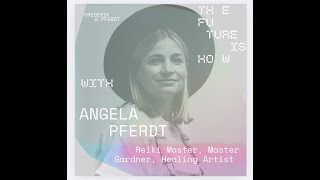
Angela Pferdt moved from investment banking to become a Reiki master, microdosing facilitator, and journey guide. She explains how plant-medicine journeys work in three stages: intention-setting, the experience itself, and integration through art or gardening. Her core belief: personal growth follows botanical cycles, not a fixed timeline.
Chapters
Hello friends and, uh, welcome to The Future Is How, the podcast where we don't just ask what's next, we explore how we create it. I'm your host, Frederik G. Pferdt, and, uh, today's episode is deeply personal and very special. I'm joined by someone who's shaped my life and my future more than anyone else. She's a healing artist, a Reiki master, a master gardener. She's my wife, my partner, and probably one of my greatest teachers on this planet. Angela, welcome.
Thanks for the warm welcome here. Looking forward to our conversation.
Yes, yes, we, we basically just about 10 meters away. Uh, you're in your Reiki studio here in our little forest. Um, but we've spent, um, decades together being very close, so this is probably something like we're going on a, on an extended walk just with a microphone on, and others can listen to our conversation. So I'm really looking forward to it. And, uh, full transparency, this is our third attempt. Um, we had to, um, redo this a couple of times for, for various reasons. So, um, let's, let's give that another try. Um, as always in this show, we begin with what I call a future bio. So we want to know not who you've been, but who you're coming. Angela, would you share your future bio with us?
Yeah, so yeah, first of all, thanks for having me here and, um, talking about the work I do, um, explaining more about, uh, Reiki, energy work, plant medicine. And, um, before I tell you, um, who I want to become, I probably tell you a little bit more about me. Uh, most of my adulthood I've been working in the banking sector and finances. Um, I worked, um, at investment banks in Germany as well as in the US. Um, then, uh, we have our 3 wonderful children. So I'm a mother, um, I'm Frederik's wife, as he explained, uh, and now I am a Reiki master, which is energy work. Um, I am a master gardener. I am part of a group, um, Feeding the Soil. Um, we can also talk about that later. Um, I am a certified microdosing facilitator from the first cohort. As well as a journey guide. So that's about me, what I am right now with all the stickers on me. But if I want to take off all those stickers and look at the future, who I want to become, I would say I, I want to become a better version of, of myself. Um, not that there's anything completely wrong with it. Um, it's more like understanding myself better, um, seeing myself in situations better, um, as a wife, as a mother, as a friend, as a daughter, as a sister, as a neighbor. Um, for me, it's learning how to become like everyday a better version of it by pausing, by listening, maybe by slowing down and understanding and being more present.
Wonderful. Thanks for sharing that. Yes. And I think many, many of us want to become better, right? Become better human beings, just as you said, with our neighbors in our communities, as mothers, fathers, sons, daughters, sisters, brothers, whatever role you are playing. So how do we do that, Angela? And you mentioned something interesting right at the end, which is being present. So tell us a little bit more about that.
Yeah. So being more present is what I learned by doing Reiki. So I explain you a little bit about Reiki. People keep asking me, what is it? So in the most basic words, it is a form of natural healing that promotes and supports your body's healing process. So it's coming from Japan. It's a Japanese word that you can break down in rei, which means universal, and ki, which is the life force, the life energy. So put together, Reiki. Again, a really traditional old Japanese healing method. But if you want to go to Tokyo and talk about Reiki, don't expect that everyone knows what it is. So it's still in its niche, but it's made its way around the globe. And, um, yeah, found its way into my home and into my heart. So, um, that's what I'm offering here in Santa Cruz in our, um, A-Frame studio that you probably can see a little bit in the background if you watch the video to it. Otherwise, I just give you a little bit more information about what it is and how it works. Again, it is a non-invasive healing method that works. It's non-religious also, and it works by placing the practitioner's hands on several head positions all the way down the body and promoting a well-being. In basic words, like, at the least, it's a form of, um, well-being. It, um, again, because of the hand positioning, a few minutes on each, um, it gives you, um, as a chance to, um, relax, to calm down, to slow down, and basically allowing the body for this hour that we spend together to rest, to reset. And allowing itself to heal consciously or unconsciously, big or small. Whatever comes up comes up in this very moment that we spend together working with the energies in your bodies.
Thank you so much for introducing that Japanese healing tradition, I would even say, to us. So I know you're also a Reiki master, right? So, and I know that your journey was very personal coming to Reiki, right? So what brought you to Reiki and what opened up for you when you explored Reiki for yourself and for others too?
So the way it found me is, and you know the story, someone really close to our heart got very sick during the pandemic. And me being on a different continent, I was looking for ways to support her in this situation while being away. And so I quickly found about this traditional healing method that also works wonderfully over Zoom, so over the distance. So I found someone really close to where the person lives and offered her, like, do you want to try it out? So I arranged a meeting with her and the Reiki master, and they had a meeting over Zoom. And I think I was probably more nervous about it as they both were. And I asked her afterwards, like, how did it go? Like, what did you feel like? Anything? What came up? And she was pretty neutral about it, saying, yeah, it was good. It was fine. It was great. But the real magic happened in my eyes. It's my opinion. The day after when she went back to see her doctor and the doctor noticed an improvement on not overall wellbeing, but also on the blood work they took. So I'm like, maybe it is related. So, if it helps her in this situation, it can help so many other people too. So that's when I, started to get interested for myself as well as offering it then to other people.
Thanks for sharing that. So why are people coming to you when you say you're sharing this practice with so many people? Why do they show up?
Yeah. So people come from all sorts of different backgrounds. And stages in their lives. And the most basic, I would say they come for some sort of healing. Healing is such a big word. It doesn't have to be those big traumas that we carry around. It can be like on a smaller scale. It can be like a situation that just keeps bothering you and you don't really have a chance to really sort it through. So, people come here and you have to imagine it as some sort of massage setting. So, you will lie on your back and me as the Reiki master, I'm gonna ask you for an intention for the next hours. So, I want you to focus on some sort of attention you have for this time we've spent together. And because wherever there's an intention, this is where the energy goes. So, this is the the first energy work. And then again, people feel some, feel different, like no one session is like the other. So it's completely personal and different. Most people though, they feel some sort of warmth. They feel some sort of tingly. They feel some sort of being held. Being understood, um, feeling like a rush of energy coming out of the body or into the body. Um, some feel like, okay, today is the day I run for president, I can do anything, I can achieve whatever I want. They feel really energized because the energy was maybe just blocked at some stage. Which just happens in our everyday busy life. Others, they feel like they want to just chill and relax and want to be by themselves and want to sort things out for themselves. And others, you know, they just break open in a way they wouldn't allow themselves to break open. And by just releasing some stuck-up emotions some sort of whatever comes up for them. So, yeah, people come for all sorts of reasons, and most basically I would say to heal from stress, from trauma, and relax, looking for relaxation, and especially calmness, calmness in their lives by balancing those energies in the bodies. In the body. And, um, yeah, by allowing themselves just to be.
So I understand that you provide, um, um, a pretty safe space for people to open up, as you just mentioned, right? To share what's on their mind, what emotions they're feeling, what's going on in their lives. So what are some of these things that you noticed in people's lives that really cause them to be in a, in a probably crisis mode, right? Where they feel some sort of emotion like anxiety or they feel lonely or other things. Like what are some of these things and stories people tell you?
Yeah. Glad you're bringing up the loneliness. And also this is part of the work where we go like deeper, a layer deeper in the body. And this is how I came across plant medicine, which is another really wonderful tool for people that just want to go deeper and go— want to go inwards. So here comes my second sticker that I put on myself as a journey guide. People may haven't heard about—
Yes. Sorry, what does that mean, yes?
Yeah, so people may have heard about it. It's out there a lot, the word journey, journey guide, talking about plant medicine. I mean, there are so many big universities out there like Johns Hopkins doing a fantastic job and offering this already in a contained setting. I know Stanford has a huge department researching about plant medicine and how it can help us with all sorts of mental illnesses, starting with depression, with loneliness, with any sorts of those big, big illnesses that this humanity has to deal with. So I found that this plant medicine gives us— me— sorry, stop, stop. Okay. Okay. Not me. I don't want to say me. So this talking about this plant medicine and how it can help so many people, is why I offer those journeys, which is, I would say, a 3-step process, process or program. It starts with a, with the preparation phase, with a huge chunk of time focusing on the intention of it. So why do I want to work with plant medicine? What does it What do I want to get out of it? What insights do I want to get? The second part of the step is the journey itself, which is a full day where we spend time together in— also here in my A-Frame studio, tucked away from the outside world, where we have time just for you to look inwards, basically, and experience whatever is there, consciously or unconsciously. What comes up? What is there which might not be bothering you but still wants some sort of attention? I call it, you know, using a flashlight. The plant medicine really helps It's like a flashlight. You have a flashlight in your hand and it helps you just to spotlight things in your life that might be out of balance or might be perfect and you didn't really appreciate it the way it is. Anyway, this is the second part and the third step is the huge word that comes in is called integration. So whatever that came up, whatever vision or version of yourself you saw, how can you integrate it into your everyday life? How can you make good use of it? How can you overall make sense out of it? Yeah, so this medicine has, I call it, a built-in intelligence. So it knows exactly what it's doing with you. It knows exactly what you can handle in this very moment. In this very moment in your life. It really depends on what mind— here comes your word— mind state you are in. So this whole work doesn't just find you like by advertising. This is a work that finds you because you want to do it. This is— you are in the right mind state or mindset, how people call it. It really it really finds you when you need it the most, I would say. So yeah, this is the other part, uh, of my, uh, wonderful—
so, so thanks for sharing that and giving us, um, a really great introduction and some insights into psychedelics and how they can not just heal ourselves but show us probably a better version of ourselves, right? And show us maybe a future version of ourselves that we haven't discovered yet. So you mentioned that the main part of the work happens afterwards in that integration phase where you try to really make sense of what you've discovered and trying to integrate that into your life. So what are some of the practices that you recommend people are doing after, you know, they go on a, on a journey?
Well, um, again, there's so many different journeys and everything is so individualized. Um, but my part is, um, I want to make sure that you can make the most of what you experienced. So I want to give you tools. I want to give you— and, and again, this could be like some people want to do gardening, some people want to draw what they experienced. It can also go like deeper into layers where you want to do like meditation, where you want to, you know, think of life completely different. You come out with different insights, with different ideas, which could be— I'm saying again, I have to say you could because everything is so individualized, but overall, this is what people report back. This is also what you can— if you talk about it with people, they've done it, they are more than happy to tell you all about their journey because it is, it's very special. It opens, you know, it opens you up in a way that you probably wouldn't think it would. And by doing this, which maybe sounds a bit creepy, but it's, it's not at all. It is, um, it is a really gentle way of finding that sort of peace that many people are looking for. It also brings, um, again, people report and say like what they found is that a lot of answers are there already. It's all there. It's all within us. We as human beings need to find a way to access that by maybe slowing down and just listening and feeling and understanding and being more present.
That's so beautiful framed, as you said, that to all of the questions that we have as human beings, right, that are on our minds throughout our days and nights, probably, that there's the answer already inside us, right? We just have to discover it and, um, let it out, right? And I think you mentioned that these journeys help you to really go deep and finding those, those answers. That you're looking for. And I think one word always comes up when I read the research or talking to people who have done this work, the word love, right? Love for yourself, love for others, love for all human beings, right? And I think that's very powerful if you discover that as one of the answers to some of those questions that it lies in, in love, right? And, um, love to nature and, and other things as well. So I think a lot of people listening might feel curious about that and want to learn more, right? But they also feel unsure, right? Is that the right thing for me, or do I need to go and do that work? So, Angela, what would you say to someone who feels drawn to this kind of healing? And it doesn't have to be like you're suffering from a trauma or you're in a mental state that is unstable. It could be also like your relationship is somehow not working out or you're not happy with generally your life or you feel that the work that you're doing has no meaning. Some of these things might come up in people's in people's lives. So what would you recommend to those people where to begin?
So I always say, like, do your research first. Like, you know, go online these days, of course. Talk to people that have done it before, and I'm sure you'll find them out there. And again, they're more than happy to talk about their experience for sure. You can also call me. I'm happy to talk you through those different steps and also you know, find your, the right research that you might be interested in. There is amazing research out there and it was about to get approved last year by the FDA, which didn't. Nevertheless, there is the research out there. There are like huge departments working on finding more out of this. What, what, what is it doing? Like, how is it so powerful? How can it help so many people? And especially as you were saying, like suffering from depression, from loneliness, the disconnection, the disconnection from oneself where your love comes in, disconnecting from other people, disconnected from the earth. It is— these are the first steps by just, you know, thinking, why do I want to do this? Why am I drawn to this? Why do I think this is the right thing in this very moment for me? And then, um, yeah, and then the journey starts by again preparing, by the journey day itself, as well as the integration afterwards.
Thanks for sharing that. Um, one of your spirit mottos is time to grow, right? And I think there's so much, um, that, um, we could explore and, and the meaning of that, right? The time we need to take, but also what growth actually means. And, uh, let's start maybe where you always begin, which is in the soil, right? You say that healing and growing both begin beneath the surface. So what does, what does that really mean to you?
Well, that brings me back to, um, being a Master Gardener. And, um, I think for me this is my grounding. Um, for me this is where I release the energy to Mother Earth, but this is also where I get my energy from by feeding the soil that later feeds us. It all started by moving here to Santa Cruz where we have a little bit of space, land, and we started planting an orchard. We both never had trees to care about before. We never had any sort of— I don't think we ever had tomatoes before, but all of a sudden— I mean tomato plants— but all of a sudden now we have an orchard, we have an herb garden, we have the kitchen herbs, we experiment with all sorts of different growing, not just in the soil but also hydroponic. How can we integrate, um, like our ponds into the, the, the food chain by growing in the water? Um, there are so many aspects that come together and here in this space and in this place. It is a great honor for me to also offer my space to clients to experience what it really means to have soil in the hand again, soil under the fingernails again, and just having this experience again of planting plants, planting trees that will later be our nourishment.
So that brings me to a mindstate moment that we probably could explore together. And I want to guide you in this mindstate moment, this short inner practice to invite in possibility. So if you're in a safe space, just gently close your eyes and, uh, take just a deep breath in. And imagine you're walking through a garden, maybe a garden that you just envisioned when Angela was talking about it. The path is soft beneath your feet. You feel the warmth of the sun on your skin. The air smells of maybe rosemary, lavender, or even maybe rain. You kneel and— you kneel down and scoop up a handful of soil. You bring it closer to your eyes and you Hold it in your hands and you can feel the soil. And ask yourself, what do you see? What life is hiding in this dirt? And as you look closer, you see maybe some ants, you see some bugs. Just noticing that there is life in this soil, different forms. Now I want you to open your other hand and just imagine that there's a small seed resting in your palm. You ask yourself, what do I want to plant? What feeling or habit or dream am I ready to grow? And place that seed into the soil in that garden that you stand. Cover it with some earth and just breathe in again. So what we plant with presence grows into our future. Thanks for pausing for a moment with that mind state moment. So let's talk a little bit more about, um, that gardening and, um, how you really see that helping you grow as an individual.
Yeah, for me it's time to grow, which is kind of our motto. Time to grow is a double meaning saying, like, time to grow, grow, like growing the plants, growing the flowers, growing the trees, but also time for you personally to grow. I think it's really important that we Be cautious. Be— oops. I think it's really important for us to understand that there is a lifelong learning, not just about the plants, that I barely had any idea about what to do, but it's also about being open to, you know, ways of thinking, new ways of seeing yourself, like seeing yourself in your community. How can I grow my community? How can I grow within my community? How can I be of service, like, not just to my community, but here comes it back, how can I be of service to the soil? How can I be like, how can I make good, good decisions today that will later feed not just the soul, but again, the soil, but also, well, it also feeds the soul, but also becomes then our, our food and nourishment.
So let's talk about psychedelics again, as there's a huge growing interest, right? But also a lot of confusion. Maybe we can talk about some myths that are around psychedelics, and maybe you can unpack some of them. As you are a certified microdosing facilitator, you are practicing with a lot of clients, but you also follow the research very closely. So, um, one of the myths I think is that we can become addicted to psychedelics. Can you talk a little bit more about that?
Okay, um, maybe I break it down into answers. The first answer is a personal one. The first, um, so I, I, I see it, um, working with psychedelics, I see it as a way of, of cleansing. It's a way of reset, resetting your status quo, resetting, you know, it's just like people did before Easter in the time of Lent when they do not eat some sort of things or do not drink some coffee or alcohol or whatever. So I personally, I see it as some sort of cleansing. And because of the power of it, it gives you time to integrate. And there might not— you do not want to do it like on a Friday evening going out. So this is not how it's supposed to be happening in an intentional setting. So again, for me, it is I see it as something that you can do, say, once a year or whenever you feel ready. Personally, I do not see it as something that you want to do, like, often, simply because it takes time to integrate and to understand. And so this is the first part of my answer. The second part of my answer is pointing to the research and pointing to the scientists and all those great people out there doing the work, um, on the research side that we heavily rely on. And, um, they say it's quite the opposite. So it actually helps getting off of addictions. So the psychedelics, the plant medicine that we are using does help getting off of some sort of addictions, again, in an intentional setting.
Thanks for sharing that. Um, and it's, uh, very interesting that it's, it's actually the opposite, right? That it, it breaks addictions. Um, and would you say that psychedelics are only for people with trauma, right, that suffer from trauma or have like some mental health condition?
Yes. So, so there are again, like people come from all sorts of different backgrounds and want to, you know, experience it for themselves. Again, if they have that huge intention they are already saying, okay, I know where this is going to take me. I know what is not going the way I want it in life. Then this is the sort of medicine that can help you break those patterns that you have, behavioral patterns, behavior patterns, or patterns in your brain, like the brainwaves that usually just shoot the way they used to. And this plant medicine gives, in fact, your brain a chance to think out of the box, if you wanted, in basic words.
Great. And maybe the third myth is around, is it only to see specific visions, right? Or colors or shapes?
Again, no two journeys are the same. And what people say is, well, you don't do it for the visions. That's not the point. You do it because, again, you want to understand yourselves better. You want to close those chapters in life that might be still open. You want to access the unconscious that might be there still bothering you. You want to understand what's going on. Why do I behave in this situation? Why do I not behave the way I wanted? Um, what is hindering me? What is holding me back from living the life I want?
Yes. Um, as you know, I'm, I'm your biggest fan and admirer in, um, not just the work you do, but the human being you are. Um, and I benefit a lot of of all the things that you do. So how would you say our kids are benefiting from the gardening that you do, the Reiki, the energy work, and so forth?
Thanks for your kind words. Brings up a little bit of tears in my eyes. I don't know, do we have to cut this out later? Anyway, so I think the kids will benefit from it, me doing the work, basically working on myself, being calmer. I think this is what most parents struggle with, just being more calm and being more present. And well, this work is only, just to be clear here, this is only for 21 and up. So the kids are not in the picture. They will benefit in a way, as I was saying, because it centers me, it centers me as a human being by being more appreciative, by being calm, appreciative, being relaxed. I think there are a lot of benefits to it that I just have not found in any other sort of natural healing.
Yeah, I definitely can say that the patience and the presence, right, are very powerful in, in ways we help our kids grow. Right. And I see that in you every time you are facing a challenge, you know, your things go sideways, right? Like just the patience and the presence you bring to these situations is just incredible. And I think our kids definitely benefit from that. And I think you're making a great point, right? Invest in yourself, right? Invest in your own growth, invest in your own healing, invest in time to really grow. I think that Spirit motto really, really works here, um, quite, quite beautifully. Is there anything else that you want to share with our listeners? Anything that's on your mind, your heart, that you feel like the world needs to hear?
Yeah, thanks for this question. This is off script, but what I have right here under my computer is some words of encouragement. I'm just going to read it out to you, to those of you who need to hear it. So it starts, if you can imagine it, you can achieve it. If you can dream it, you can become it.
Wow, that's powerful. Thank you for sharing that. And, uh, thank you for sharing all your wisdom, your experience with people. Thank you for trying to make yourself better and trying to make other people better, right? In ways that is just driven by care and by support and by nourishment and by, by deep love, right? I think that's what I can feel every time we have a chance to, to be together. So thank you for this conversation. Thank you for your presence. For your way of reminding us that the future begins not in a calendar or somewhere, but in your soul. And to our listeners, what seed are you planting today? What part of you is asking to be nurtured? Because the future isn't something we wait for. It's something we grow. And we've learned that today. We can grow it in many different ways. So until next time, stay curious, stay kind, and keep shaping what's next. Thank you.
More from Dr

You'll do to your child what was done to you, unless you notice it | Dr. Shefali

How to Stop Passing Your Past On to Your Kids | Conscious Parenting Pioneer Dr. Shefali

How to Stop Passing Your Past On to Your Kids | Conscious Parenting Pioneer Dr. Shefali

The Future Is HOW Season 4 Trailer | How Do You Prepare for a Future You Can't See?




Ruchika Sikri @FrederikGPferdt - The other person may be craving connection just as much



From Doing to Being | Ruchika Sikri on Mindfulness, Connection & Tech That's Good for Humans