How Geopolitical Conflicts Impact Stock Markets | Investor Strategy | Ganesh Komma
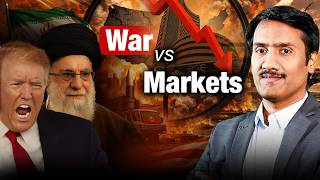
In this comprehensive video, Ganesh Komma explains how current geopolitical tensions—particularly the Iran‑Israel‑USA conflict and related oil‑related power struggles—affect global and Indian equity markets. He begins by mapping the global oil landscape, highlighting the strategic importance of Venezuela, Saudi Arabia and Iran, the petrodollar system, and the Strait of Hormuz, and then assesses India’s oil‑import resilience. He reviews historical market reactions to past wars, showing that despite short‑term corrections the Indian Nifty has consistently rebounded, and argues that the market is fairly valued on a PE basis. He makes a case for gold as a strategic hedge, citing central‑bank accumulation, limited new supply, and growing ETF assets. The video then outlines India’s macro‑drivers—manufacturing, infrastructure, digital economy, and a youthful demographic—that position the country for continued growth. Based on these macro themes, he identifies six sectoral opportunities (Power & utilities, Data‑center infrastructure, Automobile, PSU banks, Cables & electrical equipment, Defence) and provides illustrative stock ideas. Finally, he proposes a concrete portfolio allocation framework (equity, gold, silver, debt, cash) for high‑risk investors, coupled with behavioral rules such as maintaining SIPs, avoiding panic selling, and thinking like a business owner. Throughout, he emphasizes disciplined, long‑term investing and invites viewers to join his community and free masterclass.
Chapters
Right now we are living in a world where there are many geopolitical tensions happening around us in the last couple of years. Even right now, as we are right now speaking, the Iran-Israel-USA, the geopolitical tension. So as a stock market investor, as a stock market trader, what are the things you need to consider? And in this kind of a geopolitical tension where not only the Indian markets The global markets have also been very, very volatile. What are the actionables and what past has told us and how the Indian market has reacted to all the earlier wars is very, very important to know to formulate our long-term strategy. Hi, this is Ganesh Komma, finance and a stock market coach. I manage a community called as Financial Freedom Implementation Program where we as a community learn fundamentals and technicals. We blend both fundamentals and technical analysis to invest into stocks, to invest into sectors, to invest into financial instruments. And in today's session, what we will do, we'll decode how the markets behave in this kind of a geopolitical tension and what is the reason between Iran, US, Israel, the conflict which is happening and how it compounds to other countries, right? And how it impacts even what is the role of China here. And we will decode about commodities. Gold and silver, what is the reason why we need to be there as a part of the asset allocation in our portfolio. We will also go deep regarding certain data pointers which has proved why investing during a geopolitical tension or why buying strong companies during geopolitical tension is important for a long-term investor. And also we will see what are the sectors, why we need to be there, and what are some long-term sector stocks related. We will focus today and how do you Formulate your portfolio is the prime discussion point today. So please stay till the end of this session. And if you have not yet subscribed to this channel, click on the subscribe button. And if any time during this entire discussion, if you feel, sir, this is something, I got some valuable information, there are some bulb-on moments, so please do click on like button so that it reaches to more number of people. Okay, so without any further ado, let me share my screen and I have prepared certain presentation for you and we will take it more in structured manner with a lot of data pointers for you to instill this subject more in detail. So let's go through the global oil wars, market volatility, and how India should be positioning itself, and how as an investor we get benefit out of this opportunity where you get for your long-term investing. We look at the geopolitics, we look at the sector rotation, which sectors we should be there, and how we have to place ourselves in the structural themes. And as a portfolio, we look at the strategy. So before we move ahead, a quick disclaimer. We are SEBI registered, right? So a quick disclaimer that yes, none of the stocks or the sectors or the scripts what we discuss here, please do not consider them as any recommendation of a buy, add, or a sell recommendation. Rather, use it for purely educational purpose. Some of the stocks which I discussed may be in my portfolio or I would have discussed with my community members. So please don't consider them as add, buy, or sell recommendation. Rather, purely consider them for educational purpose or case study. So rather than you looking at a tips or a recommendation out of this discussion, understand the core reason, core theme why we are discussing. Focus on the process and the strategy rather than a recommendation or a buy or a sell call, right? So we'll divide this into 6 sections. So the first section is about global power shift. And as you know, oil is the real currency of geopolitical power. And if you see US, US knows that yes, oil is very, very important, and whoever controls oil will control the global progress as well. And if you see where all there are high oil reserves, right, in terms of barrels. So if you look at Venezuela, yes, Venezuela is the country where it has the highest oil reserves, right? It has close to 303 billion barrels. And the second comes Saudi Arabia, and the third, Iran. Now if you are aware about Venezuela, yes, recently US attacked Venezuela and now the power is with US, right? And if you look closely, Venezuela is a country where it trades outside dollar. It is like an anti-US stance and it's a Soviet ally of China and Russia. And that's one of the reason why recently US had this war kind of a scenario with Venezuela. Now the second highest oil reserves, Saudi Arabia. Now yes, Saudi Arabia has entered into the petrodollar agreement in 1974, and it sells all of its oil in dollars. And also, if you see, it is the largest US arms buyer. So that's one of the reason US does not have any problem with Saudi Arabia. And the third highest proven oil reserves in the world is Iran, right? 209 billion barrels. It's the third largest. And yes, this is also a country which trades outside dollar, and it also controls the Strait of Hormuz, right? So energy is equivalent to geopolitical leverage. Whoever controls oil pricing controls the global economy as well. And the recent attack, what we have seen, why US targeted Venezuela is mainly because of the dollar trade which happens out of US dollar, right? And also Chavez or Maduro traded oil in non-dollar currencies. Each such deal chips away the petrodollar supremacy. And this also is a statement which US is giving to all the petrostates, right? So dollarize your oil trade. So if you see the recent activities which has happened with Venezuela or even right now with Iran, this is a clear message to all the petrostates: dollarize your oil trade or face regime destabilizing sanctions, right? It's, it's directly a threat to the other petrostates. And now Saudi Arabia, yes, as it has majority of the trade in dollar terms, and the primary difference between Saudi Arabia versus Iran, if you see, Saudi Arabia is a more protected ally of US, right? And Iran, it sells oil to China, India, Turkey in yuan, rupee, and euro, right? So this is indirectly or even directly bypassing the SWIFT system and erodes the USD's reserve currency status. And now the Strait of Hormuz. If you look here, this is the most critical energy choke point. And now if you think that it only controls crude oil and products, no, it controls LNG. Approximately 20% of the LNG trade happens here, right? Passes through this. Methanol, approximately 35%, right? Chemicals, 14%. Fertilizers, which are very critical for India, Brazil, and China. And even your crude distillate for Asia, 80% of Hormuz crude flows happens here, right? And yes, crude oil, approximately 20 million barrels per day, which is almost 25% of the global sea-borne trade, right? And now let's look at the impact on India. Now, yes, India 85% is import dependent, but yes, looking at globally, we are strategically resilient. So if I go and in detail about the numbers regarding the Asian oil reserves, Right now India has a cushion of around 74 days. Even if the Strait of Hormuz is disrupted, approximately around 74 days we are covered. Ideally it should be 90 days, but we are very close to it, right? As per the SPR target, uh, by 2030 we are aiming for 90 days. So even right now, yes, there are some unofficial talks about the Strait of Hormuz being released for majority of the countries, but still this data is just to show you that we are strategically more resilient, right? More resilient. Now let's move to the next segment, which is very, very important— markets and history. What happened earlier and what earlier wars have taught us in terms of investing, what markets have learned out of it. So if you see on a long-term growth during any crisis, be it the very recent Israel-Hamas or even the Russia-Ukraine, Iran war, right, Iraq war which has happened in 2003, wherever we have seen correction in the market, even from 2000 till 2026, markets have bounced back very strongly after every global geopolitical tension., right? And even though there was a decline, the recovery was very, very strong in the Indian stock market. And what I have done, if you see this data pointer, which is very, very important from Edelweiss, when Nifty stagnated for around 18 months, yes, as on date from around August 2024, right? Closing January 2026, Nifty has given a 0.34% returns. Means in the last 18 months it is like flat. And if you go back and check for the last 26 years, starting from 2001, wherever Nifty has given stagnant returns on an 18-month scenario, after that, looking at a 1-year, 3-years, or a 5-year scenario, market has rewarded very well. Even if you look last like 3 years returns from the low where market has stagnated around 18 months. The next 3 years we have seen considerable returns, almost delivering double-digit return in all the previous instances where Nifty has stagnated for approximately 18 months. And if you look at the Nifty levels price to earnings at a 24,800 Nifty 50 level, we are at around 21.70. Which is a fair valuation. We can't call it as an overvalued and definitely not an undervalued, but it's a fair valued market. Even at 24,200, our PE will be at 21.18, which is very attractive PE. And if even if because of this war that continuing, and even if market cracks or corrects at 23,500, it's even a very, very attractive zone where we'll be at 20 point 5,700 Nifty levels. And this data pointer clearly proves at every market correction, it can be the very recent Russia-Ukraine conflict in 2022, Pulwama attack 2019, 26/11 Mumbai attack where there was a correction where we have observed, right? Investing during panic with a long-term mindset has always been rewarding. And the same is true in this current scenario also, right? In this current scenario, and this momentum of Sensex closing from 1988 to 2026 has always proven for every conflict which we have seen, market has bounced back very strongly., right? Very strongly. So being in the market is more important than being out of the market. Now let's focus on gold. Why gold is a strategic hedge and why every portfolio needs to hold gold, right? As I always say, even in our earlier discussions, right? Even we have done very recently one video a couple of months before regarding why gold should be a part of your asset allocation. Right. So rather than looking at gold as profits or losses, look at it as a part of your asset allocation. Up to 10% of your overall portfolio should be in gold. And if you are very aggressive, 15% or at max 20% allocation into gold is good. And why? We'll discuss with some data pointers, right? And let's look at who owns gold more. Right, so gold as we see in form of jewelry around $97.49 trillion and bars and coins $48.63 trillion. Central banks close to $37.7 trillion are with central banks, right? And now central bank buying, if you see, it is on a record level. And one very important data pointer, in the last couple of years, there has almost been zero new supply discoveries, right? The new gold discoveries has almost been nil from '23, '24, '25. And de-dollarization trend, right? Majority of the countries, especially BRICS countries, wanted to have like wanted to come out of the dollar, right, in terms of the trade related. And one of the very, very important catalyst is the family houses. Like if you see like major families where they invest in terms of equity, real estate, right, into PMS, into gold, their exposure, the family offices exposure into gold is only around 1 to 2 percentage.. And even if the allocation increases to 2-3%, it means $3-4 trillion is coming into gold. And even gold ETF in India, if you see, if we look at 2020, the AUM, Assets Under Management, by gold, gold ETF is around ₹15,000 crores. Now the recent number in 2026, is 1,84,300+ crores, right? And even recently, just last week as we speak, RBI has allowed or has given more room for the mutual funds to have allocation into gold also, right? Allocation into gold, they have given more open hands. And now looking at the entire central bank gold reserves, US holds around 8,133 tons, Germany 3,330, Italy. These are the top 3 countries in terms of its gold reserves, right? And as we see the gold discoveries worldwide, very, very interesting data pointer. If you see in the years of 2006, '90s, right, even 2010, '12, '13 levels, the new gold discoveries worldwide, where the discoveries of at least 2 million ounces of gold and above, we have seen certain new discoveries. But if you see the data from '23, '24, right, there are like zero main discoveries in two consecutive years, right? Which means the major gold discoveries are nil, right? And if you look at the Demand in gold is increasing. Why? Central banks are accumulating. Look at the pace at which the central banks are accumulating gold, right? From 2023, 2024, even 2025, the increase in gold accumulation by central banks as, as in terms of their forex reserves is increasing. And even the gold ETF AUM also is slowly increasing. So that's why gold should be as a part of your overall asset allocation. When the demand is high and the supply is limited and the new discoveries are very, very limited, there is a very good growth on the long term. And the fourth section is what we will look at India's growth story. And if you look at the data of top 20 economies in 1980, we are positioned at 13th, right? Now 2025, yes, we are among top 5, right? From 13th position to the top 5th position, and we are close to around like $4.1, $4.3 trillion economy. And our goal is to reach $5 trillion economy by 2027, right? And the pace at which we are growing, like if you look at the structural drivers, right? Manufacturing, we are doing wonderfully well., right? And on the infra, infrastructure capital expenditure, yes, urbanization is a strong momentum we are seeing. Digital economy, demographic dividend, yes, 65% of the population is below 35 years, right? The youngest populated country in the world, right? This is a demographic advantage which India has. And now looking at all these things, wars, the geopolitical tensions,, right? And even we have looked at the data what markets have done during every crisis, how they have reaped benefits for the long-term investors. Now let's focus on what are the sectors we need to focus and what are the opportunities which we have, what are the investment themes we need to focus. First of all, yes, power sector. And whoever are not aware, very recently, one week back, we have done a very detailed deep dive analysis completely about power sector. Sir, I wanted to understand more about power sector. I wanted to go deep dive on energy. We had an entire discussion, right? And even we have done an entire detailed analysis on data centers, public sector unit banks, healthcare related, even on gold. There is a very detailed video. Please go and watch our earlier videos. You'll find a lot of value there, right? So power, yes, electrical vehicle adoption is growing at a very rapid pace. Data centers, right, the data centers load by 2030, we have a target of around 7.8 gigawatts, right? Manufacturing PLI schemes, your production-linked incentive schemes, are moving ahead. So there are many good reasons where we see a very strong demand in the power theme, right? And some of the key stocks or the companies which you can focus on are like your NTPC Limited, right, where it is a 73+ gigawatts capacity largest generator. And there is a very good focus by the Indian government also on the renewable expansion. We have Power Grid Corporation, where the capital expenditure target which this company has set is like a 32% capital expenditure target, which is around ₹37,000 crores is the CAPEX target, right? And it's a monopoly in transmission. And very interesting companies like CG Power, Hitachi Energy, which is nothing but your Power India, GE Varnova, a decently good company on the fundamentals. And technically also, majority of these companies are at a very good breakout point, right? So As again, a quick reminder, do not consider any of the sectors or the stocks which we discuss here as any recommendation of a buy, add, or a sell, right? Rather, use them as an educational purpose. Study them more. Only if it fits into your investment criteria, consider them. Yeah. Second, data center. Nothing much to speak about data center. And even recently, we had the AI India Summit ended in New Delhi. And we have got like very good number of deals signed up there, right? And if you see some of the companies or the segments which are direct beneficiaries of data center or the AIT are your power sector, right? Power is a very good beneficiary. Cooling and construction, right? So data centers require that kind of a cooling equipment and the core infrastructure, the basic background, the basic built-up, right? The infra players will be a very big beneficiary of that, and also the IT services and the cloud services. And the third segment is on the automobile sector. Yes, after the introduction of GST version 2.0, majority of the automobile-related companies have been coming out with some good numbers, good sales. And even if you look at the recent number, right, as of February 2026 closing, there was a very good growth in the two-wheelers, right, the four-wheelers, commercial vehicles. We have seen some very good numbers coming out. And just to give you a number, the unit sales around 2021, which was around 569,000, right now we are at around 1.02 million units. As of FY 2025, right? So there is a very good demand and most importantly a premiumization, right? So we living as, as we have just covered about the demographic dividend, majority of the population, youngest population, and the premiumization, the urbanization, people would love to upgrade to a higher variance of cars So automobile is one of the sectors which we need to closely watch in 2026, right? And next comes financials and PSU banks. One key data pointer where you can further go and do a deep dive is on the valuation disconnect. So if I look at private versus PSU banks, the book value, right, the price-to-book value, which is a very, very important data point for banks, the private sector price-to-book is around 3 to 4x, whereas the PSU banks are somewhere around 0.8 to 1.2x on the price-to-book, right? So despite a 15%+ ROE on the PSU banks, and there is a significant rerating potential ahead in the public sector unit banks, right? And looks very good primarily because of these important reasons: NPA, non-performing assets, almost from 14.6% levels, we are right now at around 2.5-2.4% levels, which is a very, very good, uh, bounce back. And when the NPAs, non-performing assets, are lower, books are clean, provisioning will be very, very low, which will clean the balance sheet and which will help to declare some good profits going forward in the next couple of quarters. And the credit growth is re-accelerating, right? Government capital expenditure, right? As we have just looked at the earlier segments, be it on power, be it on the data centers, there is a very good capital expenditure even being built in the power or infrastructure theme, right? And this valuation disconnect gives the edge for the PSU banks for 2026. And not only that, cable and electrical equipment— there was recently a very good statement by the officials of KEI Industries. KEI Industries in an open official statement has said, from now in the next 3 years, only from the data center theme, the kind of an opportunity cables and wires have in the business opportunity is close to 25,000+ crores only in the data center theme, right? And cables and electrical equipment, there is a clear 5 to 7 years demand visibility because of the power infrastructure supercycle, real estate and urban infrastructure. Data centers, yes, is a very important theme. Railway electrification and export, right? A very good export opportunity, right? So we have some very, very interesting players even showing some very good strength in this market scenario. Be it like Apar Industries, which is a very good, uh, a fundamentally good company as well on the long term. Very good conductors, specialty cables, and it has its export even into the Middle East countries. Polycab India, clear market leader KE Industries, and even your CG Power, Havells India, some key important players in this segment. Defense— every geopolitical tension environment, defense always shows its shining capability. And even one data pointer for defense, just assume even if defense will not get any new orders now, or, or there is no new order pipeline, whatever are the orders which already they have, they can sustain a 20% growth for the next 2 years with the existing order book itself, right? With the existing order book itself, right? And even the long-term order book visibility is very good. And even India has taken a stance that yes, 75% they had a mandate of indigenous procurement, right? And even the recent defense budget was also set wonderfully good, close to ₹6.21 lakh crores. And even the export target is at around ₹35,000 crores plus target. And the countries which receive Indian exports, right, the countries which we do exports are more than 100+ countries, right? So different defense should definitely be in our radar. For 2026, right? So these are all the key sectors which you can focus. And lastly, the last segment, which is on the portfolio strategy. How should we position ourselves? What is the portfolio strategy for 2026, right? So bifurcate. Like, if you are a high-risk investor, like, you can go up to 60% into equity, 10% into gold as a geopolitical hedge, right? The reasons could be because of central bank buying, zero new mine supplies. Even if a slight increase by the family houses to increase on the gold allocation around $3 to $4 trillion comes as an institutional catalyst itself. And yes, silver around 5% because of EV, solar panel, industrial demand. And historically, right, so when gold moves silver also follows the suit, right? Debt 15% and cash or liquid like around 10% so that you can deploy during sharp market correction. And as in the last couple of minutes, I've given you the PE levels, right? PE levels for Nifty 50. So cash could be used as an opportunity for any drawdown in the market. And this is how you can distribute your entire equity allocation of 60% into different asset classes, be it like PSUs, auto, power and utilities, data center, cable and equipment up to 10%, defense, and flexibility in the other segments. And most importantly, avoid these mistakes. Do not do any panic selling for quality stocks in the geopolitical lows. Do not stop SIP. SIPs work wonderfully well when the market corrects. So this is not the time to stop SIP, right? Moving 100% to cash. Sir, I will move my entire money into cash. I'll liquidate everything so that when the market recovers, I'll be there. So you can't pick up the low and avoid all the noise, right? Social media, there is a lot of fear, there is a lot of noise. Avoid that. And don't confuse with the short-term price decline. With a permanent loss. Until and unless you book the loss, it's a paper loss. It's not real loss, right? And try to timing the exact market bottom. No one can pick the exact market lows or the exact market bottom. And don't sell fundamentally strong companies just based on headlines. Rather, what you need to do, some key lessons: accumulate quality stocks, add it in tranches, don't do lump sum investments, add it in tranches, accumulate in parts. Increase SIP amounts during 10%+ corrections. Focus on businesses where they have a 3 to 5 years earnings visibility. Asset allocation is very, very important, and that discipline will give you shock absorbers. And if you are a part of this community, you would be knowing from almost last 3 years I've been focusing on asset allocation, gold to be a part of our asset allocation. And if you go back to our courses, if you go back to our weekly mastermind session where every week we have a community meetup, March 2023, I've discussed about gold when it had a perfect breakout. We were able to track gold from a very, very earlier time. And if any one of you have gold as a part of your asset allocation, as an asset allocation discipline, gold would have protected your portfolio even in this market dip, right? So asset allocation is very, very important. And if any one of you want to be a part of the community, I organize a free 2-hour masterclass. You can attend the session, learn a lot of value, how you can use fundamentals and technicals to analyze stock, to analyze some key sectors, how you can do your asset allocation. It's a free masterclass, right? So the link is available in the description. You can click on the link and join the free masterclass, and you can improvise your financial education, right? And the next key lesson: think like a business owner, guys, right? Not a stock watcher. If you own a company, if you buy a company, you are taking part ownership of this business, right? Don't consider that as just a mere stock. Rather, assume that you are an owner of that company, right? Every share you purchase You are a part owner of that business, right? Look at it like an owner mindset. And history shows every geopolitical crisis is a good buy signal for some strong companies. Accumulate in strength. Don't do averaging down. Don't try to catch a falling knife, right? Don't average down. Rather, enter into strength. And lastly, Compounding rewards, patience, and that is beyond all the noise, right? All the noise. And lastly, before we close the room, avoid all the short-term noise. Enter into the long-term opportunities in the strong sectors. India is structurally very strong. There are many, many macroeconomic indicators pointing in favorable to Indian stock market, right? Stay disciplined, stay diversified, and stay invested. And all the geopolitics creates fear, but fear creates opportunity, and smart investors act while others react to this noise, right? So be there in the stronger sectors and the stronger stocks. Do let me know what are your key takeaways out of this discussion and any sectors or stocks which you are tracking. Or any sectors which are there in your watchlist, do share it in the comment section of the video. And any topic which you want me to cover in the next session, do let me know in the comments. And I'll meet you again in one next powerful session. And if you truly feel, sir, this discussion has opened up my mind and has opened up what is the importance of the long-term view of the market, if you love this content, Click on the subscribe button and do click on like so that this will reach to more number of people. And if you feel this is a discussion whom someone need to watch, do share this to someone else who really need it, right? Thank you, and I'll again see you with one more powerful discussion. Take care.