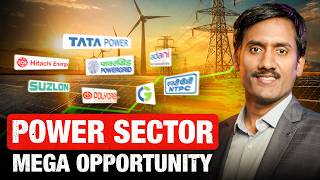
In this short YouTube monologue, Ganesh Komma argues that India’s power sector is entering a massive, silent infrastructure super‑cycle. He cites a current installed capacity of about 450 GW, with roughly 40 % already renewable, and projects a capital requirement of roughly 20.5 trillion INR over the next four‑to‑five years. While many investors focus on power generation, Komma stresses that the real upside lies in the downstream ecosystem—transmission, distribution, and equipment such as transformers, cables, substations, EPC contracts, and smart meters. He describes this as a “multiplier effect” where every megawatt of renewable capacity demands extensive grid expansion, making it mandatory rather than optional. Komma invites viewers to a live deep‑dive session (7:30 pm) where he will break down segment‑wise beneficiaries, order‑book dynamics, margin expansion, and risks, urging serious beginners to comment “power” to receive the session link.
Chapters
India power sector theme Is it the next structural super cycle or is it a cyclical play? India is quietly entering one of the biggest structural shifts in infrastructure and hardly anyone is talking about it properly. 450 gigawatts installed capacity 4, 40% already renewable. 20.5 trillion investment is expected in the next four to five years. This is not a small theme, this is a capital cycle. But here is the real question. Are investors looking at the right segment? Because power sector is not just power generation. There is a broader things for it. Generation is involved, transmission is involved, distribution and equipment. And the real alpha may not be where most people think transmission. Capital expenditure alone is around 37,000 crores. Renewable energy cannot sit idle. Solar and wind need grid connectivity. And grid expansion is no more optional. It is pure mandatory thing. And every one megawatt installed needs transformers, it needs cables and it needs substations irrespective of the other requirement. And a lot of EPC contracts, smart meters also come into the pipeline. So this I call it as a multiplier effect. Now do you call this as a super cycle? Maybe, but only if you understand where capital expenditure is flowing, where order books are building, where margins are expanding, you will understand in detail. So what we are going to do today evening there is a special live session which we will be doing where we will break down the entire ecosystem segment, wise beneficiaries, where structural compounding may sit and what are all the risks involved. Also we will be discussing. So if you are a complete beginner and if you are serious and if you want to learn about sectoral investing, this is not a session you should miss. And now what I want you to do, comment power in the comment section below so that I'll give the live session link which you can join so that we can decode together whether this is the next five to eight years structure, opportunity or not. Or is it just a hype? So I want you to watch out for the long form video which is going to come today evening at 7.30pm So I want you to comment below as power.