ADHD Focus: How to Beat Shiny Object Syndrome in Your Business with Sarah Snyder
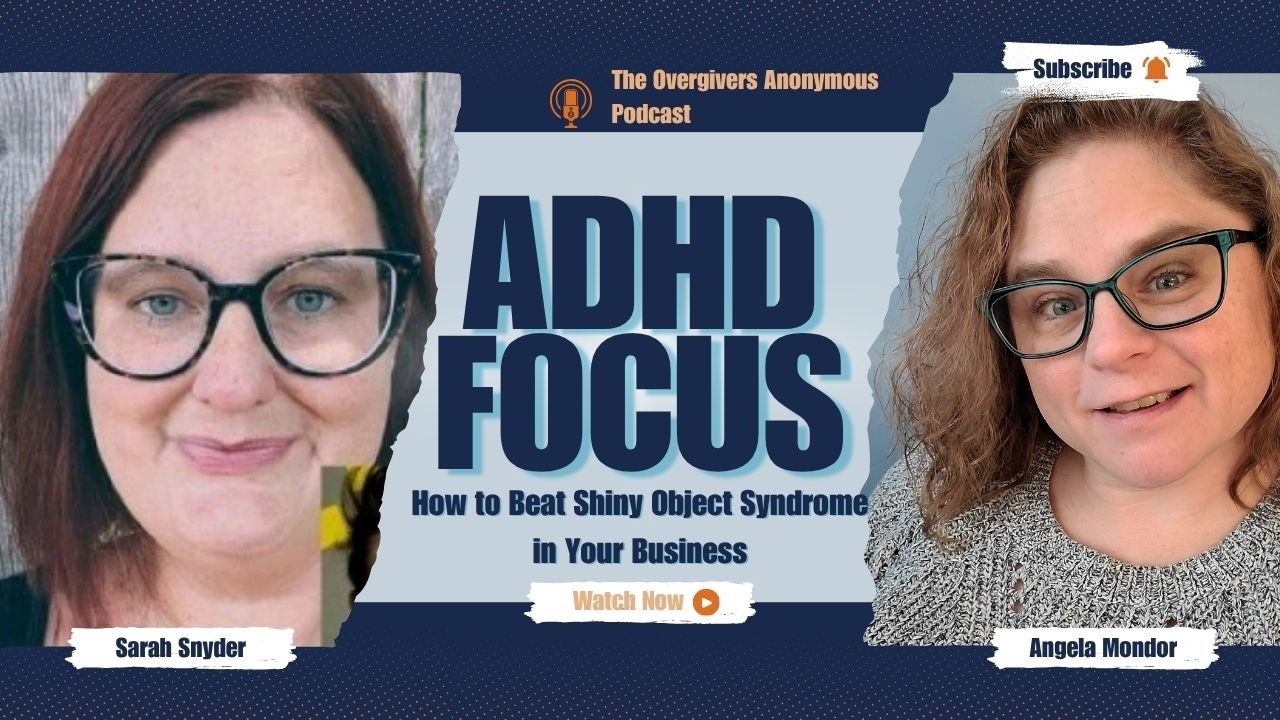
Sarah Snyder, host of Adulting with ADHD, talks about shiny-object syndrome in business and how ADHD affects focus. She shares concrete tactics like the Circle of Control, sun exposure for mood, and using post-its to manage object permanence, plus why late diagnosis can be both a relief and complicated.
Chapters
Welcome to the Overgivers Anonymous Podcast. My name is Angela Mondor, also known as the Geeky Girl. In this podcast, we're gonna be talking about some amazing things to help you get over overgiving. Hi, and welcome to this episode of the Overgivers Anonymous Podcast. My name is Angela Mondor, and I'm also known as the Geeky Girl. I am here with Sarah Snyder, and I can't wait to introduce you to her. She was part of our, our Neurodiverse Business Summit recently, and here she is on the podcast to share some more of her knowledge and You know, her thoughts and things that have happened to her in business as somebody with ADHD. It's very exciting. So Sarah Snyder is a former journalist who was diagnosed with ADHD in her mid-30s, and she's now working as a parent navigating life with neurodivergence. She's the host of the Adulting with ADHD podcast, where she brings together her own lived experiences and conversations with others who are here to explore the realities of ADHD that often don't get get talked about. Sara's work shines a light on the everyday challenges and wins of living with ADHD, making her a relatable and inspiring voice in the community. And thank you for being here, Sara.
Thank you, Angela. I'm happy to be here.
I am super excited because I, I love it when we shine the light on things nobody talks about.
Me too. It's my favorite.
You know what's interesting to me, I think, is that We're starting to get to a point as a society where we're not hiding these silly little things anymore. And now we're literally shining the light and going, hey, guess what? I'm a little crazy and fun. You want to come be crazy and fun with me?
Yeah, I think it's a beautiful thing to acknowledge it instead of just, you know, let's all push it down and all try to work the same way. I think it's beautiful.
So as an ADHD person who also has a podcast, how is podcasting treating you? It's wonderful.
It pushes all those right buttons that keeps me engaged. And when it doesn't, because the novelty always does wear off, even if you love it. I do know of one person who once said, you know, I never, never, never got tired of it. But I am not afraid or ashamed. I'm not ashamed to tell you that, you know, there are moments of lulls where the shininess kind of wears off and you have to have a plan for those days too. And so, I think the sweet spot is staying engaged enough that you don't get distracted. And then having like fallback, your core habits, your core deliverables so that, you know, you might go extra one time and have a super extra episode, but you're always going to have that consistent quality. So it hits all the right buttons for me, for sure.
Fair enough. And of course, because we have all this beautiful flavor as neurodivergent humans, what's been the biggest curveball for you with your podcast?
This one was surprising to me. The biggest curveball was I've been doing this probably more than 7 8 years at this point, on and off. And I was so raw and unfiltered in the beginning, which is great, that's what you want. But I really took for granted that rawness, that, you know, in my own bubble online I had this community and I felt so, you know, at home and accepted. And I just took that everywhere, and I took for granted not all spaces are that welcoming. And I think the most surprising thing for me was I had been in this environment, and it doesn't really matter which environment it was, but, you know, I became acute— it was multiple environments at once. And I became acutely aware that this is a beautiful thing that needs to be protected and nurtured, and you can't take it for granted. And I just remember I, I had a really bad bout of anxiety, um, and I was going— I was kind of spiraling out, and it hit me like, I'm so raw and I'm out there, and what, you know— and I got over it, right? But it made me appreciate that there is a bravery to exist openly that you can't take for granted, and we have to protect.
100%. I think it's interesting that you brought that up because I think about that too sometimes when— because I surround myself with so many people who are neurodivergent, like, it's literally like my life mission. I want to help everybody who's struggling, and I'm bringing in all the people who are in this world of neurodivergence. And then I come across this neurotypical person and I go, is that how people think?
It's like, why are you so rigid?
Yes.
You take for granted that that's their normal. And yes, weird role reversal. Yeah, it is.
It totally is. Because I mean, I lived corporately before I owned this business, right? So I was surrounded by what we're typically supposed to be and how we're supposed to act and how we're supposed to behave. I was never really good at it. Which is why I'm not there now, right? Yeah. But I think you're right. We, we get to a point where we're building these communities and we're surrounding with the people who we know are gonna support us and be there for us. And then when we step outside that, that's when we realize, oh, it does require some bravery to be this crazy, right? Or crazy is a fun way, right? Like—
Yeah, be this authentic.
It does.
You know, I always took that for granted. People always said, you're so real, you're so genuine. And I took it for granted. I didn't even consider it a gift. It's like, are you kidding me? I would give anything to give this away. You know? I don't like it at times. I mean, I've come to accept it, but there is this vulnerability And I can't turn it on or off. It's not a choice for me. I have to just, you know, harness it and protect it.
Well, I think the interesting thing is when you said, you know, people had told you how honest and how real you are, and how it was almost like, well, this is just who I am. And when we can have people around us that can say, hey, here's your gift, right? Like you said, it didn't seem like a gift to you. But when we have people around us that go, hello, here's your gift, it's helpful for us because we just think, oh, that's just how we should be, right?
Yeah. For example, my daughter, she has this very profound sensitivity that I share with her, and I love it, right? I love it. But there's also this part of me that's— it's very prolonged and it's very profound. And it's like, okay, how can we you know, get this to a point where she can still act on these things, but it's not all-consuming, all-distracting. I can't function because it's so unfair. And as a grown-up, I do it too. And it's, it's a gift to care that much. But how do you care that much and stay functional and protect yourself, I guess?
And it's hard, especially with kids, because they don't understand the wider scope of the world. And I feel the same way. I'm very— I, I'm empathetic, right? Like a very high empathy scale. Like, I walk into a room and I can tell exactly who needs the attention. And like, I could just pick up on all of that, right?
Yeah.
One of the things that I was taught years ago that is valuable— that it's been valuable to me and of course to my clients as well, but maybe you guys will like it too— it's this concept of the circle of control. Okay?
Yeah.
So we have the circle of control, the things that we can control, and then the circle of influence, which is just a little bit bigger, the things that we can influence. And then there's the circle of concern. And I have found that I need to spend as much time as possible in my circle of control so that I can still, I can still look at the concerns and go, yeah, that concerns me, but all I can do is this. And then the circle of influence is like writing letters to your politicians or whatever, you know, like going to marches, whatever, like those kinds of things.
Mm-hmm.
Like I can influence things. But when I start to look at it and I go, I'm looking at a concern, there's nothing I can do about it. I can still feel sad or upset about the people, But is there anything I can influence? No, there's nothing I can control and I have to let it go. You know what I mean?
Like, it's very helpful. I'm gonna borrow that. Yeah. Her brain's on fire right now and there's a lot of themes I think she's not ready for, but she totally is. I just, this whole generation blows me up.
Yeah. Well, there's so much going on in the world right now. There's so much, there's so much to be upset about and it's hard, especially when we feel so much. Right. That, yeah, to look out and go, how can I?
Yeah.
Yeah. So do you, when you're thinking about like marketing your podcast, do you use this piece in your marketing, your injustice feeling and your empathy and those kinds of things?
Yes, actually, I'm glad you mentioned that because that is something that this is probably my third iteration of being a business owner. I, I go in and out of corporate and then I go do my own thing. So in the first two iterations, I was very strictly business, but in this third iteration, Very mission-driven. You know, I'm being very selective in not only who I work with, but the messages we're putting out there. It's definitely a new level of marketing I haven't done before. So that's exciting and shiny, as we talked about.
And so because you're bringing in those things, are you having a harder time with shiny object syndrome with the marketing?
No, I think it's enhanced it because I kind of, I have so much practice with the fundamentals. That really it's just been unlearning a lot, unlearning a lot of brand preferences, for example, and just like just listening to myself more. But I always had the tools there. So the tools carry me and the tools actually give me more freedom to, to try on different things and be authentic.
So how does shiny object syndrome show up in your marketing then? Like, how does that impact the way that you have been marketing? Now or in the past? Yeah.
So I originally got started in SEO, so I'm going to use that as an example. SEO is search engine optimization. And, you know, it was every single week it seemed— well, we had a weather report we checked every morning to see what Google was up to. You know, algorithm chasing is what I'm getting at.
So, yes.
Yeah, it prepared me for this. It prepared me for modern day with the social media and the AI and all the platforms and everything being so fragmented. To me, there's a freedom to it, but it can be so terrifying if you don't live in this. I've always lived in it with the, you know, the uncertainty, and I always diversified my platforms anyway. So I was always trained not to put all my eggs in one basket, but it can be intimidating if you're new to marketing. It can be very intimidating to want to be. And honestly, these days you really do, you know, you do have to be everywhere until you figure out what sticks. And that's a hard thing to unlearn. As a marketer, I was always told, you know, really focus on where you shine. But today everything's so fragmented. I mean, how do you even know what's out there until you test and go out there?
Well, the other part I think is that we don't, you know, coming back to that concept of somebody else showing us our gifts, we don't really know what's working or not working unless we focus on it. And sometimes we can focus and become hyper-focused. And I'm like a stats person, like, we're, we play hockey up here in Canada, and I don't play, I watch, but I love the stats of the game. And I literally can go down rabbit holes of while I'm watching a game, I'm like, oh, his save percentage is blah, blah, blah. So I can do the same thing with my stats, but in my business on SEO and all those kinds of things. But to me, I feel like that removes me further out of being a human. And I struggle with trying to not be as Corporate, right, when it comes to showing up?
Yeah, yeah, that's exactly it. And so what I tell people is, yeah, there's so many tools out there, just find one or two that you're really into and just really hone those. But the AI thing, I mean, that— it's so hard to focus on your work when there's all these shiny tools telling you, here's how you can automate the work, and that's work. And then it becomes this endless cycle. But if you can find a way to wrap your brain around it and find a way to make it work for you, I think it does. It's— I really— that is the one thing I do like about it. There is a lot to be criticized, and I have a lot of mixed feelings about the bigger picture, but I love the fact that it's freeing people to be more human. That's, that's a good thing if you use it correctly, right?
Yeah. Well, and so, like, talking about tools, and you're right, there are like a billion and a million and 100,000 more every single day, right? And we're constantly getting emails about, hey, this tool, that tool, have you tried this? These people, these AI agents, and I mean, I just got one this morning, right? How do you manage those kinds of thoughts of, oh, am I using the right tool or should I switch?
Yeah, that's a good question. It's the same thing when I'm in a grocery store or I'm getting a pop-up ad. I kind of ask myself, is this something I would have bought anyway if I hadn't been served this ad? And that's easy to say because I'm a marketer, but I really do. I think anyone who Who is trying to decide, am I being a shiny object person or is this solving a real need? I think that would be the first step. And then also to sleep on it. I can't tell you how many unfortunate software purchases I have made impulsively, but if you just sleep on it and not commit to the annual even until you know you're going to use this thing for life and then commit to annual, that's really helped me a lot because especially towards the end of the year, you get all those great great deals, it can be so enticing. And, you know, it hits all those buttons as an ADHDer too. And impulse buying is a huge deal for some of us. And so I would look out for that kind of stuff especially.
100%. I'm the opposite. I kind of have, I kind of have a marketer brain in terms of like the— I can't, the words aren't coming to me at the moment, but subliminal messaging, right?
Yes.
Like, for example, I walked into my dentist's office one day and they had a brand new fountain in there. And I'm like, that's not going to make me feel any less happy about being here, just so you know. And they're like, oh, nobody else has noticed that. I'm like, yeah, but I did, right? It's like when I watch videos and I— it's something across my newsfeed, I'm like, okay, what's the catch? What's happening? And I'm like, I'm the one that's digging through. And it's like, I scroll to the bottom of the page. How much is it first? Okay, what's included?
Exactly. Get to the meat of it. Yeah, for sure.
Which is interesting for me because marketing Then changes the way I do things, right? Because I'm looking at it from my perspective when I should be looking at it from my client's perspective. And I think that can be difficult in that whole, you know, getting that shiny object syndrome in terms of here's what I'm focusing on as opposed to focusing on what they want me to focus on. Do you know what I mean? Yeah.
And that's a huge part of the relationship actually. That's such a good point is, and I think where it's turning now is it used to be the marketer telling the client what to do, but Nowadays, it's really a partnership. It really is. There's so much that the business institutional knowledge, the business has industry knowledge, the business has that it really does take a partnership. You can't really, you know, one hand washes the other for sure.
Yes.
Yeah.
So when you're on social media and you're engaging with your clients or potential clients, those kinds of things, building your audience, do you find yourself squirreling inside those platforms while you're there?
Yes, and it's— talk about shiny object. That's one of the huge pitfalls, and I might need to crowdsource a solution for this because traditionally I wasn't a social person. Traditionally I was more podcasting, website content, but now of course because of the fragmentation, I'm learning social. And so that was the first thing is like you get on social and immediately you're responding to your feed, you're wondering why you didn't think of this, you're wondering, oh, I need to do this, and all of a sudden you have a whole to-do list, but you haven't done the thing you logged in for to do. So yeah.
Right.
Yeah. Third-party tools help a lot in that situation. It keeps you from logging in, but then it also keeps you from staying updated inside. And there is a benefit to being in there with your community. You want to see what they're putting out there, but you don't want to get sucked away with it. That's such a good example of shiny objects.
And for me, I think on social media, I have more of the object permanence problem with it, where I'm like, oh, I haven't logged into Facebook, so I have no idea that I got— oh geez, look, I got 5 messages from people. Darn it.
That's how we reconnected. We reconnected because I could not access my Facebook page for like a year. I had a whole hacking incident, and I finally get in there and I found your message, and it was complete object permanence. Totally. Like, well, I can't get in, so this page doesn't exist. There's no way people are messaging me. You know, that's a big one. That's a huge one with tasks. Like, there's so many tasks that— I mean, and I'm sure you have a lot of guidance on this with your clients, but like, how do you fight object permanence when the task is in the place where you always have it, but you have to see it? Your eyes can't glaze over it. You know, like, I don't know what that word is called. It seems similar to object permanence where you're so used to seeing something that you just like stop seeing it.
Just that blindness.
Yes. Yeah, that's always been a huge challenge on my end. So that's another reason I think this AI stuff, there's a lot of potential there to help people, you know, if you know what you're doing. I'm still figuring it out.
Well, you know what I mean? I think that because our brains are so fun, And they're always changing, and we're always looking for the new latest whatever anyway. Like, the brain always wants the fun stuff.
Yeah.
The things that work for us for a long period of time, that whole blindness thing comes in because we're like, we get numb to it almost because we're doing the same thing over and over again. And then we have to sort of change it up so that we add some excitement to it so we remember it exists. I'll tell you what, I mean, Post-it notes are awesome. Even in my— even in the planner, like, I mean, I have laid out all the things I have to get done, but I still have Post-it notes. In here too. And you know what, one of the things that I do, especially if I'm having a particularly squirrely moment/day or whatever, is I'll take the sticky note and stick it to my monitor.
Yeah, how do you ignore something when it's like right there in your line of sight?
Like in my way.
Line of sight. Yeah, for sure, for sure.
Yeah, but that doesn't work for everybody, right?
So that, that's a good example. I, I heard the term— have you ever heard the term re-sparkelize?
So yeah.
Yep. So that's, that's a term I've heard for that. And I, I was so happy when I heard that term because it finally gave me permission because I had never had a word for this phenomenon. And so like, I do have planners that I rotate out. Like it's not even the same planner. And I don't know, I could never explain my system to someone else, which I know is a big business no-no. I could never explain it to anyone, but you know, it works for me. So I'm just going to ride with it. You know, until I, until I have a team and then I have to figure it out, which is also a business no-no. I hear, I hear you're supposed to, you know, document all that stuff right away.
Well, I mean, document's important. I think that this is where we kind of get caught up in the whole SOPs and processes and procedures and those kinds of things. We're, we're never going to run a corporate business that way. Like, I don't think that's ever going to be the thing. And the way that, the way that it works in my world is, is like, here's what the task requires. So this is what we have to start with, and here's what the end result needs to be. And whatever we have to do in the middle, we have to do in the middle. I'm going to do it this way, you might do it a different way, and you might do it another way. But here's the steps I take, and then go, right? Like, so when I get— when I've done that with Julia, I'm like, here's what— here's how I do it. And then she goes, oh, I'd rather do it this way. Fine, as long as we get to the end, it doesn't matter, right?
Yeah.
Because I love to work with neurodivergent people, and I don't want to put them in a box that I don't want to be in.
Yeah, I love that. And it feels so freeing just hearing you, you speak like that. And because I've been, I've been going through so much learning materials lately and you, you can really get stuck in the shoulds, you know, you can, well, wasn't that your talk? Stop shoulding yourself. Wasn't that you? Yeah. Yeah.
Stop shoulding on yourself. Yeah.
Yeah. I could definitely hear myself just now shoulding on myself as I'm speaking, like, oh, I know you're not supposed to do this, but this is how I do it. But you're right. I mean, I'm the same way and I have like 2 or 3 ways to do a single task. And depending on how I feel that way, I'll launch into it different. That's awesome.
Well, one of the things that I, that my, my concussion has taught me, I literally have, you know, notes from my physiotherapist, and it's, you can start a task and walk away from it and come back to it later. And that's never, it's never been positive for me to do that because then I leave things undone and I forget that, right? The whole object permanence piece. But I've had no choice because I can't do things from start to finish right now. I have to still rest in between. And I've learned now that I can rest in between, right? Like, even I was making— I was making a— it was like a dip for my friends that were coming over for book club, and I was able to like chop some vegetables, and then I was like, okay, now I'm too tired, I gotta go sit down. But then I could go back and chop the other vegetables later, whereas before my brain would be like, no, you can't, you have to finish everything exactly. And so I think it's important, the whole re-sparklize, which you said, right?
Yeah.
Sometimes we're not re-sparklizing, sometimes we're just doing it because we have to survive, but, but it is still changing the process of what we do. And I think that being— being not okay with it, honoring that is different, right? Knowing that it's time for a change, I just want to change the way I do it.
Yeah, it's almost like there's a mental strain happening and you're allowed to put that strain down, put it down, walk away from it, come back. Like lifting weights, you don't keep lifting. You put it down, you walk away.
Yeah, I often say give yourself some grace.
Yeah, yeah, for sure.
What has been the hardest thing about marketing this time around compared to the other times you've done?
I would say the uncertainty and really just needing to stay authentic, follow your North Star. Oh, my favorite. This is something I tell myself all the time. Don't look down. If you look down and you start crunching numbers and looking at the odds, well, for freelancers, I mean, the world is your oyster, but you know, like the job market numbers, I try not to look at that. I try not to think about my age, that kind of— there's a lot of messages that can get in there that you really gotta, you gotta be very careful about. And they can really take you away from the focus. And if you look down and you focus on How many odds you're defying and how hard this is. You know, definitely you get those moments. Definitely don't deny yourself those moments. But I would say don't look down so much that you know you're not able to move forward because there is this paralysis I've experienced. If you know just this this fear of failure, fear of disappointing yourself or others, you know that that could be very challenging. And it also in my experience it's it starts with a thought and. Making sure you're being careful about the kind of thoughts you're giving your energy to.
I talk about that as in terms of stories, the stories I tell myself, the stories that other people put on me, right? It's not— they're not my stories, but people who have, you know, typically when you're growing up, right, your family members or teachers have put stories on you, right? And for me, the power has been in taking back the power of those stories and changing them.
Yeah, I like—
So like, you know, a teacher who once said that, you know, I was so unfocused and that I was a daydreamer, blah, blah, blah. And I take the power back from that by going, yeah, I did daydream, but I was also paying attention and I needed to think about more than just your voice in order for me to assimilate your information into my brain, right? So no, I wasn't useless in my daydreaming. I used that. That was a tool. Congratulations, little Angela. Like, you were amazing to be able to find out that you needed to do that, right?
Yeah. And that's my hope for all of us, is to be able to reclaim that. That would be incredible. And I see my daughter doing it, and it just— it's so healing to see the next generation do that. For example, I, you know, she was approaching a challenge that I would have approached differently. And instead of her just being like, yes, Mom, or whatever, I mean, she full-on was like, well, I'm doing it this way because, you know, blah, blah, blah, blah, blah, point A, point B. And I'm sitting here thinking, you know, maybe she is listening, you know? But my wish is for us as adults to have that naturally as well. And I feel like it's in all of us. And, you know, we grow out of it and it gets taught out of us. But to get back to ourselves, that's what I want for all of us.
Yeah, it's pretty awesome. How old is your daughter?
She's 8.
8.
Oh.
Brilliant. I have to tell you, mine are much older.
Yeah?
Mine are like 25 and 30. So, but you know what's really cool is that raising these amazing human beings to stand up for themselves, to acknowledge that the things that they need and to just be unapologetically asking for it. The problem is, is that when they get into their teenage and older ages, they rebel against us. And it's like, but I didn't teach you that to go against me.
Exactly where I'm at. I'm already there. And she's so mature for her age. And I tell my husband all the time, it's like, I mean, I— it's like I created a monster, but I don't want it to stop. I just— this is— it's very hard in the short term to maintain that when you were the one who created it, like the situation. Yes. Yeah.
But trust, trust that it will serve her well. You know, my adult children have used their skills well in the world. It just sucked that they used them against me too.
Yes, 100%. I feel that. Feel that. Deeply feel that. We're actually, we're having that happening right now and I regret nothing.
Right. Yes. Yeah, for sure. Well, it's interesting when we look back and see the difference between like, you and I were both diagnosed in our 30s.
Yeah.
And so I don't know how you feel about this, but I have some theories, so I want to test them on you.
Sure. Yeah.
Because I was diagnosed in my 30s and we didn't really talk about these kinds of things as I was growing up, I had to come up with my own coping mechanisms to make it through life. Your daughter, I don't know if your daughter has been diagnosed or not, or if they're also neurodivergent, but my oldest was diagnosed, she was about, I wanna say she was 15 or something, something like that.
Mm-hmm.
I can't remember exactly, but it doesn't matter. She was in high school and I noticed there's a difference And it could just be her own neurodivergence, I don't know. But I think being diagnosed later was helpful because I had to come up with coping mechanisms, as opposed to being diagnosed younger when you get more— I don't know, what do you think?
Yes. Well, I'm glad you brought that up because I spent a lot of time thinking about, and I had the experience of being pregnant after I knew I had ADHD. And so I was able to compare and contrast. And what I have come up My conclusion is, no matter who you are, you're going to eventually, for some reason, not be able to rely on your meds or whatever pain modality you're using. And so eventually, you're going to have to fall on some backups. And I am so grateful that during my pregnancy, I set up what they call scaffolding because now that I'm middle-aged, I mean, there's certain medicines I can't take that I got all these interactions. I've got an aging body that I have to think about. And so knowing that if I can't access a certain medicine, maybe my insurance won't cover it, what have you, you know, knowing even if it's not right, knowing it's going to be okay, knowing I have these backup things. And the most common ones of all the guests I interview, it wouldn't surprise you, a lot of it is outdoor time, being around grass, getting physical activity, all those things your mama taught you. And all those things that are so hard to do day after day, but if you can break them up one, you know, one little habit at a time and build up on them, they're very effective in my experience. I mean, nothing's going to replace stimulants, which are the first line of medication, but if it's not for you or you can't do it, there is hope. There's lots of other things out there. So yeah, it's—
It's one of the things that I love doing because I live in Canada, so we do get this awful winter thing that happens. And so getting outside is a little more challenging simply because it's just too much work to get all dressed to go outside. Like, it just really is.
Oh my goodness.
But one of the things that I love doing is I'll go out on my back deck and just look at the sun, right? And somebody had, somebody had coined this phrase, and forever it will be in my soul. They called it sunflowering.
Oh, I love that. And it's like you're—
You just go to the sun, you close your eyes and just let it wash over top of you. And I'm like, oh yeah, I'm sunflowering. See you later.
I started sunflowering, not knowing it was sunflowering, about a year and a half, a couple years ago. It really was life-changing. I mean, as someone who always avoided the sun because my, my skin will just burn looking at the sun, I'll burn. Yeah, you're nodding.
Me too.
She's nodding. So I've always been afraid of the sun and I have eczema and all that good stuff. But, but I do go out there now and it is like night and day. It really does turn my brain on. Someone told me like 15 minutes is the number. I don't know, but I just started doing it and it's incredible.
Yeah.
If you can, if your weather allows you to. We don't get a lot of snow here, mostly just heat, but the heat's finally going down. So I get out there every chance I get. And this is someone— I call it my delicate flower problems. I have so many delicate flower problems like dehydration, sunburn, eczema. This is someone who spent most of my life hiding inside and now I hang out in my backyard. But, you know, I I'm in a climate where you can do that. It's not necessarily possible year-round. But do you— have you ever used those sun lamps?
Are those legit?
Have you ever tried one?
I have not used one, but I've thought about them a lot. I definitely know that sun's important to me. And even though, like, I burn crazy, like, same as you, I think that it's important for us to look at what are our needs and what are the, you know, what are the Threats based on what's going on, right?
Yes.
Um, so for example, like, every— in this, my husband's a teacher, so he's off all summer and those kinds of things. So every Friday we do what we call Freedom Fridays. We pick a beach and we go to the beach. Now I have a tent that I bring that is UV resistant, and so I set up this UV resistant tent on the beach. I don't— it turns out most people are doing that these days, so I'm not as crazy as I think I am, you know. And so it's just this open front tent. It does have a zipper, but we open it and we put our lounge chairs inside there, and I don't have to worry about being burnt by still being out in the sun. I can go and wade in the water, swim in the water, and then come back underneath there. I don't have to like scour the side of the, you know, the beach looking for the shady spot to hide in. So I think that when we're looking at how can we look after ourselves and we think, here's the pitfalls of what that is, even You know, wanting to be outside in the wintertime, it's important for me to have the right equipment, right? I need to have boots that fit me properly, and I need to have ski pants so that I can go touch trees, right, in the middle of the winter. We got snowshoes. Find the things that work for you, and even if they don't work all the time, they'll work sometimes.
Absolutely. And what that looks like for me on my back patio, because we are in Texas, And I live near open water, is mosquitoes. So when you go out to my backyard, there's always a jar, there's always sunblock and mosquito spray, always. And I buy it in multiples because that will ruin— nothing will ruin my good time quicker than a mosquito bite. Like, it just drives me up the wall. And I'm allergic to mosquitoes.
Yeah, I literally take like allergy meds like all summer long because if I get bit, they just turn into these great big huge welts on my skin. Me too.
And I take— I'm allergic to everything in the air. I take allergy medicine all year round. And there's some— there's something where I live where it's like the highest concentration of the bad pollen in our, in our country. And I live there.
Nice.
Yeah, I know. I hit the lottery. But no, it's good though. You, you find ways. You, you find your ways around it.
And I heard that if you eat honey that is generated in your neighborhood, it's supposed to help us. With this. So yeah.
And if you go to a health food store, some of them, like local, local people will manufacture them with the certain strain of what you're trying to beat. Those aren't scientific terms.
No, not at all. But you know what? I mean, it's not going to hurt me.
That's right. Nobody cares.
I'm not going to die from honey.
Exactly. True, true. Yes.
I think that's the other thing too. I think that sometimes we rely I mean, I'm all about science. My daughter's an environmental biologist. Like, science is a big deal in our house.
Nice.
But also, I think that sometimes there's some other things that are like, this isn't necessarily completely vetted by all these sci blah blah blahs, but it helps somebody else because they said it did. And whether it helped them because it was placebo or not, you look at the risk factor of it and say, you know, Is this going to harm me by taking it?
Well, no.
Then I can give it a try for 3 months and see if it helps, right? Like, we're not taking chances on those things, I don't think.
Yeah. And it can be overblown. Yeah, for sure. Sometimes you just kind of have to go on a leap. And if it works, who cares? Who cares why?
Right?
Yeah.
I mean, like, some people will say that drinking green tea is better for them than having coffee because they say that the coffee hits their system and disappears right away, whereas with the green tea, you know, like, I don't know. I mean, if it works for you, do it, you know. And I'm also not really a big fan of making sure everybody's been diagnosed. If somebody feels like they, they fit with a neurodivergent profile, then why— who are you to tell them that they should see a doctor to make it that way? Like, if that's what's working for them, then let them be.
I've never had a huge problem with it either. I do see a lot of times diagnoses Like getting in the way of accessing certain things, or, you know, and that's certainly a problem. But just someone identifying, self-identifying, I mean, yeah, it's never bothered me, but it seems like it's a pretty hot-button topic.
Well, and I know that there's barriers to being diagnosed too. Specifically, I know that Americans have a harder time with those barriers, especially now, than, than we do. There's still, there's still a financial barrier to some degree in Canada because our psychological stuff isn't covered the same way that our other health stuff is covered. We're fighting, but whatever. So there are barriers to getting the diagnosis, but also on the flip side, you're right, having a diagnosis can also hinder you with your opportunities with choices in careers and stuff. I know that there's certain diagnoses that will keep you from taking certain jobs. And I mean, I think that's all bullshit too, but—
Yeah, well, I guess what I was referring to in certain situations, you kind of need that diagnosis to access certain resources. So it's like, yes, you know, and, and that, that's heartbreaking to witness, is, you know, for the people who do want to have it and, and not, you know, they're not being able to have it. Is it— we gotta—
It's such a double-edged sword, eh?
It is, right? Yeah, exactly, exactly.
Oh my gosh, I have loved chatting with you today though. I know we, we zoomed around at a bunch of topics, you know, we But I think that's part of who we are, and it was just nice to kind of zip around and be present with you.
Thank you, Angela. Me too. This was wonderful.
So where would you like people to follow you?
So you can go to adultingwithadhd.com, and there you'll see my podcast. And if you're— you have any marketing questions, any follow-ups from the summit, you can reach me through filling out that contact form.
Excellent. And we'll also put that in the show notes so everybody has a link to click on as well. So, okay. Awesome. Thank you so much for being with me today.
Thank you.
Have a great one. You too. Thank you so much for listening to the Overgivers Anonymous podcast. Your support means the world to me. You can find show notes for this episode and other goodies at overgiversanonymous.ca. And if you enjoyed this episode or you enjoy the podcast in general, why not join us in the Overgivers Anonymous Facebook group where you can connect with overgivers from all over the world? Head on over to geekygirl.ca/group.
More from Angela

How to Leave Your Business for 3 Months (Without the Guilt) with Candy Messer

Neurodivergent Entrepreneurship: Building a Business Without Burnout with Alyece Smith




Stop Being Your Own Worst Critic: Mindset Tips for Success with Sandee Sgarlata

ADHD & Success: Navigating Neurodivergence in the Workplace with Sarah Olaifa


