Neurodivergent Business: Breaking Free From Neurotypical Norms with Pippa Parfait
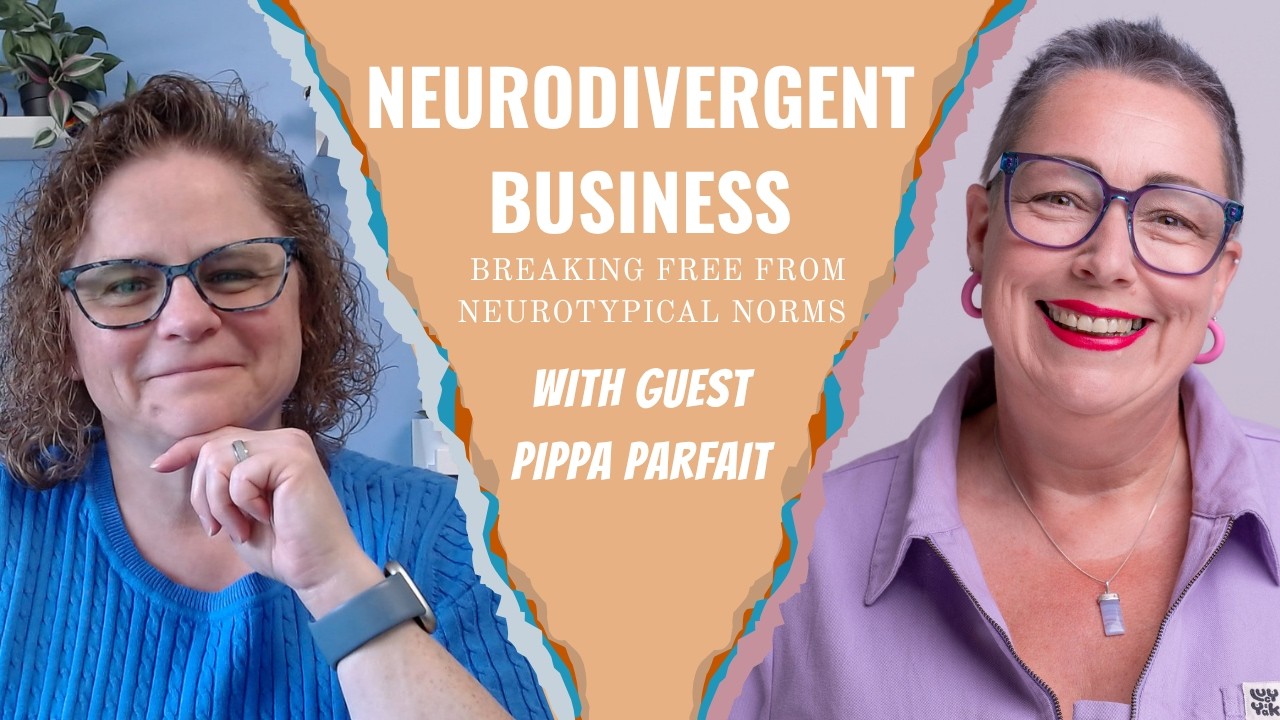
In this Overgivers Anonymous podcast episode, host Angela Mondor (the Geeky Girl) interviews neurodivergent coach and co‑founder of Disobedient Business Co., Pippa Parfait. The conversation explores how ADHD and autism shape the experience of entrepreneurship and work. They critique the neurotypical default that underlies concepts like "executive function" and "demand avoidance," revealing how these terms carry hidden expectations of self‑governance that clash with neurodivergent wiring. Both guests share personal stories of late diagnosis, the challenges of corporate environments, and the appeal of autonomy in running one’s own business. Practical coping strategies are discussed, including body‑doubling, coaching, community support, experimental trial‑and‑error approaches, and designing tools that are "backwardly compatible" for neurotypical users. They also identify a new, high‑impact stressor: cognitive overload from constant decision‑making and AI‑driven toolchains, which amplifies the "friction trifecta" of choosing, committing, and doing. Throughout, the tone remains conversational, candid, and supportive, emphasizing that neurodivergent diversity is a strength and that tailored support structures can turn perceived dysfunction into entrepreneurial advantage.
Chapters
Welcome to the Overgivers Anonymous podcast. My name is Angela Mondor, also known as the Geeky Girl. In this podcast, we're gonna be talking about some amazing things to help you get over overgiving. Hi, and welcome to this episode of the Overgivers Anonymous podcast. My name is Angela Mondor, and I'm also known as the Geeky Girl. I have a fabulous guest for us today. Their name is Peppa Parfait, and they are a coach and mentor for ADHD and autistic business owners and co-founder of Disobedient Business Co. I love the name. With their eldest sprout, Lucy. After escaping corporate and public sector leadership boxes, she retrained as a coach and is late diagnosed ADHD. Pippa blends strategy, systems, and geekery with vibes. She creates a supportive space to rebuild self-trust and map practical next steps. Fair warning, if she says lovingly, a big dose of real talk is coming. Coaching is open and capacity mindful and clear. priorities, simple plans, and kind accountability that fits real life. I am super glad to see you here today. How are you?
I am so well, and it is always achingly awkward listening to someone sum you up in a kind of Pippa is this, Pippa is that, and I'm always kind of like halfway down the line between super impressed and going, oh yeah, that's quite cool, that's me, and wanting to crawl under a stone somewhere, which feels quite balanced, right?
I feel the same way when people are introducing me. Isn't that funny? And even when you have to introduce yourself, you're like, oh, I don't want to totally like go that way.
Oh, right. Just like this, this being out there in the world as a so-called business owner, and I'm using the, uh, speech marks advisedly now, is a whole, right, it's a whole thing. Yeah.
All this uncomfortableness that we are told that we have to get more comfortable with.
Yes. Yeah, don't even get me started. That's a whole podcast episode of itself, isn't it?
It is. It totally is. Yes.
But yes, I am very well, thank you, to answer your question. And I am very happy to be here.
Fantastic. You know, I think about some of the things that we talked about pre-recording, right? And sort of our topic and what we want to discuss. And I always find executive function— honestly, I really hate the words. I also, in my own personal neurodivergence, I have trouble with things like sunset and sunrise and descending and ascending. Like, those are some issues that I have in with my own flavor, right? And so executive dysfunction, and I think about it and I go, it just doesn't— I know what it means, but it just doesn't land right in the brain, right?
It's really weird, isn't it? And I could only— I mean, in this precise moment The thing that really comes to mind is that everything that we shape in the world is shaped from a largely neurotypical lens, right? And so there is a default that says, right, this is, this is the way XYZ goes, right? And it's, and it comes from a neurotypical standpoint. And sure, you know, it's a bit like the prevalence of whiteness as being such a, you know, challenging thing and, and all this kind of shit. Oh, there's— I've dropped the S-bomb already. Wow, we're barely a couple of minutes in. Sorry, folks.
I'm all in.
That's very much a sorry, not sorry, folks, but there we are. Where I was going with that was that it kind of— whilst I realize there's a lot of scientific stuff that lives in this arena of executive function, executive dysfunction, and so on, and it's talking about a certain part of your brain and so on and so forth, just what's hidden under it is very much that whole executive function therefore means, like the subtext is you should be able to show up at will in life or in business or work or wherever, and you should be able to do the thing that is being required of you or that is you are requiring of yourself. And that might be challenging occasionally, but you certainly should be able to do it. And if it's difficult, you should just be able to try harder. And so the subtext around executive function or I'm struggling with my executive function or executive dysfunction, all that kind of stuff. It's just got this slightly— I'm gonna throw a clever word out there now and go pernicious. Google it, pals. Google it. Like icky under the surface kind of vibe that says you should be able to because that's the norm. And that's why it bothers me so much, because it's, it's, it's a loaded phrase that just gets chucked about half the time by people that don't really understand what it means. And definitely all of the time with that kind of subtext going on.
Yeah, and it's— and I like the way that you talked about how we're looking at things, and typically we do, through that neurotypical lens. It's what we've been taught to see the world through typically. And for those of us who are coming into it later in life, like, I mean, I didn't get into any diagnoses until my 30s. When you start to come into that concept and you're seeing things from a totally different lens, it takes a really long time for you to sort of Oh, so I've been looking at the life this way, but really you're looking at it this way, and this is how I really want to look at it. There's a lot of sort of adjustment and change that happens.
Completely. I mean, I'm just from so many conversations I've had with folks that are ADHD, myself included. And that's that moment that whether they were diagnosed, you know, maybe not as kids, but whether it was 20s, 30s, 40s, 50s, whatever it is. And obviously there's been a lot of late diagnosed, particularly, you know, humans that menstruate, et cetera. In terms of, you know, being passed over because high masking and so on. And just having that realization that, oh, oh, not everybody has a constant conversation in their head all day. And I can't, I was writing something for, I can't even tell you what purpose this morning. I've had a day of writing today where I said something along the lines of, I don't, I wouldn't know how to explain it to a neurotypical person. Every single person that has ADHD or experiences this, whether they have ADHD or not, will know what I mean by an inner, and it's not even a monologue. It's not a monologue, it's definitely a dialogue. There's more than one person in there. And I'm not trying to make light of that in terms of mental health and so on and so forth, but there's a constant conversation between me, myself, and I around how I'm going to handle something or what something's going on. And no matter how focused I am on a person or a task, there's never not a conversation. And then you, you realize that having gone through, I mean, what, 45, 46 years in my case, That's not everybody's experience. I had no reason to think that that wasn't everybody's experience when I was growing up. It's like, surely this is what happened. Didn't even occur to me to question that's not what's happening to everybody else.
100%. I remember it was even just like, I don't know, multiple years ago, but I can't give you, 'cause time is fun. But I was, I had said to my husband, I said like, what do you think about when you go to sleep? And he goes, nothing. I was like, what do you mean nothing? It's just like black and quiet. He goes, yeah. I went, what the hell does that feel like?
Yeah. I mean, there's even the, what do you think about while you're asleep? And whilst I realize when you're actually asleep, you're dreaming, but there is that— well, I mean, I certainly get this a lot. We are definitely going off on a tangent now, but bear with me while I go down the rabbit hole. I have that kind of like in-between sleep and awake thing, which is fairly frequent, to be honest with you. where my brain speeds up, doesn't slow down. It kind of goes, right, how many more things can we think about now?
Why?
Why is it doing that? Anyway. Yeah, yeah.
But it is interesting, first of all, to think about how our brains are different and how they function different. And even still, your brain will function slightly different than mine anyway, regardless of diagnosis, right? Uh, part of, part of the beauty of, of our neurodiverse piece is that we are diverse. It's not the same. It's not a copy and paste. And even neurotypicals, they're going to be a little different between each other as well. We are, in fact, unique, which is fantastic.
I think that's so unbelievably important because there are a lot of folks within the community that have kind of jumped on a little bit like in the coaching community, where if you go back a year or two, it became the big buzzword to start throwing the words trauma-informed around without really even understanding what trauma-informed meant, let alone actually being So this last bit of time, very much supporting the ADHD community, particularly ADHD. People haven't jumped on the autism and other neurodivergences bandwagon quite so much. And I think the trouble is a lot of them are just talking about it as this great big, you know, in exactly the same way as at one point in time it was just talking about all people homogeneously. Now we're just talking about all folks with ADHD homogeneously or all neurodivergent folks homogeneously. And the— how many times can I say the word homogeneously? And, you know, there is massive diversity within that. I completely agree with you. And also, I think it's really important not to then feed into that narrative that gets thrown out there. And God help her— actually, no, you know what, not God help her, God love her. My mother started there in terms of her understanding of— because, you know, she's 79, love her, my mum— started there in terms of her understanding of this stuff over the last few years, because I am neurodivergent, so is my eldest, so is my youngest. You know, we're, we're, we're all of us, we're all in a fun, you know, a fun, flavorful pot. Um, and that is that it doesn't feed into that whole, well, we're all just neurodiverse, aren't we? We're all, we're all different. And so therefore, what's the point of having all of these labels, etc.? And I don't want to get up on my, um, on my box and start ranting because you'll really set me off. Um, but I think it's really important to distinguish between everybody's a bit different, 100% on board with that. And then there are folks whose brains function in a way that is significantly different to change the way that they can interact with society and work and business and life. That gives many, many benefits, but also many, many disabling factors to it as well.
100% true. And, and I think that the, the flavor, right? So, you know, somebody who has ADHD obviously is going to have different challenges and, and, and, you know, joys as well than somebody who has ADHD or somebody who's autistic or somebody who is, you know, um, like I have my brother-in-laws, for example, they're autistic. They are, um, very autistic to the point where they, you know, cannot live on their own and that kind of thing. So they have a different level of need in terms of what is happening for them.
Mm-hmm.
So the spectrum of where we are, I think it's important for us to understand, especially if we're newly diagnosed. And I think diagnosed diagnosis is, for me, it was, it was great. But, um, the concept of here's all the things that you might be experiencing, and maybe these things could shine a light on some of the things that are happening in your life, um, but you don't have to have them all to get the diagnosis or to be part of our community. You don't have to relate to them all. And maybe you have an offshoot of this one that, you know, uh, maybe blends with this one over here, that kind of thing. Um, you're right, uh, The neurotypical, they're not going to have the same sort of flavors.
No. And what I do love though, well, I mean, a sidebar to that is that, you know, that's one of the reasons why when they go, you know, and obviously I'm sure the diagnosis process is slightly different from country to country and so on. So, um, we certainly have a massive challenge over here in the UK with them getting pursuing diagnosis at the moment because the National Health Service is so unbelievably overwhelmed with the quantity of people seeking a diagnosis. So that's become quite challenging. But I think there's a, there's a really good reason behind the, the diagnosis criteria, and I definitely don't want to get into the details because it's not without its challenges and it's not massively inclusive. Yeah, don't even get me started.
Yes.
But it helps distinguish between that whole, I identify with some of these things. Well, yeah, because if I went out there onto social media this afternoon, for example, and just posted a, these are some of the, you know, these are 20 of the things that, that come up for me fairly frequently as an autistic and ADHD human being. Um, undoubtedly every single neurotypical that read it would be like, oh yeah, that's me, and that bit's me as well. And the difference is it does not disable their life. It's a weird quirk or a weird, oh, look at me and my time, you know, and I've got no track of time and so on and so forth. It's the culmination of a lot of things together that are actually hampering how you get the best out of the world. in the way that many disadvantages do, whatever they are in life. Um, the other thing I wanted to say was around self-diagnosis being 100% valid, and couldn't agree more, you know, with what you were saying about, um, folks self-identifying, etc. And if pursuing a diagnosis is supportive for you, great, do it. Um, and if it isn't, that does not mean that you are any bit less valid than the next person.
100%. And there are reasons why people won't— that feel that they cannot or won't— don't want to get a diagnosis. And I Honor that. Um, there are times when people might say, oh, I might be such and such, whatever it is, but if I get that diagnosis, it's going to impact my livelihood, or it's going to impact my weight, my, you know, quality of life. Like, honor that for yourself. And you're right, just because you don't get a, you know, an actual, like, medical diagnosis with the air quotes again, um, doesn't mean to say that you're any less welcome in the community.
Yeah, there are no nightclubs where you have to turn up at the door and bring your ADHD certificate with you, so you're okay.
Thank God for that.
Can you imagine? Yes, I'm here. No, I will not know what time I'm supposed to leave, but I've arrived and I've— I am— and I'm eligible.
And besides, I have to remember one more card.
Yeah. Oh yeah, forget it. No, look, I mean, I don't even know where it is. It'll be lost in the, uh, the graveyard that is my Google Drive somewhere, I'm sure. Right.
I'm sure I took a picture of it somewhere.
Yeah. How many screenshots on my phone of things that I think I'll remember one day? Tell me about it.
Yeah. Oh my gosh. I mean, you know, like, I think that when we talk about like our executive function specifically in terms of like the overall things that we go through, one of the things that you had talked about was this demand avoidance. And I thought those 2 words together are so powerful. We end up putting so much on our plates And we're spinning. So many of them are spinning, some of them are falling, they're toppling. And, and, you know, there is that concept of a lot of people think, oh, I'm lazy, or I'm, you know, I'm no good. And it isn't. I never see it that way personally. I always think your plates are just too full. They're all spinning like crazy right now. And, you know, that concept of demand avoidance to me brings that to light. It's like, I don't have energy for any of that stuff, so I'm just gonna— Avoid it.
Yeah, demand avoidance is a really interesting thing. Now, I will preface what I'm about to say— I probably should have prefaced everything that I'm about to say with that— I'm not a therapist. I'm not a qualified psychologist. I could not do an autism or an ADHD assessment if you gave me all the money in the world because I am not qualified legally or otherwise to do those. However, demand avoidance in the context of pathological demand avoidance is actually a profile within an autism diagnosis, that when you are assessed for autism, uh, the person that does your assessment will identify whether or not you have a tendency or a profile of pathological demand avoidance. So that's slightly different from demand avoidance as to how it shows up potentially in the broad spectrum of humans, and particularly in the spectrum of, um, ADHD and related, um, humans. And I, and I qualify that because demand avoidance is getting a lot more attention these days, as it should. It's a, it's a real challenge for, for a lot of us. Um, and I think if I was a fairly, you know, if I was an autistic person who had a strong what's referred to as PDA, uh, and not public display of affection, uh, pathological demand avoidance profile, um, I'd be getting a bit pissed at the moment about the way demand avoidance is being kind of thrown out a bit. Now, I don't have And I feel quite fortunate because I know how challenging it can be to have a huge demand avoidance challenge. But she says, if I think back to my childhood, which of course when you go through diagnosis and all the rest of it, it's all about that whole, you know, can you see this thread all the way through your life rather than it being something that you've latterly identified with as an adult? And I look back to this belligerent, won't be told what to do, stubborn, you know, very happy to do it if it was my decision, but you can fuck right off if you think you're gonna tell me to do it human being. Now, in a 7-year-old, that's demand avoidance. And yeah, okay, you could put that down to just belligerence. I mean, maybe I was just a bit of an ass as a 7-year-old, which is fair enough. I was. However, the demand avoidance piece is the, the best way I can describe it to, to people. And I'm hoping that people listening to this think to themselves, oh my God, that happens to me all the time. Well, this is the language around it. You could be sitting there, just imagine like a teenager in their bedroom, and they're sitting there thinking, you know what, the next thing I'm gonna do once I've finished with this video, you know, probably a video game, whatever, I'm gonna sort this shithole out because my room just looks like, you know, it looks like I've been robbed. Mum walks in 2 minutes later and goes, You're gonna sort this room out with that tone. And there is nothing that could make, that could compel that teenager next to clear that room. Now, sure, we can totally put that down to stubbornness and belligerence and so on and so forth. But the context here is the, I was absolutely planning to do it 2 minutes ago. It was top of my list. I want to do it. It's really annoying me. It's really frustrating. I am motivated to do it. I might even have the executive function to do it. But now someone else has said, you must do that, i.e., in some way, shape, or form has made a demand of me. And it doesn't have to be couched in actual demand words. It could be around the tone or the language that they've chosen to use as a road. It isn't necessarily do that now. That doesn't necessarily, you know, yes, that's definitely a demand. Nothing could move them. Nothing. There is nothing. And it's not belligerence. It is a brain wiring thing that goes, no. Because it comes— so, and this is where we get into a territory where I'm probably not qualified to comment, but I will just from an observational point of view, which is it feels to me like it's linked to that lack of, um, something else that's incredibly important to neurodivergent folks, which is autonomy. We are driven by design and desire and self-direction in a funny kind of way, because in other ways we have no self-direction whatsoever. We're a disaster.
Another topic.
But we're driven by this desperate need, right, for autonomy and sacred sovereignty and all this kind of stuff. And the minute someone strips that away, the fuck no or fuck you switch goes off in your brain and you won't do it.
And it's literally like my adult daughter, like, we'll be finishing supper or something and I'll say, hey, could you empty and fill the dishwasher? And she'll look at me and go, I was literally gonna do it, but now that you've said it, I really just don't want to. Yeah, like, she's actually— it's— she's gotten to a point where she can verbalize that now.
She can articulate it. Amazing. Yeah. And it's, it's really— go on.
I was just gonna say, it's— it is something that I have recognized in myself as well. Mostly, mostly, I, I've mostly worked on myself, right? But like, when I was a kid, like, at my, my wedding speech, my dad said You know, there's one thing that you need to know about Angela. If Angela wants to do something, you can't stop her. If Angela doesn't want to do something, you can't make her. Like, you can't start her. So it's interesting to hear that piece and go, oh, click, click, click, click.
Right. I couldn't agree more. And where it's so, um, and I think why demand avoidance is one of the things that's one of the most challenging things, to be fair, um, for me, it's right up there with rejection sensitivity dysphoria in terms of challenging for challenges for people.
Yes.
Whereas executive function is this kind of big blurry kind of amorphous blob phrase that gets thrown around. And it— I think the reason for that is the minute you are working with other people or living with other people, and remember, and actually bear in mind, this also applies to demands that you make of yourself. So that's a real headfuck, which is that whole when you make a demand of yourself and then you, your brain goes, well, no, because it's been turned into a must now. It's not an option. I've lost my autonomy. And even though it was you that was setting the— it's a hole, but I can't, you know, I didn't, I didn't decide this stuff. Don't blame me, folks. Blame, I don't know, chemistry or physics or whatever it is. But it's the, it's the cognitive dissonance around sitting in that teenager's body on the edge of that bed who was gaming before mum walked in and feeling the need, the desire, the, the motivation, the wish, and all the rest of it to do these things and being unable to, you know. And I can almost, I can almost visualize it as a person who is inside of a box, and they definitely, they were, they were getting out. They knew the way out, the door was there, uh, and then suddenly the door disappeared. And so now they're inside the box banging on all the walls. No lack of a desire It's getting a bit dark, isn't it? No lack of a desire to get out of the box anymore, but they just can't get out of the box because someone flicked a switch and the door went away.
And you know what, it may get dark, but it's, it's the truth, damn it. Right.
Yeah, yeah, yeah, completely agree.
There is that, there is that, you know, when you get into that place and I, and it's so good that it's, I can visualize being stuck in this box and banging around inside it. Like, Sometimes you're in that box and you think, okay, I just need to find a way to find a door. And then you get exhausted by just looking for the door. And by the time you do find a way out, a hatch, a hole in the ground, or however you manage to get out of this damn box, you get to the other side and go, well, now I'm just too exhausted to do it. You've lost all motivation.
Yeah. So, the thing that was on the other side of the box that you decided that you were going to do is no longer within your gift. It's just not going to happen. Yeah, I get it.
Yeah, I used all my spoons to dig out, you know.
Yeah, literally. Yeah, you were digging a hole with your actual spoon. And I think one of the things, you know, one of the things that, I mean, Lucy and I navigate this all the time. So Lucy's both my, as you mentioned in my intro, both my eldest sprog and business partner in the Disobedient Business Co. And we navigate the whole demand avoidance thing constantly. I mean, all day long, let alone a week long. Because imagine a scenario where one business partner says to the other business partner, you're gonna get that thing done today. Now, everything about how you couch the language around, are you gonna get that thing done, whether it's necessary, whether it's important, urgent, and all of those other fun words, everything about the way they put that to me or I put that to them will change the outcome of that conversation. In terms of being able to find language that helps the person that is being asked something of to understand the importance of something or the urgency of something without it feeling like a demand, without it feeling like it's being required of them so that they retain their autonomy, but finding a way that they retain their autonomy and the shit still gets done. Right.
Which is a real challenge. Yeah, 100%. It is. And, you know, I think that These things that we're talking about today, these specific pieces of this fantastic puzzle are some of the reasons why A, we really need to be entrepreneurs. But B, why we're good at being entrepreneurs.
100%.
In your bio, you talked about your corporate shitstorm. I had one of my own, right? Getting locked into these roles or ways. I mean, I've had great experiences in the corporate world. Ones that allowed me to use my entrepreneurial mind that I didn't know that's what it was at the time, right? But the funny thing is in that role, when I left that company, they replaced me with 3 people.
Yeah, always the way.
They wouldn't give me a raise but they replaced me with 3 people. That's, you know, but in the other positions where I felt cornered, where it was literally like, if you step outside this box, like I literally have a friend who works in a hospital and his chair was loose. It was just one little screw was loose on his chair and he couldn't He, he had to call maintenance or whatever. Well, one day he just got pissed off and tightened the screw. Well, maintenance showed up and ran his ass up a flagpole because he took his job away from him. Like, I couldn't live in those situations. I couldn't, I couldn't thrive there. Wow.
I mean, that's quite the example. Okay. Yeah, no, I've never come across anything quite that. I mean, I can understand that everybody's very defensive at the moment of everything, aren't they? Nature of the way the world is currently. Yeah, yeah, yeah.
But, you know, I think that's why, you know, this, this concept of needing to be autonomous, needing to be in charge of where we're going with the work that we're doing, the life that we create, you know, the love that we enjoy and all those kinds of things, needing that autonomy, I think, is one of the, the biggest pieces of all this. And how do you do that?
Yeah.
When, when even you or me, myself and I are fighting over what's the best thing to get done.
Well, that, yeah. And on the one hand, I completely agree. Entrepreneurship, running your own business, whatever language lands for you, is a fantastic option for folks with a neurodivergent brain. It gives us the way to self-govern, have that autonomy, work within our values, which you quite often are not in a position to be able to do in a corporate environment. A lot of us, and I'm gonna be a little bit homogenous here, but I, I find a very high percentage of people that are neurodivergent have an incredibly highly tuned sense of fairness and justice, quite often around social justice and so on and so forth as well. And so the idea of working for the so-called man is— does not sit well with a lot of us. All of that is really positive, a great— we're quick thinkers often, we're very insightful, highly creative. etc., etc. All of those things are amazing. And also, all of the challenges that we had when we were in a corporate environment in terms of being able to move things through are actually 10 times worse when you work for yourself.
Right.
Because at the very least, much as it pains me to say this, because you couldn't pay me enough money to go back into corporate if you tried, but much as it pains me to say it, it gave you structure. It gave you demands that were built into your contract. And so therefore, you sucked them up from day one, demand avoidance or not. And you did the deliverables, and you lived within the structure, and you went to the endless meetings that were a complete waste of time, and you did all of those things. And whilst you may not have been thriving in many ways, and like I said, I'm not saying this as a pitch to go back into corporate by any stretch of the imagination, but unless you can bring some kind of accountability, support structure, and the things that were potentially the good parts of being in around, or the good parts, but they needed tweaking, and you didn't have the scope to be able to tweak them because you weren't the CEO and the organization organization and so on, then it's actually 10 times harder to run a business, truth be told, because there is no framework, there is no structure, there is no expectation, there is no make you do that thing even when your brain wasn't playing. And it's very hard to tread either side of that, you know, it's like splinters in the fanny moment where you're treading either side of a fence trying to decide whether It was better that you had that stuff and you pushed through because you got things done versus it's better that you didn't have those things. You don't push through, you don't work against your energy and all the rest of it, but shit didn't happen. And so it's like trying to find some kind of middle ground between those things perched on the top of the fence. I've taken this metaphor a bit too far now, but it'll do. To get the best of those things rather than, rather than sadly where a lot of people end up is the worst of those things. They lose all the so-called positive bits out of corporate, come in, start their own business, and they neither get the freedom nor the structure. And as a result, they get like the worst bit and the worst bit. So, yeah.
So, and I think that what you said about support, I think is really important. And support can come in so many different ways. There are so many different ways that you can get support. Some people thrive on You know, being coached. And some people thrived on being in a community. Some people want a bit of a mix of those two. I personally think, like, I rely on my executive assistant, Julia. You guys know, like, if you've ever had, you know, any communication with Geeky Girl, she's in there. And, you know, so there's times when I'll go, Julia, I just need to get this done. Do you have some time to sit with me? And literally we body double together. She's also neurodivergent, so we know that works for us. Finding the people that can support you in what you're doing, I think, is really important.
Mm-hmm.
And you've got to move through some things, try a few things out. And just because one flavor of coaching didn't work for you, there are so many different people that are offering coaching and so many different ways that coaching occurs that, you know, it's not just because coaching didn't work, but maybe it wasn't the right person, wasn't the right coach for you or the right kind of setup.
Yeah, I completely agree. And it's a bit like anybody that's ever been in therapy of any sort, you know, for any reason. Very, very rarely do you go along and find the right therapist on the first go, you know, or the right anything. You go jeans shopping, you don't go and find the right brand unless you're somebody that's been buying the same jeans for years and years and years and years and years. You don't go jeans shopping and find exactly the right jeans on the first attempt. You end up going through a few shops. So I think there's, I think there's that. I think, I think there's a piece that I haven't mentioned yet. Um, which particularly in 2026, so if we're thinking about kind of like where we are in the world right now, and obviously, yes, this is set amongst a backdrop of the world being quite literally on fire, um, which is disturbing, uh, to say the least. There's a big piece, I think, around cognitive load for neurodivergent folks at the moment. I think there is for all people, but I feel like this last bit of time The work and the support for neurodivergent folks, particularly that are also then navigating their own business. But to be honest with you, I could probably say the same for people that are navigating an employment situation, is around— is much less around the throwing around of executive function and things like that, all of which are super important and are, you know, part and parcel of the life that we live.
Yes.
And I think there's a there's a couple of things going on. One is there's just too much coming at us. And I don't necessarily mean that in a social media is scary and, you know, especially with things that are going on in the world literally in this week or the week of recording, folks, who knows when you're listening to this. And but around that kind of, I mean, AI is a good example. I'm not gonna come out in favor of AI or not in favor of AI. That's not the point of me mentioning it. But a lot of people would advocate for AI being incredibly supportive for neurodivergent folks, and in many ways I'm sure it is. Um, but in many ways it's also added to the cognitive load because we have to feed the beast. There's— I don't know whether this is a phrase that will traverse the pond or not, but there's a lovely phrase that gets thrown around over here, which is the tail is wagging the dog. And it's that whole like you're, you're managing a system whereby, you know, um, the dog is doing all the work and the tail is just sitting there going, yeah, great. And I feel like AI, to a certain extent, unless you're using it in a very particular way or you have a very particular so-called custom GPT or whatever it is that other people are using, that actually, if you were to look at how much time it's saving you, it's actually adding to your cognitive load. Because what it's doing all day long is go make a decision. You give it some information, it goes make a decision. You give it some more information, make a decision. And I think we are really struggling with the fact that every single day we are going decision, decision, decision, decision, decision, change this, go in that direction. And particularly for ADHD folks, but I think this would apply to autism as well, is that all day long, therefore, the sands are shifting. Yeah, new stuff is happening, new impetus.
And you're right. One of the things that Typically, you know, in our neurodivergent brains, a lot of us like the new, they like the flashy. I mean, there was nothing better than the beginning of a school year and I got all brand new scribblers and, you know, paper and pens and all that kind of stuff.
Yeah.
And then they got dirty and messy and then they weren't so fun anymore. But, you know, so the fact that we have so many choices, there's so many ways that we can take this. We're hearing from this person to do it this way and we're hearing it from that person to do it this way. And there's all that constant right, in our ears and our minds and our brains. And you're right, there's a lot of decisions to make. And one thing that I focused on is stick with something, even if it sucks for a little while. Stick with it even though it sucks, to be able to get to, you know, commit to whatever it is, right? Put a timeline on it so that you know where your end in mind is, so that you can get to the end and go, did I like it or didn't I like it? Did it work or didn't it work? So you can actually Look at it and see what were, what were the good and bad pieces of this, and should I continue, as opposed to doing it for a few days and going, well, somebody else said to do this, so I'm going to change my mind, right? I believe in taking all of those really great ideas that other people have and having a place for them. So you have a repository of ideas that you could look at later. But you're right, there are so many things hitting us and so many ideas that we can make changes. And I can see how that can be really, really difficult. if you are flipping with the wind or changing with the wind, I suppose, right?
Yeah, I mean, I think, and this is a decision in and of itself, this irony is not lost on me, but I feel like there's a decision to be made that goes, how long am I gonna try a certain something? Because on the one hand, I'm with you, and on the other hand, I'd offer a slightly tangential, fun word, thought process, which is I'm a big fan of running what I would refer to as running the experiment, which is kind of what you were saying anyway. Around, okay, so there's this thing, I need to try and find a way to make this thing easier. Okay, so I've been talking to my coach or reading a book or whatever, here's a thing I could try. And I always come at these things from the point of, A, run the experiment. What is the thing that you're trying to do? B, decide how long you're going to run the experiment for. It may be totally valid to run it for 24 hours and then can it? Depends on the experiment, right?
Right.
It might be totally valid to run it for 3 months and then can it? We'll see. If it works, great, try it again. Might not work next time because our brains are not that straightforward. We do not have a, I have found the solution to this thing and I'm gonna do that thing again and again and again. Amen. That's absolutely fine. That thing will solve that problem every single time. It won't. You'll probably need a slightly different approach times 20 for that thing.
Exactly.
So put that in your tool bag if you've got some positive results from that experiment. And then pull it out and try it. And if it doesn't work in that particular occasion, back in the tool bag, try something else. So on the one hand, I agree with the sticking power, and— but I think there's a, there's a hold things lightly vibe for me that goes, if you're running the experiment, don't be too attached to the experiment because we're running it with the viewpoint of I do not give a fuck whether it fails or succeeds. I simply want to see what the results are. And if the results are fairly positive, I'll put it in one of the pockets in the tool bag because it could be useful again another day. If the results weren't very positive, I might try it another day because actually on another day it might actually be successful.
Yeah, 100%. And you're right about the length of the experiment. I mean, if you decide, oh, I'm going to commit to this thing for 3 months, but a month and a half in you're burnt out from it, then don't keep going, right? I mean, there's some caveats in there, right?
Yeah, as always, context and nuance is everything, right?
Right, right. Yeah, yeah, yeah. Well, and like you said, there is something that fits today that's working really well, might not work in 2 months or 3 months or, you know, the next time around, whatever. Um, but I think that the lessons that we learn through the pieces, we get to learn more about how, how we function in the world and what things typically have gone well before, and we can sort of tweak it at that point. But you're right, I mean, we're not Generally, here we go with the general piece, right? We're not machines. We don't like to do things the same way over and over again. We like to have a little bit of fun and nuance.
Yeah, actually, you know what, I thought of something that I meant to say to you earlier, and I don't even know if I can insert this back into the conversation because it refers to something we were talking about ages and ages ago around, you know, designing for neurodivergent folks and things being neurodivergent friendly in, you know, and that being such a massive thing because obviously we're all very different and And so on. But I think one of the things that's incredibly important, and I'm going to attempt this to sound profound, but it's probably not going to sound profound at all. I'm always only ever accidentally profound, never intentionally. And that is that when you design things with neurodivergent brains in mind, whether that be a course, a program, a tool, a mastermind, whatever, or anything, you know, a checklist to doing the shopping on the fridge, whatever, it will be, to use a Microsoft off of the '80s term, backwardly compatible for neurotypical folks. That's because being accessible means it being inclusive for everybody. Whereas when you design with neurotypical brains in mind, you are being exclusive and you are making the assumption that everybody functions in a very similar way. That is the neurotypical way. So one of the things I love about, literally love about my job so much is that we can design things, programs and tools or otherwise for neurodivergent folks, but they're as likely to be as beneficial for neurotypical folks as they are for anybody. not our community is for the most part, but, you know, well, you're welcome if you are neurotypical. But because of the fact that they are, and I love the phrase backwardly compatible because it kind of, you know, you know what it infers. I'm not going to spell it out, folks, but they are backwardly compatible from neurodivergent design to neurotypical use. And that means accessibility is brilliant for everybody.
Right, exactly. No, and I think you're right. I mean, it's one of the things that I love the most is being able to say, Where are you right now? What is it that you're trying to accomplish? Okay, let's try to design something that's going to work with you where you are using your current systems, using your current habits, right? Let's not try to basically throw the baby out with the bathwater and start over.
Yes.
Like, let's start where we are. Like, let's make, let's make some inroads to, you know.
Yes.
I'll use an example I used with my kid recently. It's like, okay, normally like you take off your clothes and you put them on the floor over here. How about we put the laundry basket on that place on the floor? I don't care if it doesn't look aesthetically pleasing, but let's put the laundry basket there.
It's definitely worth a try.
It's been mostly okay. There's been a couple pieces beside it, you know.
Cool. Okay. Yeah.
But that's the thing, right? You, you try it, you see, hey, there, here's a, here's a situation, here's a little tweak that we're gonna make, and it's based on where we're currently at. And then let's see what we need to do to move it closer to the goal.
Yeah, yeah, definitely.
Yeah, it works. It works with all things. And I think that, you know, what we learn in our businesses, I think that, you know, running our own businesses, it's one of our biggest self-help things that we've ever done in our lifetime.
Yeah, I mean, I've been divorced twice, moved house more times than I care to mention, and I've dealt with the odd bereavement. And I would say running your business is harder than all of those things.
Agreed, agreed.
Tenfold.
So in terms of, you know, the things that you're talking about with, you know, the executive dysfunction in the world and all the things that are going on, is there anything that you didn't hit on that you want us to know about maybe how this is impacting us the most right now?
Yeah, well, I think that comes back to what I was saying around, you know, the impact of AI, the impact of constant decision-making. this, you know, we've all been playing with executive dysfunction and demand avoidance and rejection sensitivity dysphoria and all those kind of things that are the well-worn, well-understood, you know, or relatively well-understood aspects of working with a neurodivergent brain. But it feels like at the moment the biggest challenge for people is this cognitive load, you know, it's that cognitive overwhelm. And it's not just I'm overwhelmed as in look at my to-do list, it's too big. It's just a permanent state of brainpower overwhelm in the sense that there's too many stimulus. There's too many constant changing of decisions. I've been talking a lot recently about what I refer to as the friction trifecta, which is this notion of a kind of the triangle of choosing or deciding, committing, and then doing that lives in any kind of task, you know, start, middle, finish type situation. And that so much of the narrative in neurodivergent circles is around the doing. We're all, you know, so many people are just talking about the whole, we've got a doing problem. Sure. But too many of us are not getting beyond the deciding and the committing corners of the triangle. And we're not even getting to the doing corners because we decided, but then, oh, this happened and then that tangent and then that tangent or that input, or we went over to ChatGPT and we tried to do this, or, you know, we've just, we've just migrated to Claude. So you went over to Claude and so on. And then you committed, but then did you? Because you kind of decided. And so you end up kind of traveling backwards and forwards between that corner of the triangle and never quite making it over to the doing. But yet we talk about that as executive dysfunction or lack of follow-through and all the rest of it, whereas actually plenty of us are bouncing around in those first 2 points and we're never actually getting over to the last point.
Yeah, I see that. I see that with everything that's going on. And like you said, so much that's happening on our planet.
Yeah, it's a fun week to be recording this podcast, Angela. It's a fun week.
You know what? It has been a fun week for at least a year and a half now.
For 5 years. Yeah. Kind of since COVID really. Yeah.
Yeah. Oh, yes. Well, that's an entirely different— yeah, but totally.
Yeah.
Yeah.
Hasn't it just?
It has.
Yes. When are we going to be living in precedented times, for God's sake? I've had enough with all this living in unprecedented times. Give it a rest. How can it still be unprecedented? We've done it already now.
True story. This is why my husband and I are retiring to the woods. Too right.
I'm gonna dance around a fire in my pants. That's what I'm gonna do. Beautiful.
It has been amazing having you on the podcast. Truly, I, I could sit here and just spitball with you forever. So thank you so much for being here, for your take, for your knowledge, sharing with us your ideas. I think that there's gonna be some people who really get some different takes on maybe what they've been thinking previously, and there's going to be some great value that comes out of this. And I'm so appreciative that you're here today.
Oh, I'm so grateful to have been here and to have given you my take. Nobody's ever accused me having a take before. That's exciting.
I love it. Uh, I hope you have an amazing day. Hopefully the week does better for you, and I look forward to talking to all of you next time. Thanks so much and have a great day. Thank you so much for listening to the Overgivers Anonymous podcast. Your support means the world to me. You can find You can find the show notes for this episode and other goodies at overgiversanonymous.ca. And if you enjoyed this episode or you enjoy the podcast in general, why not join us in the Overgivers Anonymous Facebook group where you can connect with overgivers from all over the world? Head on over to geekygirl.ca/group.
More from Angela

How to Leave Your Business for 3 Months (Without the Guilt) with Candy Messer

Neurodivergent Entrepreneurship: Building a Business Without Burnout with Alyece Smith




Stop Being Your Own Worst Critic: Mindset Tips for Success with Sandee Sgarlata

ADHD & Success: Navigating Neurodivergence in the Workplace with Sarah Olaifa


