Unlocking Neurodivergent-Friendly Workplaces: Expert Tips
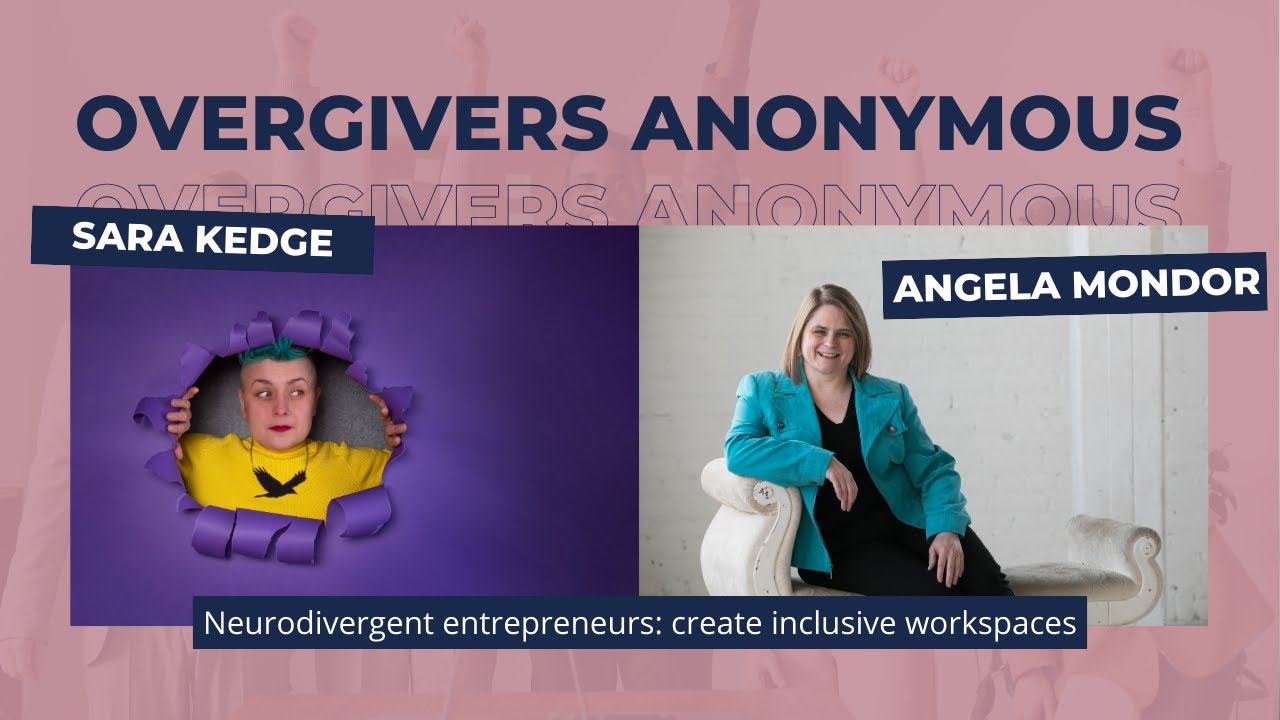
Sarah Ketch, a DEI strategist, talks with Angela Mondor about why corporate systems burn out neurodivergent workers and entrepreneurs. She shares practical tools like body-doubling and breaking goals into tiny steps, and explains why standard business frameworks like SMART goals don't work for neurodivergent brains.
Chapters
Welcome to the Overgivers Anonymous podcast. My name is Angela Mondor, also known as the Geeky Girl. In this podcast, we're going to be talking about some amazing things to help you get over overgiving. Hi, and welcome to this episode of the Overgivers Anonymous podcast. I am super excited. I've had some fun getting to know Sarah here, so I can't wait until we can dive into a few things. But this is Sarah Ketch, and she works with corporate leaders to create inclusive, healthy, and more productive workplaces that work for everyone. A renowned DEI design thinking strategist, coach, and trainer, Sarah blends curiosity and playfulness with deep cross-functional knowledge. She prides herself on helping teams move out of stressful dysfunction to create human-focused workplaces and cultures where critical thinking and people are encouraged and valued. Sarah carries the collective experience of the neurodivergent community into the solutions she co-creates with, and with her clients. As the founder and curator of How to Entrepreneuro, we're going to talk about that, an online community supporting neurodivergent entrepreneurs. Sarah is constantly learning and hearing from the people she supports, most of whom have suffered burnout in the corporate and public sectors. You all have known how much I've burnt out in that place. Sarah's clients vary in reach from global to local across a range of industries, including academia and training institutions, public and third sector, technology, biomedical, and international development, Sarah co-creates bespoke solutions for each new client challenge, drawing on years of change management consultancy and her current role as a lecturer from the Business and Management Faculty at Oxford Brookes University. Sarah's commitment to delivering a playful, human-centered approach to transition and culture development makes her an outstanding and refreshingly unusual asset to her clients.
I really should have made that shorter, shouldn't I? It's all good.
It's all fun.
Basically, what I do is when I go into businesses, I help people learn how not to be assholes to each other. And we need that.
We really need that.
Yeah. We absolutely do. And it's one of those things where when, when I, when you'd say that in the difficult language or the corporate language, it's just like, it sounds really snazzy. But actually, I teach humans how to human with each Yes.
Right?
But nobody buys that. Nobody buys somebody who's gonna— because we all think we can human with each other.
Yes. Yeah. It's, it's the self-awareness. It's the reading the room. The pieces that we think should come— not should. I hate shoulding all of you people, but it's true. We think people should be able to get these things, but it is so clear to those of us who are neurodiverse how it's not normal. It's not Normal in neurotypical people. I don't know.
Well, and, and part of that is because, um, you have— most businesses have amazing human beings in them. And what they're doing is they're working within constraints and processes and systems that are designed to get things from A to B as efficiently as possible. That doesn't work for most humans, and it never has. So what you've got is you've got amazing humans trying to human in an imperfect and really difficultly designed institution.
Well, and I think that, you know, one of the things that, that we're, we're sort of gonna float around as we're talking today is the, the fact of building this inclusive space, right? To be inclusive as a business. For those of us who are neurodiverse, our businesses are inclusive because, hey, yeah, we need it to be, right? I think that what's interesting to me, and I know that you work with business owners who are neurodiverse as well on a smaller scale from corporate, is that we think, and I think this is what breaks most of us as neurodiverse entrepreneurs. And I think this is, this is my mission, and I, I think that you share it, is like, seriously, fuck corporate. Because what it's doing is it's telling us that we're no good because we don't fit their boxes. When in fact, the reason why we don't fit your boxes is because we have so many more things to offer than your box has space for.
And actually the box that's been designed, it doesn't, as I said, it doesn't work for human beings. The real tragedy is, is that when you have neurodivergent humans who get burnt out by corporate environments, they come out and go, I'm gonna go out on my own. I'm gonna design, I'm gonna create a business and I'm gonna have freedom. And they then design a business to the model of the thing that just burnt them out.
Yes.
And it makes no sense until you think and recognize that nobody tells you that there's another way.
Yes.
Throughout the whole of your schooling, your— we have college and then we have university, all of your years, there is this one model on how things work. And then you go into businesses. So nobody tells you that there's another way. Nobody tells you that you can be creative with your business and design it in a way that really works for you. And that's a tragedy.
Well, not only is it you can do it, but you need to. Like when we, when we look at everybody thinks, oh, I used to have a job and when I was at my job, I worked 8 hours a day. No, you didn't. You didn't work 8 hours a day. You had a lunch and girlfriend, you took more than your lunch break. If you smoked, you took a lot of smoke breaks, right? You got up to pee, you went and chatted with the little neighbor down, down the way, whatever. You didn't work 8 hours a day. So why are you busting your tail as an entrepreneur trying to work 8, 9, 10, in 12 hours. You do not need to be doing that. Your brain does not function well like that.
And some— I hear you. And also the experience of a lot of neurodivergent people is because we have been given the message since we, we've, we're very small, we've been given requests to modify, which is you're not okay. How your brain works isn't okay. You should just work harder, get better at it. So we have had this message that we, we have to try harder and we just Trying and trying and trying. So although the Karens of this world will have gone out for smoke breaks and walked down the hall and la la la la la, most neurodivergent people you'll find will be working extra hours. They'll be working twice as hard. They'll be doing over and above. They'll be volunteering for projects because they're trying to be good enough in a world and a business that is not designed to acknowledge. Their brilliance or to support them to deliver good.
Yeah, it's gross. And I feel it, I mean, to my core, because, like, we've all lived it, we've all experienced it, and maybe you've not been able to quantify it. I had a really great quantifying moment in my career when I left a business because I asked for a raise, God forbid. I asked for a raise and they were only gonna give me, I don't know, 3% or whatever over last year. And I said, but my job has changed a lot since then, blah, blah, blah. Now I left, they replaced me with 3 people.
Stop. So, so, so that even the 10% raise would have been a bargain. And this is one of the things that I don't— I struggle with in when I'm working with corporates, because quite often when I'm sitting doing training or I'm doing Needs analysis, the response that comes from management is, well, all of this reasonable adjustment stuff, it's really expensive. It costs a lot of money. It takes a lot of time. And I'm like, you're right. Now tell me how much it costs to replace an employee.
Yes.
Tell me how much it costs to advertise. Tell me how much it costs to get the job description, the interviewing, the checking. Tell me how much it costs for you to retrain a new employee. And then tell me a couple of thousand pounds or a couple of thousand dollars On a desk, a monitor, something. Tell me how that's more expensive.
Yeah. Or a room where you can go to where it's quiet and dark for a little while.
The, the number of neurodivergent people who, when they come out of the workplace and, or like the amount of time I spent in the toilet, I wasn't, didn't actually have a, a, a problem with peeing and pooing. I was just going in there to decompress and to hide and to just sometimes cry and just go, I need to stop.
I am so grateful I worked in IT because we had a server room I could go to. And we would literally hide in the server room. All of us neurodivergent IT people are like, er.
I mastered the art of wandering around the office with a piece of paper with a really concerned, purposeful look on my face. And nobody— so I just, I used to do laps of buildings just looking purposeful just because I needed some time to decompress. And not people.
Smart, smart. Yes. Well, and the, and the piece of paper also, when you get that look on your face and the piece of paper, they go, oh, I'm not, I'm not talking to her. I'm gonna let her go. Even, even if it's not because you need the time, but you just need to get from point A to point B in 2 minutes, not 10.
But it's also, it's really sad because it's not until you go through your neurodivergent awareness journey that you, and you start unpicking all of these adjustments that you make and these coping strategies that you go, Oh, what do you mean not everybody does this?
Right? Yeah. Well, and I, I would say I'm fortunate. I didn't get diagnosed until I was in my 30s. My oldest daughter did. She got diagnosed like 2 weeks after me, which was hilarious. But the difference between my journey and hers is interesting because I had to come up with coping, coping mechanisms for myself. I didn't know what I was doing, but I was creating these coping mechanisms. But when my daughter was diagnosed, she was in high school or junior high. I guess it was high school. But For her, we had to start— we started thinking differently. How can we, how can we adjust? How can we change? Blah, blah, blah. And I think it changed the way that she handles her own neurodiversity. It's a very interesting sort of dichotomy of how it came about, just because we were diagnosed similar at the same time, but a different sort of space and time in life, right?
I think that's amazing. I mean, that's amazing. I think one of the things that that I'm really grateful for is to have developed the language and the confidence to say, this is what my needs are. You have a choice. You either meet them or we don't engage with each other.
Yes. Boundaries are something that I am so passionate about. And, you know, people say, oh, I've set my boundaries, but people keep walking over them. And I say, well, that's because—
You haven't set your boundaries.
Well, you've set them, but you haven't reinforced them. Like, it's, it's okay for people to walk across them if they don't know that they're walking across them. People aren't gonna just know. And if you've— I mean, obviously, if you've been in a relationship with somebody for a long time and they keep walking over the boundaries and you keep reinforcing, that's a totally different problem. But if you set a boundary and you say, hey, you know what? You know, Sarah, please don't email me on the weekends. It really doesn't work for me. And you email me on the weekends and I reply back to you on Monday and go, yeah, thanks for emailing me, but could you please keep that till Monday for me? Right?
Mhmm.
Then I'm reinforcing the boundary rather than going, I told Sarah one time not to email me. Right.
Right. And there's this really difficult thing because in the neurodivergent space, with many neurodivergent people experience rejection sensitivity.
Yes.
And it's really difficult when you're trying to set boundaries because rejection, what people don't think about is rejection sensitivity works in 2 ways.
Yes.
I don't like being rejected, so I'm rejected, rejection sensitive for myself. So I try to cultivate an environment where I'm never rejected.
Exactly.
But we don't think about, actually, I tolerate people's behavior because I don't want to reject somebody else. So when you're sort of— you're somebody sort of setting down boundaries and going, no, this is a boundary, this is a line, please do not cross it, it then sort of becomes difficult because I don't want to give a rejection to that person, which then means I'm reinforcing my boundaries. So it's a difficult thing to navigate.
It's extremely difficult to navigate. And, you know, a lot of us with neurodiverse— and so there, I mean, there's different scopes, right? So for those of us who have the, um, the rejection sensitivity part, I mean, there's also neurodiverse people who don't have any of that. They don't understand how what they're doing is impacting the other people. Like, there's that, that other side to it. But for those who are more sensitive to other people's thoughts and feelings and how How am I gonna be perceived if I say this? And how are they gonna feel if I say that? And I mean, I'll tell you that that is a lot of the reasons why email is difficult for me. I have an executive assistant who writes my emails because I can just say, say this, blah, blah, blah, blah, blah, and then she cleans it up and makes it nice, right? Because I don't like— even when I send somebody a text message or something, I'll be like, here's the data, and then I have to go, oh no, hi, how are you today? So my brain doesn't function in a way that is receptive really well to some people. And so for me in my business, those are what I've had to do is say, how can I make it so that I can still say what I need to say, but so that my clients and the people that hear me get what they need as well?
It's one of those really interesting things. So in the How to Entrepreneur a group, we have a thing called the Wednesday thing, and it's, it's a weekly peer, peer coaching, peer support group. Everybody comes in. Anybody who's in the House of Entrepreneurial Community can come in. They come in and you ask a question, and then the room answers it for you in all of their beautiful neurodivergent ways. We have none of this. Let's have a round of check-ins. How is everybody doing? It's like, hi, hi, you know, hi, Karen, you're in. Hi, Ben, you're in. Hi, da da da da da. Right, let's get into it because we have no need for— it's not I don't care about somebody's dog or their child or the whether their flowers have been— it's not I don't care. care. I have no need for it, and neither do anybody else that comes into this room. So it's really refreshing to have a space and cultivate a space where it's like, hi, everybody's here, let's crack on. Is everybody done? Have a good day. See you around.
And that's the important piece that I think that as neurodiverse business owners, it's important for you to create these communities or to find these communities that support you in the way you need to be supported. Because a community you walk into, maybe they have the tools you need, maybe they have the classes you need, maybe they— whatever the case may be. But maybe the facilitator isn't right for you, or maybe the group of people don't feel right to you. It's okay to say, oh, this isn't for me, I gotta go and find something else. Again, that rejection thing is really difficult, Rare. I mean, I talk a lot about— there was one year I lost $10,000 simply because I was in the wrong space. Right? And I didn't have the confidence to go, oh, I'm not in the right place. Okay? So, and, and, and I was, I, that's, that's not even accounting to the sales I lost. That was just the cost of the program. But, you know, we as, as neurodiverse people, I feel like when we move through something, when we, when we grow, it's important for us to share those growths with other people. It is, it can be difficult sometimes. to learn from other people's mistakes. But please, please take my mistakes. Please learn from mine.
And actually see my celebrations as well. I think that's one of the important things that you just said, which is share your successes. Because one of the things that I know from my community is that as much as we want it, actually being able to say I did a good thing and receiving praise or acceptance or acknowledgement.
Yeah.
You did a good thing. Well done, you. It's really hard.
Yes.
And it's really important for people to see because there is, it's in the, in the community, in the group, there are regularly people going, I just need to share that I did a thing. And it's as important for the person to say, I did a thing and I'm really proud of it, as it is for all of those lurkers in the room who watch the posts and never, never comment, never like, to actually see it is possible. It is possible for me to be moderately, profoundly experiencing co-occurring difficulties. It is possible for me to experience this in my life and have a successful business, whatever success means to you.
That is key. That is key because I fight, I fight the fight all the time because if success to you means that you are making enough money to pay for your child's hockey, gear, yay. If success to you is making $1 million a year and having a team of 10, yay. That's not my— it's none of my business what your success is. Whatever your success is, I'm here to support. And we need to bring more of that, just like you said, like, whatever that is to you, that's all that matters.
And I think when people setting up their business, again, this is this, this neurotypical model of, of how you should plan a business, what successes you— if you Google business planning, you will see a whole fuck ton of stuff around. Set yourself some SMART goals. What are your sales projections? Who's your target audience? All of this crap. And you fill these business plans and you put them on the shelf, even if you get through your damn business plan, because hello ADHD, I'm gonna get 2 pages in, get bored. Hello dyslexia, you're asking me to write 1,000 words. You know, hello autism, you're asking me to sort of think in an abstract, just doesn't work.
Yes.
So there's, there's this curiosity and, and, and allowing you to have experimentation on actually what's gonna be meaningful for you. What's the journey you want to take, and in which direction do you want to take that? So you're setting not a target, not a goal. not even an aspiration, but you're saying, where am I heading? What journey do I want to go on? Yeah, because, and it's much, and I get sort of, it grinds my gears when you sort of look on sort of social media and look at marketing and stuff. People are like, get yourself to a $10K month.
Well, maybe I don't want a $10K month because there's a lot of hassle that comes with a $10K month.
There really is. But also a $10K month is quite an abstract concept.
Well, people don't understand what it takes. First of all, what it takes to get there or what it takes to sustain it or what it takes to actually— you're not actually taking $10K home. Let's be honest. You need a team because you can't do that shit on your own.
I mean, I used to sort of say if someone says get a $10K month, it's like, yeah, I can get a $10K month. But that might be, I only get one $10K a month in a 12-month period.
And then you're exhausted for the next 3 months.
Exactly that.
Yeah. Yeah.
But also it's more about actually set, for me, it's more about setting a journey that's something really meaningful to you. So people who come out of corporate life go, I want freedom. Okay, fabulous. What does freedom look like to you?
Yes.
What does that— what does freedom actually mean to you? Does freedom mean you have a camper van and you go away for 4-day weekends? Does freedom mean you have the— you have the car of your dreams? Does the freedom to you mean you can get food delivered from Hut to home? And it's like, define your freedom, define your success in a way that's meaningful for you.
Yes.
And then walk back from that. What do I need to achieve my freedom? Because then the freedom becomes the, the intention and the journey, not a 10K month.
Yeah, there's, it's interesting. I still, I'm a, I'm a project manager brace, brace brain. It's, I have a really interesting brain. Even though I have ADHD and all those other kinds of fun stuff. I also have something called OCPD, which is obsessive compulsive personality disorder. Um, I really like things to be in boxes. Boxes have to have things. I kind of like it, which allows me to be able to see sort of the corporate side and the non-corporate side when it comes to planning. As much as I hated strategic planning corporately, I hated the way it was done. I hated the words that were used. I just— it just didn't make sense to me why we were doing the things that we were doing. And what I love to help business owners do, the same as you do, is like, what is Your freedom? What is your goal? What is, what is it we're trying to accomplish? And then match everything back to that, same as what you just said. Like, do I want to go and be a traveling, you know, professional speaker? Okay, well, I have to, you know, pack my bag every week and I have to be in 3 different cities and I have to travel this much. Is that what freedom looks like to you? Oh, that, that sounds like it sucks. Okay, then don't do it.
And, but you can do it in the corporate space. There's, there's a, there's a model of planning called Beyond Accounting. And this is really paraphrasing. It's slightly more complex than this, but there's one really rather multimillion-pound business, touching billion-pound business in the UK, and they use this theory. And the only target anybody in the organization has is do your job better today than yesterday. So whether you are cleaning the toilets, whether you are the chief finance officer, whether you are on the tills, Your only job today is to do a better job than you did yesterday.
That's cool.
And it gives it an expansive going, actually, I have autonomy, freedom. I'm trusted in my job to do a good job. I have freedom to make the change that improves the quality of the client customer experience, improve the efficiency of the experience, improve the quality of the design of the products we're putting out there. And it feels scary. But when you start thinking about it, that freedom is liberating in a way that a SMART goal never will be.
Well, and I will challenge you on that because I use SMART goals a lot. I do change them up a little bit. So I definitely do believe that there's some, there's some logic to it. I like to change the A out. They need to be actionable goals. But, but when we take something And we can— so a lot of times as neurodiverse entrepreneurs, we get overwhelmed really easily, right? It's like, I wanna— so let's use the example of the $10K month just because we've brought it up a few times. So you wanna make $10K this month? Well, that's really nice, but how, right? So we need to figure out what is it that we want to do that could possibly get us to that goal. And we need to let go of the goal. We need to let go of it to some degree. so that it's not the only thing that drives us, right? So we wanna also be happy. We wanna have a balanced life. We wanna be able to feel energized every day. We don't wanna be dragged down by the things that we're doing. So how do you wanna get there? Oh, I wanna get there because I wanna sell X amount of things. Okay. So how are you gonna sell X amount of things? What is the logic behind that? Because we do need to break it down. And then when we break it down from those boulders to the pebbles to the rocks, like we break it down into sand, then every day we're only working on the little things. And they're actionable items that we don't have to think about because I know, I don't know about you, but I know myself and a lot of others. If I look at something and go, oh, I have to write an email campaign that has 17 emails in it. Huh? What? Where do I start?
All of a sudden my brain's going, yeah, that's too big.
Right? But if I go, I need to, I need to write down the, the— I can't even speak right now, but that's okay. What is the what is the theory of this one email, right?
Oh, what's the content pillars?
Content. Yeah. What's the one thing I wanna talk about in this email? That's way easier than I've gotta write 17 and they all have to interact with each other, right? So breaking it down into small pieces, I think, has been really successful for lots of people.
And I, and I, we use, I use the first next step approach because when you've got somebody who is overwhelmed and actually in the Wednesday thing today, we had a wonderful human who came in and it was like, I know I need to do some things, but every time I think about it, my brain goes, what if, what if, what if, what if, what if, what if? And they were creating a decision tree that from this one tiny decision, they, they were so overwhelmed by options. They're like, I can't even cope with it.
Yes.
So you, we break it down. Okay. So what's the first next step?
Yes.
And they were like, well, I could do this. And then what if, what if, what if, what if it's okay? That's not the first next step. Okay. Step one back. What's the step before that? And we, you walk back until the first step, and it might be sit up in bed.
Yes.
That might be your first. And then what's your next first step? Put one foot on the floor. What's your next step? If it's, if you're sitting at a computer and you're overwhelmed, okay, so what's your first next step? Open a document.
Yeah.
What's your next first next step? Write a title. And so it's sort of like going backwards to actually the tiniest step that you need to take, which is doable and achievable. And then you break your inertia and keep focusing on the— it's the 1% theory, isn't it? Because if you focus on your 10K goal, as you're saying, focus on your 10K goal, that's enormous. But actually, if you focus on 1% improvement and keep walking 1%, you will damn get there.
I hear you. And I, that is the one thing that I think helps most people. And the other thing to remember is that you might not be the person that your first step is sitting up in bed. Your first step might be go make breakfast or go to the toilet or brush your teeth. Like, you, you might not have to say sit up in bed, take the covers off, put your foot on the floor, but you have to find what's right for you. And that's where the experimental piece comes in. And give yourself grace and encourage yourself and honor your own self to know that today's goals or today's first steps, maybe in 6 months they're different, and be okay with changing that too. Maybe there's a lot going on in your life and maybe you didn't have to write down your first step was get to sit up in bed one day, but maybe it is today. And that's okay too.
And I find, and we find quite often, or I find quite often, is that entrepreneurs, they're absolutely smashing out the park. There's, I'm not there yet, I'm still not there yet. And it's like, okay, let's look at the gap and the gain. Because what you're doing is you're looking at the gap from where you are now to where you want to be. Let's have a look at the last 6 months. What gains have you made? And then using the measures that works for those people or You know, okay. So what have you done over the last six months? Let's just do this. Da da da da da da da. Okay. So although you're between here and where you want to be ultimately, we've got a way to go. Let's acknowledge that you've already made some gains.
And I think that's something that is very, very difficult for most neuro people, neurotypical people to see because they are so focused on trying to be normal or trying to fit in or trying to be successful in other people's eyes. That whole concept of you know. not wanting to be shunned and that kind of idea, right? But when you're looking at not acknowledging where you've come from, then you're so busy focused on the stretch in front of you that you exhaust yourself and you'll— because you're never getting there. Let's be honest. We are never going to get to our end result of successfulness because we keep moving the goalposts. So we have to acknowledge that we've done some good things so that when we move the goalposts, we understand, hey, we moved the goalposts.
I, I, there are 2 things, 2 activities I absolutely love. Number one is the monthly to-do list.
Yeah.
And just, it's 90 seconds, 90 seconds. Just get a piece of paper and a pen. What did you do this month? And just achieve it. The second thing I have, I work in, I use a project management tool. So I have a list of doom.
Yes.
And that's a list of all of the things I need to do. And then every time I move it to the list of done.
Nice.
And then every month I create a new list of done. And what I can see is I can see this list of done growing and growing and growing. And it's, it's a dopamine exercise, and it's a reminder that I may feel today that I haven't been as productive or as effective as I might have planned or ideally wanted to be. But look at my done list. I've got some shit off that. I've done something. The list is growing.
Yes.
Yeah.
And that's the piece, right? Finding out what it is that drives you, knowing who you are as a human being and how your brain operates. For some people, they love the checkmarks, right? They need to see the checkmarks. For some people, they need to give themselves a reward that if I do this, then I'm gonna be able to go do this. Or if I do this, then I'm gonna get a brownie out of it, whatever the case may be. Whatever drives you, whatever gives you that dopamine to keep moving forward, it doesn't matter what it is for you. Just understand what it is for you and give it to yourself.
Last year I spent, I spent, I was going to say way too much time. I spent a lot of time creating a worth ethic manifesto for myself. And that meant for me sitting down with, and I had a bunch of categories like relationships, work, quality of life. home life, and actually writing down what is it that— what is my journey towards? What does that actually mean for me? And then writing down, okay, so what's my strategic plan for getting there? And then what are my habits that I need to cultivate to get there?
Yes.
And then I got it published.
Nice.
Into a book. So I— and it sits here.
Beautiful.
You got this.
Perfect.
This is my book. And so although I don't look at it every— I don't read it very often, but because I've written it and because it's in there, my brain is always looking at it, even in the corner of my eye. So it recognizes that. It reminds me, actually, this is where I'm going. This is why I'm going. These are the habits I need to cultivate to actually get from where I am now to where I would like to have my life looking.
Yes. Yes. That is so beautiful. I love that you put it all into a book. That's so gorgeous. I did.
I got it published. Canva. Amazing. Canva. You can put this stuff in there. Design my own book.
That's beautiful. I could talk to you all day, but I know that we need to wrap this up. And, but I absolutely love your energy. I love what you do for people. I love to hear about the way that you help other people, both corporately as well as entrepreneurs.
I think it kind of tells you something beautiful today.
Yes.
Oh, so as I mentioned, the Houseware Entrepreneur community, that was, it was a complete accident. We had the one and I designed it. I set it up because I was sitting in the beginning, beginning in lockdown as a distracted ADHD human trying to set up a business. I'm like, I haven't, I have no, I have no friends, no people like me. So I sort of like started Houseware Entrepreneur to go and find other people like me. And we've been running the Wednesday thing for, yeah, for 4 years now. And we have a virtual office. And I was in client meetings and I came out of the meetings. We have like chat threads and there was this conversation going on in, in, in, in one of the chat threads. And then at the bottom it's like, Sarah, is it okay if we do this? And what they've done is there's about 10 people in, in the community who have all come together saying, we're really struggling with clutter. How about we set up a day where we get together and we peer support each other?
Nice.
And I was just filled with so much joy and love for these people that they're self-organizing support for each other with the things that they find hard. And I was just like, my work here is done.
It is beautiful. There is nothing like body doubling. I mean, it just gets so much done. Yeah.
Which is again, which is why we have the virtual office. There is a, there's a, there's a Zoom link that anybody can go and use. You just drop a message in, in the group or in the, in the chat thread and you just go in there and just body double. And the friends that have been made, the connections, the amount of work that's been done just by random people who don't know each other, just going sitting in a Zoom room together. It's beautiful.
Brilliant. Just brilliant. I love it. That's awesome. I love making a difference, helping people to build their lives so that they actually enjoy their lives more. I mean, there is nothing greater. I just, I think that it's so amazing to support people like that. And it's nice that they're starting to self-actualize their own groups as well.
Oh, yeah, we've got— there's another lovely human in there who's organizing poetry and spoken word event. There's people who are organizing fitness. It's so lovely that the space is safe enough that people are like, oh, we can go and do some things. And it's all with love and kind. And that coming to know what your purpose is and know where you're coming from, that she— it was really one of the things that came out of my Worth Ethic Manifesto was The whole purpose of my, my life is to leave, leave people and the place and the planet better than when I found it.
It's sort of like camping, right? You always leave the spot better than when you left it. Yeah.
Yeah. Yeah.
Yeah.
It's awesome. I was, I was a, I was a Girl Guide and a Brownie. And the thing we had when we were Brownies and Girl Guides was, it was leave only footprints, take only memories.
Yes. Yeah.
Yeah.
Yes. Very good. Oh my God. It's been so lovely having you here. I know that everybody's going to really enjoy listening to you. And of course, all the stuff will be in our show notes so you can go and follow your podcast as well and hear you do your interviews. You've got some really, really cool stuff that you've been doing over there. So I've been enjoying listening to your episodes as well. I hope you have a fantastic day.
Yes, thank you. And you're coming onto my podcast soon, so you'll, you'll be, we'll be able to sort of talk, talk, talk more, which would be amazing.
Cross the pond conversations. That's awesome. Thanks so much. I hope you have a great day.
Thank you so much for having me.
Bye now. Thank you so much for listening to the Overgivers Anonymous podcast. Your support means the world to me. You can find show notes for this episode and other goodies at overgiversanonymous.ca. And if you enjoyed this episode or you enjoy the podcast in general, why not join us in the Overgivers Anonymous Facebook group where you can connect with overgivers from all over the world? Head on over to geekygirl.ca/group.
More from Angela

How to Leave Your Business for 3 Months (Without the Guilt) with Candy Messer

Neurodivergent Entrepreneurship: Building a Business Without Burnout with Alyece Smith




Stop Being Your Own Worst Critic: Mindset Tips for Success with Sandee Sgarlata

ADHD & Success: Navigating Neurodivergence in the Workplace with Sarah Olaifa


