Construction Worker To 6-Figure Trader | Student Interview - Jack Andrews
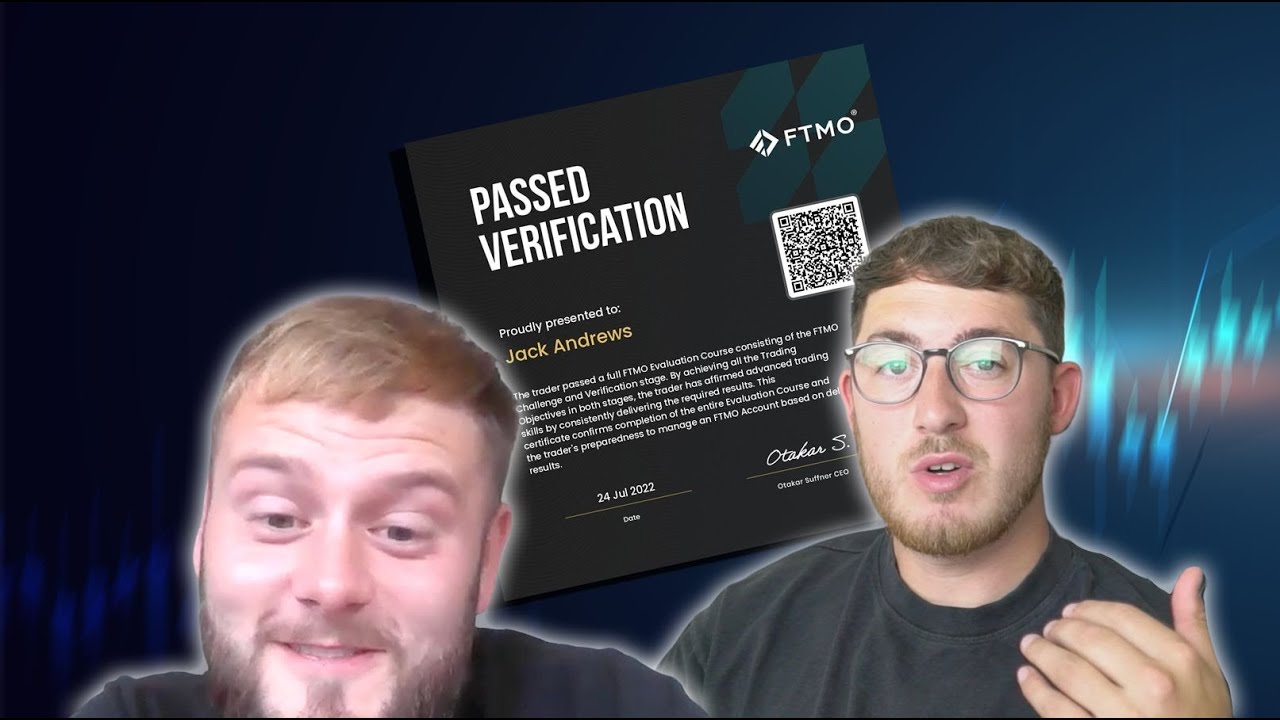
In this interview, host Jamie talks with Jack Andrews, a construction worker from Suffolk who recently secured a six‑figure funded trading account through FTMO. Jack explains why he turned to trading—seeking financial freedom and better lifestyle after years in window‑and‑door installation—and describes his first steps: joining Jamie’s course in October 2021, opening a demo account, and learning supply‑demand concepts. He recounts early highs (making £12k in a day) followed by sharp losses, highlighting the pivotal moment when consistent profitability emerged, prompting him to attempt an FTMO trial and eventually pass. Jack emphasizes the psychological side of trading—over‑trading, fear of loss, and the need to accept losses—stating that trading is roughly 70 % psychology, 30 % strategy. He details how he fits trading around his construction job, using long drives and early‑morning windows to trade the Asian session, favoring the 15‑minute timeframe and a 1:3 risk‑reward ratio to keep sessions short and manageable. His learning method relies on repetitive video review, note‑taking, and screenshotting setups on TradingView. Looking ahead, Jack plans to quit his construction job, scale up to larger FTMO allocations (up to $400k), acquire more property, and eventually become a full‑time trader. The conversation serves as both a roadmap and motivation for aspiring traders balancing day jobs with trading ambitions.
Chapters
What is up, people? I hope you're doing well. So I've just finished recording a student interview with my student Jack. Now, Jack has just acquired a 6-figure funded trading account, so huge, huge milestone. In the interview, he essentially spoke about how he was able to acquire this funded account all whilst working in his construction job, how he was trading and making profits whilst he was going to and from work in the van. And ultimately now he's got this six-figure funded account, what his goals are for the future. So I hope you enjoy it. Of course, any questions or comments you have, stick them down below, uh, but I'll see you in the next one. Firstly then, um, who are you?
Yeah, so I'm Jack, I live in Suffolk, I've been in construction for about 3 years now, um, fitting windows and doors up and down the country. And that's pretty much, you know, my life. Yeah, it's pretty much where I've been at.
On site.
Sorry?
On site then, just working on site basically.
Yeah, yes, I do. I did new build on site, lugging it out, you know, hard hat, hi-vis, you know, safety boots, all that sort of stuff. And then I come away from that and I'm doing more customer care work now. So if something's fitted poorly or cosmetically damaged, I'll basically go there, rip it out, refit it, do the making good, make it look pretty again.
So I mean, that's obviously completely different to trading then. What sort of— has like this sort of entrepreneurial life been something that you've been sort of living since like early years, or is this something that you've recently started to like really look into?
Yes, I'll be honest with you, I mean, I've always wanted nice things. And the jobs I have had have never really given me, uh, the freedom, first of all, to do what I want, um, and second of all, the money. You always see it on social media, Forex, um, sometimes it's got a bit of a, bit of a bad stigma around it because people are trying to, you know, get your money, they're trying to, you know, do you dirty. So your back's always up straight away.
Yeah, 100%.
But I never wanted to take signals, do you know what I mean? I don't like having to depend on people. Um, but yeah, no, it's probably since COVID to be honest with you. Since COVID that's when I started, you know, getting my money up, um, getting my savings up, um, and then looking for that next venture, like the next serious career choice.
Yeah. So obviously before trading, was there anything else there that you had tried?
No, no, it wasn't. Do you think I stumbled across trading? Like I said, I knew, I knew a couple of people that, that did it. Um, a couple of people failed, a couple of people doing really, really well. Um, so, you know, the proof was in the pudding, do you know what I mean? Like, people were doing well, people were going to London, splashing out, um, and I really like the lifestyle. So that's, you know, where I wanted to better myself, um, and that's when I got involved.
Of course, of course. So what was that first step into trading then? I'm not sure, was— I don't think— did you work with me first, or was there anything before that?
That's the— do you know what, I think I got quite lucky because, you know, there are some courses out there that let's just say probably below par. Um, I think I've got quite lucky. Um, obviously joined you, like I say, in October last year. Um, and ever since then, yeah, I haven't looked back. But I know I've never done anything else. Joined, joined your course, um, started right from the beginning, went through it, um, opened up my own little demo account. And you know how it is when you first start, you're just excited, but then you see a trade and everything. Yeah. Um, and sometimes it feels like it's really easy at the beginning, you know, you're getting it, you're smashing it. And then as you get into it, you think, of course, it's not that easy. I was obviously riding a good wave at the time, and then you sort of bring everything else in that you learn from the course.
Yeah, of course.
I'm—
I can't believe that. I actually can't believe that. Literally, I reckon we could probably ask everyone in the community and 99% of people would have said that they've done Signals before, they've lost money before, they've done some other course before, they've done something before. But literally, this was like your first ever time trading.
Yeah, yeah, honestly, I laugh about it myself. I got really lucky, I think. I literally came into it, you know, your course has got great content, you know what I mean? And don't get me wrong, I lost money. I've definitely lost money, but I mean, well, what, since October last year, I've probably spent near enough 2.5 grand, obviously including a laptop, paying for the course, paying for the FTMO account, multiple other things. Like, I've spent a lot of money. I've never made a penny so far. Um, but like I say, now I've passed, hopefully all that hard work will, you know, pay off. I can start seeing some good, you know, some— get some of that money back essentially, and way more.
Yeah, of course, of course. So, so tell me about those sort of, sort of early, early days in trading then. How were that— how was those sort of, let's say, like first like 6 months of, of learning?
Yeah, so I mean Look, I say, when I first started, I was on the demo account, I was catching some good trades, and I was like, God, this is, this is easy. So I mean, I was like, this is too easy, I don't understand, you know, why it's so hard. And then I think I just started at a great time, the markets were awesome. Um, I only was doing, you know, supply demand, I wasn't including liquidity and, you know, all the other sort of stuff that, you know, molds a great trader. Um, so yeah, I mean, but I've had some real ups and I've had some real downs. I remember making 12 grand in a day. And I was like, right, I'm ready, absolutely ready. So I mean, that was like 2 months in, and then like, you know, I lost it all on the demo account. And I was like, God, like, it's not as easy as I think. And that's, that's the thing though, sometimes you've got real bad days where you worry, but then also the, you know, the flip side of that coin is if you're too confident, do I mean, you think you're, you think you're the shit sort of thing, that, you know, it doesn't work.
Yeah, yeah, massively. So what do you think was like that pivotal moment? Because obviously you've gone from, from not being profitable to now being— well, you're now a six-figure trader. So what do you think was the pivotal point that switched when you went from not being consistent to consistent to hitting the results you have, obviously now passing?
Yeah, so to be honest, it was probably something— look, I've done one FTMO trial um, I didn't pass it at all, um, but I didn't— I see a lot of people making new F2A trials all the time. I didn't bother doing that. I just kept using that same account even though I'd failed until I saw myself making consistent trades. I was consistently being more profitable because, you know, there was times where I'd make 5 grand, then I'd lose 5 grand. I'd make 10 grand, I'd lose 10 grand. And it was so like up and down all the time, um, but yeah, I mean, yeah, that, that was pretty much it for me. As soon as I started seeing me making good money, more than I was losing, um, that, that was it for me. I was like, well, I'm going to go for it, I'm just going to risk it, um, and see what happens. And luckily, you know, it paid off.
I, I think, I think a lot of people do sort of overthink becoming profitable, and they really do try and overanalyze what they're doing to try and find so many specifics to try and find where they can be profitable. Whereas if you just sort of train yourself to find the setups that are good and train yourself to identify the setups that are not good, and then you can just say stay disciplined. You can quite easily shift yourself from finding good trades and finding bad trades to finding good trades and being consistent.
I mean, I was, I was overtrading massively. I think that's, that's a problem as well when you first start. Like, you know, I mean, even now I'm excitable still, Jamie. I've just passed and now all I want to do is hit that button. Yeah, yeah, it's so hard to sit on my hands. Like, I mean, I had my account 2 days before I placed something because I didn't see anything I liked, but God, the willpower I needed to not— I mean, to try and find something was ridiculous.
Yeah, I, I, I always say, I think, I think fundamentally trading is, is actually quite easy. Being able to find the trades is quite easy and understand the strategy and stuff like that is easy, but it's the psychological side where you find all these trades but you have to know which ones to trade, you have to know when to sit on your hands. But I think it's the psych—
psychology—
psychology behind it that pushes you into being unprofitable. And ultimately you just start losing loads of trades because you shouldn't be trading. And then where you could have been profitable, you're so far down, it's so difficult to then come back.
Yeah, absolutely. I mean, when I first started, I mean, I remember seeing it was like 70% psychology, 30% strategy. At the time you're thinking No, you're thinking, no, no, no, no, no, no, come on, that can't be right. But honestly, the emotions, the emotional rollercoaster that I've been through is ridiculous. It's ridiculous. Like when I did the FTMO, I mean, I went, there was a point when I was down 5 grand, do you know what I mean? And I was like, oh my God. And then you're kind of scared to take the trades, but then you miss really good opportunities and you're kicking yourself and you know, and then I'm up 5 grand, I'm like, right, cool, I'm doing amazing. Then you think you're not gonna make a loss, but then you trade again. It's so up and down, but it's just the way you sort of control it. I mean, I mean, I don't even think now I've 100% learned to love my losses. Even now I haven't 100% learned to do that yet. Um, that's sort of the next stage in my psychology that I want to overcome.
Yeah, yeah. Again, I think there's definitely a natural progression even when you are profitable. So even me now, like, I find myself looking at trades and I'm taking trades and like why have I taken that? So there's, yeah, there's literally, there's always progression. No matter how profitable you are, you're always going to be analyzing your, your performance to some basis, regardless of what, what level of the journey. Like, you can, like, for example, you, you can, you can still be there, you can be making money, you might not be at the absolute pinnacle of your profitability, but you're profitable enough to start to look to go full-time, start making money and stuff like that. Like, you don't have to be at 100% capacity to, to absolutely see results.
Exactly. I mean, yeah, you know, I want to accept— because obviously I'm just moving out, so I don't want to completely take away my job just yet. Um, but you know, I want to make some good money now I've passed the account. I want to go down 2 weeks a month from my work because I'm self-employed as well. Um, so I can work because I can still trade while I work. It's just, you know, when I'm driving like all across the country, it's difficult. Um, But yeah, I want to go down to 2 weeks a month and then slowly start fizzling out and then, yeah, go full-time. That, that's, that is the dream now.
Yeah. Well, whilst you're on that point, obviously you've been full-time working whilst learning and passing, so how did you manage your trading around your work to obviously get you to this stage?
It was, it, like I say, because I'm not working in an office-based role, I mean, I'm on my own or with my uncle, um, doing windows and doors. We're driving up and down the country. So a lot of time, I've got a lot of time in the morning, I've got a lot of time in the evening because I'm driving 2 hours to the job, 2 hours home.
Yeah.
Um, my uncle was a legend. I mean, he actually, um, would drive to the jobs and drive home to help to allow me to, to learn more. Um, so that was really good. But yeah, getting up early in the morning was a big thing. There was times I was waking up like, you know, half 6, but then I have to drive to the yard, half 7, load up for work. It's then 8 o'clock and I've missed, I've missed all the opportunities, or at least the, um, part where you, where you're doing your analysis.
Yeah.
Um, so sometimes I was getting up even earlier than that, but it's what you got to do to succeed, isn't it, really?
Yeah. Well, I think that's something that, I mean, that's how I trade. I'm very much like, I just get up early, trade like the, the Asian, the Asian range. I just trade that, that morning move every single day, and yeah, that's it. And then I'm, then I'm done. So I think having those Yeah, routines are massive, and you start to see the patterns in how the market moves at that time. So like the same setup will basically play out multiple times a week, and you just jump in in the morning, you find it, you take it, and then you're done. So I think, yeah, literally, like, those routines are massive. And if you can find like that block of time in and around work, I think it's— I mean, I think anyone can really make it work.
Oh yeah, I mean, like, yeah, so I mean, getting up early was a big thing. And also, you know, just going for the 15-minute one sometimes is a lot easier. Like I say, you haven't got to be on the markets watching them intently. You can just set your order, go do your bits, and then come back and check it, you know, as when you get the chance. That, that was also another big, big thing, uh, because I was always trying to go for, you know, the 1-minute entries, you know, trying to get the maximum amount of profit, you know, as you do, especially when you just start. You just want to make as much money as you can as quickly as you can.
Yeah.
And it took me a long time to realize, you know, it's not a get-rich-quick scheme. That's not, that's not what it is, do you know what I mean? You're gonna, you're setting yourself up to fail if you think you're just going to be a millionaire real quick.
Yeah, that's it. Well, I, I think, I think, I think you'll agree with me, putting the majority of people on like the 15-minute system and just trading the 15-minute time frame. I mean, since we did that, it's been, it's been massively pivotal to the community. And I think you'll agree, it's much easier to manage in and around work.
Yeah, definitely. Like you said before, I mean, I think sometimes people are getting lost in the 1-minute, and myself included, um, of rubbish 15-minute POIs. Yeah, it was actually getting, you know, you gotta go for the root of the problem, do you know what I mean? So finding those good 15-minute POIs and then the rest will sort of follow. And I even, I was getting lost in that.
Yeah, well, that, that's it, isn't it? Like, as long as you, as long as you understand and you can train yourself to identify the actual areas that you should be trading from you can, you can trade it off the 15 if, if that's how you need to trade and you haven't got a lot of time. If you've got time, you can look for a confirmation entry if you've got that ability. And then if you've got more time on the market, you can wait for that initial mitigation, see if your trade plays out, and then you can drop down to the 1-minute and you can use that to scale into those positions. And then you can, then you can start to maximize the profit. But that's like, that's like so secondary to that initial, that initial goal of, okay, I need to get in and I need to trade objectively here if I want to go and become a 6-figure trader, my objective should be to be consistent and making 10% a month.
Absolutely. And like I say, like, I mean, a 1:3 is amazing. And it took me a long while to realize that as well. I was always going for like, you know, the 1:20s, the 1:15s. Well, do you know what I mean? Because again, I was just too, too greedy. But the 1:3s are amazing. Like, I mean, 1:3, 5 days a week is still like, what, 15%?
Yeah, you only need to touch a few of them and you're there.
Exactly. And I'm now realizing that, which is really, really good. And that's really, really helped me with my trading as well. Pulling it down halfway down your laptop screen is, is not the way.
No, no, not at all. I, I think, I think it is, it is massive. Like, you shouldn't— I mean, I, I preach it now a lot— you shouldn't be trying to make your profit from the percentage of your trade. You should be making your profit from the consistency long term and being able to acquire capital and then being consistent and making a very small, a relatively small amount of profit in a quick amount of time to take care of your psychology. So you're not in the markets for like hours at a time. You're literally like, like, yeah, when we're trading, we're in and out of the market within like an hour, 2 hours like maximum.
Yeah.
So the, the less time you spend in the market, the less time you're sat there stressing. So then when you do go to make that second trade you're so level-headed, you can just go bang, smash, another trade done. And then it's just a case of, yeah, consistency with those numbers. You get that first funded account, you then get your payouts, you get another funded account, you get your payouts. And, and instead of you trying to improve how much percentage you can make, you just build capital, and then that's, that's where your money comes from.
Yeah, absolutely. I mean, another thing that I found out that I was doing that was just not good for my psychology was Instead of looking at just how I place a trade, I'd be looking at the numbers, the profits. I'd be looking at the numbers. I wouldn't be looking at the graph, seeing where the logical points are to take my money out. Yeah, I'm just, you know, staring at my phone like, oh my God. And I like whole numbers, do you know what I mean? So if that's just under 2 grand, I'm like, no, no, I want to be 2 grand before I know it's 1,400. And I'm like, oh God. Yeah. Um, so yeah, for anyone like watching this, I mean, try not to just watch the numbers on your phone because it it, it messed with my head quite a lot. Um, rather than looking at the graph and thinking, right, that is a logical place to take it out. Yeah, no matter what the numbers are, I'll take it out there because it's better to have that than lose half your profits.
Yeah, yeah. And it's very, very easy to get caught up by the profit and not the, not like the percentage. So it's like, oh yeah, big time. Like, my trades run to 3% now, but if I leave it a little bit longer, it's going to be 3 grand, or it's going to be it's gonna be 5 grand, I'll just— let me just catch that little bit more. But it's like, as soon as you— as soon as you do it once, then it's like, oh, I'll just do a little bit more the next time and next time. And then, but before you know it, you're not taking your profit at 1:3, and then it's back at breakeven, you know, and you've sat there with nothing, kicking yourself.
Yeah, literally, mate. I've been in that situation so many times. Like, even, even though I've passed it, I'm not perfect at all. Even now I'm still making mistakes.
Yeah, I, I, I 100% agree. I, I think as soon as I started to instill that in the community of just I mean, who— if it goes 1 to 10, it goes 1 to 20, it goes 1 to 1, whatever, if you can get in and get out at 1 to 3, you're not only— are you making— you can be making very, very good money. I mean, 1 to— like, you're making 3% on even a £100K account in a day. You're making thousands of pounds. So it's like, you know, you have to, you have to like really break down these numbers. But so what if it goes 1 to 10, 1 to 20? Who cares? Because it might not. Yeah, next time. Or you might be so stressed out trying to catch that that the next trade you do, you find a trade and it's like it's not even a trade and you end up taking a 1% loss. It is, I mean, it is exciting to see those big numbers, but it's also way nicer on your head if you just get in, out as quick as you can and just get on with your day.
Yeah, the little numbers add up. I mean, like you say, you know, 3% a day, it's say you're risking 1% on 100 grand, that's 3 grand. That's 15 grand a week still, which I mean, it adds up. It's not all about getting the million in one day.
Yeah, of course, of course.
I mean, there was one time, you know, I've watched the same video 3 times in a day. So I mean, I'll just have it on the background, like not necessarily watch it, but say I'm driving, I'll just listen to it. And then I'll watch it again when I'm home. And then, you know, that is the only way I got to where I am is watching the same stuff again and again and again and again, drumming it into my head and then practicing it and then drawing up the graphs after watching it and then you know, having it alongside my graph so I can watch it while I do it.
And yeah, touching on that point then, what do you think was an effective technique for you to actually learn how to trade? Like, how did you sort of go about learning and actually processing the content?
So I mean, the way I learned is I watch, I do, and then I just repeat it, to be honest with you. I mean, my screensaver on my phone is actually, um, just notes, um, I've written out key points Um, but yeah, writing stuff out was a big thing for me. Um, I've also found setups on TradingView, screenshotted them, so if I see something similar, sometimes I'll refer back to it and, um, go over again. That was quite handy. Um, but yeah, just watching it, watching it, watching, watching, watching it every day, every day, every day, just drilling it into my head. Yeah, until it becomes second nature. That, that, that, that is literally it.
Yeah, yeah, 100%. I mean, it's just that, it's just that repetition you put in the reps and it becomes— I mean, it's just muscle memory at that point. And you can spot the setups, you can spot the patterns, you know what's going to happen when, when you see this. And then it's, it's so easy to execute off of, off the, off of that basis. Absolutely.
Yeah, definitely.
So you're now a six-figure trader, massive, massive milestone. Of course, where is next? What's the, what's, what's the path ahead? How are you planning to, to move forward from here?
So yeah, so obviously I want to quit my job this year, ideally before Christmas. Like I said, I have got a house, so I'm not gonna, do you know what I mean, jump in two feet. I'm gonna, you know, take it easy. Like I said, I can still trade alongside my job. So at the minute, um, yeah, that, that, that's, that's one avenue. I want to get a new car, that's definitely on the books. Um, my little white stallion, my Ford Fiesta, is, um, good old girl, but yeah, I think she's ready for a new home now. You know, next year, it's absolutely plausible if I get enough money, I want to get another house, rent it out. Do you know what I mean? Just start building, building, building.
Yeah.
Yeah.
Just start making that money. So in terms of your actual funding, what's the plan there? Are you going max allocation FTMO and then?
Absolutely. Absolutely. Yeah, absolutely. I want to get— yeah, so obviously once I'm comfortable doing my first one, uh, with the profits from that, I'll then, you know, like you say, venture out and get the next account. I'll probably go for a $200K one next. Um, I think you have 3, can't you?
You can go through 400K allocation with FTMO.
Happy days.
So get that $400K and then, and then it's going to, uh, gonna try and rinse another prop firm and, and get that money.
Absolutely, mate. Absolutely. That, that is the goal, mate. You know, as much money as possible, hungry for it. Um, yeah, max allocation is definitely going to be on the cards, 100%. Hopefully by next year as well.
Well, I mean, the good thing about this is once you get past that initial level, that's the hardest part done. Once you can— one, that first payout, once you've got that first payout, that's when things can snowball. Yeah, that's when things are really stable. All right, perfect. Well, I'm sure we'll do another interview at some point when, when we're sort of— we've got those payouts, when you've got another house or whatever, once we're max allocation, another interview. Um, but yeah, it's been, it's been sick speaking to you. I think a lot of people are going to get a lot of inspiration from this. Um, and yeah, we'll get an update as soon as possible.
Absolutely. Cool. Cheers, mate. Thank you very much.
Nice one. Perfect. Cheers, mate. Thanks for that.
Take care, mate.
Bye-bye. See ya.
Bye-bye.










