Flight Attendant Acquires $600k In Funding | Student Interview - Chris Coyne
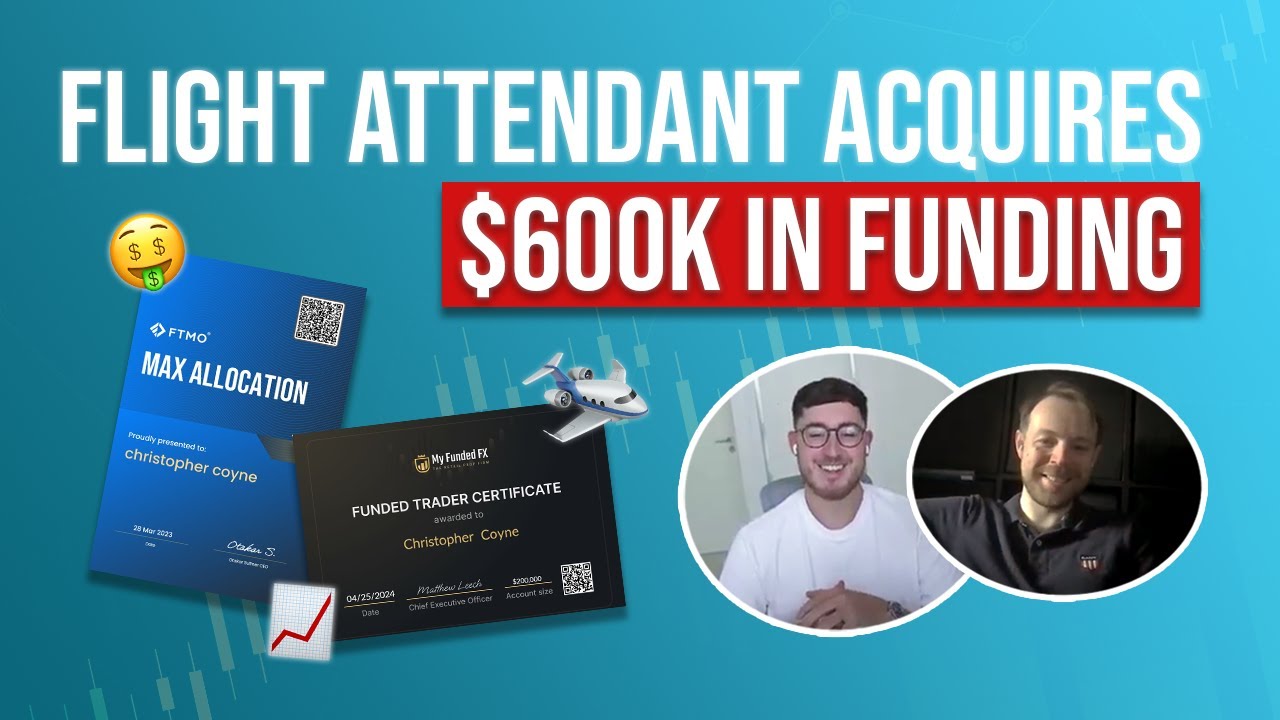
In this interview, host George Linfield talks with Chris Coyne, a former UK flight attendant who transitioned into professional forex trading using funded‑prop‑firm accounts. Chris recounts his early, unstructured attempts at trading with a £300 demo, the pivotal moment during COVID when he invested a work bonus into a structured course, and his progression through FTMO challenges—first securing a $100k account, then scaling to $200k, $400k and ultimately $600k in funding. He explains his risk‑management approach (risk per trade 0.25‑0.5%, minimum 1:3 risk‑to‑reward), session timing (London vs New York vs Dubai), and how he adapts his routine to different time zones. The conversation also covers his mindset practices, the importance of sleep and mood, platform preferences (MT4, DX Trade, cTrader), and the value of a disciplined, low‑frequency trading style. Chris shares advice for newcomers—avoid signal services, secure sufficient capital to learn without financial pressure, and focus on mastering the process rather than chasing quick profits. Finally, he discusses future plans: reducing airline duties, investing his earnings (S&P 500 for his infant son), cautious view on crypto hype, and potential relocation to Dubai or Argentina. The interview offers a detailed roadmap of how a former flight attendant built a sustainable trading career through funded accounts, disciplined risk management, and a growth‑oriented mindset.
Chapters
Now when I tell you I've been waiting a long time to get this interview done, I mean, I've literally spoke to Chris probably a year ago trying to get him onto an interview. He has a very, very busy job, very busy life, but this interview is me and Chris talking about how he has gone from somebody that's working as a flight attendant traveling all over the world to now a $600K funded trader who's tapering back on his work, transitioning into essentially full-time trading, and really his life has changed dramatically since then. So strap yourself in, I hope you enjoy this one. I'm not super jet. Um, I've been trying to get you on this interview since you told me that you've had like your first $400K in funding and things are really kicking off. So, um, as always, let's start from the very beginning. I think we've been working for— working together for like maybe 2 years now, 18 months or so, I think it is. Um, so yeah, let's start from before we were working together, and I guess firstly introduce yourself and then sort of talk about, I mean, how did all of this, how did all of this start for you?
Well, my name's Chris, I'm from the UK, 31. Um, so when I started the journey in Forex, I found it online, and you know exactly which way I'm gonna go, sign up, 300 quid, where the £300 went, times it probably by quite a few, tried different people, and in the end I just got to the stage where I thought, this is not for me, it's— I'm clearly doing something wrong. Obviously when you're doing like what used to be 10 pips, you know, I mean, whatever, 10 lots, you're just thinking this is not risk management. When the— what I know now in reality is, where would I got this £300? Maybe I might have got up to about £2,000 by now in 2 years. Yeah, so that was the start. And then literally I took a long break during COVID and I remember, um, I got my bonus from work and I thought, am I going to waste it on beer, food? Because I was in Phoenix, I literally got paid. I'll always remember you, I was speaking to you before about hair tablets, believe it or not. Of all things. And in Phoenix, I thought it's time to get this course. So I got the course, worked through it, took some time. Um, I'm very like, I've got to do it, I've got to open the laptop and have my own private workspace. And obviously my work time is my downtime.
Yeah.
So I, I used to go out for beers down Route. Instead of that, it was laptop open and getting through the course. And once I got through the course, I was like, should I start, should I try an FTMO account? I thought, and you know, you're just on the fence because obviously I've never tried. So I tried a few demos, demos, demos. Right, you've done your time now, you've done your time. So I first of all tried a $100K account. Yeah, ready just yet. So I passed Phase 1 and I thought, well, I've got the hang of this. Phase 2, I tried to rush it, you know what happened. So took a little bit of time, went back through the course, strategy as in like me timings, exactly what I was thinking. It was mostly about a mental capacity. So I went, right, let's go for the tune, Ricky. I know I can do it. Let's go for 200K. So I start my first 200K account, passed that, got the other 200K, quick concession. I think it was literally in space for a week, I got 400K funded from—
yeah, yeah, I remember you showing me, I remember.
And literally got my first payout from FTMO, and literally it was not a lot. I still don't— like, at the end of the day, I clear enough, I'm not after the big numbers. Like, some people are after the 20, 30 grand. I don't want the Lamborghinis. Yeah, I don't know what that's saying. When I was 18, I would have loved one, but because I've got a newborn, a Lamborghini two-seater is not going to work for me.
No.
So for me, it's like bringing— what life can I bring to my family now? So I'm happy to clear 3 grand a month off Forex, and then the rest comes from my salary at work. Yeah, so I'm clearing about 6, 7 grand a month. After tax.
What is—
yeah, I think that's impressive compared to what I used to be getting paid.
I mean, and then it's pretty much just doubling what you're earning, right? And you're doing very little added work for it, really. It's kind of a no-brainer, really.
And then it's another thing, I was speaking to George Linfield about 3, 4 weeks ago, I can't remember. He's been chasing me as well, and I cleared another £200 grand. So I've got £600 grand funding.
Awesome.
Um, so I haven't started that yet. Um, to be fair, I want to start doing gold. Gold. I don't know if it's going to be on an FTMO account or it's going to be on funded accounts. Is it going to be my own personal capital? Because I know the volatility of gold is very, very dangerous at times.
Yeah.
So at the moment, I'm trying to build up my own capital to do basically my own account. So I can leave away— not leave away from FTMO, that can be building me cash flow, but I can be building my assets for going future.
Yeah, no, for sure, that's, that's great to hear. I mean, I, I'm a big believer in the whole model of using your funded accounts to increase your income, get that to get— use that to increase your monthly cash flow, and then you can use that cash flow to invest in your own personal funds. And then I think having like the— I mean, when you, when you start to get to the $400, $600, $800 million in funding, I mean, you're gonna— you're naturally gonna be in a great position to do 5 figures a month from your trading. So you then start feeding money into your personal funds, and then that can obviously— that can obviously sort of build your wealth over time. Um, but cool. So again, things have gone really well for you now, um, 18 months or so, $600K in capital. I want to go back to the beginning a little bit and sort of understand sort of where your head was at in terms of why trading? I mean, why were you sort of specifically attracted to trading? I mean, there's a million ways of making money online, so what was the sort of main thing for trading for you?
So let's think. I would say probably it's— I used to do knocky door neighbors, I used to call it, cold calling.
You know that one?
You probably used to slam the door in the face. And I was in Newcastle. I'll always remember, I was quite young, left the bookies when I was about 21. And I thought it was the dream and literally was no dream, walking down icy streets, knocking on people's doors, getting rejected, and it learned us a lot of lessons. So from that, I was like, right, at least with forex, I'm in control. If I'm selling a product online, I know there's some very good people who sell products online, but for me, I'm I'm waiting for someone to buy that product. And I'm gonna use a good example, your nipple tassels.
Yeah.
As you can tell, I've watched some of your podcasts, especially the one with Brits. I learned a lot through that podcast, to be honest with you, George. I remember watching that in Aberdeen and I learned so much where entrepreneurs go. For example, yourself, you've tried different models. And for me, it's just me online. Forex is the way for me. And me trying FTM and what's it called, like Amazon Resell, and what else is there? You've got loads of social media marketing. For me, it's just too much effort.
Yeah.
And I'm not saying forex is not effort, but it's less effort because I know what I'm doing.
Yeah, I always say, I think when you look at like the risk to reward or like what you have to put into, what you have to get out. If you look at trading, you have to put a lot in, right? You've got to go through a lot of trial and error, a lot of struggle to start with, and you're not going to earn money straight away. You know, you're not— you're probably not going to earn any money straight away. Like, whereas if you start with e-commerce and social media marketing, you might make a little bit, you're not going to earn a load. But with trading, you don't earn anything. You build the skill set, but then as soon as you've got that skill set and you unlock $100K in funding, $200K in funding, all of a sudden you've opened a floodgate of a lot of money to be made. Like, you, you don't just start making a few hundred pounds a month here and there. You, you have a skill set, you use that skill set, and you're, you're making thousands. Like, it's— there's sort of no in-between. So it's like, yes, you have all— you've obviously got to put in a lot of work at the beginning, but the rewards outweigh, for me, anything else in terms of like making money online.
Yeah, it's like, for example, like, um, Mrs. the other day I was having a down draw day, 1% down, and I don't very have many of them these days, but when I had the 1% drawdown, I thought, oh, you know, you're just thinking, am I gonna go down the same mental route? Am I gonna start going down that down path? I thought, oh no. Walked away, came back the following day and made 3%. Yeah. And me missus doesn't understand 1% and 3%. Obviously what we talk, she just seen the number at the bottom and she went, oh my God. I went, and she went, you don't even look bothered. I went, I'm not.
This is trading, this is trading life.
As long as you have an up month or an up year, that is the main thing. And I've had them days where you've— I wouldn't like to put a number on how much I spent on Forex over the years. It's probably— I'm obviously up now I'll tell you now, putting the money in from the start, I've put in a lot of investment.
But when you do learn the skill set, like, you might be in a bit of a hole, but as soon as you learn that skill set and you do things the right way in terms of funding, you can pretty much wipe out those losses in a month or two of payouts. It's, it's really— it is kind of like you front load the spend and the ex— and try and get that experience in, and then as soon as you get that edge, as soon as you learn what, what your edge is in the market, it's the sort of floodgates open. Which is why, which is why I'm a big believer in funded accounts, especially for, for new traders that don't have that capital behind them. It's, I mean, it's a life-changing opportunity. I'm sure that if there wasn't the opportunity of funding, I can't imagine that things would be as good as they are now for you if, if that wasn't the case.
If there was no funded accounts, I'll be honest with you, I would be in the same routine, 300 quid, losing every month. And for funded accounts, it's incredible what you can achieve. And I had it, it was funny or not, because I used, um, my Forex funds, the first, last 200K, and I got a random email in the email box. And the only thing this email account's linked up to is me trading. And it was like, hi, can I take your signals off? What are you talking about? I ignored the email because it was clearly just a try blank run email. I realized on that website they give your email address out, you can actually— traders can email you, right? And I went, you cannot— you're not getting any of my trades. I mean, if you want to learn trading, get onto George Linfield and he'll get you on the course.
Yeah.
And the thing is, that's, that's where people are at. I've got a good friend, Aldo. He's like, I want to learn, I want to learn, I want to learn. I'm like, you're 64, do you want to learn, yes or no? And I'm trying to make him save for another 2 months. Only because if he sees it for the next 2 months, I know he wants to learn.
Yeah.
But for 1 month, because he's seeing profits, what's he after? The profits or the skill set? And that's where I'm at with people. And that's the way you probably get people into the course now. Yeah. You actually want it, are you just after the money?
Yeah, no, 100%. And that's, that's why we do our calls before the— before people join, right? Because We don't want— we want to work with people that we can do this with, that we can sit down with and talk about their results and how they've changed their life through trading. We don't want to talk to somebody that said, oh yeah, I followed your signals and I've made £1,000 this month. That's not what we want to do, and that's not how we create like life-changing results for people. It's by having that pain that you want to fix through a new skill set. You work hard at something, you learn the strategies that are already proven You put the work in and you then see results. And it's not just results for 1 month or 2 months. It's a life-changing skill set that will last forever. I mean, once you've got the skill of being able to read the markets, you can read the markets. It's going to be here for a very, very long time, if not all of your life. So yeah, I think mindset is for sure. You have to be coming into this for the right reasons. And I think that it obviously took you in the beginning of your journey it took you a bit of time to figure out maybe what those reasons were, like going through the signals and stuff like that. You sort of have to make those realizations before you go, okay, right, I need to, I need to cut the shit here and do this properly. And then that's when you obviously start seeing the results.
Yeah, 100%. 100%. With the results itself, like every single payday when I get the payday through I just looked at him and go, how did I do that? Like, even to this day when it hits my account, I'm going, wow. Because my missus is the first one, and she went, oh, this is a scam. I will not believe it until it hits the bank account. And when it hit the bank account, this didn't drop, but it was like, yeah, what? At the end of the day, no one's heard of, like, who's not in the trading space of FTMO or these funded accounts. And I'm quite glad of that because if people knew about these, you get the gamblers coming in and just trying it and trying it and trying it because someone's going to get lucky and get the 200K account. But it's maintaining the 200K accounts. Yeah.
Oh, you see people that gamble, get the account, get one payout, and then they've lost it. Yeah, and it's just not sustainable. Like, you need to have solid foundations first. It might take you a bit longer to pass the challenge, or you might have to be a bit more aggressive to pass the challenge, but you then need to be able to understand— you need to then understand, how do I preserve this capital and make it last so you can then build on that as well? Which is, which is, I guess, is what you've done, right? You've started $200, got to $400, got to $600, and, and because it's sustainable what you do, you're going to maintain that capital.
It's quite interesting because when I do a trading challenge to when I actually trade on the actual funded accounts, I trade two different ways. Um, I'm down to 0.25 risk, so 20— like, literally less than a quarter of a percent now on every trade. Because then my risk to reward's really low but the capital's high, so I'm still getting the profits but my risk is really low now. Yeah. Compared to when I'm doing the challenge rate, maybe 0.5% halfway through, and then I go up to 1% to finish it off.
Yeah, yeah, it's kind of for purpose, isn't it? I mean, if you look at a funded challenge, like, there's no point sitting in that challenge forever. You might as well fail it or pass it because you need the capital there to make money. So you might fail a couple of challenges, challenges being a bit more aggressive, but you've only essentially risked £1,000, £2,000 in doing so. Soon as you get the funded account, you're going to make that back in— I mean, it's a couple of trades worth of, of, of profit. So it's, it's kind of the risk to reward balances itself out sort of over the course of maybe a few challenges or so. Yeah. Um, so yeah, I do, I do. I'm very much behind that strategy as well. Um, I just want to talk about, obviously you've had a fairly good journey, right? You've, you, you smashed it. You're obviously doing great things now, but Is there any sort of main struggles that you, you had or anything that you sort of, that you found quite difficult to, to, to get over? Like a sort of a breakthrough that was a little bit difficult for you to, to make?
So, because obviously our strategy is with Jamie trade the London session and I'm in different time zones and I've been trying to get up for the 2 AM in New York. I've been trying to— I'm in Singapore. I like Dubai the best because it's generally a good time to wake up. And then you get your trading done for the day. But for example, now I've kind of moved away from that system, getting up at 6 AM and getting on the— if I miss the London session, there's a New York session.
Yeah.
And I try and tend to now go on the time zones of where exactly I'm trading from. So for example, this month I'm not much in the— I go out the world, but next month I'm in New York for 4 days, so I'll probably trade the New York session because it's easier. Yeah, than it is to try and trade the London session tired.
Yeah, and I think that's— that demonstrates skill set, right?
You—
once you've got the understanding as to how to find higher probability trades in the market, it's going to present itself continuously through each session. So you can kind of plug and play what you've learned into the session that is, is most viable for you. And like, I think, uh, I think a lot of traders do get quite fixed I think it happens a lot. So for me, I've always been in London session trading zone, so I just focus on waking up, get my training done, and then that's me, that's me done. But regardless, somebody that is maybe not in UK time zone, what we teach can be plugged and put into a different time zone. It's, it's, it is, it's still the same concepts are going to give you that edge in the market. So yeah, I think that is, uh, that's, that's, I think that obviously clearly demonstrates that you've got the knowledge and you can apply it to wherever you need to apply it to get the results you need to get.
And that's where I'm at, and that's exactly where I see the time zones is probably the best adaption of the course. The course itself is very, very knowledgeable, but it's how you acknowledge the knowledge, man. For example, I don't trade obviously 7 days a week because the market's only open 5 days a week, but the other 2 days I'm preparing for the next week. Um, so for example, a list of podcasts, listen to high-end traders, and I'm talking, we're talking millions. I listen to what they've done, what's their story, what's their background, and then I go, right, let's have a look at the markets, play it back, markets, watch me, analysts, and watch me winning trades and me losing trades and wherever I went wrong. And generally where I went wrong is I either entered the market too late or I've had not enough sleep and bad mindset that day. And that's generally the 3 major reasons. So I always wake up in the morning now and go, am I awake to trade? Because then that narrows one down. Am I in a bad mood? No. Right, let's get this laptop on.
Yeah, making sure that you're in the optimal mindset, you're actually able to perform at a high level before you start to go and take risk in the market. Yeah, yeah. No, I like that, I like that. I think some people aren't self-aware enough. I think we do see it a lot where people just look at the charts, they try and find a trade, and then they're like, wonder why they're taking losses. And it's like, are you thinking straight? Are you following the process? Are the rules being met? Have you had enough sleep? Are you actually sharp? And I think those are definitely things that you do need to, need to think about. And if you're not optimizing your life around that as well to ensure that you can do that on a consistent basis, then I think you're putting yourself at a huge, huge disadvantage. I mean, it's something that we see commonly across the top performers in our program and in, in the trading industry wide, I guess. I mean, you look at all of the top performers, they're all optimizing these, these sorts of things as well.
It's the community— what I laugh at is when people go, I've lost a trade. I'm thinking, why are you entering this trade at this time in the morning? When I look at the market, I'm going, there's nothing there. Yeah, but that's just because obviously they're still learning at that stage. When they get the experience, they'll realize to sit on their hands Wait for the right ones.
Like, there's high probability, there's low probability. Don't be caught by those. Don't be caught by those early moves. So many people do. So many people do.
Like, I've been times where I've sat on my hands for a full week, not place to trade. Yeah, and I don't look at the charts all the time. I literally— I find trading very boring now, and it's not because it's boring. It's very, very— I go on the charts in the morning, have a look. If there's nothing there, shut the laptop, call it a day. If there is something there, I might be on the charts, maybe. I like being in and out of trades in 90 minutes. Yeah, in and out. I don't like this. I know people do day trading, people do swing trading. For me, I couldn't think of keeping a trade for 3 weeks. I couldn't think of anything worse. Yeah, no, maybe, maybe when I get my own account and keep it on like my own personal capital, I might do more swing trading because you can leave it longer. But on FTMO, the idea is to get the money out the FTMO as quick as possible. Yeah, in and out, in and out.
Yeah, no, I, I completely agree. Um, and I guess just kind of expand on that and get a bit more detail from you in terms of your trades. I mean, what would you say like your average risk to reward is? I mean, what sort of R are you looking to take on a single position?
It depends. I always do 1 to 3 as a minimum. If I can't see that, there's no point. But yeah, for example, the other day with them on Friday when it was heavy news in the US, I went from 1 to 6 and it was in and out in 25 seconds.
Yeah, yeah. So a little bit more aggressive, like the risk to reward has to kind of make up for the, for the aggressive side of the position. But yeah, same as me, 1 to 3 is always the minimum that I'm gonna allow myself to take as a viable position.
But it's not even worth getting out of bed for anything less because— no, I remember a bit on your course, it was like 1:1, no, you're not profitable, and 1:3 is where you just start hitting profitability. And that's where you've got to look at it.
I think it's about ease, right? I mean, obviously if you have a 1:3, you can lose more trades than you win and you're still going to make money. So just by adding that into the way that you trade, it allows you to find edge so much easier. Because like the winning— like you don't have to win that many trades at a 1:3 or above to be profitable. So it kind of— like I think the win rate is far more difficult to achieve. A high win rate is far more difficult to achieve than, for example, a certain risk-reward, like a minimum risk-reward. So it kind of makes sense to sort of optimize your system based on risk to reward as opposed to trying to get like the best win rate. Obviously finding a balance, right? You're never going to get like 1 to 10s or 1 to 8s all the time, but finding that balance so that you, you know that you can underperform in terms of percentage and obviously still be, still be in a position of being, of being profitable.
Yeah, cool.
So I guess kind of want to talk about the future a little bit. Obviously you're, you're really starting to kick on now. Um, you're, you're still obviously in in work. Um, yeah, what are your, what are your future plans? I mean, are you looking to transition away from your, from your, uh, your— I would say 9 to 5, but it's obviously not a 9 to 5 job. I mean, have you got the thoughts about going into the full-time world, or—
It's a hard decision, believe it or not, George, if I'm perfectly honest with you. So my missus is Argentinian. I would love to move down there, but the climate down in Argentina is not the best for myself. So it's like, we've had this discussion lately. I was talking to you the other day, I was like, Dubai's too hot. I mean, Mrs. went, it was like, oh, I would consider Dubai, but then I don't want to be that person who moves to Dubai because everyone's moving to Dubai. So I would say at the moment what I'm doing exactly at this moment of time, I work full-time. I've dropped a contract down 87.5% last year, so I have dropped my contract a little bit of work. Um, I've minimized my time in the air so I can do more time on the ground, so I work for the union as well. And I use the union time for trading time as well because I can manage it more on the ground. If I've got signal, there's money to be made. Yeah. And literally going into the future, I'm already investing for me little boy in the S&P 500. I know it's, um, he's literally one month old, so with that one month over the time, it's going to build very nice for him. Yeah, I mean, I even said to me missus, it's going to be a decision when he's 18 or 21, wherever I decide. He either can take half out and spend it and not get the other half, or you can invest the full amount. So that is where I'm at with investing. However, I have looked at crypto before, and I've always got a saying: if everyone's talking about it, it's too good to be true. And it's not because it's not going to be true. There is money being made. But at the moment everyone's talking about the hype. I'm not going to advise. I know from trading, sit on your hands, wait until everyone stops talking about it and then have a look at the markets.
Yeah, for sure. Making sure you're deploying your capital at the right time. I mean, I think especially in investing, if you're investing in markets, crypto, equities, whatever, I think if you're making those long-term investments, then to some degree timing the market is important. Obviously you can dollar-cost averaging and stuff like that. But obviously when the hype is here and we're at all-time highs, it's like, okay, well, maybe now isn't the best time. Maybe just stay patient, wait for that correction, and then, yeah, jump in.
I've got a friend who did that a few years ago. It was on Ethereum. He got in at the all-time high and then obviously went all the way down, but he was cost averaging. And he said the other day, he went, I'm just back to even. And I'm thinking, if you just put in the all-time low, at the lower points, you would have been— because he's running the hype.
Yeah, always painful, always.
And I'd rather sit on the investment and wait for the right time.
Yeah, no, for sure. Uh, yeah, I think people have such desires to be in the market. It's the same with trading, right? They have so much desire to be in the market that they just get in and they don't time things properly. They don't write for the right setups to be provided. But often you're far better off just sitting on cash deploying it and being patient and deploying at the right time than you are just getting in. Like, it's, it's just the, like, opposite of human, like, human psychology. I think you kind of— when you feel like you should be in, you probably shouldn't, and when you feel like you shouldn't be in, that's when you probably should be in.
But yeah, I think I've learned that from past experience. So now I know to sit on my hands more.
Yeah.
And that's what I do. I don't literally sit on them, but I feel like I sit on them more than I'd actually trade. And even like me missus, like, used to go every day, how much you made on Forex? How much you made? How much you made? Now she doesn't ask us. She goes probably once a month, oh, what's your profit like this month? And it's just because it came from experience from her, from the support point, because you're asking how much I'm making. If I'm on a down draw, you know what you're going to end up doing. And yeah, now if I'm on a down draw, I just say, yeah, I've had a bad day, I've lost 1%. Yeah, it's being true to yourself about it.
Yeah, and I think a lot of traders, I think a lot of traders really do struggle with, with sitting on their hands. Like, the amount of people I see, and I'll go back and I'll look at the trades they've made, and they've made like 7, 8, 9, 10 trades in a week, and it's like, how, how, how are you doing that? Like, for me, I've made 3 trades this week, 1 breakeven, 2 wins. Last week I had 1 trade, week before that a couple of trades. Yeah, it's like, I, I feel like sitting on your hands is like, you, you cannot trade that, that higher frequency and still make money. It's just the more you're in the market, the harder it is. And I think having that ability to sit on your hands, understanding exactly what you're looking for, is so, so powerful. Okay, that was— you just get sucked in and you become a gambler, and then you lose your money, and then you've got to go through the harsh realization that what you're doing isn't right, and start all over again. And I'm sure you've kind of been through those thoughts, I imagine.
Like, this, this week I've literally placed 3 trades, and one's actually still running now, but literally 3 trades all week. And what day we're on? Friday. Last week I think I placed one trade. Yeah, so I don't trade every day. I look at the markets every day, but the trade's not there, it's not there. And some people look at it on a Monday and go, oh, I hate trading Mondays, they're my worst days. If I trade on a Monday, it's generally my worst day. On the market, it's either flat or it's too volatile for me, it's not in the middle. Yeah, Mondays I do look at the market, but it has to be very special for a Monday trade.
Yeah, like an A+ setup's got to be all of the rules and Yeah, no, I, I definitely get you for sure. Yeah, 100%. I mean, it's always, always looking at your data, right? It's looking at your data and seeing where the wins are, where you're profitable, where you're not, and then refining from there. I think a lot of people don't do that.
And I've also as well realized, um, I used to have a bad habit, you know exactly where I'm going to go with this, um, I used to look at my trading account on FTMO Well, obviously it's on MetaTrader 4 every half an hour. Keep an eye on the trades. I keep the stage now where— let me check that off for now— maybe once an hour, maybe once every couple hours, depending what I'm trading. I like, um, DX Trade a lot better than I do MT4. And it's just— MT4 is a great software, but you got to work out your obviously your risk size, your lot size. And then put it on DX Trade. For me, it literally clarifies what I always make sure I do myself, but it clarifies exactly what I was doing.
Yeah, a lot of these new platforms are doing that. And, and I think like even like cTrader— I haven't used DX Trade, I've had to play around with cTrader— and I think obviously what they're doing is they're looking at what a lot of these previous platforms haven't done and what people are adding into them to try and make them better, and they've just done that into their, into their single platform. So Yeah, I think there's a— there's definitely a lot to be thinking about now in terms of platforms and prop firms and stuff like that. But yeah, cool. We've— I mean, we do— we've been going for half an hour or so now. So a couple more questions just for the people that are listening to this. Firstly, for anybody that is sitting on the fence, people that are thinking about getting into trading, maybe they're in trading, they're not getting the results that they want. What would your biggest tip be to them?
Don't go for signals, don't go the easy way. And that's my first tip. And definitely, probably listen to your podcast, especially with the one what you did with— oh, what's his name?
Riz.
Riz, yes, that's the one. Definitely listen to that because it'll tell you the journey what George Linfield went through. Listen to the testimonials. Testimonials don't lie. And then literally, if— save up enough money for you to buy the course, but also as well to live a sustainable life while you're learning the skill. Because if you're chasing the money and you're struggling for money, the course— you're going to rush it and not learn the course the way you should be learning it. That's me, probably top tips.
Yeah, 100%. Yeah, I think so many people look at trading as, as a way to solve their money problems, but it will just make it worse. Like, getting into trading, you need to have money behind you, right? You need to have that comfort being able to focus on the process, not the profits, and then the profits are just a byproduct of mastering that process. So yeah, I think that's, uh, that's, that's definitely great advice. Um, yeah, cool. Thank you for jumping on with me finally after all of this time of me asking you. Um, I'm sure there's a ton that people have learned from this, and I'm sure, as I said in the last interview with, with, uh, with a guy that's just about to be launched, actually. I'm sure there's a lot of people thinking right now and having some big decisions to make. So I do appreciate it. Hopefully we'll jump on in another year or so, see where you're at. All the best. And yeah, we'll catch up soon.
Well, hopefully the next one's in Dubai with a beer in my hand.
Everyone says that. Everyone says that, Chris.
Listen, I'll be in Dubai probably from September onwards when it cools down.
All right, cool, cool. Let me know. Let me know.
All right. Awesome.
Nice one. Yeah, I do appreciate jumping on with me, mate. And yeah, have a good rest of your weekend and yeah, we'll catch up soon.
All right, take care. All right, bye-bye.
Take care, mate. Bye-bye.










