The exact strategy I used to make £4,947.40 in 32 mins
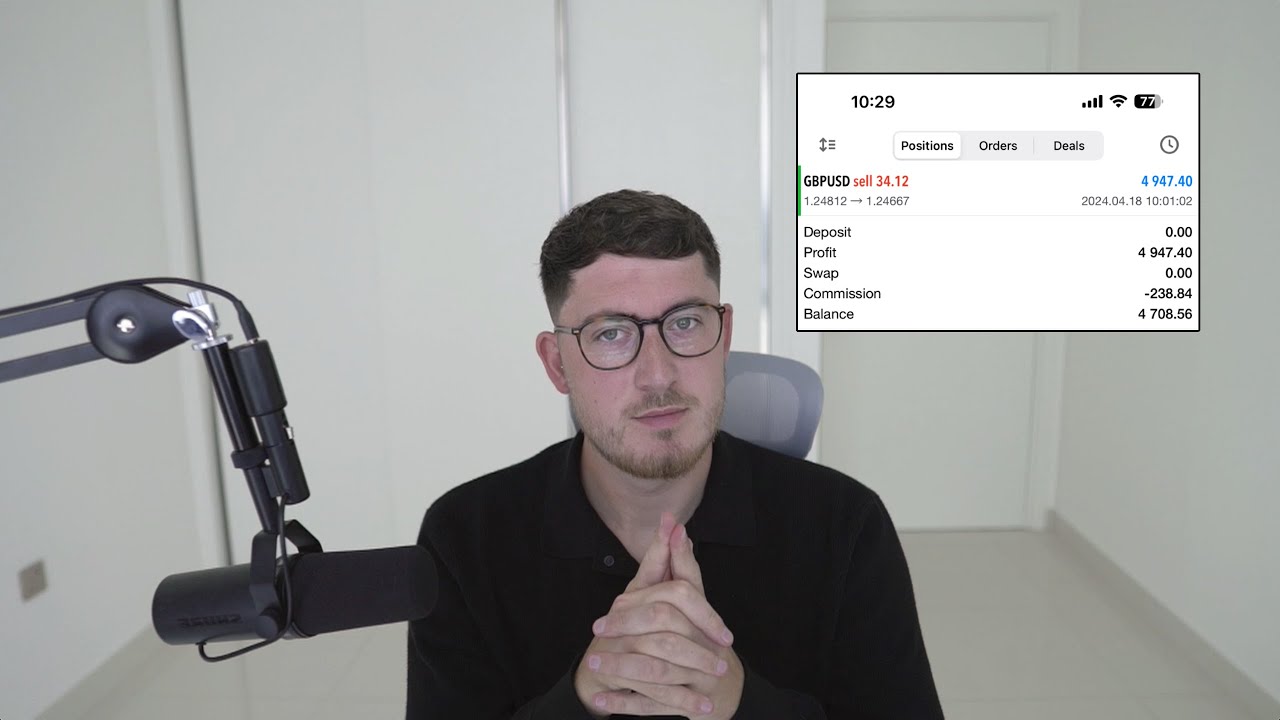
George Linfield made £4,947.40 in 32 minutes trading GBP/USD using a two-step system: spotting liquidity runs on the 15-minute chart, then confirming on the 1-minute chart before entering. He trades only two pairs with minimal indicators and strict rules, avoiding the clutter most retail traders use.
Chapters
Right, so it's me again. I had a really, really great response from my last video. I think a lot of people took quite a lot of value from me sort of explaining my sort of process. So in this video, I wanted to go a little bit more in depth on that and actually showcase a very similar sort of thing that happened to me this week— on Thursday, actually, a couple of days ago. So let me quickly share something with you. So this is a trade that I took on Thursday. I was able to pull out £4,947.40 from the market in around about half an hour. And instead of this being very surface level, I wanted to give a little bit more insight into the strategy that I follow to be able to find trades that are like this on a consistent basis, majority of weeks. So like I said, in this video I'm really going to show you the strategy that I use to pull out just shy of £5,000 from the market, I mean, in a very, very short period of time. So let me just get rid of this quickly and let me, let me share my screen with you. So this is, this is the trade right here. This is GBP/USD. So only one of two pairs I trade. I only trade GBP/USD and EUR/USD, have done for many, many years now. And like I was saying, there is only, there's only really two things that I look for to get into a trade. I mean, there's a few more things, but fundamentally if you really boil everything that I do down, it comes down to really two concepts. And the first one is, is something that is, is really present on, on the 15-minute timeframe for me. And that's what we call a run on liquidity. I see a lot of people trading support and resistance, indicators, trend lines, supply and demand, and all that sort of stuff. But in reality, the only thing that actually moves the market is liquidity. Without liquidity being taken, you can't really expect much to happen with your trades, right? You can very quickly shift the probabilities quite drastically in your favor by, by implementing the fact that you need to see a run on liquidity before you take a trade. So again, this was the exact trade that I took. We saw run on liquidity to the upside, and, and that's when I'm then looking for my second thing. And that's what I call a— that's what I call a confirmation, right? I have certain confirmation models that I use that tells me if I should take the trade or not. Okay, it gives me that final tick, that final box is ticked. And once I see that, I know that if I place that trade, the probabilities are quite significantly in my favor of being able to make money. So we drop down to the 1-minute time frame. This is where I, I wait and I look for my confirmation. After that run on liquidity, I look for my confirmation. That confirmation gives me the go-ahead to pull the trigger and set my order. And then I'm in the trade. So this position in particular, um, I was able to pull out 3.56 R from the market. So R is risk-adjusted return. If you're trading at 1% risk, that's 3.56% pulled from the market. And the reason that I like trading this way, and the reason that I'm, I'm a big believer in, in time in the market doesn't mean more money, right? I mean, I could count on one hand, probably on a— I mean, really less than one hand. If I had 4 fingers, that maybe be a bit more accurate. I could count on one hand the amount of hours I spend on the charts each week. Um, and that's because this strategy that I've built and the way that I trade is, is so refined now. So if we look at this trade, I was able to get into this trade at 7:33 in the morning, and my take profit was hit at 8:09. So 28 minutes— I think that's 8:09— 28 minutes after I got into the trade, my take profit was hit. And that's when I was able to pull up just shy of, of £5,000 from the market. Again, in and out, my day was done by just past 8 o'clock. Um, yeah, just past 8 o'clock. And that was me done. I mean, that was, that was me done pretty much for the most part of the week. You'll see that, I mean, I don't, I don't trade indicators. I don't use support and resistance. I don't use— I mean, I don't really use much, right? My charts are very, very simple. All I really need is a couple of lines to identify areas of liquidity. I need this little green box here that tells me what's going on in the morning session of the markets, gives me a good idea as to where price is likely to go, and I need my confirmation. And that's pretty much it. Again, when my rules are met, I take a trade. If they're not, then I'm not on the charts, right? I set alerts at certain areas of liquidity so I know when to come and check back. And if those alerts don't go off, then I don't come back to the charts. And everything is very, very straightforward. It's very, very focused. Like I said, I only trade 2 currency pairs. Um, and I think this should be, should be a big wake-up call, right? There should be a really big wake-up call because I see a lot of people have their charts, they've got a million lines everywhere, they've got indicators here, they're using RSI, stochastics, they're using all sorts, moving averages, they've got a trend line here, then they've got a Fibonacci level here. And I mean, none of that is necessary, right? As long as you've got a set of rules that you know when you follow provides you with a statistical edge in the market which is backed by data— again, you can only know this if you've got the data on your set of rules— and you can follow that in a mechanical sense, then that's basically everything you need to become profitable. If you compare that with getting properly capitalized, if you can get access to £100,000, £200,000, £300,000 in capital, I mean, you've got everything you need to become a full-time trader, and you can start taking trades like this where I was able to pull out £4,947.40 from the market in 32 minutes. Doing so in such a simple way. I cannot— when I started, I was probably very similar to the way that you traded. I had indicators here, support and resistance there, Fibonacci here. Everything was very much about me trying to find ideas. And now I just wait for the markets to come into my sights, right? Wait for the market to meet my set of criteria, and then I pull the trigger when I've got confirmation. I know where I'm entering, I know where I'm exiting, I know where my stop loss goes. For when the trade's invalid. And it's just repeat the process. It's rinse and repeat. Every single day I'm up, I'm seeing if I get an entry. If I do, fantastic, I make some money. If I don't, I walk away, I come back the next day. I get on with other things I've got to do. I, I mentor my clients, I put some new videos together just like this, I go and sit at a beach club for the day. Um, I don't let trading run my life. I know what I need to see to ensure I gain an edge in the market. If it's there, I take it, I make my money. If not, I walk away and I come back the next day. So a little bit more insight into the way that I do things. Um, again, this might make sense to some people, it might not make sense to other people, but if this is something that you do want to learn, if you want to get a bit more in-depth knowledge and on this side of things and sort of how I operate, and maybe you want to get rules to my strategy, then there's a button below this video. It's going to take you to a new free training I've put together for this year where I essentially explain everything. I explain start to finish exactly how I was able to become successful in the markets, my idea and sort of how I apply my rules in the market and why I trade a mechanical edge. I show you some of the results we've got for our clients, and I also show you the quickest way that you can scale to your first $10K a month in the market doing so completely emotion, emotion-free, stress-free, no need to make decisions. Again, really putting my brain inside of your brain. That's the idea of what we do. So I hope you've enjoyed this video. I hope this is a bit of an insight into what real trading is, right? It doesn't need to be complicated. If you have done, or if you've got any questions, stick a comment below. Make sure you like the video. Make sure you subscribe as well. If I see my subscribers are growing, I see people are getting value, then I'm gonna make some more videos very similar to this. Um, yeah, that's it for me, and I'll catch you in the next one.










