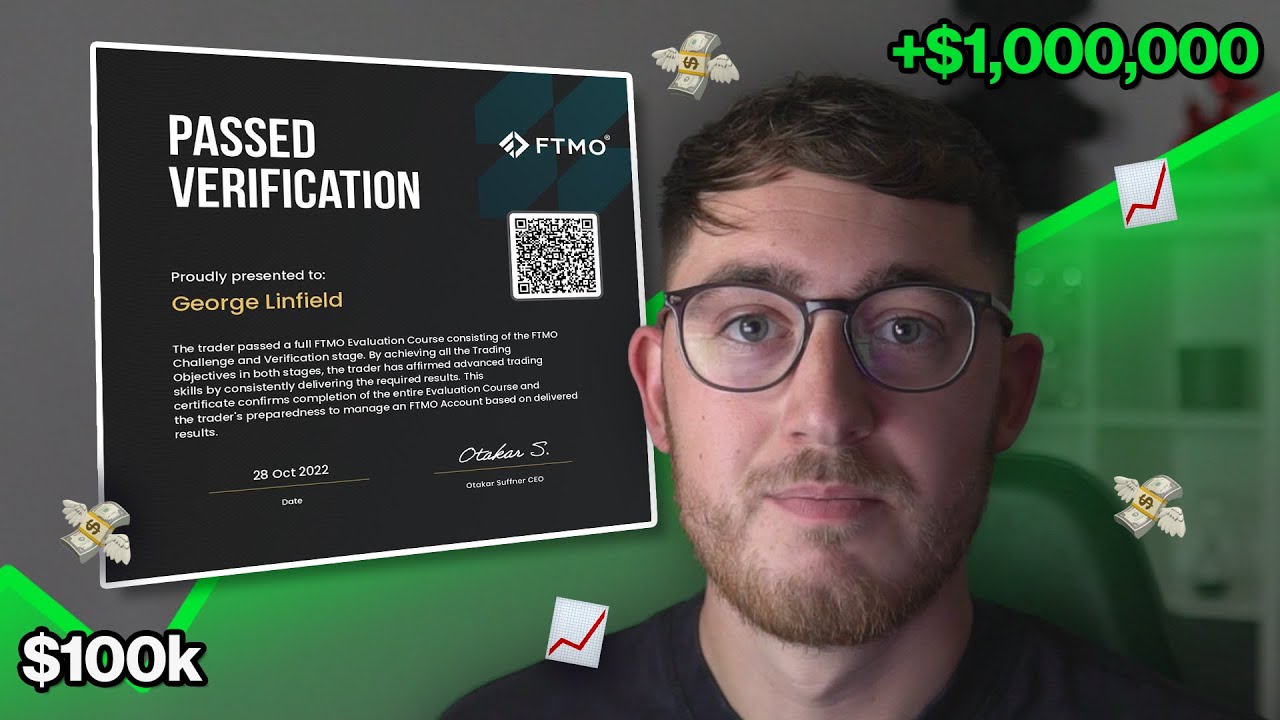
In this documentary‑style vlog, trader George Linfield launches a new series called “Road to $1M Assets Under Management,” documenting his attempt to grow a single FTMO $100,000 funded‑account challenge into $1 million of managed capital, starting from a £450 entry fee. He explains three core motivations: personal challenge, the “free‑money” nature of funded accounts, and a desire for transparency in the trading‑education space. Linfield walks through the purchase of the FTMO challenge, the rules (20‑day minimum, 5% profit target, max daily loss), and his initial risk‑management approach (starting at 0.5% risk, scaling to 1%). He then reviews Phase 1 results: 15 trading days, $10,095 profit (10% gain), 47 trades, 31.9% win rate, 3.74 average risk‑to‑reward, but heavy over‑trading early on. He analyses a key GBP/USD counter‑trend trade that delivered a 1:6 payoff and secured the phase win. Moving to the verification phase, Linfield details a rough start with two severe losing streaks, a drawdown to $98 equity, and a maximum $9,900 loss, but ultimately recovers to hit the 5% profit target ($5,000) on the final day of the 60‑day window. He presents detailed statistics: overall win rate 30%, average profit $931 vs. loss $326, risk‑to‑reward 2.85, 27 long vs. 48 short trades, instrument performance (EUR/USD +$14k, GBP/USD –$7.5k, AUD/USD –$1.5k), daily‑of‑week profitability (Monday/Wednesday weak, Friday strong), trade duration profitability (30 min–2 h best), and lessons about overly tight stops. He then breaks down the final successful EUR/USD trade (10 lots, 1:3 R‑R, $2,200 profit) using supply‑demand zones, multi‑timeframe analysis, and market‑open dynamics (Frankfurt, London). Finally, Linfield outlines his next steps: awaiting live‑account credentials, planning the first payout, and aiming to bootstrap the initial $100k into $1 million using only the original £450 investment, while continuing weekly updates. The video ends with a call for comments and subscriptions.
Chapters
So welcome back to another video. This has been a long-awaited one. I've been talking about doing this for a long time, but I haven't really got around to doing it. But I've just purchased my first FTMO account, which essentially marks the beginning of a new series I want to do, which I'm calling Road to 1 Million Assets Under Management, funded accounts, whatever. Essentially what I want to be doing in this little documentary, I guess, a little series, is documenting the whole journey of going from this this first $100,000 account all the way up to $1 million in management. There's a number of reasons why I'm doing this. Firstly, uh, I think it's going to be a fun little challenge for myself. I mean, I've been trading the same accounts for like 5 years now, so really, again, it's just something just to sort of get myself stuck into, to challenge myself, seeing if this is something that I can actually do. I mean, I might just choke this and I might fail. Just a little bit of a challenge for myself first and foremost. Secondly, the funded account route is I mean, it's literally game-changing for people that are profitable. It is literally free money. I mean, once you pass the account, you get your, get your first payout and you get that refund of the initial fee, the return on investment is essentially infinite. So for me, being profitable, the lure of going into the funded sort of game essentially is massive. Not having to risk my own capital and being able to generate some of the returns that you can through funded accounts, uh, is, is something that I really want to explore. As well as that, I've also got other projects that I can allocate my personal capital to, as opposed to— I mean, I can't go and get funding like this and go put it into property, let's say. So I can take some of my personal capital away from my trading and I can allocate that into other investments to again just help progress my wealth-building journey, I guess. And finally, for transparency, I think funded accounts are really giving people, especially in the education space, no real excuse not to be transparent. I completely understand if people don't want to be showing their account results and stuff like that if they're trading personal funds, because I mean, that's your net worth essentially. That's going to be a large portion of the capital that you actually own. I understand that, but now that funded accounts are here, if you're in the education space, I think it's absolutely vital to be transparent and actually show that you're profitable. I mean, trading is a game of making money, so I think anybody that is in the sort of industry and providing a service to show people how to make money, they have to show that they can make money themselves. This is a good way for me to show transparency and show my ability as a trader, which is obviously in turn going to help me market my education company. Obviously I'm in the space. So yeah, 3 main reasons really. New challenge myself. It's free money essentially, and just to have that element of transparency that I think not a lot of people are willing to do, especially to publicly document it like this. So 3 main reasons why I'm doing this. Idea of this documentary is essentially to go from $100,000. I'm going to try to 100% bootstrap it from this initial £450 investment. So I want to try, at least to some degree, to just grow this from the payouts from the initial account. So yes, it's a challenge for myself, but it also is a series that's going to allow the beginner investor to be able to see what is actually possible from small investment. Theoretically, if this goes as planned, I should have $1 million in managed funds that have essentially all come from this original £455 investment. It sounds mental talking about it like that. I mean, just a few years ago it's not even possible. Yeah, I'm looking to try and bootstrap this to some degree. Obviously £450 is an initial investment. I'm trying to bootstrap it from here. So let me just share my screen. So we can see here, um, I've just paid for the FTMO Challenge. Haven't yet started it, literally just paid it. $100,000. Now this is a big one. Why am I doing dollars? Well, if you look at the conversion rate, $100,000 is £82,807. So you get almost £13,000 more pounds than you would if you were to be using a GBP account. So I actually get more money for what I'm paying. So I'm going to pick this video back up once I've done the challenge and the verification. So I'm going to start here. I'm not going to post this yet. I'll wait until I've done everything. The whole time I'm going to try and do sort of weekly updates where I document all the trades I've taken, why I've taken them, look over some of my metrics, and then of course when the payouts start to come in, showing all the payouts and all that sort of stuff, showing how I'm going to be connecting all the accounts up. Again, I should probably say my plan at the moment is to go max allocation with FTMO first, and then I'm yet to decide what firm I'm going to go with second. So Any comments below suggesting another prop firm to go with? I haven't yet decided. There's a few in the mix, but yeah, I guess this marks the beginning essentially. I've got the account ready to go. I'm hoping to get this done— well, I shouldn't really be saying this, but I'm hoping to get this done within the 20 minimum days. Just get this through, get some payouts in, and then we can go for the next— we can go for the next lot. I'll check back in. I'll record the next bit once I've made a bit of progress on the account. But yeah, thanks for watching so far. Wish me luck. This could go completely wrong. I'm hoping it's not, but I'll check back with you once I've made a little bit of progress on the account. Right then, so first update: I passed phase 1 of the $100,000 funded challenge yesterday. That's done and dusted. 10% has been hit, so I ended up making $10,095.28. So got that one buttoned off. Well, I've just set an order for stage 2, so we're getting that one underway. So what I figured I was going to do is go through the metrics on the first one. I'll show you the trade that I took yesterday that took me over the line. Obviously we're on the FTMO dashboard. You can see here that my challenge has obviously passed and I'm in the process of doing the verification. I haven't actually made a trade on that account just yet. I only, only logged into that account today. But let's have a look at the metrics on the, uh, on, on the Stage 1. So as you can see, 15 days it's taken me 15 trading days. My max daily loss was $2,200, so I took a 2.2% loss in, in one day. Yeah, this was funny because I'm not actually sure when that was because I don't ever remember having that big of a loss. So I'm not 100% sure exactly where that came from, but again, nevertheless, I kept the downside very, very minimal as much as I could. So I started the, I started the challenge with 0.5% risk, uh, and then when I got a 3% buffer, uh, that's when I increased the risk to 1%. And essentially that's what, that's when I sort of kicked on and ended up hitting, uh, hitting the profit target. So you can see profit target hit $10,095. So it's all ticked off. Now you can see here with my with my equity curve on the actual account. You can see I pretty much went through a period of— I think it was about 10 trading days, um, pretty much like 2 weeks in total of the markets— well, of my results going sideways for the most part. Um, the first couple of weeks of August, or the first or 2 weeks of the challenge, market conditions weren't fantastic. Um, I took a few trades, made a few wins, took some small losses, but I couldn't really find that consistency to really kick on. I was also— I also found myself in the first week or so definitely overtrading and really trying to rush getting this passed. Um, I was— I, I subconsciously went into the mindset of just trying to get it done in, in one trade, I think, and just trying to smash out a really, really big position. And obviously that didn't work, so I went for a period of pretty much just break-even. I'd go up a little bit and then I'd end up losing that money and so on and so forth. But eventually we got there. And again, as soon as we sort of built that, that momentum up, uh, it was pretty much just like 2 trades basically, and then we'd hit the target. So we can see here, uh, how the days went. So average profit $1,500, average loss $418. So good risk to reward there. 47 trades in total. I was 100% overtrading to to start with. I was having days where I was making like 5 different trades. You'll be able to see it down there, which is like not how I trade at all. Average risk to reward ratio, 3.74, which is obviously not, not too bad at all. 502 lots. Expectancy was $214. That's pretty much because I took so many small stupid losses. Win rate only 31— well, 31.91%. Now again, I'm not massively happy with that, obviously. I mean, with the 3 risk to reward and 31.91% win rate, you're profitable, but I'm not 100% happy with that, like I said, because I was a million percent overtrading when I was— when I first started. So I was taking way too many trades, trades that didn't fit my trading plan, which is why the win rate is, is, is definitely lower than what I was anticipating. But again, nevertheless, it's about understanding these things and assessing. I mean, the only reason you get these statistics is so you can assess what you're doing. Um, so not massively happy with that, but again, I understand exactly why, uh, why I've done it. So daily summary, you can see there yesterday $5,860. Um, 26th, so Friday, I took a $918 loss. You can see that pretty much every single losing day was, was kept minimal. For the most part. And then when I was winning, my win— my win— my winning days and my wins are just massively bigger than, than the losing days. So, so keeping that risk nice and low, um, trying to keep as strict as possible on that downside, so then when you do catch those nice winners, you're obviously able to maximize that upside. Okay, I mean, if you're going to go through days where you're just going to take massive losses and you're not going to limit that downside, then it's going to be very difficult because when you do end up making money, all you're doing is making your losses back. So I try to keep the, keep the downside as low as possible for the most part. You can see here like 4 trades, 7 trades, 7 trades in a day is just ridiculous. I should have never done that. Even like 4, 4, 5, 5, you can see pretty much from my win. So 3 trades in a day, 2 trades in a day, that's where my wins are coming from. So all in all, I'm pretty happy with my performance. I mean, typically the first couple of weeks of August aren't that good in the markets anyway. Um, but again, 15 trading days, up $10,000. So that's a nice 10% gain. Again, you, you can't really complain with that. So let me show you the trade that I took yesterday, which took me over the line. So it was a nice GBP/USD buy position, um, trading that counter trend, um, trading the counter trend move, anticipating the move back into the premium of this, of this bearish leg. So Essentially, you can see we had this big push to the downside. Once you see a nice break of structure, once you see the market pushing to the downside like this and you see a big overextension, what you're really looking for is to try and trade that counter-trend move, okay? Looking for that shift in structure, waiting for order flow to really start to, to pick back up and to start moving the market to back to the upside. So I was watching the price action here and I could see that structure in here started to shift, okay? So we can obviously see how this high was then taken out. We can then see how bullish order flow started to kick into the market. Okay, so I had a nice bit of confirmation here that the market was going to be beginning to see that move back to the upside. We came into this next supply zone here and we had this little reaction. So this is what I would call a flip zone. We had that reaction to the supply and then the market ended up breaking through it. So again, we got more confirmation here that, that bullish order flow is really starting to kick back into the market. We can see that supply is now failing. Consistently failing. Okay, we've obviously got supply failing. All of these supplies in here are now failing, and we can see that demand is holding. So as we saw this level being taken out, we saw this nice demand zone being created here. I was essentially going to be looking within this zone for an entry. Now one thing I did find actually really helped me, um, passing the challenge is looking for confirmation entries. So lately I have been pivoting a lot more to trading directly from my, uh, supply and demand zones, trading directly from those POIs. But it's helped me a lot. I don't know if it's just psychology or actually helping you get past is looking for those confirmation, confirmation entries. So looking for the lower time frame shifts in structure just to help you increase that risk to reward and just to give you that peace of mind that that move is actually starting to play out. So as the market came into this region here, I was then— I then dropped down to the lower time frame, so 1-minute in this instance, or 1 and 5-minute, and I was then looking for, uh, that that lower time frame confirmation, okay, that shift in structure out of this, out of my POI. So again, I was looking, I was watching this move to the downside here. I was waiting for this pullback to show me that this— we're now sort of beginning to turn. As I saw this high being taken out, I then got my confirmation. So I then had my order set So I had my buy limit set something like this. So this is actually a 5-minute, a 5-minute demand zone that I traded from, but orders like this. And I actually ended up my risk to reward— well, I was targeting this high up here, but on my MetaTrader, on my MetaTrader 5, I use something called Trade Assistant so I can essentially see exactly how much profit I'm going to be making um, literally to the pence if the trade hits TP. So I think I needed something like, like $6,300 to hit, uh, to hit my target. So I literally just adjusted my TP. So when I hit TP, I hit my $6,300 and I obviously passed. So I think it was around 1 to 6 or something like this. Yeah, I'm pretty sure it's 1 to 6 exactly, basically. So I took a nice little 1 to 6 there, which obviously in turn, uh, put me over put me over that profit target. So all in all, very, very happy with, with how things are going. The markets are definitely looking much, much better this week, or so far this week. So now all I've really got to do is hit my— hit the next target. So, so I've actually just hit my thing. Looks like I've just taken a trade, so I need to check that out. But I've now got hit a 5% target, so make $5,000 without obviously hitting the, without obviously hitting the max daily loss and max loss. And I've also got 60 days to do so. So you're gonna take it nice and slow, not in any real rush. I'm just gonna wait for the right setups to take place, and then we can obviously look to, look to execute from those positions. So as soon as I've got uh, some up-to-date— well, as soon as I've got an update, um, I guess I'll check back in. Uh, but fingers crossed I don't fail the next bit and then I don't get to release this video. Um, but yeah, I'll see you in the next bit. Right, okay, so I'm back. Obviously it means that I haven't failed, which would have been quite embarrassing. So I've just passed my verification, just hit the 5% profit on the account. What relief it's done! After starting the verification, I went on 2 pretty bad losing streaks, one of which was I think my worst losing streak ever. In the last week, I managed to get the account back from pretty much failing to hitting my 5% profit, um, with pretty much no losses. So we're gonna go through the stats now, uh, I'll walk you through them all very, very open and honest, showing you absolutely everything that went on, all of the trades, all the losses, um, and obviously how I recovered. And then we'll jump in and I'll show you the last trade I took on the verification that actually helped me get over the line. So let me just get the analysis up now and we'll have a look. Okay, so you should now be able to see the FTMO website. As you can see here, we've got the FTMO Challenge. We're obviously here, £110K, and then we've now got the verification and you can see £105,093 and I have obviously passed. Let's take a look at the analysis. Now when I say I went on one of the worst losing streaks I've ever been on, I literally went on a horrendous losing streak and I'll show you in just a second, but Again, we'll take a look at just the basic stats here. So if you look at the balance curve, my balance went down to 8,000, um, an 8,000 total loss. I went down to £92,000 in terms of balance before, again, you can see a massive, massive recovery there and taking myself back into profit. But we can see there, $5,093 win rate, 30%. Again, so I still managed to keep, um, in a fairly good win rate. Considering my risk to reward, and managed to get back into a profitable state even after hitting so many, so many losses. Average profit $931, average loss $326. So again, still keeping that ratio quite nice. Risk to reward was 2.85, so definitely a little bit lower than what I would like. I'm not massively happy with this, but of course you need to do what you need to do to become profitable. Um, if I hadn't have gone on that big, big losing streak to start with, my risk— my average risk to reward would obviously, uh, would be much better. Um, but again, it is what it is. Max profit, so the biggest profit I made was $4,405, and the max loss I made was $568. Okay, so again, you can see there I'm making sure I'm actually managing my risk correctly. I'm making sure that my downside is, is very limited. I'm keeping, well, the max loss I actually made was, was only 0.5% on the account at any one time. And you can see my max profit was obviously much, much greater than that. Uh, average win, we've already had a look at that. Um, so long and short comparison then. Number of trades long, 27, and number of trades short, 48. My net result was $4,000 for long positions and $900, uh, for short positions. You can see that my short position win rate was actually much better than my— well, not much better, was marginally better on short positions than it was on long positions. Again, long balance, pretty choppy. Short balance, you can see there pretty much all of, all of the losses that I made on my, um, on my losing streak was pretty much sell trades. Um, it wasn't, wasn't great at all. So you can see here my results by day. Now this is very, very sort of key analytics. These are really important things to look out to try and judge your performance and understand when you should and shouldn't be trading. As we can see here that my, my trades on Mondays were statistically not as good. So these are the types of things you need to be looking at. Okay, well, if I'm, if I'm not consistently profitable trading Mondays, then perhaps they're the days that I should perhaps look to take off. We can also see here that Wednesdays aren't particularly profitable for me. So again, perhaps a day that, that I should maybe look to slow things down or maybe look to look for a little bit more confirmation on my positions. But again, really, really good stats to be looking at, um, understanding when you're profitable, when you're not profitable. You can see here on Fridays I'm fairly good at trading end of the week. Let's have a look, what else have we got? So we can see here results by instrument. So this is very, very interesting, and then this is something that I've been taking paying a lot of attention to and really trying to understand, okay, well, where am I actually profitable? And something that I have done during the verification process is actually begin to start not taking so many trades on GBP/USD. And one of the things I did during the verification was actually stop trading pound altogether. We can see here that Aussie/USD only had 4 trades, but my net result was, was minus $1,500. EUR/USD, I took 38 trades and my net result was $14,000. And GBP/USD, 33 trades and my net result was minus $7,500. So you can see there's a huge difference in my performance and the way that I trade across these two pairs. So this is key, key data. And again, if I just didn't trade, um, if I didn't trade pound in this instance, I would have had pretty much another 50% profit on top of on top of my result, or I would have passed the verification much, much quicker if I was just trading EUR/USD. Because obviously you can see my net result here is, is obviously $14,000, so 3 times as much as I needed to make in order to actually pass the, to pass the verification. Again, you can see here massive, massive difference between, between the 2, uh, between the 3 assets, let's say. So trading days, um, took me 30 trading days. So I actually ended up passing Um, I actually ended up passing the verification on the very last day that I actually had. I only had one trading day remaining. Um, so really did manage to pull this one out the bag. I really did take, take my time on this one. Um, you can see 30 trading days, obviously had 60 days to pass. Um, average number of trades was 2.5 a day, uh, 10 positive days. Average positive day was just under $2,000, and I had 20 negative days. Okay, but I managed to keep my negative days much smaller than my positive days, which allowed me to obviously see those positive results. Uh, position size, so again, this doesn't really matter. Results by duration, so again, you can see here how long— I mean, if you can stay in the trade for a certain period of time, then you have a better statistic advantage of actually being profitable. So, uh, I'm assuming this is 6 to 12 hours. Yeah, I imagine this is 6 to 12 hours, and you can see my results are $4,400. 1 to 2 hours, again, just under $5,000. And 30 minutes to 1 hour, also $4,000. So statistically, if I can hold my trades between sort of 30 minutes to 2 hours I'm in a better position to be able to make money. It's typically when I'm in trades for less than 30 minutes that I tend to, I tend to suffer losses. Okay, now one thing I did pick up on with the losses that I was actually making and that put me into the, uh, into that big losing streak was I was trying to manufacture a risk to reward to try and just get the challenge passed as quick as possible. So my stops are very, very small and I was, I was being really aggressive in my stop loss. And I found a lot of the time what was happening was I was getting stopped out and then the trade was going in my— in the right direction. In fact, I think about 90% of the losses I did take ended up going on to hit TP if I just had a bigger stop loss on the trade. So being aware and understanding what is actually going wrong with your losses has— is one thing that helped me. Again, in the last week or so of verification, I end up just adapting how I was trading a little bit, and I ended up going on pretty much back-to-back wins. Uh, results by open hour. So we can see here the final evaluation. So 30 days of the, of the 10 days minimum. Max daily loss, when I only lost a maximum of $2,000 in one day. Um, you can see my max loss here. You can send— this was, this was squeaky bum time at one point. My, my equity went down to, I think, $98 at one point. I had $98 remaining, so I was really cutting it very, very fine. You can see my— the max drawdown I had was $9,900. So again, I, I did start to sweat at that point, but it was literally just after this— after I hit this $9,900 in drawdown, I ended up making like $4,400 from one trade. So I ended up recovering very quickly after this period. And then you can obviously see there how I, uh, how I ended $93 in profit. So all in all, I'm not massively happy with how I did overall in terms of my stats. I know that they can be, they can be much, much better. There's a lot that I learned from this verification and how it affects you mentally. Again, it's very, very different to trading obviously a demo account and for trading personal accounts. The mindset and the way that you do perform with these targets in place is is very, very different. Having that sort of end goal that you have to reach definitely makes you try to manufacture your results more than it would if you were just trading normal, let's say. So again, I just want to show on the metrics some of the positions that I took, and then we'll have a look at the last trade. So we can see here on the daily summary, actually, obviously how I went on a very, very bad loss. So again, we start here from the start of the verification, pretty much out the, out of the gate here. I ended up taking some some pretty hefty losses back to back. Again, I was keeping my stop losses way too tight, way too tight, and I was just trying to catch a winner to put me into profit and to win the challenge in one trade. That was my problem. So again, you can see lots of losses. I ended up having one, uh, one profitable day here, another couple of losses. Again, things started to get a little bit better here. I actually ended up getting the account back to break even, um, got the account back to break even, and then that's when that big, big losing streak started. So 1, 2, 3, 4, 5, 6, 7, 8, 9, 10, 11, 12 days back to back of losses. Um, so very, very stressful at this point, but again, you just have to stick to your plan, make sure you're adapting and being cautious of where you're going wrong, and you have to try and, um, try and do what it takes to actually to come back from this. But you can see I took some time to reflect, I took the day to reflect and readjusted and reapproach things and did things in a slightly different way. And you can see here I went 1, 2, 3, 4, 5 days of trading and I went from pretty much 10% down to 5% in profit. So in these, in these what, 5 days, I ended up making about 15% profit and managed to win that challenge. So very happy with how I came back from this. At one point I did think I was going to fail, which would have been very, very annoying because this whole video would have been a waste. But obviously now, um, nicely managed to get the challenge back and obviously pass the verification. Um, so I've just had my— I've just had my contract through. I've just sent off all the verification stuff for that, so should be getting the account, um, later today or tomorrow. And then I can, uh, I can start obviously documenting, getting the first payout, and so on and so forth. But what I wanted to show you just before I end the video is the last trade here that, that ended up, um, putting me into profit. So we can see here EUR/USD 10 lots on this position, ended up coming out for $2,230. Let me just jump over to TradingView and I'll show you that position. So EURUSD, um, this is essentially where it happened. It was on Friday. Now I was expecting the market to push to the downside, right? So what we had here, if we go to the 4-hour, in fact So if we look how we, we had this big move here, we can see that we had a big, big push to the upside and the market then started to turn back down. So I was expecting for the market to want to come down into the discount of this overall 4-hour range, right? Again, we had this full range here. I was expecting the market to want to come down into this discount. So any price action up here, I understood there was definitely selling pressure here, so I was looking for short positions. To want to see this level here being— to be mitigated, and obviously this potential demand here. So I understood that there was a, there was a draw to want to see the market coming down into this region. We also had this big imbalance here, um, that again is going to want to be filled. So there was a number of reasons why we wanted to push down into this area. So if I go to, go to the 15 We opened on, uh, we opened on Friday. We had this small little supply chain starting to form here. We obviously had a small reaction to this demand. We had a bit of a pullback to come and mitigate this supply just here, and then we started to form this supply chain. Okay, now when you see these supply chains starting to form, it's typically building those orders, building the appetite for the market to start that move. So we go down to the 5-minute. Typically what I'm going to do is when you see this price action forming like this and it's all sort of very like itty-bitty and there's not really a huge amount of volume kicking on, I'll typically drop down a time frame to try and get a bit of clarity as to really what's going on within the markets, right? So I drop down to the 5-minute time frame and ultimately what I'm looking for here is, is just some form of idea as to sort of where the order flow is really wanting to head and where, when the order flow is really starting to sort of pick up within the market. So we can see here that about half past 6, so just before Frankfurt open, we had this big push to the upside to sweep this liquidity from these highs. We formed this big shooting star candle, and then we had a nice bit of volume pushing the market away from this level. Okay, so this is sort of when I started to, to sort of get that appetite that the market is going to want to start to head— I want to start to head to the downside, and we can then start to obviously target and look to take out these weak lows just here before obviously looking to take target this, this level down here to obviously reach that higher time frame level. We can see here that, um, again, half past 6, we had this push to the downside. We then had a little bit of consolidation, which is obviously very, very normal because we haven't actually got, um, any real volume kicking into the market yet. What we're doing is we're waiting for that Frankfurt open. As we saw Frankfurt open, here we go, about 7 o'clock, we had a nice push to the downside. Now if we see Frankfurt open and we see the volume pushing to the downside that typically gives you that, that idea as to where the market's going to be heading for the morning. As we opened, we formed this nice little supply zone here after this push to the downside. So this gave me a very clear level of supply to be looking to trade from. All I've then done was set my orders at this supply. So I had a sell limit just here. We came up and we got triggered, um, about, about 40 minutes later. Okay, so obviously formed this level here at 7 o'clock. Got tagged in about 20 to 8, so again, just before the new— just before the London session opens. I ended up staying in this position for, again, about 25 to 30 minutes. And then when we saw the London session volume kicking in, we had that nice push to the downside, which ultimately pushed me into my target. So what I actually had was I had my entry here my stop loss was just above this supply zone, and then my risk to reward is about 1:3. But again, like I've said previously in this video, I use something called Trade Assistant on my MetaTrader, which allows me to ultimately see how much profit I'm going to make from wherever the market goes, right? I needed $2,200 profit, so all I did was I set my TP, um, at a level that allowed me to make $2,200. Again, I don't need to stay in a position any longer than that, so I got in here, stop loss was just above, and then I ended up getting out around this sort of level here. So we had a really, really nice push to the downside about 8:10, pushing me straight into my, um, straight into my TP, which allowed me to then, allow me to then pass that position. So that was it, very, very simple. Um, very glad I got it done early morning on Friday. I didn't want to hold and have to try and trade through London, through New York session to get this past. But of course, I did what it took to get this across the line. I'm very, very relieved. We're very happy that, that I have now done so. So we are now, um, we are now fully funded with that first $100,000. So again, I'm just waiting for my credentials for the live accounts come through, and then we will have that first $100K. So my plans for for this account now are. I've got 14 days until I can make my first withdrawal or get my first payout. And again, like I've said in video 4, I'm looking to completely bootstrap this challenge and go from this initial 100K all the way up to $1 million in funded capital, pretty much from that first £450 investment. So as soon as I've got that first payout, I'll give everybody an update on how things are going, and then I'll get my next challenge underway. So I hope you've enjoyed this video, um, probably the longest one that's going to be within this small little series. But I hope it's given you a good insight as to some of the stats that you should be looking for, as to sort of how I trade and what I'm sort of expecting and what I'm looking at, giving you an actual honest insight into, into a real trader's statistics and, and how we operate, and ultimately the sort of stats that we're getting as well. So I hope you've enjoyed the video. I look forward to recording and releasing the next one. Make sure you subscribe. Any questions you have, just stick them in the comments below, and I'll see you in the next video.










