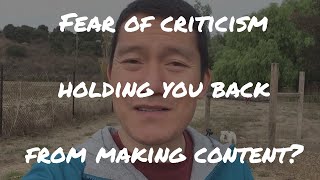
George Kao (speaker) reassures introverted or criticism-sensitive people who want to create content online. He explains that fear of criticism is evolutionarily normal (tribal ostracism), notes that early online content rarely receives much visibility or negative feedback, and offers practical tips: don't rewatch or over-critique your own videos/articles, share initially with supportive friends, and lean into the overwhelmingly positive early responses. The tone is encouraging and pragmatic.
Chapters
One of the questions I get sometimes from audience members is you want to show up online to spread your messages and your services and products, but you feel introverted and sensitive to criticism. I don't know if you relate to that. Feel free to comment below if you do relate to that. So I want to share a few things here in this video that maybe will help you to start to overcome that. First, know that it is normal. And by the way, before I go on, I just have to show you this dog. I'm here filming this on a farm where there's a dog here. And this dog is so cute. I just have to show. Show you this dog here. Hello. Such a cute doggie. Okay. All right. And Buddy is walking around here somewhere. Buddy, My dog. So first of all, know that it's normal. You are a human being. You have. We have evolved as human beings to be tribal creatures. We, for tens of thousands of years, hundreds of thousands of years, we evolved as a tribe. Okay, You're. As a human being, you are. Your DNA has been built to thrive in a tribe and to suffer when you're out of a tribe. And so back then, when we were living in tribes, if you got criticized from your tribe, then you were in danger of being ostracized by the tribe, which meant you would be shut out into the wilderness without food and resources and ability to survive and you could die. And so we have this deep seated fear of being ostracized and before that, being criticized. It's a very normal evolutionary fear. You just have to train. Keep on reminding yourself that, okay, that was evolution. I can be conscious now of the fact that criticism today is different. I'm not going to be without. Well, I guess in some way, if you're always being. If people really don't like what you do, always don't like, then yes, you'll be also bereft of resources. But the reality is that. Let me tell you what the reality is. When you first start putting content online, whether it's videos or whether it's articles, you will be lucky if you got any criticism or any feedback at all. Okay? A lot of people have this fantasy that they put a video on YouTube or they publish a Facebook page and oh my God, does that mean the whole world sees it now? You don't realize that just about nobody will see it unless you do a really good job of promoting it and sharing it everywhere. Almost no one will see it. Even if you put your videos online and you get like 10 views or a couple dozen views, it's very likely those people just viewed it for a few seconds and it was just one of dozens of things they viewed that day, or maybe hundreds of things, hundreds of articles they saw that day as they were scrolling through. So the reality is that just about nobody will see your stuff when you first show up online. And the second reality is that the comments you're going to get at first are almost entirely positive comments. Probably going to be all positive comments because I know that you are coming from a place. I mean, given that you watch my videos, we probably share similar values. You're coming from a place of service, you're trying to help in your content, you're trying to uplift, educate or inspire through your videos or through your articles. Right. People sense that. And so the comments you're going to get are going to be supportive comments, positive comments, if you get any at all. Again, okay, so just know that that is the reality of having done hundreds of videos by this point and written hundreds of articles as well. So be encouraged that. I know you are sensitive to criticism and I want you to know that actually most of that criticism is probably coming from within yourself. Within yourself. It's your own self criticism. So let me give you another tip for that. You don't have to watch your own videos. Typically we can't stand seeing ourselves on video, hearing our own voice. We're shocked by it because we're not used to it. But other people who are watching our videos or hearing our voice, they don't know any different. They haven't lived in our head for years, decades. And so they are just taking us at face value and they, they will be almost overwhelmingly supportive of us. So don't watch your own videos. You don't have to read your own articles and be critical of it. Just put it out there and let others be supportive of you. Now in the beginning, you might want to be choosy whom you put it out to choose the most supportive friends and colleagues to share your content with. At first, don't just share it with people you know, family members who might be critical of you, etc. Even on Facebook you can be very choosy. Instead of sharing, you're posting something to all friends. You can post it to a specific set of friends. Even though it goes on your timeline, only a specific set of friends can see it. Learn how to do that. It's called friend lists on Facebook. So anyway, I'll end this video now, but I'll just say that don't be afraid to put your stuff online you don't have to watch your own stuff, you don't have to read your own stuff, but other people will benefit from it. Okay? And you want more people to see it because the positive feedback you're going to get is what's. What you're first going to get. And then eventually, as you. As your content gets more widely known, you'll build larger and larger audience. You become more and more immune to feedback. Okay? And at some point, your audience will be large enough that you will get some critical feedback. But by that point, hopefully you'll be more. You'll be stronger within yourself and you'll have some more perspective. That. Okay, as long as the feedback is mostly positive, it is a good thing you're on the right path.