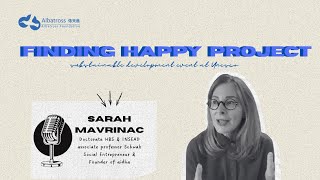
In this UNESCO‑hosted presentation, Dr. Sarah Mavronak (Harvard Business School PhD) recounts her career trajectory from academic posts in Canada, INSEAD, and Singapore to founding AIDA, the world’s first micro‑business school for impoverished migrant women in Singapore under UNIFEM/UN Women. She reflects on the limitations of traditional classroom models and how scaling required a shift toward community‑based behavioral change. Over the past year, she and longtime friend Ghislaine of the Albatross Foundation have co‑created a new genre of AI‑supported children’s books that deliver personalized, 24/7 behavioral coaching, aiming to embed respect, goodwill, and other Sustainable Development Goal (SDG) behaviours in children. The talk emphasizes that sustainable impact hinges on community, simple behavioral cues, and technology‑enabled coaching rather than complex curricula.
Chapters
Hello, my name is Sarah Mavronak and I earned my doctoral degree at the Harvard Business School. I have held academic posts first in Canada and then at INSEAD in Fontainebleau and then on the campus in Singapore. But in 2006, I left academia and became a social entrepreneur on behalf of UNIFEM, what is now UN Women. I launched a school for impoverished migrant women. That school, AIDA, still exists in Singapore today and indeed is one of the country's most prominent charities. Ghislaine, who's been my friend for 20 years, watched as AIDA unfolded. And I similarly was able to watch as she brought her Albatross Foundation to life. But more importantly, over the past 12 months, we've had the opportunity to work together again and innovate an entirely new genre of children's literature, the AI-supported text. When Guylaine and I first started talking about marrying AI to children's books, I was transported by the power of the idea because AI can deliver what no educational institution can easily deliver, and that is comprehensive, personalized, 24/7 behavioral coaching, which translates to profound behavioral change. And that is what the world needs for any of the SDGs to succeed—behavioral change. That's certainly what I learned growing IDA. IDA was and still is the world's first microbusiness school. We promote savings and the launch of small businesses that can create sustainable futures for migrant women. Now, of course, savings requires some behavioral change, but I didn't fully appreciate that when I first launched IDA. I launched it as a traditional school with me, the professor, at the front of the class. It was very successful but completely unsustainable. And I knew to scale AIDA, I would have to transform the model and get rid of those classes. Thankfully, business is not rocket science. Uh, we need of course to transfer ideas to the students, but what's important to the students is not how the ideas are delivered or who is delivering them, it's that they can use them, that they can make them their own. When I realized that, I realized that of course Aida wasn't at all about sharing any complex cognitive or intellectual ideas. It was simply about changing our lives, about creating a place where women could learn new routines, Look, for example, at any of the famous behavioral change programs of the world like Alcoholics Anonymous or Weight Watchers. They are not about complex ideas. Their ideas are very simple. Alcoholics Anonymous says don't drink. Weight Watchers says eat less. They're not providing courses. To make the changes. They're providing community. They're bringing people together to share how to eat less and how to avoid alcohol and what works and what doesn't work and hopes and dreams and how to be strong when the going gets tough. That's what people at Alcoholics Anonymous need— community. That's what my students at Ida needed. Behavioral change and community. It's what the world needs. And to make this SDG 18 successful, I hope to publish many more books like Ellen Langer's very powerful Finding Happy. And to create the AI programs that will provide the necessary behavioral change. With these tools, our children will learn what respect and goodwill is. But more importantly, they will know how to embed it in their everyday. And we can too. If we could all learn about respect and goodwill and learn how to embed it in our everyday, in our relationships, the world without question will be a far happier, healthier place. We will have done good. Thank you.