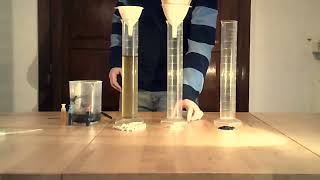
In this instructional video, the presenter demonstrates a simple, multi-stage water treatment process using everyday materials. Starting with heavily contaminated water (augmented with food coloring), she first allows particles to settle (decantation), then filters the water sequentially through gravel, sand (using a coffee filter), and finally activated charcoal packed in a cut plastic bottle to remove colour. At each stage she explains what impurities are removed and shows the visual improvement. The demonstration concludes with a clear warning that, despite the visual clarity, the treated water is not safe to drink without professional testing, emphasizing the need for proper water quality analysis before distribution.
Chapters
Hello! Today we will try to clean water. Yes, because the water that we draw from our taps has to come from somewhere. It can come, for example, from underground springs or from rivers, and we will not drink the water directly from the river. It has to be cleaned first, and that is what we will do. Now, here I have some water that is very dirty. It has flown through some soil So we have some really dirty water. To make it even dirtier, I've decided to add a little bit of food coloring. I stir it well. The first step to clean the water is what we call decantation or settling. We will first let the water rest a little, and that way the heavier particles like the soil or some little pebbles will sink to the bottom of the recipient. So we will first wait a little while to get rid of the biggest and heaviest stuff. Now, as you can see, the water has already been partly filtered. You can actually see here some particles that are sinking to the bottom of the recipient. But as you can also notice, even if a part has sunk, another is still floating in the water. So I will now start filtering the water with some gravel. You can see here that the biggest impurities, those that were still floating in the water and had not sunk to the bottom, have been trapped by the gravel here on the surface. There are, however, still impurities in the water here in the recipient floating about. I have a part that was filtered but not all. In order to filter these small impurities, we will need to filter a second time. And for the second filtration, we will use another funnel and we will use here a coffee filter. Why? Because I will now have to filter my water just like in a water treatment plant. With sand, and sand is made up of small grains, the filtering will be much more precise. As you can see, there's now some sand in my second funnel, and I shall now filter the water that has been already partially filtered. You can see that on the top of the sand there are the small impurities that had not been filtered the first time round. I pour some more. You can now observe the evolution of the dirty water at the beginning, the water that has been filtered by the gravel, And now the water that has been also filtered by the sand. You can see— well, see the evolution. Filtration has removed the biggest impurities and now the smaller ones. But the water is still not really clean. It will be necessary to go through a third step, a third filtration. And this third filtration I will carry out with some activated charcoal. The activated charcoal will allow me to remove the colour. Using the funnel is a little tricky as we need a large quantity of activated charcoal, quite a deep layer. So rather than using the funnel, I will use a plastic bottle. I have here a simple water bottle. I've cut off the bottom and I have filled it with activated charcoal. I have made some little holes in the screw tap. You see, very little holes. And I will now continue cleaning the water. I will continue filtering it and remove the colour. Now there, we have finished filtering, we have finished cleaning the water. I started off with this and I end up with that. Quite efficient really! But careful! Even if this water is much cleaner, it is not drinkable. A whole series of tests have to be carried out by the companies that clean water and that channel it into the water distribution network. So don't try to drink this water.