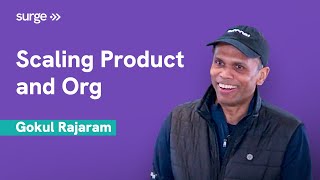
Gokul Rajaram on Starting a Company in the Age of AI

Gokul Rajaram says founders need a mission that's big, meaningful, and personally resonant, with co-founders who are complementary and enjoyable to work with. He argues AI-native teams should favor polymaths over siloed roles, and that senior engineers should return to individual contributor work to gain AI fluency. The biggest opportunity: applying AI to the physical world through robotics and infrastructure.
Chapters
I see a mistake founders make again and again. I started a company because I wanted to start a company, and I wish that someone had sat us down and said, guys, first figure out what you want to tackle, because startups are not a straight line up. There's all kinds of— everyone had near-death moments and painful— unless it's something you're really passionate about, you're going to abandon it, quit it.
You've had the chance to be part of 7 different, frankly, generational companies: Meta, Google, Block, DoorDash, Coinbase. When you're trying to construct a good team to take on a mission in startup land, that is in the AI sphere, are there other things that you need to considering when putting together like a team for AI kind of startups that maybe perhaps wasn't the case, I don't know, 5 years ago?
The technology itself can lead to interesting product breakthroughs if you live and breathe the— because the technologies underlying it, the LLMs are changing so rapidly. And I think if you just get somebody who's a good engineer but doesn't live and breathe this, doesn't understand all the breakthroughs that are going on as part of the founding team, I think it is hard to build what is called an A&M degree.
Welcome everyone to another edition of the MinusOne podcast, where we discuss kind of the lives and the stories of some of the most interesting and accomplished people in the world. I'm honored today to kind of like have Gokul Rajaram on the podcast. Gokul has had a legendary career kind of in Silicon Valley. I'd say you'd be hard-pressed to find a product that you have not used or been touched by as a result of kind of like the work that he's done. Gokul Rajaram, welcome to the podcast. Welcome to MinusOne. We're excited to have you here.
Aditya, my friend, great to see you again. I'm excited to be here. Thanks for having me.
Gokul, you know, I was just reading, you know, your website right before this, right? And it was one of the interesting, amazing lines you kind of start off with is that you've had the chance to be part of 7 different, frankly, generational companies, right? Meta, Google, Block, DoorDash, and so on, Coinbase. So in some ways, probably more so than most of us, you have probably been in that -1 phase more so than I would say most people, because I like to think that in between each of these kind of projects, these companies, you must have had a time when you're trying to figure out, is this actually something that is worth spending my time on, right? Like, is this a project or a company or a founder that is worth kind of like spending time on? So how do you in some ways, like, what is your mental model? How do you kind of figure out what are the important things for you to focus on, particularly, you know, now that in some ways you probably have a plethora of like projects that you could kind of pick from? So what is like, walk us through your mental model for picking interesting things to work on.
I think it's a great, great question. Great point. And I think a lot of folks today especially are between things. I think always there have been people obviously between things, but I feel even more so as this new wave of AI over the last 2 years has gotten many ambitious people thinking on what next. And essentially, if you think about it, I think of 2 things as the most important. One, does the mission— is the mission big enough meaningful enough for it to matter? So, and is it aligned with my own personal things that I care about? And now we can go deeper into each of those. And the second is, if it is a company I'm joining, or if it's, you know, sometimes a company I'm joining or it's an idea, who is it I'm doing it with? Is the team or the person I'm going to be working with or for, are they inspirational? Are they complementary? Is it someone I would basically enjoy I spending time with? And is it the right person that together we can accomplish great things and accomplish the mission? So it's mission and people. I think mission is number one in some ways, because I feel once you are aligned on the mission— and I think I made the biggest mistake in some ways, which proved to be good in retrospect, because I joined Meta, Facebook, back then when I started my company, Chai Labs, because I think And this, I see a mistake this founders make again and again. I started a company because I wanted to start a company. I was at Google, I saw a lot of people leaving to start companies, and I said, you know, it's something I want to do. And my brother had just gotten his green card, and he was a very good engineer. And I was like, you know what, we've never worked together, let's work together. I can be the product, I can be the engineer, let's start a company. So we started a company for the sake of starting a company. And what is crazy is that Silicon Valley enabled it. We were able to get money from Facebook's investors, even though we're not Facebook. We've got Accel, Greylock, Mark Andreessen, Reid Hoffman, all of these guys put money into us without even knowing what the hell our idea was, what problem we were solving, what we were targeting. And it was really bad in some ways because they were just enabling us. And I wish that someone had sat us down and said, guys, first figure out what you want to tackle. And I think it basically, without having a not-start problem that you go after, you basically, we kind of We're like the tree in the wind. When the wind blew this way, we blew this way, and then this way. And so we read something and say, let's go pursue this. And then we pursued this and that, and it was painful. And we ultimately glommed onto something, but I wouldn't say it was our passion. It was more almost necessity. We had to do it. And that's not a way to build a great company. So I've had so many people work for me, with me, who are like, hey, my buddy and I are going to start a company together. Is that what you're going to tell me? It's your buddy and you're going to start a company? Is that what you want to start a company because it's your buddy? Don't do this. And I'm telling you again and again, I see this, people make this mistake. So what is your problem which is meaningful enough and meaty enough that you want to tackle that for the next 10 years? It can be a north star for you to pursue that you're willing, because as you know, startups are not a straight line up. There's all kinds of—
so hard.
Everyone had near-death moments and painful unless it's something you're really passionate about, you're going to abandon it, quit it. Yeah, I think the only lucky thing was my brother and I were brothers, so we never quit.
You can't quit that. Yes, exactly.
So we could have just— one of us probably would have walked away at some point. It was so painful, also in the middle of the global financial crisis in 2008-2010. So I think it's mission and people, mission and people.
That's actually a great crisp articulation, and I'll get into a bunch of that. But first, Gokul, I want to give you credit. I think Chai Labs is actually a great name. Like, it is very evocative. Like, at least perhaps because I'm Indian, I just like the idea of kind of like sitting, thinking, having a chai, kind of like figuring out what to work on. So like, it's just actually a great name. So first of all, good credit for names, you know.
There's at least one thing we built which is happening.
It's a great name. Um, but you know, I think, Gokul, obviously I, I think, you know, at SPC we strongly subscribe to kind of this idea that startups are a— I mean, we'll get back to this. We think startups are a marathon, you know, it's a marathon that you're running at a sprint often, which is kind of like exactly. So it's kind of this weird combination where you are, you have to sprint for a very long time, but it is definitely a marathon, right? And so our take is that, man, like, if you're going to be running for a very long time, it's okay to take 6-9 months to figure out what is a race worth running. Right? Like, you know, put another way, you know, if you're so focused on scaling the mountain, what happens if after 3 years you figure out it's a wrong mountain or it's a small mountain, it turns out to be a hill, you know? And great mountaineers often spend more time planning the expedition than they do actually kind of like climbing the damn thing. So you're speaking, you're definitely, I think, very resonant with our worldview. You know, we've both been in Silicon Valley for a long time. Uh, you know, I've been in Silicon Valley for 20 years and you've kind of been around for almost 25-30 years as well. And one of the weird things to me is that, Gokul Rajaram, like, compared to even a decade ago, there is an order of magnitude more venture capital in the system today, if not more, right? And yet, if you ask me, are there like 10x more amazing, strong, big ideas being tackled, I'm like, I'm not sure, right? Like, it's weird where like the rate of like ambition is not increasing at the same rate of like venture capital. And I think a lot of it is because there is this big amount of impatience in starting a company where it's very hard to sit in the muck, sit in kind of the discomfort of like, you know, I don't know, I'm not 100% sure, I don't have a great kind of insight yet, I don't have a mission that I'm passionate about yet, right? So I guess, you know, from your perspective, here's maybe the precise question. I actually am curious to get your answer. Do you think it is possible to almost first principles your way into a great mission Or is that some amount of serendipity, intuition, kind of creative, kind of like the creative stroke that kind of comes to you? Can you almost will your way into a good mission? I'm curious.
You sometimes can, but ultimately it comes from a personal connection to it. I think, I feel if you look at, and many times if you look at these missions, they evolve organically, but it has to be something you're passionate about. And I think if you start a company just to start a company, I think that's a very mercenary way. And I feel that's not— if you look at Zuck, right, great example. He didn't start a company. He first wanted to just solve a problem for himself, and that became a company. Larry and Sergey, they just wanted to build a search engine, and then it became a company. So that's a crazy thing. Most of the companies I've been involved with— DoorDash, the guys just did a research project or a project for school at Stanford. The same with Jack and Jim. Jim was at Square. Jim was rejected for credit card processing, and they said, This is bullshit and we are going to solve this problem. And it became a company. So solving, I think trying to solve problems and then it morphing into a company is a great way. Because then versus like saying, well, I've read in TechCrunch that this market is this big and I'm going to solve it. And there's no personal connection, no authenticity in the story. I feel there has to be an authentic thing because if you don't truly feel it, you're going to always abandon ship when things get tough and things get painful.
Yeah, it's interesting. Oftentimes when people are in the idea maze, what I keep on coming back to telling them is that you kind of go back and figure out something that you're actually passionate about working on, solving. What problems have you faced? And this is why it's tricky because you often have to go searching back through either your work history or through your personal history. And I think that the thing that perhaps should give people hope, I suspect everybody has one of those ideas in them. You know, like, and you can get stuck. It's not easy to draw it out. But I think if you are kind of smart and creative, you have it in you. Some people, it might be more buried than other people. Some people are more natural, I think, at being generative and being creative. But I do think that those— that kind of well of creativity exists in a lot of people.
You know, one of the best ways I feel to force people to do this is if anyone comes to me with a B2B idea where At Square, one of the biggest challenges we had, unlike DoorDash, Facebook, and Google, was those are consumer companies. So as consumers, you could live the problem.
You could live the problem.
You're not a merchant. So we would force people to go and spend one week working the counter of a merchant, and it was pretty cool. And so I think increasingly I tell, okay, you want to solve the problem for an HVAC company? I want you to go and work for two weeks at an HVAC company and be the IT consultant there. If you can't, How the hell are you going to sell anything? Go and find a job and be the IT consultant. Go native, go undercover, and basically then truly experience the pain. And then come back to me and tell me what the pain points are. Don't just say because you read this, you interviewed— I want you to spend time in the shop on their side and then experience the problem.
Let me ask you a spicy question. I'm actually very curious to get your take on this. Perhaps it's because I'm bad at doing this. I have never believed that talking to users is that interesting. I would much rather get people to react to ideas and solutions. Because if you ask most people, because it's not the user's job to tell me what great ideas are. That's my job as a builder. Right? So I'm curious, does that resonate with you? Like when people say to do user research, I'm always like, to what end?
Yeah, I think there is a subtle thing here. My take is you interview people and there's a way of interviewing them. To uncover problems. You never interview them to uncover solutions. As you know, if you ask people for solutions, they will ask you for faster horses and so on, horse carriage. And the way to interview them to uncover problems is to ask them to tell stories. So in other words, for example, if I were to say, Aditya, why did you choose Netflix yesterday night to watch a movie? You might be hard-pressed to kind of tell me exactly why. Or why do you choose Netflix? But if I say, just tell me the last time you chose a movie, tell me about the process you went through, tell me the story. Well, we were sitting around, the kids wanted to watch something. I opened the TV. There's nothing on Xfinity or YouTube TV. So you basically go through the whole journey and then you're like, okay, so this is the journey. So the journey is what then it talks about the decision point, talks about the why. And so I like hearing the stories of what caused them to take a decision. And the story is a way to interview. So I used to try to use storytelling. Everyone likes to tell stories of what they did something. Richer, the better. And the stories have a lot of nuggets that help you uncover what pain they were trying to solve and what you can do to make it actually really good.
I mean, I actually think that even for my own personal kind of canon of knowledge, I'm actually going to stop calling it user research and I'm just like, call it user storytelling. Like, I just want to hear stories about users' lives, right? And about Frank Zappa. Yeah. And like, make it like mundane. So the mundane can be fascinating if you just like— actually, to your point, Dude, you had 3 hours. As a young parent, who has 3 hours to watch something? How did you— what did you do? Tell me everything.
Exactly. Tell me the context. What were you doing? Where were you sitting around? How did you guys even decide to watch a movie versus doing something else?
Exactly.
Let's go to that discussion. And so you just unearth a lot of— so you just get them to describe. And then obviously, thankfully, now with pendants, Limitless and so on, you can record a lot. So you don't have to— like, earlier I would be sitting and taking notes seriously. Now you can just record it with Granola or something like that, and then you can extract stuff from it.
That's amazing.
But you're right, solutions have to come from your own intuition, but the problems can be surfaced through these rich stories, hopefully.
Yeah, it's one of the weird dichotomies of starting a company where I tell people, to your point, the harder you are trying to start a company, the least probably you're going to be straight-line successful. So in some ways, you almost have to be a little bit light about it. You can't force it. You kind of have to let go to the process of serendipity. This is why I think at SPC, when people come in and if they've had a really stressful kind of job at a startup or like they were doing some, you know, something crazy, and then people ask me like, oh, this really fun person, you know, this really talented person joined SPC, what are they working on? I'm like, they're going to take 2 months to kind of just like unwind.
And I think it's a great philosophy, man, because I mean, I admire some of these accelerators. No, But I do think they quickly get you to pivot and you have a certain amount of 8 weeks to come up with an idea of pivoting. And that's hard.
It's hard. And like, my take is that like in the beginning, and I think the part that's tricky is that we don't know how to appreciate the fact that when your brain is being truly creative, it is making a lot of like interesting connectivity. But your brain also just takes a little bit of time because the day you, you know, when I left Facebook, for the next 2 weeks, I was just still thinking about Facebook stuff or Dropbox stuff when I left Dropbox, right? So, um, it's interesting. So you almost have to let go and be a little bit rudderless— not rudderless, you have to be less like straight-line directed, which is hard for us in Silicon Valley because we want to be in control, you know, like this is the key.
So many good ideas for people come in the shower or when they're out in nature or so on because you're not connected with something, your mind is free, and it's free to make these connections that would normally not happen because you're in a structured environment.
Yeah, it's interesting, you know, to your point, when you go talk to a lot of these founders, whether it be Larry and Sergey, whether it be Mark, whether it be, um, obviously, uh, Jack at kind of Square or Tony at DoorDash, you can boil— I mean, there's obviously a lot of mythology that gets created over time, but there is often a moment where you can boil it down to like some moment of frustration and serendipity and then intense activity following that moment of creation. And then after that, there's a lot more company building. And I find that fascinating because at its root, that is what creation is, where there is that spark of, in some ways, creativity and innovation.
I think one of the most interesting conversations I've ever had was Dylan Field at Figma.
Oh, God.
I met Dylan in 2012. In fact, I was at Facebook. He came to have lunch with me at Facebook. And the guy, I could just see he had an obsession with design. He had dropped out of Dartmouth, if I remember, or Brown or somewhere, and he was living at home.
Either Brown. He was Brown.
Yeah, he was at Brown. And I had used Photoshop at my startup and it was really crappy. I couldn't even download it properly, use it on my IBM laptop back then. And Dylan said, I have Photoshop. I have a better thing than Photoshop running on my browser. I'm like, no way. I don't believe this. And then he showed it to me and it was super fast. And it actually worked. I played around with it and you could just see the subtle touches he had around design. There was no sharing capability, nothing. It was simply a single user mode, but it was Photoshop in the browser and you could see it was better than Photoshop in many ways, not fully baked in other ways. And that passion for design, passion for him, coupled with the fact that the guy, I think he had one other person on it, was able to build this.
Evan.
Yeah, Evan, exactly. And just that instantly, that was one of the meetings where—
You know, immediately, you know, immediately, like, this person, you know, it's— I mean, one second on Photoshop. Honestly, I bet this is— Photoshop is one of those pieces of software that 98% of people who have heard of Photoshop have never figured out how to use it because, like, the complexity of the layers, all of the things, you're just like, most— and I'm a software engineer, and I have never really used to use Photoshop, right? It's too complex. But Figma, it's in the browser, nothing to install. Within 30 seconds you'll figure it out, right? And that's incredible.
Think of it, it came from his passion over years. Yeah, his passion for design led him to this. It's almost a natural thing. You can extrapolate young Dylan.
Correct.
Yes, that's the kind of company he would start because, you know, so—
and Dylan is, I mean, he is truly passionate about design as a craft. Like, he just believes deeply in it. Um, And, you know, to you, one more thing that you said, which is that the, you know, kind of the— and this is— it's hard to kind of give people this advice about something, but the best founders have insane fractal knowledge and obsession about what they're working on. It's not because they just want— that's the right way to do a company. It's because they're genuinely deeply curious.
You're absolutely right. In fact, Colisons, I believe, went and got a book on payments from the 1950s. Yeah. And looked at, completely read the entire history of the payment industry, why it worked, interviewed every person they could find. And this is the thing, your point about the idea maze. I ask all kinds of random questions to understand why did you approach this? Because they've taken— most founders have a specific approach to solving the problem. I always ask them, why couldn't you take this other approach, random approach? And I want to understand how deeply steeped are they in the history of this problem. Why haven't they— they're so excited about this problem, why haven't they gone super deep? Exactly, super deep. Why is this approach not? So they have a very well-reasoned answer for how they navigate the idea maze to get to this way, this wedge, correct? Tackle the problem first was this other wedge. And you're right, it shows in the passion, it shows in their understanding the history of the industry, of the problem, of the pioneers. This problem, I promise you, someone would have tackled it in some way, shape, or form before. Yeah, none of these companies— Search was not the first one, Facebook was not the first one, Square was not the first one, the first delivery engine— they've all been tackled. Why is this better? What is the problem with future? If you can't tell that, hang on, you don't know what the history of what you're doing is. That also is an interesting—
And perhaps maybe the way to frame this into advice for founders is that if you are not that obsessive about something, you just might not care enough about— this might not be your mission. This might not be your mission if you're not that passionate. Listen, You're either the kind of person who's really into HVACs or you're not. Okay. Like, if you're into HVACs, you'll probably figure out why heating and cooling is such a big way for expanding, frankly, like, geographic colonization of the world and living in different places. It's been a big boost to human productivity. Like, it's actually like a really deployed piece of technology, and it's really important to do it cost efficiently. There's a ton of money that goes into it. But if you're not a nerd about it, then maybe you just don't care, and that's okay. Go find something that you actually want to be obsessed with.
You should live, living and breathing within the HVAC community if you really of building a company. I mean, the ServiceTitan guys came from a family, I believe.
I know, exactly.
Attract people, right? I mean, their families, they lived and breathed it for many years before ever doing it.
And they're truly— if you talk to Ara, and you— I mean, I've kind of got the chance to kind of like, I would say, help them with a bunch of CTO-related stuff over the years. I mean, whenever he asks me a question about how to build the engineering organization, it is— he's very honest. Like, listen, I am building HVAC-related kind of like, you know, end-to-end software I'm building. And so I don't want a general-purpose great CTO, I want a CTO who's great for this. I'm like, that's well framed. Very few— like, not every CTO is going to love this, right? But when they do, they should be super obsessive about it. So perhaps to switch gears a second here, do you think that there's enough of— you've obviously, you know, you're familiar with the ecosystem in India as well. Right. Um, and so one of the things— we started SPC in Bangalore about 12 months ago, and it's been awesome recently, and there's definitely a buzz around it. Okay, I appreciate you saying that. Um, and I've just been blown away by the quality of founders, just like the raw talent in India. And I think the big— one of the questions that I'm trying to figure out is like, how do we more fully embrace this idea of illegible kind of like early, like somewhat weird ideas, go deep, right? They might be not like— and don't just focus on the operationally heavy businesses, also go for places where there's true technology and product alpha, right? So I guess perhaps other pieces of advice you would give to the ecosystem in India in particular on how to create these seminal companies, uh, that I think India definitely has a raw talent for, but today I think sometimes we— you know, everybody's talking about like where the AI companies out of India and so on. So I'm curious, what advice would you give to the ecosystem in India?
I think the number one thing is being patient. I think Indian society in general, including parents, which are a big part of the ecosystem, there is a lot of focus on role models. So I think the more every role model— Flipkart, a role model, the Bansals basically led to a million e-commerce startups, and that became legitimized. Similarly, Uber or Ola, Ola, OYO, etc., they created another ecosystem. So I think financial services grow and Zerodha, they create another set of— so I think if you look at the top Indian companies, they're either financial services or e-commerce. It's because the pioneering companies that inspired them. So I think we need one or two winners in deep tech out of India, which are basically— so I think we need patience. There are some good ones, there are some space tech ones, there are some other ones. We need a couple of them to win. And the good news is Economic Times and other newspapers and media broadly, not just Economic Times, but Internet does a good job of making these heroes broadly accessible. And there's enough people, they just need role models. I think in general, Indian youth, it's because I think very various societal pressures, but you need role models to show it's possible. And then there is going to be—
that's a good way of articulating it.
Even Arvind from Perplexity, he's a role model. You could argue that obviously he's done it in Silicon Valley, but having him go to India and spend more time in India, people do think of him as a role model. I've heard Many times people mention so many folks like you. I mean, the more you go and more we spend time in India, Arvind, there's more and more Indian founders of global companies, founders of global companies out of the US. There were not as many earlier. I think there were more B2B kind of companies, but now they are founders of consumer companies, consumer companies that are used globally. That's a rarity. And I think the more we can say that global companies can be founded by people who have similar backgrounds to you, You have no— and talent is there.
Talent is there. This is a good way of articulating it because you're right, because the positive way of stating this would actually— I mean, sorry, the one-way interpretation is when you can point the talent towards like a good kind of, kind of in some ways a good persona to kind of get inspired by, then, you know, you can actually— we can make that happen, we can enable that, right? And you're right, like in particular some of the deeper tech stuff in our portfolio in India around drones and kind of space and kind of like flight, essentially. Uh, they're very interesting companies, and we have one in particular that I'm very excited about. He's started by a guy called Sri Purna. And so I think that the— I mean, he's kind of building essentially like high-altitude essentially drones that can carry like 200-kilogram like payloads or something, right? And this is, if done well, this could actually be something that is obviously very relevant in India but globally. And this is just a young team, kind of out of IIT, I think, Madras, like 22-year-olds who can kind of pull this off. So that's kind of the role model, right? Which is this true technology, this true daring, this true ambition. Very interesting.
Get him a good mentor. Connect him. I think connect them with these promising people. Connect them with good mentors who they can look up to, aspire to. Every one of these people should get a mentor that they can be coached by. I always say one of the things that every founder— I mean, Tony was excellent at that. I don't know about Zuck. I'm sure Zuck. Zuckerberg, Peter Thiel was his mentor, right? I mean, yeah, you know, always like, who's the mentor? I mean, he had so many offers to join boards, but he took the Meta offer, I think, because he saw that he can learn a lot.
Yes, I mean, like, Mark has always— Mark has always built an incredible board, right? Like, between, like, you know, Mark Andreessen has been on the board for, gosh, like 18 years or something. That's right. Yeah, Reed Hastings back in the day. And even today, like, you know, his board is a little bit— I would say, um, uh, you know, his board is definitely somewhat unique in, in terms of like the setup, but he's clearly bringing people onto the board that he wants to learn from, like Tony from DoorDash, right? Or Patrick now, right? And I, you know, I've seen Zuck over the years. When Zuck gets into learning mode, as you know, he kind of gets locked in. He gets locked in. And I, you know, I always tell people that the— I mean, I've Mark is obviously a dear friend. I've known him for a long time, but what's incredible about him is that he learns faster than most people, you know. So it's not just that his clock speed is like already very high, is that his desire to kind of get better is also very high. And he, he just is like a sponge. He will just kind of like start peppering you with questions, examining his own beliefs. Uh, it's remarkable.
Um, coming back, many, many successful entrepreneurs— I think this might be one thing In India, you're judged on how well you pass or do well in exams, but the reality is you need to fail. And learning involves having a beginner's mindset, acknowledging that you don't know anything, and humility. And that's the thing. I think he's perfectly fine saying, I don't know something. And ads, for example, when I joined, he didn't know much about ads, but my God, he was just— by the end, some of the best ideas in the ads team came from Zuck because he understood what ads was all about.
You know, it's funny you say this because I always tell people life is so much simpler when you have a beginner's mind. You don't have to be smart about most things. You can kind of be like, listen, I'm here to learn. It is so exhausting when you have to pretend to be an expert at everything, you know. And I think that like, this is one of the parts that I love about, well, Silicon Valley, but in general about our culture, which is that it's okay to kind of admit you don't know something. Like, it's actually much easier to be like, this is what I know, This is the extent of what I know, and I'm here to learn. And I think we can take it off.
You are very successful. So I think I've seen that the more successful you are, the more comfortable you are. You don't really owe anything to anyone. You're not in an organizational structure.
That's true.
If you're coming up and you're striving as a product leader, that's a challenge, I think, within an organization.
Well said, because I judge the people who work with me sometimes. You're right. Because I'm like, how do you not know this simple thing? You know, you're right. No, you're right. I, I, fair call out, fair call out, because there is a method. Like, because, yeah, no, you're totally right. And I appreciate kind of the more successful you get, the easier it is to not give a fuck.
And I think when you're, when you're exactly NGAF. Exactly.
Interesting. Uh, let me switch gears to AI, okay? Because I think we're living in super interesting, weird times where not just the nature of what we build, but also how we build. It all seems to be shifting. So let me come back to your mission and people kind of framing. Let's talk about the people part of it for a second, maybe the team part. When you're trying to construct a good team to take on a mission in startup land that is in the AI sphere, there's a lot of things that you want to make sure, you know, there's values alignment. Obviously, both sets of people are aligned on how hard they want to work. Like the modality of working. And I think— but are there other things that you need to be considering when putting together like a team for AI kind of startups that maybe perhaps wasn't the case, I don't know, 5 years ago?
I think one of the most interesting things in AI, I feel the technology itself can lead to interesting product breakthroughs if you live and breathe the— because the technologies underlying it, the LLMs, are changing so rapidly and coming up with Computer use was not a thing till one year ago, and it's become a huge part of many things. Similarly, if you look at multimodal stuff, vision, voice, and some of the other things, I think image processing and so on, they've become much more advanced, document processing, et cetera. So I think you need truly someone who lives and breathes it. And I think if you just get somebody who's a good engineer but doesn't live and breathe this, doesn't understand all the breakthroughs that are going on, as part of the founding team. I think it is hard to build what is called an AI-native company. In general, if I look at the founder persona, I am seeing you have a much broader vantage, but I'm seeing the lack of one specific type of founder archetype I used to see. I'm seeing a lot of very young kids who are right out of college or in college. It's crazy. A bunch of my kids are in college and some of their classmates, I see them pitching me. I'm like, holy cow, 20-somethings, they're fearless. I mean, they've grown up with AI. Another one is people from research labs and they've been in DeepMind or FAIR or something. That's the second persona. Third person is repeat entrepreneurs. They've had a moderate success. What I'm seeing less of is people with 5-6 years at a company. I think they are more nervous. Why? Because they came of age in a company which was not AI. They've kind of gotten to a mid-level manager role. And now they're like, okay, so I'm not seeing those people raise their hands and start companies. So that persona would be a very active entrepreneurial persona 3-5 years ago. Now I'm seeing much less of those kinds of people.
At least in our SPC part of the world, we are definitely seeing all of this play out. We're definitely seeing more younger folks, basically people who don't have any shit to unlearn. There's no baggage. There's no baggage to let go of. They're smart and they're kind of like first principles. They'll just learn the new thing. And number 2 is the repeat entrepreneurs, the basically the people who have already in some ways, you know, that they have grit, resilience, and kind of like drive. And they're like, oh, this is a beautiful time of platform change to go apply something. But we are seeing less, you're right, of like kind of the whatever, like, you know, the 7, 8 years at like a high-flying company or like a unicorn who— because for them it is unclear if what they are great at actually is that interesting or relevant, you know? Like, frankly, if you have spent the last, you know, 10 years at a place like, you know, places that we love— Facebook, Google, Meta, and Google— I often wonder, I'm like, man, were you doing things the old way? Because I suspect you're doing things the old way, and in fact, like, your old way is going to get outcompeted by somebody who's not going to have that baggage.
Um, and the same— I mean, I think one of the hardest— I feel in some ways sad that I'm not in the job market or not working in some ways, that because it's such an incredible thing to actually work in. But I also feel, man, the skills— I mean, the head of product role, these are some later stage companies, is one of the hardest roles to hire for today because everyone wants people who are fluent in AI. How the hell are you going to get a head of product who's fluent in AI? Most people who are fluent in AI have 1 or 2 years of experience.
Exactly.
They're not necessarily head of product. So it's that I have seen a lot. In fact, I tweeted about this. A lot of people have gone back to becoming ICs, and that is what I really want to see.
Yes, I think this is a good thing.
Go back to being IC, go back to being an IC, learn the basics, work at that kind of engineering product, whatever it is. It shows humility, it shows a beginner's mindset. It shows— because of people management stuff, you'll get back if you're a good people manager. It's not going to go away. It's like riding a bike. But understanding this new thing, you can't lead a team unless you know the technology, unless you know how the damn thing works.
Yeah, yeah.
And so go and build some real hands-on skills and show that you can do the shit work.
I completely agree. And you know, it's interesting because I think coming back to you, you said this in passing a little bit, the only real way to become an AI expert today is to just use these damn things all the time. All the time. Like instead of reaching for your default like workflow, use AI to do it. Build a small tool. That is the only way that you can figure out what the limits of this technology is. And it can be frustrating because it will feel like you have to go slow to go fast. But all the truly AI-native people are just using this all the time. And I think that is literally the only way to learn because nobody has built up tribal knowledge that you can learn from yet.
Julie Zhao, actually our dear friend and colleague from Facebook, she basically had a very good podcast a few days ago where I think she said something that really made me think. I had been thinking about it, but she articulated it well. She said that— I think she said the Captain Planet model is breaking, where she said there are all these planets— product, engineering, design— which used to be traditional pods where you have a product person, engineering, design, analytics. Now you just have 2 or 3 people who are all builders and you can't classify them. You can't say, is it a product person, engineering? So increasingly hearing this need for polymaths, Design, hey, you know what? I also want you to be able to do some frontend engineering. I want you to be able to understand product and customers. Product, I want to be able to understand engineering and so on. Maybe you're better at one or two, but you need to know, you have to have a T-shape more and more and more. Maybe you spike on one thing. And Julie was taking to the extreme saying everyone has to know everything. I think there's still some esoteric things like building an iOS app. If you want to do that final thing, you need— I had a guy who worked for me who was an IC8 or IC9. IOS engineer, and that's the only thing he did. He didn't know anything about backend, but he was damn good at that, and we needed someone like that. But maybe you need one of those for a company, one or two of those amazing people. But everyone else is a polymath who's able to do a bunch of things. You need one designer specialist who can make sure design rules are there.
Now you're making me want to go— I always tell people, I think I was a pretty good engineer.
You were a damn good product guy and a damn good designer.
But I was more like, I kind of like to do a bunch of different things. So perhaps I should go back and get more leverage. But to your point, I think that's actually really well said by Julie and articulated by you as well, which is like, I think today if you're not actually feeling that you can cross over like the prior boundaries you set for yourself, like you are then not using AI correctly, right?
Actually, I would say then let's go back to our founding team. The founding team, just like we expect the hustler and the hacker prototype, the hustler, we expect them to do sales, marketing, everything. The hacker actually should be able to do many different things.
Correct.
It's not a pure engineering. It could be someone who's engineering, product design. We expect them to do many, many, many things.
And honestly, like today, if I were running an interview for like kind of like a founding engineer, or maybe even a founding CTO if you wanted to, right? If you give them a problem and they don't return you a pretty polished end-to-end up and down solution within 2 hours, like then what? Like that means they're not using AI correctly. Like, because like the AI can— like, it should allow you to do that, right? Um, and if they cannot speak intelligently about the nuances of GPT-5 for coding versus like, you know, Opus 4.2 and where it excels, where it doesn't, why they might like, you know, Replit versus Windsurf versus kind of like, um, Cursor— like, that means they're not actually thinking about the tools hard enough, you know?
Like, um, this is why there's so much AI fear. I mean, in some ways, because not only do you have to do your job on a day-to-day, but you've also now got to learn a new way of doing things and stay on top of this incredibly fast-moving cycle with dozens of companies, with dozens of new tools.
I mean, Gokul Rajaram, like, I used to be a very avid reader. Like, I used to try to read, call it, like, you know, a book every 2 weeks. I haven't touched a single book for the last 3 years, or actually 4 years, because I'm like, listen, I, I, I, as an investor, I need to know what's happening. Right? So every spare moment I'm learning about, like, you know, these models, playing with these models. And there's a sense of, like, you're— it's this— maybe fear is the wrong word, but there is a sense of, like, being overwhelmed. There's a lot going on, right? Like, no matter how hard you try, you cannot keep up with everything. You try your best, right? Uh, but we live in, in very, like, profoundly, in some ways, fast times right now. In a way that I've never seen.
Unsettling.
Yeah, exactly. Gokul, we could go on for a very long time. Yeah, this is, this is fun. Um, perhaps I'll ask you, uh, one question to kind of finish off here, right? Um, if you— what are, you know, if you could, you know, we talked about kind of your Minus One stories, we talked about obviously the team, we talked about a little bit how you construct good missions. But if you could almost put a clarion call out into the ecosystem for, hey, these are some missions that you want to see get tackled, what would you ask people to think about?
I would like to ask people to think about, broadly speaking, AI and the physical world.
Yes.
I feel we are living a lot in the digital world. The reality is the physical world is— and there is a lot of things that are wrong and busted and failing and can be done better with AI. So I'm a huge fan of AI projects, whether it's for defense resilience, whether it's for building dams, better humanoid robots. How does AI manifest itself in the physical world? And I think that's the other part of being a polymath. I think all of us learn computer science, electrical engineering, and mechanical engineering, but a different beast. Now, I think Elon is one of the first few people that has built a company that transcends all of that. I think we're going to have to really bring a bunch of disciplines together. Computer science is not just in this thing, toy world. How do we fuse electrical, computer science, mechanical engineering, all of those together?
Yeah, I mean, I think as a computer scientist myself, right, like the challenge to me has really been like, you know, which is known for robotics. Robotics, I know. So like my take is like, my God, like why can't we all build robots? Actually, probably the biggest area of investment for us at SVC, uh, like the new area of investment for us over the last, call it, 2 years has been kind of like physical, like physical world and AI. So robotics, drones, foundation models specific to the physical world and so on. So it's a very exciting time there. And honestly, even if 10% or 20% of all of that stuff comes to fruition, our lived experience will be very different.
That's right.
That's right. Well, Gokul Rajaram, thank you. You know, like I said, we could continue talking forever. Your wealth of experience, you know, I feel as though I've learned a bunch. I'm kind of going to change some of my, like, you know, mental models on how to think about you know, great founders and great things to invest in. But thank you as always for everything you do for the community. Thank you for sharing some of your stories and your tips.
Thank you for starting SPC. It's an incredible thing for the community. Thank you.
I appreciate you saying that. All right, thank you. All right, take care. That was another episode of Minus One from the team at South Park Commons. Make sure to subscribe to our show wherever you listen to podcasts and find us on social at South Park Commons. And thanks to our friends at Atomic Growth for their support in bringing this episode to life.
More from Gokul

Gokul Rajaram on the 8 Moats Companies Need & Why Dropouts are "AI Maxing" the World




#80: Becoming an IC again is how products leaders will stay relevant in the AI era | Gokul Rajaram
#80: Becoming an IC again is how products leaders will stay relevant in the AI era | Gokul Rajaram


What I Learned Working for Coinbase, Pinterest, Facebook, & Google | Gokul Rajaram
What I Learned Working for Coinbase, Pinterest, Facebook, & Google | Gokul Rajaram