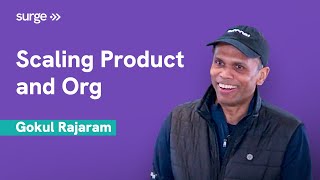
What I Learned Working for Coinbase, Pinterest, Facebook, & Google | Gokul Rajaram

Gokul Rajaram, who worked at Google, Facebook, Pinterest, and Coinbase, explains what he looks for in startups: a product that's 10x better on one dimension, authentic market insight, and hyper-focused customers. Red flags include poor industry understanding and large founding teams with unclear ownership. AI will speed up prototyping and reduce junior engineering roles, but enterprises will migrate slowly.
What's a red flag that you often see within a deck?
Number one reason for failure is founding team breakup. The larger the founding team, the higher probability is that the founding team is going to have a breakup quite early. The second one somebody not having an understanding of the industry they are in and I want people who can truly articulate the idea maze and why they've navigated the idea maze in this way.
Go cool.
Roger Brown is a prolific investor and board member of global organizations such as Pinterest and Coinbase.
You've worked with some of the most successful founders of all time. What separate a truly great, exceptional founder as opposed to just an average one?
The common thing they all share is.
Welcome back to Decoded. My name's Alfie Wattam and this is the show where I speak to experts about what it takes to build great teams and companies. Make sure that you click the Follow or Subscribe button for more great content like this and I hope you enjoyed the episode. Gokul, you're an investor in Airtable Deal, Figma, Vercel and so many other exciting companies. What do you look for when deciding to invest in a startup?
Well Alfie, one of the interesting things about most of these companies I invest pretty early first of all. So at the stage I invest, it's basically you have a founder, you have the beginnings of a product. So the two things I look for is does the founder have an authentic earned insight into the market that they are targeting. So trying to understand what makes this founder a good fit for the market, the customer segment, the pain point they're going to go after. So what is their reason to start this company really barreling down into the authenticity of what they're doing. Second, is the product remarkable? Does it solve the pain point the customer need 10 times better than what already exists and what can exist. And I think that second one, ultimately you need go to market all of those things. But the kernel of a great company always starts with a remarkable 10x better product. It doesn't need to be 10x better on all dimensions. It needs to be 10 times better on the dimension that matters to customers when this query was launched. And I think that's why segmentation and understanding your customers is so important. You can't be all things to all people, especially to start with. So you've got to have a hyper focused segment of customers that you are much, much better at even if you end up underserving everyone else. So for example, it could be ops managers at seed stage fintech startups in San Francisco, and you're just building a product for them, but that's fine. So I very much believe in hyper focused, hyper specific customer segments that you're solving very, very clear problems for much better than anyone else.
Okay, so the niches, sorry, the riches really are in the niches. And you can have a huge TAM in a very, very segmented, focused area. And if you can build something times better, and I believe that you can, especially with AI, I think basically every large incumbent is going to get seriously challenged by people that build, you know, variations of their business model from the ground up using large language models, a tenth of the cost, ten times the speed and execution. So I understand the remarkable product aspect when you talk about earned. Was it earned? Interest was the word that you used to insight. Sorry, what about people that don't have experience working in a particular domain? I worked in recruiting for a decade before I started my AI agent for recruiting company, for example. So I, I had that from, from doing that and being in the weeds and knowing that space extremely well. But what about somebody like, like a Zuck who has never worked, he's a university dropout, he never really worked in that space before. How do people get that insight without doing it and actually being in that space?
Well, the good news is, look at Zuck, Mark Zuckerberg, he built a product for consumers and everyone's a consumer. Consumer products are different because you are essentially trying to solve your own problem. And so he had a problem around trying to find what the faces to associate the names were in his class and he built a product for it. So I do think, I think consumer products are different than business products. I do think going after a business like trying to build software for H vac, which is heating and cooling systems, trying to do that, you better. If you just Suddenly read in TechCrunch there's a good space and you try to build a product, I don't think you'll succeed. I think it's much better to go and spend three months of your life working at one of these businesses, understanding the pain points and then going out and building. I think you'll also know whether or not this is a space you can actually build a product for and build a company and do this for the next 10 years. Like, you know, you've got to really enjoy the work you do, I think, and you can't really enjoy something if you only have a theoretical idea very quickly you could realize, oh man, this is a much more painful industry to be in than I thought. You've done recruiting for 10 years. So you know exactly what you expect. These are your people. Selling to them, engaging with them is something you've done, you love. So it's much easier to love this because you know what you're getting into.
And you have to, right? I mean, Steve Jobs famously said that you're going to get in the hit in the head by a brick. So you have to love what you do because if you don't, you're going to quit, you're going to give up. It's too hard. And that's the thing about missionaries versus mercenaries. The missionaries are usually the ones that make all the money because the mercenaries, they're in it for the cash, but they don't have the persistence and the grind to stick it out when it gets hard. But the people that are passionate about it, they'll do anything to succeed. So that's what you'd like to see, right? What about the flip side? You've reviewed thousands of pitches from investors and entrepreneurs. What's a red flag that you often see within a deck?
I think a couple of things. One is the opposite of this, opposite of what I just talked about, which is somebody not having an understanding.
Of.
The industry they are in. And the way you test it is by basically everyone goes, when they tackle an industry or a customer segment, they approach it a certain way. You want to really understand that they have navigated what I call the idea maze and they have a very clear sense in the head of why this other approach wouldn't work. So for example, if you're building a product for ops managers, seed stage fintech startups, why did you not select ops managers at seed stage software startups? For example, you want to ask these questions that really get you an insight into why they chose this specific path to navigate the idmas and not the other parts. Why did they rule them out? And so you want someone who can articulate why this is the best path to get to that, you know, get to that rainbow, you know, the pot of gold at the end of the rainbow. Build a compelling company. And so I want, I want people who can truly articulate the idea maze and why they've navigated the idea maze in this way. The second one, which is an interesting tell, is when they start, I think when you see very large founding teams, I think I do feel the larger the founding team, the higher probability is that the founding team is going to have a breakup quite early. Number one reason for failure of companies is founding team breakup. And companies don't necessarily fail It's a pretty big blow to the company and then you've got to survive it. So very rarely have I seen three or four person founding teams survive as a founding team after six months. So I think I like two person founding teams a lot. I do, for example, believe that it's very hard if you don't have all the skills needed in a founding team to both build a product and market and sell the product. So you do want complete founding teams, but you want complete and ideally small founding teams. You don't want complete funding teams that are six people or eight people or something. That said, there are situations where there's a single founder and there's a bunch of founding engineers. I think that's a different situation. I'm talking a situation where three or four people have come together and started the company together and they're equal founders in some ways. And so it's also hard to figure out who the decision maker is. And so I think the founding team and the composition of them and you're like, okay, you're a four person founding team and you have no one to actually go to market and there's a lot of unclear, there's a lack of clarity around who owns what in within the founding team. That's the other thing I've seen not work well.
This is a quick message to tell you about my company, Alpha AI. We built Lisa, the world's first AI powered recruiter who screens candidates for you on autopilot. You can make your recruitment process 10 times faster, 90% lower cost and significantly improve the candidate experience, all with our AI agent for hiring. Learn more@welovealpha.com or click the link below in the description. And now back to the episode Gokul. Do you think that will change in the world of AI agents where an idea guy can in a couple of years from now tell a lovable or a bolt or a replica to build him a B2B SAS. And right now it's a bit of a meme. You can build something very basic, but it's pretty incredible how quick these tools are advancing and who knows when you know, Cursor and Claude will get to a point where basically anybody can just build something using plain English. Do you feel like that dynamic where the two person, maybe three person team being the holy grail will change and maybe a single person founder will be better because then you don't have a risk of them breaking up.
I think it's possible to prototype with these tools and I think you always, even today, even within larger companies, you see product managers doing prototyping with these tools. But I think you're going to see prototyping because I do feel the right way to in many cases build companies, especially the application layer, is instead of you building features, launching, hoping someone buys, etc. You talk to potential customers or you understand these customers well. You then resell or get strong commitments with a prototype and then you build an MVP based on the fact that there's commitments. Heck, even Tesla has done it right. We've all put down $1,000 ahead of time. So Tesla will say, here's the spec of a car, do you want it? And then you put a commitment. So I think that's a. And so how do you build these specs or prototypes? You build this with these tools. I do think to productionize it, to run it, to host it, to improve it. I think you need engineers. I think it's going to be hard. But the reality you don't need to hire them, maybe till later they've actually validated demand, gotten paying customers, gotten a few iterations of prototypings and early, early product stuff. So I do think they're going to get really good. But for many application level companies now, for infrastructure and security and those middleware stuff, it might be harder. But for app layer companies, I absolutely think they're going to be tools that are used by entrepreneurs to move fast and validate customer demand.
Do you think those application layer companies will be hiring more or less engineers as we kind of move forward over the next couple of years, given the advancement of these tools?
Great question. I've seen two models. One, you hire a smaller number of senior engineers. So Instead of hiring 10 or 15 engineers, mix between junior and senior, your AI tools are taking the place of a junior engineer. And so you hire maybe three or four senior engineers. The other way, other one to do is you hire mid level engineers and you give them these tools to get them to operate like senior engineers because they are up leveling the skill set. But either case, you're right, you hire fewer engineers. I think companies, depending on their ability to hire engineers, are either hiring mid level or senior engineers. I think the junior engineer jobs are going to be the most at risk. And so I do think this is going to lead to a vacuum because how do you get a mid level engineer? You start with a junior engineer and they have a few years of experience. If you're not hiring junior engineers giving them experience, how the heck are you going to 10 years from now creating mid level and senior engineers. So I do feel, I do worry a lot that the computer science fresh grads of today being unable to find a job easily will result in a dearth of mid level and senior engineers. 10 years out.
Okay, makes a lot of sense. So Gokul, you've worked with some of the most successful founders of all time. Like you're currently a board member for companies like Coinbase and Pinterest, you know, plus you've previously held leadership roles at Doordash and Square, Google, Facebook. So what separates in your eyes like a truly great, exceptional founder as opposed to just an average one?
It's so interesting. I think first of all it's important to know I have been lucky to work with some of the best founders in technology. It's very interesting. All the founders I've worked with, each of them has a separate superpower. Their superpower is different and is uniquely suited to the company that they're building. And so I think what the common thing they all share is relentlessness and an impatience which almost is in some ways a lack of complacency. I have truly never seen Zuck, Mark Zuckerberg or Larry Page or Tony at Doordash or Jack Dorsey at Square. I've never seen them being complacent. So even if, even when the company was hitting, you know, each of those companies or products are hitting some new goals, they were always paranoid, hungry and basically looking to the next horizon. So I think lack of complacency, even though you're like, oh my gosh, the company has accomplished so much, they're like it's accomplished nothing. And so Mark, for example would always say we are less than 1% done. And he would show it in his actions. I mean he's probably one of the youngest self made, not just billionaires but far beyond that. And its company is a trillion, $1.5 trillion company. Yet I'm sure if you meet him today, he will be focused on how do we win in AI as if all the things that he's built over the last 20 years don't count. It doesn't matter, it's the next thing. So I think they're always perpetually dissatisfied. Mere mortal CEOs I think get satisfied, happy and they basically show it and celebrating things and so on. They're just very bad at in some ways celebrating milestones. They acknowledge them but then they look, they always use that as a way to say what's the next thing? I remember when we hit at Facebook there was a long time goal, 10, 15 years ago hit a billion maus at the company. But as soon as we hit a billion maus, I think there was a small acknowledgement. But then within a couple of days the new goal was a billion daus. And we were like, okay, I was thinking, hang on, we were trying to get this here for like seven or eight years and literally seven or eight years worth of striving to get here. And then literally the goal is now goal post has changed and I'm sure the goal is much higher now. But so it just shows you the goal posts are always moving for them and it's for them. It's not about money. That's the other thing I think they're not focused on money. They're focused on really achieving global impact, worldwide scale, winning in a way that is outside of money and riches and all of those things. They don't care about that. They care about a vision of the world that they have in their brain and how that can be fulfilled or satisfied.
Okay. I love it. I love it. You mentioned AI then and I watched your episode on the AFI and Sriram podcast where you were talking about artificial intelligence a few months ago. How do you think AI will change the world over the next five years? Have you got any kind of key beliefs or predictions that you think will happen?
I think right now what is crazy is that enterprises are under investing in AI. I recently learned that in 2025, AWS's top priority for enterprises is not AI, it's number three. Number one is cloud migration is literally in 2025, enterprises have still not migrated to the cloud. They're still using on PREM software. So if that's the case 15 years after the cloud was essentially scaled, you can think how long it's going to take AI to permeate enterprises. Not Silicon Valley or technology companies, but the normal business. So I think it always takes longer than you expect, but once it happens, it goes vertically, asymptotes vertically. So I do think it's going to go. What is crazy is that a huge percent of people in the world are already who have connection, who have internal connectivity, which is basically everyone are using some kind of AI agent, whether it's ChatGPT, Claude Gemini or something else. But on the business front, not enough people are using it as employees outside of ChatGPT. So I think the work of business, the work of enterprises and large companies and employees within those companies using these tools is basically still absolutely fallow. And I think that's the biggest change you're going to see over the next five years, enterprises being transformed with AI just like our own lives, consumer lives. I mean, you think about companions, you think about counselors, you think about essentially what we're using these things for on a day. You think about search, everything. I mean, I bet that 20 to 30% of our time from other tools has now been pulled into these things on a consumer level. But on a business level, I think it's far behind. So I think that's going to be the big transformation. And that's where you're seeing companies like yours building tools that enterprises and companies can use.
Yeah, no, absolutely. You mentioned there about counselors, for example, that's like a service that somebody would offer which is now starting to be automated through software. So rather than us looking at the TAM as software as a service, do you believe that with AI agents we'll move into more of a service as a software type approach where the market is no longer just hey, how can I out compete somebody building this accounting tool? But how can I out compete the accountants and build software that can automate a large percentage of that job? And then we're not talking about time being this big, we're talking about the global labor market being the opportunity as we're going to agentic workflows.
That's exactly right. Most of these tools start out being co pilots which augment humans. But then quickly they start making it so that you don't have to hire new humans to do the job. And maybe over time you can even start trimming down. If someone leaves the role you need to replace them. And so it automatically leads to as attrition. So I don't think many of them smartly are not positioning it as saying, hey, you can fire five people. But what they're saying is now you don't need to hire new people in the role, you can just turbocharge the people you have in the role. And then if someone leaves, maybe you don't need to backfill them. So there's always natural attrition in department. So you see that absolutely happening. And I think what that means therefore is that you're going to have a small number of people. I mean, the question is what happens to all these skills and people with all these skills? I think I do feel you're going to have up leveling of skill sets. I mean, every industrial revolution that has happened in humankind has resulted in new types of jobs being created. I mean, I still remember 40 or 50 years ago there were these typists. I mean, if you were a manager at a company, you had a secretary whose job was to type your letters and send it out. That doesn't exist anymore. Why? Because typewriters are built into computers now. Everyone types their own email. And in fact, I won't name the company, but I was at a company where there was a board member and we would joke that you would have to email them and their secretary would type the email, they would read the email, they would print out the email and give it to this person, and this person then dictate email and they would type the email out and send it to you. That's kind of almost a humorous thing now, but that's a role that literally was eliminated, that task, but it has been replaced by many other things that EAs do for people. So I think you're going to find upskilling up leveling of tasks and you're going to find simple, repetitive role tasks increasingly start being done by AI agents. We're going to go up the, up the pyramid in terms of things that fulfill humanity more and use creativity. And that's why I think increasingly when you look at college graduates, you want people who are more well rounded. Because I do think a lot of.
More from Gokul

Gokul Rajaram on the 8 Moats Companies Need & Why Dropouts are "AI Maxing" the World





#80: Becoming an IC again is how products leaders will stay relevant in the AI era | Gokul Rajaram
#80: Becoming an IC again is how products leaders will stay relevant in the AI era | Gokul Rajaram

What I Learned Working for Coinbase, Pinterest, Facebook, & Google | Gokul Rajaram