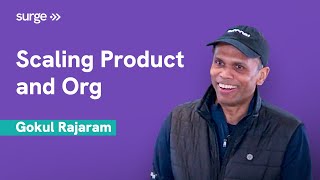
Why Big Tech Talent Fails in AI Startups with Gokul Rajaram

Gokul Rajaram, who built products at Google, Facebook, and Square, explains why big tech talent often fails at startups. He argues that in AI, credentials matter less than organizational velocity and customer relationships. His rules: talk to two customers weekly, focus on retention metrics, and kill products that can't scale beyond a niche audience.
Questions this video answers
Talk to two customers per week, ~30 minutes each (≈1 hour/week per product team).
He said revenue increased by about 3x–4x in one day after the auction replaced the prior guaranteed CPM model.
Yes — Rajaram states Facebook used a holdout group of users who didn't see any ads to measure engagement delta.
Hiring people without experience is actually better because they're going to be first principles, thinkers. They're not going to bring the baggage of the experience along with them. I've seen now more and more product people go to market people failing in AI native companies. Truly, I think at this point, all your credentials, all the things we think of as markers of success at a prior company that can be transferred over, I think they're much less important now.
The Library of Alexandria was an attempt to capture all human knowledge. Fire and war destroyed it. Today we try again. Welcome to the Library of Minds where you'll learn the frameworks and mental models of the world's greatest thinkers. And when our conversation ends, yours begins. Each guest has created a digital mind on Delphi that you can talk to anytime, anywhere. I'm Dara Lagavardian. Let's dive in. So I'm super excited for Gokul to be here. He is a legend and he needs no introduction. But there are certain people here have only been in the tech industry for a couple months, so thought I'd go ahead and introduce him. He helped build out the ad team at Google, launched Facebook's ad model, has worked at Square on the boards of Pinterest. He's been on the board of Coinbase, trade desk, legendary investor, also investor in Delphi and super excited to have you. So I'll start in the beginning. I'm curious, in your upbring, what kind of information did you consume people did you look up to that informed some of the way you think about the world today?
Yeah, I grew up in India and so a lot of the media was somewhat. I think I had a diet of media, but I realized as I grew up that some of it was maybe a little bit aligned politically. For example, India was close to the USSR back then, so we were kind of brought up with the ussr, Soviet Union basically being like this great thing and then somewhat anti us in some ways, which is strange. As I grew up I realized that that was incorrect and so I really started leaning towards the fact or the root cause, which I think I started reading a lot of research papers. And so a lot of my information came from trying to get to the root source versus trying to trust someone who just puts a layer on top. So even in my own decision making, one of the top frameworks I use is root cause analysis, which is trying to ask why five or six times and trying to go beyond the symptoms. Root causes really come from trying to read technical papers. So when someone says excerpt AI, I don't really trust it. I try to go to the paper and see what the paper says and try to understand it versus trying to take interpretation. So I'm very I don't like interpretations. I want to interpret it myself. I want to try to understand the root. And so citations are very important to me in anything and I don't trust things without citations. Even in Delphi, when I was testing out my own thing, I was like, did I ever say that? Where is the citation for that in some way when I was testing it out?
Citations are very important. Let's bring that mental model to your work at Google. I've read in this book Loonshots that Google's success was not necessarily a product innovation, it was a business model innovation. And you worked on the AdWords team at the time. Were you actively trying to innovate on business model because you had all this usage and now you have to figure out revenue or what was the problem you were trying to solve?
I think what is interesting about the best business models, including Google, is that the right business model aligns the interests of everyone. So Google had tried after one or two years of the search engine taking off starting in 2000, Google was trying a bunch of different ways to make money. It wasn't important, it wasn't urgent, but it was important to figure out what the long term thing was. And the number one thing Larry and Sargy always emphasized is it should align users and advertisers together. It should be a way of monetizing that doesn't favor one over the other. For a long time we couldn't figure out what it was. So Google actually at the top of search results sold the ad for a guaranteed cpm. So the sales team used to sell that ad space. Eventually the AdWords auction was invented and Salar, who invented it I think beautiful. That was the core of the and really the notion of click through rate and CPC being used together to determine ranking versus just cost. There was a company called Overture which is what by Yahoo. Which just used cost per click as the primary mechanism to determine ranking. But it didn't take relevance into account at all. So click through it to start with. Over time it became more complex and sophisticated. So that mechanism is only used on the right hand side. Right hand side ads for desktop, obviously with MOOC on the top on desktop it was still sold by the sales team for massive guarantees. And so I still remember the massive crazy discussion that the head of sales Tim Armstrong had with Larry and Sergey where he was like if you take this down. Advertisers will flee because they all value this top space. Larry and Sergey wanted to also bring the auction to the top of the search results, but they overrode him and they just said, we don't care what the short term revenue impact is going to be, we are going to do that. Turns out the day that was replaced by the auction was the number one day of revenue bump in Google's history. I think it increased revenue by 3x or 4x in one day because it was just opening up to the free market and it was much better ad model. So there was no debate after that. But I think when you're building it within the belly of the beast, you never truly realize how revolutionary it was. So we were just trying to solve customer problems with this mindset of trying to bring value to all parties. Only later did I see how important it was as a construct and how revolutionary the business model was. You don't realize that even within Facebook, we're always just trying to continuously solve problems. You don't realize only a few years later after I left Facebook, I was able to look back and say, man, that was something good we did there. Just like within here, you're probably constantly on day to day solving problems for users, for customers, et cetera. And then you look back and say, my goodness, I created this incredible company.
So what are the key metrics that you would track in validating whether a business model is worthy business model to approach given the constraints that you want it to be aligned with users you want to track?
For example, for Facebook ads, which I truly, I think Google, I was running one part of it, Google Adsense. So I can't speak to the whole ads business because I was not overseeing the whole thing in Facebook, I was running the whole thing. And the things we looked at were we had advertiser metrics, but we also had user metrics. So there was a constant focus on is user engagement being suppressed by ad load. So we would negotiate with Zuck every year and he would give us a certain engagement budget so we would have a certain way to measure engagement. And engagement budget was basically we had a holdout group of users who didn't see any ads. It still exists today. So there's some percentage of Facebook users who don't see any ads. So we compare what their engagement is with Facebook with people who do see ads. And so there is Delta. That's a reality. However relevant your ads are, the reality is that there is a engagement hit compared to people who don't see ads. So the question is, how much more or less do you want that? And so Zuck could slowly apportion that out. And our goal was to stay within this. On this side, that was a guardrail on the user side, and the other side, the guardrail was roi. So it's constantly like, how do you drive ROI for advertisers while also keeping the user experience, not screwing it up too much?
And why does it make sense to ignore the data? And do you have any examples of times where your judgment was against the data?
I think you should ignore the data. Look, I think unfortunately the last 10 years of product managers are very data centric. I think we have lost the fine art of customer interviews and speaking to customers. I think it's because, to be honest, at Google, we didn't have access to data easily. We had access to dashboards, but I couldn't run my own queries. I had to go through 10 layers. So it was very hard for me to slice and dice data. It became easier 10 years later at Square. So I feel like I grew up in a time where I spent a lot of time with customers and spent a lot of time understanding customer problems. And most of my product relations are based on customer. And I think there's obviously there's a middle ground there. I feel like you cannot identify problems based on data. You have to identify problems based on customer feedback and talking to customers. Data helps you figure out whether your solutions to the problems are working. I don't think data should be used to identify the problems because data can never tell you the root cause. You have to talk to the customer, truly understand what the root cause is and truly understand what the problem is. And then you have a few hypothesis to solve the problem. You test these hypothesis, then you get data by testing the hypothesis and the data tells you whether hypothesis whether you're on the right path or not. So I do think whenever someone brings data, I always ask them, have you talked to customers? Have you talked to customers? What is the root cause problem? What is the actual problem you're trying to solve? And if they haven't talked to customers? I think one good thing for product teams, which I used is I would like every product team to talk to two customers a week, half an hour per customer, one hour a week. If a product team can't spend one hour a week talking to customers, I don't trust that they care about customers or they even know what customers are thinking or what their problems are. It doesn't the same kind of customers you could talk One week to churn customers, another week to newly signed up customers, third week to loyal customers, fourth week to a customer who just signed up last month and is still going on, or who's maybe about to churn or is not using the product, is paying all these segments every week we talk to two or three each segment and understand what's going on. And we just build this robust set understanding of different segments. Ultimately, that's the other thing about product development. It's not a one size fits all. If you're building a product for everyone, you're not building a product for anyone. We've got to understand what the different customer archetypes are and problems are, as they call it, jobs to be done are, and what two or three jobs we want to do. For example, is Delphi going to be used for people who want to build a business off of it, or is it going to be used by people who truly want to just be an influencer and scale without building a business off of it? How important is monetization? It comes to. That question, then comes from there. So you can't really answer the question of how important monetization is without knowing who we are solving the problem for.
And how do you prioritize as you speak to all these users and you find different Personas and wedges? How do you decide who's important and who's not?
Well, on one side, it comes down to market opportunity. And so how big is the market? How big is that segment in terms of their pain intensity, their pain they're feeling, and how underserved is the segment? I think there is. Obviously there could be a really deep pain, but there could be 50 companies trying to serve it in different ways, and our solution is not remarkable enough. So on one side we want a deep and large market within that segment or for that segment. But then we want our solution to be so remarkable, better than all the other alternatives they have. So those are the two things you have to use. It can't just be one. It could be remarkable, but the segment is not large enough to matter. It could be large enough, but then ours is not remarkable enough compared to alternatives. So we have to see what are the alternatives they have. If someone's using Shopify, a merchant to monetize Shopify might not be writing for something else. Our thing is not as good as that or just as good. Then it's not remarkable enough, even though Shopify could have a big opportunity. Sure.
So I'm sure at Google, Facebook and Square, you've been a Part of kill decisions to get rid of certain features or products. And as you speak to customers, there could be a vocal minority of people who want something, but it doesn't serve the overall mission and vision of the company. How do you decide whether to kill something and how are you okay with just making those specific users that you spoke to pretty upset for removing it?
I've killed, I think four or five products in my life and each of those was really killed based on, I think Square Wallet was the first one, which was a beloved product 1012 years ago in San Francisco. Especially in a certain area where you just use this thing and it would automatically pay at coffee shops. Unfortunately, it was just not easy to expand it. In general, many of these products were killed because they were unable to go beyond the very small and vocal initial user base to get adoption broadly. And so I think what we've done in general is when first you explain the reason why you're killing it or why you're ending it, in this case, there's an internal way of expressing that reason which is more that we couldn't get product market, we couldn't scale the initial product market fit. And the external reason was simply, I think you basically just say that this product was not able to be successful, but what you do for the external folks is you give them an alternate. So we basically said we launched something called Square Order or we gave them some credits at these shops or something like that. So it alleviates the thing. But the reality is if our customers can't understand that we are a business and we have to make right decisions, then you know, it's okay. I think increasingly I realized that it's perfectly fine, especially today, the news cycle moves so fast that within two days. So it's much better to not be held hostage to a small group of vocal users because ultimately they care about problems to be solved. But you for themselves, but you as a company need to care about solving a problem for a big set of users, not just for a small set of users. So it's perfectly fine to piss them off.
Sure. So people think of PMF as like a one time thing. And you've been at these companies where they have worked on many different products. So you're constantly trying to find pmf. When does it make sense to say, hey, like this product is good, now it's time to invest in something more.
You know, I would have said 10 years ago, I would have said the time for product number two is when your first product gets to 100 million five years ago I've said the time for product number two is when the first product gets to 20 or 10 million. Now I think the time for product number two especially I think your guys case is different because you're more B2C at least in B2B context. I tell companies the time to build a second product is when your first product has product market fit. Essentially as soon as they get to product market fit find the second product that serves the same customer base. Why? Because in the world of AI I truly think there's no other moat except there is an organizational moat and a speed mode that you can build AI native companies that can move really fast. But the other moat is customer relationship. If you have access to a customer you better damn make sure that no other company can get into that customer and you better surround them with as many products you can, especially in your area. I think service Titan is a company that went public last year. They did a great job. If you look at the S1 of building like 25 different products to serve field service companies over 15 years I don't think any of the products are necessarily that great. But together they just have a very very make it very hard for anyone to enter the space. If you talk to there's lots of startups trying to go after that segment. It's just hard with st just like owning that over time. And so I think we have to really think about with the customers we have. Some of them are businesses. In some of the influencers, they are businesses. What are the needs can we serve so that we really surround them with a set of interlocking products so they don't ever have to go to someone else for monetization or something else. What are the four or five overlapping? We just want to make sure our customers protected, defended and we are not just building a fortress, we're building the boat. And the boat is multi product. Remember that doesn't mean you have to monetize every single product. That's the other thing companies mistake. Some products are for retention and some for monetization. And so I think it's very important to understand which are retentive products. The only goal of theirs is to drive risk retention and usage stickiness. But then there's a small number of products which are profit pool products. And so profit pool every product. Actually making money sometimes can be distracting because you're trying to make some minimal amount of money from some product does not even serve serves that person. Make it free, make it free, make money from the product that's used to make money. That's designed to make money. Whose strategy is to make money explicitly? That's why Facebook has never charged a subscription. Facebook could in theory charge subscription for different things. It would not make enough money compared to $100 billion in ad. Even if they make 5 billion from subscription like Snap Snapchat has done or so on, who the hell cares? Periodically they'd be like we should sh premium insights. It would just not be enough. It would just be on the margin. If you piss off some advertising instead, let everyone have it for free. Make money off ads, but massively monetize the ads. So let's be very careful and thoughtful. Many companies are like oh yeah, let's make money off all of these products or six products. No two products should make money. Four should be free.
Enjoying the conversation? Got a question you can ask Gokul's digital mind? Just check the link in the comments or description. You talked a little bit about AI and how you think the only moats maybe are velocity and customer relationships. Are there any other things that you used to believe that now with AI you no longer think is true?
I think, I feel like I always believe that titles are not important, but I used to believe experiences and what people have done earlier matter truly. I think at this point all your credentials, all the things that we think of as markers of success at a prior company that can be transferred over, I think they're much less important now. Maybe they're worthless at this point. I said credentials are worthless. I posted a couple of weeks ago and I think I've seen now more and more product people go to market. People failing who are successful in other companies failing in AI native companies because the way products are developed are completely different. The way go to market is being done is completely different. For example, at prior companies people are used to selling a product. At AI it's increasing a consultative sale and people are failing at consultative sales because they're used to selling hey, here's a widget, here's a product, a SaaS product. While the consultative sales what's your problem? Let's figure out the right agent to build. Sometimes it's not the right exact thing. So I feel like increasingly I'm seeing the demographics here. I mean this is the kind of company that's built to sell. So I feel in fact very lucky that I'm not in the job market right now because I feel like hiring people without experience is actually better because they're going to be first persons thinkers, they're not going to bring the Baggage of their experience along with them. For every role. At this point, what's been the most.
Difficult moment of your career, whether as an investor, board member, professional, and how did you deal with it?
For me, it was basically at my company, Chai Labs, that was doing okay. And I was trying to think that maybe, you know, it was. It was not going to be the rocket ship, I thought. But then we had only 12 people at the company, smaller than this group because it had gone through the global financial crisis and we didn't have much capital on hand. And then our lead engineer called me in and our senior most engineer after our CTO and gave his notice saying that he was. He had gotten offer on Facebook to join. And so that was a pretty tough thing because I almost reeled when he said that because I realized that once he gave notice, then as soon as the other engineers saw this, it was mostly like most people were engineers and it was me and our biz dev person that basically we would just be decimated very quickly. And our core IP was basically these people. And so at that point, thankfully, as I was walking back thinking like really reeling down the stairs to go to my car, Sheryl Sandberg called. And she had been trying to. Facebook had been trying to buy our company for a few. For one or two years. And so at that point she got me at the right mind where I was like, okay, this is going to be. So thankfully we were able to convince the engineer to just stay put. I'm like, look, we have this thing coming. Just hold off on saying yes. And over the next two, three weeks, you'll negotiate a good agreement with Facebook. And all of us basically went there, which is great for us. But I think it really showed me the showed me that when you have something going on, you can't wait for. You can't let events. You can't become reactive. I think literally I was being reactive there. I should have been proactive and basically gone and sold us to Facebook because there was an opportunity back then, I think waited too long. And I think I used that lesson with Caviar where once doordash came to San Francisco, Caviar was part of square. I was running Caviar. It became clear that Doordash as soon as they saw the first doordash ad on a bus, I realized that game was over. Because anyone who can afford bus ads for a food delivery company in San Francisco, you basically know that they can outspend you 10 to 1. And they started doing incredible things in terms of marketing in the City where we thought they would never really come. We had our stronghold in sf, New York City and a few other Miami, et cetera. As soon as doordash came in, I realized that Tony was not going to spare any effort. So instead of trying to wait to see a market share erode proactively went and ran a bidding war and sold ourselves to the highest bidder or the best company, which turned out to be doordash. And I think always be proactive. I think never wait for you again. This is similar to the customer thing. You've got to be proactive. As soon as you get the inkling that I actually tell entrepreneurs look at the second derivative of your growth and the second derivative flattening out. Sell or like think rethink what you're doing. Maybe not sell, but rethink. First derivative is okay. Second derivative. Second derivative, which is basically a leading indicator of flatness at some point leading into a first derivative and then leading indicator of flatness. So second derivative of the growth curve.
Part of being a founder is just being paranoid all the time. So I mean, you could be proactive about things that may not actually be threatening. When is it threatening enough to be proactive?
Always look at things from the lens of your customers. So paranoia by itself doesn't serve purpose. Your lens of your customers. If your customers are defecting in droves. I think if you ask me what's the single most important thing single one metric to adjust the quality of a business, it is either gross retention or net revenue retention. Gross retention is what percent of the customers stay on and net revenue retention is the cohort that stays on. Do they grow over time? And you can argue actually both are very important. Why they're actually check metrics in each other. Gross retention says that because net revenue retention can be very high. But what could happen is maybe most customers are churning, but only one or two are growing really fast and making up for it. So I think you need gross retention high in addition to net retention high. So I think the retention metrics, as soon as it start eroding, that I think is a very, very negative sign, I think. So I would be paranoid from. I always say everything should be done from a customer lens, whether it's product development, even how you evaluate your competitors. I actually don't care about competitors at all. But I care if my customer is telling me that my competitor is solving their need better than I am or that they're going to leave. So I always, I'm like, okay, forget about them. But are your customers Our potential customers are they solve this competitor solving your customers. So everything can be framed through the lens of the customer. And that's what I think we should do as a company. Paranoia should be around retaining customers, growing them. Those are the two things we should be doing and acquiring them, of course.
So having built and invested in many companies, what are common themes of cultural elements in the early teams that you think are most indicative of ability to grow into something much more? And how do you maintain that culture as you scale?
What is interesting is I think monocultures are better. Very early on, I think Levchin said that and I was like, yeah, he's right. The first 10 people actually share the same worldview in terms of even things like how many days to spend at the office and so on. Because what happens is the first 10 people, the first one year of a company is around survival and getting to product, market fit and figuring out what to build, who to build for. If you're fighting about basic things around, basic worldview, things around how many days we should be in the office, the company is all going to be focused on the most important thing that matters. So I think it's very important to have almost an alignment for the first now over time you have more people coming in and so on. So at Google, the first 20 people were all engineers, so they shared a very engineering centric view of the world. At Facebook it was basically all Harvard undergrads as my take, I wasn't there literally. They all shared a very similar view of the world. So I think you need a monoculture early on which then obviously the culture over time diverses, but around their view of the world and what they think is important. At Google, everyone cared. The important thing was engineering excellence, not product, not even product, but engineering excellence and doing things that are not possible. Even that permeated for many, many years. So I think that I think is the most important. Making sure that there is a uniformity around worldview. It's crazy to say because I do think diverse teams win, but the reality is at the inception of the company, the first all of you need to be aligned around what truly matters and really not argue about the things that are less important. Now you know how many. Yeah, so those things. Because then you're infighting about things that don't matter versus together presenting a united front and winning the customer and winning their mindshare and their wallet share. Great. Love that.
A couple more questions and want to open up the team. So what's a question you wish people.
Asked you more Often I think it's a good question. It's two questions. One is how to find underappreciated or undetected talent, I guess diamonds under a rock kind of people. I think a lot of companies I've seen do well have focused on again, this goes to not traditional market success, not going after the Harvard or Stanford people, but finding people who have been college athletes at a D1 or D3 school. I think college athletes, for example, is a great, great, great Persona that I've found. Have grit, have ability to balance stuff, are super organized, can learn new things, et cetera. I think the second question is around the importance of org structure, around execution. Especially as a company grows beyond 10 and 20 people. The way you organize is going to be so important. How do you organize? Once you have more than just one thing you're doing, once you have two or three things you're doing, how do you organize yourself? How do you, what is the, how do you communicate? How do you. So I think the importance of organizing yourself, whether it's into self contained units, who's the. Is there one lead per thing or is it more? How are decisions made within each of these units? How do these things move? How do they report, report out to the rest of the company? How do they ask for help, how do they collaborate with each other? So organizing is so important. You're probably at a point where it's not a single unit. There's probably two or three units. How are these units organized? Are they organized into. Each unit has one product kind of person and a couple of engineers or is there a different. So those are all interesting choices that you're going to make that are going to determine how successful you are.
And at a company at our stage, you see, you know, Razer Series A, we've proven something. And then you'll see some companies inflect and maybe some companies weather off. What are some core mistakes you see companies at our stage make that prevent them from really making it to the next level.
It's all people centric. I think a lot of it is people centric. I think some of the biggest mistakes I see people make are trying to get people executives. I think. I don't necessarily think you made that mistake. I actually don't know. The looking at the folks here, I think a lot of folks think, oh, I've gotten a series, I should get a big company head of X or something like that. Because sometimes the founder is like, well, I'm too young. But I think that's okay. Zuck Never got ahead of engineering till much later or whatever it is. I think we need to make sure that we don't try to get folks who are not a good fit for what we're doing. And I think trying to get leaders too early in the company. Slife is important. The second one is I think trying to have that balance between too many things and too few things on one side, too much focus. I think this is the time where we probably are at a few million of run rate. We have a bunch of customers. We probably do need to do maybe one more thing which still helps our customers and helps us figure things out. But we can't do like six things. So there's a balance between focus and distraction. But I think the people thing is the most important thing. We're still, look, this company can all be contained in this group, so every person you add is still going to have a pretty big impact on your company. So keeping standards extremely high and really making sure that we are actually making sure that people can do the work and are good culture fits versus many times what happens is, oh, they've done this work at some other company. That doesn't mean anything. I can tell you this. At this point, having done the work at a different company doesn't mean at all that they can do the work here. They can do the work. Engineering is actually the best at evaluating people because engineers are generally cynical and will say, okay, here's the problem. Do this. So the interview process needs to verify, needs to be very tight and you need to approve every person. And I think the back channels matter a lot. The back channels matter a lot. So at least have one, if not two back channels per person. And we should not approve hires until they can get two back channels per person for sure.
If you could have dinner with any person that are alive, who would it be?
You know, it has to be Jack Welch, because I used to think so highly of him. I read his biography two or three times. You know, 20, 30 years ago, he was the most adored CEO in the U.S. i mean, it was in the world, probably with Georgia. And then he just fell so badly that I think I remember reading his obituary when he died and people just. It was a small thing and it was just ridiculous. I mean, just people think of him as such a. With such a negative lens now. He was truly, I mean what Elon is now Welch was to the industrial era. So I really wish I could sit with him and just think about, you know, how on one side he made a lot of decisions, but I'm curious to really see what he felt going through that because seeing, I'm sure him himself having fallen from that height is someone I really admired and I wanted to understand what drove his decisions that led to some of the bad things that happened and also how he felt. So I feel very sad and sorry for him.
Hopefully we can make that happen one day. Well, great. Want to open it up to questions?
Mateen, thank you so much for coming today. You've worked with incredible founders, people who have been like the top three most impactful. And what lessons did you learn from that? Yeah, I think it's been Susan Wojcicki, may she rest in peace. She was the CEO of YouTube. She was my first boss and only boss at Google. Actually. What I learned from her was she was not technical. She was not technical at all. She had a degree in econ or biology or econ or something like that, and an mba. But she was able to hold her own in a very, very technical company and was very respected because she knew what she stood for, which was the voice of the customer. And I think it showed me that you don't necessarily need to be exactly like everyone else, but you need to know what value you bring to a company. And she was also the adult in the room where basically a lot of personalities are very, very strong. But Susan could essentially get warring camps of engineers and so on in a room and mediate in compelling ways. So it really showed me what calm leadership was all about. She taught me how to manage and lead. Second one was Sheryl Sandberg, who was the force behind her acquisition at Facebook. And what Cheryl taught me was essentially decision making. There were some very high stakes decisions that I saw her make and she had this specific process that I use some of those to make decisions at Square and DoorDash. So that was the second person. The third one is probably Tony, Tony Hsu at Doordash. Because I think we competed for several years when I was at Caviar, years at Doordash. Then I worked for him after joining Doordash and I was able to see him and it just again, I have not ever met, worked with Bezos or met him, but he is, I think Tony is the most. He's the closest to Jeff Bezos that we have in an operating role today. He is just exceptional at balancing, I think, at running a company like Doordash. Just like Amazon. You need to be extremely steeped in operational details, but you also need to be able to zoom out and take a 10,000 foot view and so Tony is the best ever. I think I've seen at being able to do that in an exceptionally complex doordash people think is a two sided marketplace. It's actually a four sided marketplace that is consumers, merchants, dashers and cities. Every city has different regulations on what you can pay drivers. Now New York City you have to pay something different. Seattle you have to pay something different. Suv, you have to pay something different. And every municipality has now started putting different things. So we have now this different entity that crazily enough feels that in a capitalist society they can do this shit, but they are. And so there's four different entities in each order that has been taken into account. And so being able to navigate and I saw him lead from the front during COVID Exceptional, exceptional. Just so many lessons I feel in the last five years. I feel very lucky to have worked there and seen him in action for five years. So those are the three people, two women. I mean I think I've learned a lot more from women leaders, to be honest. They just lead extremely well.
Andrew, you just mentioned Sheryl Sandberg's decision making framework.
What was so unique about it? I think the most interesting thing was that a. She took ownership. She didn't just say it's consensus, she took ownership of the decision. But at the same time she made all of us feel heard, even her exec assistant. She got her to come sit at the table, she was sitting outside, she said come join us, listen to all these arguments. And then at the end she went around the room and asked each of us to send us send her our opinion in a private way what we thought the decision should be. And then she made the decision. So it really. I think you, you can't. I think if you just go around the room and ask people to say what, what they feel, then you see that there is an effect where people feel compelled because of seniority, hierarchy or peer pressure to say whatever the other person said. But keeping all the discussion public, but the decision, each presentation private to her, she basically preserved it. And then the other thing she did was interesting. She made in order to make sure there was Steelman arguments and not just strawman arguments. She basically got us to flip sides. She basically there were some people who are arguing for one versus the other. She basically said I want you to take the knight and make arguments for the other side. And so she basically forced us to defend the other person's position so that all the arguments came out. So I think it's very important to make sure all the different and the other thing is, it also made me realize that most decisions in the company are two way door decisions. They're reversible, they can be done pretty fast because you can reverse them. So it's important for those decisions to be done fast, but to monitor, to make sure what's happening you thought would happen is happening so that you can reverse them. But where you want you need to use this kind of framework is when there are one way door decisions that are irreversible because once you make them, you can't reverse them. So it's only a small number. But they're so important that you should take a lot more time to make them because you can't reverse them easily. But for most things you should not even be making, you should just let the team make the decision. Just let them run with the caveat that they should monitor the impact of the decision and if it's not what they think it is, they should reverse it. That's very important because you can make it and say, but if you don't monitor it goes off and does something different, you have to be able to reverse it. Great.
Thank you so much.
Thank you. This is amazing.
Thanks for tuning in. If you enjoyed today's episode and want personalized advice from Gokul, head to the link in the comments or description to ask his digital mind on Delphi.
More from Gokul

Gokul Rajaram on the 8 Moats Companies Need & Why Dropouts are "AI Maxing" the World




#80: Becoming an IC again is how products leaders will stay relevant in the AI era | Gokul Rajaram
#80: Becoming an IC again is how products leaders will stay relevant in the AI era | Gokul Rajaram


What I Learned Working for Coinbase, Pinterest, Facebook, & Google | Gokul Rajaram
What I Learned Working for Coinbase, Pinterest, Facebook, & Google | Gokul Rajaram