How to Nail B Corp Impact Reporting and Storytelling in 2025
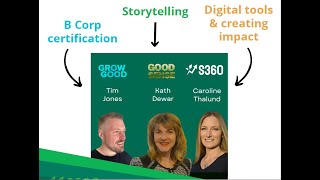
Caroline Taylor, Tim Jones, and Kath Durer walk through B Corp reporting and storytelling for 2025. Tim covers why it matters and common mistakes like single-person knowledge silos. Caroline demos S360, a tool that tracks impact goals and KPIs including gender pay gap and emissions. Kath shares four storytelling frames, with examples like Untouched World's 44% waste reduction.
Chapters
All right, well, as everyone's dropping into the session, we'll just get slowly started. So Kira and. Hello, everyone. Thank you so much for joining us today for our B Corp impact reporting and storytelling masterclass. It's great to see so many of you here already, so feel free to keep dropping in and whether you're already a part of the B Corp community or just starting to explore a certification, or simply looking to improve how you measure and communicate impact in your organization. So my name is Caroline Taylor and I'm the founder of Sustainability360 where we help businesses embed sustainability and to make it simpler to track and create impact. I'm also a professor of practice at the University of Canterbury in Christchurch where I teach business sustainability to exec teams and senior leaders. And this session really came about because business, between us, we were chatting about how it's so common that B corps feel a bit stuck after certification and not quite sure of how to keep on top of things and tracking. Import, import. I keep saying import, impact, impact. Or how to turn it into something that could easily share internally and externally. So today is all about sharing, sharing why ongoing import impact reporting matters, how to track your B Corp impact in a way that's efficient and audit ready and translate your data into compelling stories. So I'm joined here today by two fantastic speakers. So we've got Tim Jones, one of New Zealand's leading B Corp consultants and passionate advocate for business as a force for good. And Kath Durer, the founder of Good Sense, an expert in ethical marketing and someone who knows exactly how to turn impact data into stories that people actually connect with. So together we'll be sharing some great content here today. Practical tips, expert insights and real world examples to help you strengthen your approach to impact reporting and storytelling. So we'll kick off shortly with Tim and then I'll walk you through some tracking tools. And finally, Kat will share her expertise on using storytelling to bring your impact to life. And we kept this interactive. So after each of the speakers, there will be a breakout session of about five minutes after each of us. So let's get into it. Tim, do you want to kick us.
Off if you unmute yourself still, it feels like we're 20 years into online calls and we still haven't worked out the mute unmute function. But I'm sure the robots will sort that out for us. Cool, right? I'm sharing some slides. Why not? Can everyone see my slides or can someone see my slides? Let me know. Fantastic. Kate and Kev giving me thumbs up. Fantastic. So I've called it Legends of Impact because it just sounds cool. Why not?
Yeah, as Caroline said. So yeah, who am I? I'm Tim. I run a company called Grow Good, based here in Ototahy Christchurch. I basically help people simplify and fast track their journey to B Corp. I've been doing it for quite a while and I've helped quite a few B Corps get certified. So that's kind of who I am and why I'm here talking to you about this stuff.
I guess splitting my talk into three parts. So like why impact measurement, tracking, why should you be doing that at all? Specifically what I see with B Corps. But I guess it works really for any company whether you're a B Corp or not. I guess that would be a quick question. Maybe just put in the chat if you are a B Corp or if you've heard of B Corp. Maybe give us a thumbs up in the chat and let us know if I'm speaking to the converted or to the be curious and then I'll sort of talk a little bit about what I see as the do's and don'ts around impact reporting, but just a little, a little depth because obviously Catherine is going to be smashing that part of the talk. All right, so let's get into it. So why should you be doing impact reporting? Well, transparency for me is the biggest thing. Like if you're a B corp, being transparent about what you're doing and how you're doing it is a key part of what you've signed up for As a B Corp it's pretty hard to be opaque or not transparent with what you're doing because you fundamentally it's become a B corp, you have, you have reported against a bunch of things that you're doing and you've had to provide evidence to prove that you're doing that. So increasingly the world is looking at all businesses and wanting to know how you're doing things and why you're doing things and what is the results of that. So transparency is the key thing for me.
As I've just sort of mentioned, you know, increasingly. So if you look at your business, there's kind of four main groups of humans that every business needs. You typically, unless you're a solopreneur, you will have some sort form of employees who hang out with you. Every business needs customers. Most businesses will have some kind of supply chain. And depending where you are, you're either going to be, you know, at the one end of the sort of the value chain or somewhere in the middle. But increasingly, you know, you've got people, you're all buying something from someone and you're selling something to someone else. And then lastly, all businesses currently run on investment and money and all of those groups of humans are increasingly wanting to know what your business is doing and how it's doing it. Customers increasingly want to know, you know, the supporting brands that care. I'll talk a bit more about that in a second supply chain. Increasingly we're seeing pressure, particularly in export markets. If you're exporting a product into the EU in particular, like there's now increasing regulations around expectations that you are meeting certain standards. So in some of these it's, it's, yeah, it's, it's becoming a requirement. But yeah, I think certainly the transparency and accountability around your employees is massive. And there's a couple of recruitment companies or people and culture based companies in New Zealand that are B Corps and they all say that the companies that they represent that are B Corp certified get better and more candidates applying for their jobs. And so I think that's, yeah, if you're looking to increase your employee base, it's a massive, massive thing to think about.
This is from Kantar. So Kantar is like a research company and they do an annual survey or an annual report called the Better Futures Report. And this is from a couple of years ago because their most recent one was mainly on social issues rather than social and environmental. So they didn't, they didn't update this data. But this is something where I think people are really, really missing opportunities is like essentially customers, consumers want to support brands that can prove that they're doing good, but they don't believe what you're saying in most cases because there's just a lack of trust within the business community. So having that third party independent verification of the claims that you're making and then talking about those claims in a really effective manner is going to really help you close that gap. And it's kind of like there's a real opportunity here for companies that can effectively tell authentic, true stories of the good that they do. It will connect with consumers.
And then lastly, I kind of talked about it a little bit previously, like increasingly regulatory pressure. So red tape as some people might call it. Yeah. In certain markets there are now just expectations that you will be meeting a certain level of expectation around social and environmental performance. And again, if you can't prove that, if you don't have reporting and measurement around that, then this, this is no longer aspirational. You know, this is Going to become table stakes in, in many areas that people might be doing business in. Similarly, there's a big like knock on effect that we're seeing. Well, I'm certainly seeing with people who I'm helping with B Corp, where they might be a small business, but they sell into a medium business that maybe sells into a large business. And most of those big, large businesses are having to do mandatory disclosures around their certainly environmental performance in New Zealand and increasingly social performance as well. So if you've sold one thing into a medium sized company, who sold one thing into a big company, they now want to know what that, what you did as maybe the small company at the end of that value chain have done. So getting on the front foot for some of this stuff, definitely, definitely worthwhile. But it's increasingly less becoming aspirational. It's becoming like you just need to be onto this stuff so that you can, like I say, run these reports and tell people what you've been up to really easily. Possibly the most important thing, and this is particularly from a B Corp perspective, is once you've, once you've met a certain standard of performance around impact. Ideally we want to get better, we want to create more impact. So if you can get a baseline of performance, that's really cool. But obviously we want to look at that baseline and we want to find other areas and so helping you, which will lead into my next part of the, of the talk like post certification or Post, you've done some initial reporting, having that as a, as a, you know, having KPIs and basic numbers that you're tracking across the business. It's the baseline that you can then build on to do more good. And really that's what we're all trying to do, particularly in, in the B Corp community. And that's because traditionally reporting has been seen as like the side dish. It's like, hey, we do our core business over here. Reporting is something that we maybe have to do. It's separate to the business. And that is one of the really big mistakes that I see with people doing any kind of impact reporting. B Corp's not so bad at doing that. But the risk is if you don't bake in the idea of the impact into your core business and it becomes a key part of what you're doing, then you're at real risk of losing sight of what you're actually trying to achieve. And that's why for me, baking in the impact, baking in the reporting, Baking in the KPIs is a really, really critical thing. I'm really dogmatic. When I work with companies through their B Corp, I make you bring your entire team on the journey. And the reason we do that is because when we go through the assessment and we go, oh, we're not currently tracking that, but that's a really cool thing that we should be tracking. Great. Who now owns that in the company that needs to sit on somebody's dashboard and that becomes a weekly, monthly, quarterly, annual number or whatever it is that someone owns. And we now bake it into the company. Because if we're tracking a new KPI, it possibly means that there's a behavior change that has to happen in the company as well or we're changing a supplier or we're changing how we deliver something to our customers and so someone has to own it. And that for me is the, is the absolute key to proper impact measurement and reporting, is making it happen on the day to day. Because moving into sort of the challenges, what goes wrong with B Corp is it's not baked in. And then the person who, like if you have one person running your B Corp assessment, which is not uncommon and you haven't distributed the reporting requirements across the broader team.
Is if that person leaves the company and all of that data or like how they were reporting it. The one spreadsheet was it. There was a company recently that had like the whole company was run on one spreadsheet. Well, if that person leaves the company and no one understands the formulas on that spreadsheet, you're, you're, you know, you're dead in the water. And that is a massive thing I'm seeing. I've got a bunch of clients I'm helping with their recertification who they didn't make use of me first time around but literally they've got a new person in the team and it's like I don't even know where the coffee machine is yet. I've never heard of B Corp but they've asked me to do the recertification. I've got, I've got no idea what's going on. So that is a massive, massive thing. Thing that I see more often than you'd hope. And like I say, the main reason is because they haven't, they haven't baked in that reporting across the company.
Yeah. So yeah, this is what the new employee looks like when they haven't found a coffee machine and told that they need to go and do, do the B Corp. And then moving on lastly to sort of the impact reporting, how we are doing impact reporting isn't working. If, if I see another 80 page impact report I'm just like really? You know, if someone sent you an 80 page PDF of your own company for your own team for the thing that you actually have to do every day, would you read it? No is the brutal, honest answer. Like no one has got time to read an 80 page PDF on somebody else's business, let alone their own business. So these massive impact reports that we're doing, it's like yeah, no, no one's reading them so stop doing that. What I think it comes down to is and I love this quote from Benjamin Franklin, either write something worth reading or do something worth writing. And I think that for me is the absolute key. Like just do cool shit that people want to talk about and that is how you will get, you know, stories of your impact out there. And the company for me that I think is the best at doing this is Patagonia. So at a global scale, absolutely amazing how they pull legends of impact across all their business into all their day to day activities. Now yes they are what's called in the U.S. they are what's called a PBC, a public benefit corporation. So it's like a B corp but ever so slightly different. Won't get into the detail. So they have to do an annual impact report. This is only 25 pages, so go them. But if we think about how Patagonia activates stories of their impact it is absolutely phenomenal. So Patagonia Global business doing good on their website you can see how what impact Patagonia is doing with why Wanaka and some local donations and charities that they're working with in Wanaka to clean up fresh waterways. So telling a story on their global website about work that they're doing with communities in the south island of New Zealand, like that's an interesting story that I might want to read rather than some bland we donated X amount of money to one small charity as a line on a spreadsheet in the middle of an 80 page report that no one's going to read.
Kiara Tim it's also a great idea of how that old slogan that those of us have been activists for a really long time think global actlocal brand in that the local gives the relevance. So great, great.
If any one of you has sent your 80 page report and had 3.6 million people read it, I will stand corrected. Send me through those stats and I will stop talking and but you know Patagonia here, 3.6 million views on a 1 hour 40 documentary that they've made all about surfing, but it's tied in with the environmental performance and what they're all, what they stand for about preserving Mother Nature. Similarly, on their Instagram, 5.4 million followers checking in daily, possibly on these little micro conversations and stories that they're telling all about the good that they're doing. But it's also baked in to each of their stores as well. So if you go into any Patagonia store, the story is layered. Like the staff know what they're doing, they're connected, they're understanding, they are the ones doing this good locally and it filters all the way up through their global brand. And you haven't had to read an 80 page impact report support. So that's, that's my kind of example. So we've got the breakout rooms for you to all go and have a bit of a chat and maybe decompress after that barrage of slides. So we're going to chuck you in some breakout rooms and give you a few minutes and just have a chat with the people in the room. What's been your biggest challenge in tracking your B corp impact? And if you're not a B corp, maybe just what's been your biggest challenge? What is your biggest challenge in tracking your impact as an organization right now? So Caroline's going to hopefully make those breakout rooms work and we'll see you in a few minutes.
Yeah, don't go. See you again soon.
So what have we got? Anyone? Anyone brave enough to talk about what they talked about in their little breakout room?
I'll go. A couple of things I heard in mine were that it's a lot of the time it's kind of about getting the timing right for when you can communicate. Like you kind of get to be at the right stage of the process. So you're going to be thinking through the right period of certification to then want to be able to talk about stuff. So there's some stuff around that and also around how to make stuff that can be quite dry and quite technical.
Get more, more people to get engaged with it, more people to see it.
Nice. I guess one thing we talked about in our group was sometimes there's data that you might want to report on, but you can't get the data from your supply chain to actually create the data that you need to create. So the example we had was, you know, waste measurement maybe from like a skip company. And then they can't tell you. It's like, yes, we may be having less skips on our building site, but we're not measuring it ourselves. So it's very anecdotal, flimsy evidence that you can't then really say, yes, we've created this impact here. So, yeah, bringing other people on the journey, I think is a. Is a big thing.
Anyone else?
No.
Go for it.
Yeah. So I'm Heber from Account Canterbury University. We talked about measurement criteria in terms of waste and recycling as well. So it was an interesting conversation with Steve from Melbourne.
Nice.
And Kate, you had your. You were about to.
I was just gonna say, so I'm not someone who's got hands on the tools with doing any of the impact reporting myself, but a couple of things I heard in our room were one, oh, gosh, the complexity of it in the time that it can take, but also a bit of, I guess that inspiring and motivation of seeing areas that you can continue to lean into and can continue to improve on. So that. That was pretty cool to hear.
Nice. I think that kind of leads to the conversation around materiality. I don't know if that's a word everyone kind of knows about, but basically, like, material. Material impact is, you know, where. What do we affect or create something that has a. Has an impact on other people around us. And I think that's a really critical thing to think about before you get into like the impact measurement and reporting is, are we reporting stuff that people actually care about? Like, do we care as a team? Do our customers care? Does, you know, does anyone else care? Sometimes, yeah. There might be a metric that is really personally.
Impactful to you, but not everyone else actually really cares about it. And that's okay. You can pick that as a metric. But I think that's a really key thing, is actually talking about stuff that people want to hear about as well. Otherwise you're shouting into the wind.
Awesome. Very good points, Tim. Thank you.
No worries. Over to you.
Fantastic. Back to me.
Awesome. So that was some really, really good, good insights there and really great examples from Tim as well. I think that's really, really key and getting that information right and not making it too long. I see heaps of that as well. Like really, really long impact reports, sustainability reports, and short and sweet quite often hits the spot a lot better. So in terms of kind of getting that data together, that's what I would like to share today of how to kind of like track what you guys were just talking about as well. Sometimes it's the challenge is actually getting the data and then tracking it so that you can tell those stories as well, so I, I worked for a long time in sustainability and internal roles and then only a couple years ago I went out to work for myself. And so I kind of really know all those pain points of being internally in organizations, trying to track and measure all of this, and both from a general sustainability point of view, but then also a B Corp point of view. So I helped, as an internal role, I helped a very large company become B Corp across four different countries. And I tell you what, if I didn't have any more gray hairs after that, it was quite stressful. So that's why I came up with a tool. I built a tool for this to help with this. It was really for myself to begin with. And then I realized that others were having these same challenges. So what I would like to do today is just share with you what I have built in the hopes that it might help someone else as well. So let me just share my screen.
Here we go. Hopefully sharing the right thing. Can I get a thumbs up if it is? Yes. Excellent.
It needs to go the full view, Caroline.
Oh, is it not full view?
We've got notes and next slide is what I'm seeing.
Bother. I was sharing my screen, the full screen, entire screen. Why is that not working? Okay, let's try this one. How about that?
Hurrah. Hey, presto. It's working great. Good start.
So I just want to start off with. Click here, next page. Start off with some tools that I have personally been using as well as many of the other B corps and customers that I talk to. And it's everything from, you know, good old, good old Word documents and of course, Excel spreadsheets, we love those. A variety of different project management tools for general project managing, and also dedicated carbon options. And of course you may also store these documents in a variety of different folders on OneDrive, SharePoint, Google Drive, or someone's laptop. And you may also manage your own projects or tasks in a number of ways. But setting up calendar reminders seems very popular. So whilst all of these are amazing for some things and you can achieve really great results for part of your sustainability and B Corp journey, you have to be across so many tools and then when it's time to report on your prep or prep for your recertification, it kind of becomes a really stressful scramble. And if you've been through the certification process, you probably have downloaded some terribly fun Excel spreadsheets. So this one in particular, for example, is the B Impact assessment. And so you can see lots of, lots of rows, lots and Lots of columns and you have to scroll all the way to the side just to understand what points you got for those and what opportunities that you have. But then, you know, what, what do you do after that? So you've downloaded your Excel spreadsheet. How do you make the jump from there to action? How do you ensure that you keep doing the things that will maintain your existing scores and also how do you take action on the ones that will improve your score and then also create a greater impact? And then how do you measure it all? So it kind of, quite often it can feel like a little bit like this. Thank you, AI.
It's a tsunami of spreadsheets and things. And if you were to outline the whole journey, this was actually a little scribble from a note I've had with someone recently on just what the common recertification journey looks like from my own experience and others, you know, quite often you kind of maintain existing initiatives while some are, you know, some are new but a bit disjointed, not terribly planned, and then all of the evidence is not necessarily stored effectively. And then there's a whole three years. Right. So you always like, ah, that could be done later. Is there someone that's unmuted that wouldn't mind muting themselves, please?
So yeah, eventually though, later will turn up and that can kind of result in a really last minute scramble that's super stressful and time draining, at least from my experience. So what does the ideal journey look like? This is what I wanted to achieve. I wanted to try and achieve one that was more planned, where evidence was stored ongoing. And then when recertification time rolls around, instead of days and weeks to prep your evidence and answers that it would only take seconds as the evidence is already there and there's no stress involved. You just hit one button and then sigh. Peace of mind, right? Hopefully. So this is what I wanted to achieve anyway, like, you know, the secret to blissful recertifications.
So what I would like to show you is what I have built. So this is S360 and I kind of want you to take you through the journey of how you can take that B Impact assessment spreadsheet and turn it into something really actionable in S360. So this is the landing page where any new team member starts when they log in. And it's customized to them so you can kind of design.
You can designate different beekeepers across the organization that has special access to this part. You can then pull your impact assessment straight into S360 and instead of having to navigate through that massive spreadsheet, everything just gets sorted into your 5B corp categories in a much simpler way. And if you're already certified, this kind of gives you a clear picture of where you stand and where the biggest opportunities are, as it filters automatically to show you the biggest points you can see here in the top right. And if you're working towards certification, this is one of the best ways to kind of get organized. It gives you structure, helps you see what you need to work on. And it turns a long, slightly overwhelming list into something you can actually action step by step. From there, you can kind of shortlist what you want to work on and it just presents those to you, cutting away all the noise and just makes it a lot simpler. And now you can turn any B Corp item into a goal. And then that goal could be broken down into tasks and each one can be assigned to someone else in your team with due dates and reminders. And everyone can log in online or in our mobile app and update their tasks. And then every task also has a spot where you can upload the evidence, your B Corp evidence. So when it's time to report or recertify, it's all there. It's linked to the relevant goal. You're not hunting around in folders or email attachments. It's already where it needs to be. And as soon as you start entering data, the system starts building out your dashboards. You've got a clean, simple overview of how you're tracking both at the goal and task level. And each user has their own landing page with just their tasks, so it's easy to stay focused. So here's also the KPI dashboard. As you can see, there's lots of different metrics built in and you can make your own custom ones too. Everything from environmental ones to gender pay gap like this one.
So you can.
You can for example, enter for the gender pay gap. It helps you calculate it. There's also more complex ones of ways of doing it and lots of guidance to help you understand how to do it. We've also built in cabin tracking. There's a full module for emissions including scope 1, 2 and 3. And we've got emission factors for Australia and New Zealand now and spend based data as well to help with those pesky Scope 3 emissions. And it's designed so that you don't need a specialist to get started, you literally just need your business data and just a bit of context. And this is a brand new impact dashboard for B Corp that we just rolled out this week or rolling out this week. It gives you a really clear view of what you'll be working on and how far along each of the initiatives are. And at the end of the year or when you're preparing a report, this basically pulls everything together. Engagement is also a big part of B Corp, especially with staff and customers. So we built an idea generator that lets you collect ideas, feedback or suggestions, and you can have it on your website, on an iPad, in a reception, or in your staff portal. You write the question, you choose the design, and then you can get feedback on any sustainability topic that you can come up with. And finally, to the support side, there's a full resource library that I'm working on adding to constantly. So templates, guides, how tos, walkthroughs. So it's basically 20 years of my knowledge that I'm pouring into the software to help you guys out so you don't have to reinvent the wheel because I know how painful it is. This one, for example, is Materiality assessments. Speaking of materiality that Tim was earlier, where you can see it kind of walks through both for small and medium and large businesses. And if you're part of the we also have an S360 experts supported community. You also get access to our monthly discussion sessions, Sustainability Sparks, where all of our customers talk through what's working the share resources and help others navigate the messy parts of sustainability work. So I will just move on to the next one.
Oh, it's so good. It was like we just got to the end of our process when Carol and I really properly reconnected after a few years and I was like, no, but next time.
Yes, it would have.
Been perfect for that.
Caroline, were you going to do a breakout group for your section?
Yes, yes I am. So I'll just do this one slide and then we'll do the breakout session. So just a quick note on. As you might have heard that B Corp is going from five to seven categories. So just a quick note that basically sustainability S360 is already built for that because it just dynamically adapts to any structure. And so all you need is just to download the latest spreadsheet from the B Impact assessment and then the system just adjusts to it. And we're also talking to B Lab about direct integration and when that happens, we're talking about the part of the recertification process that usually takes days, if not weeks, literally is seconds of pressing a button. So that is really, really excited and I see that as a massive game changer for these recertification processes. So very last one, just to sum it up, lots of different options out there, but I just wanted to share ours that is built for bqool. So yes, breakout groups. So let me just see. I put this question in, but feel free if there's something more important that you want to discuss with the group that you have in there. But I was wondering what areas of your B corp impact you find hardest to measure and what would help make it easier. So let me just stop sharing and then I will set up the breakout rooms and we will open them up again. Here we go. See you soon. In five minutes.
Cool. So just returning from the groups, I hope you had some good conversations. Does anyone want to share what they were talking about or if you're talking about what areas that were hard to measure?
There was one thing that came up in ours, Caroline, which is about supply chain measurement and how you don't necessarily know if your suppliers are tracking that stuff. If they are tracking it, they may not want to give you information. And for some suppliers it's kind of really not a good fit to be tracking stuff. Like, you know, an indigenous community maker isn't going to be reporting on their climate emissions. So that, that was a really good point that came up.
So yeah, no, that's a great point.
On that one as well. Actually. I helped a B corp and then they had some private equity invest in the company so they got a seat at the board table and this is just more of like a general comment.
The, the director shareholder then wanted them to be reporting on stuff that was completely irrelevant to their business because they were just, they were like similar thing. It was like carbon emissions. Carbon emissions. They were a small distributed tech company of like five people with no office. It's like our emissions are basically, you know, next to nothing. So the poor ops manager was having to run this report every week that one person wanted to see that was going nowhere. So be, be confident in pushing back against reporting for the sake of reporting because it's not making, it's not making any improvement to. And I think so, you know.
Yeah, awesome. Does anyone else want to share anything?
I'll mention, Caroline, that.
What you showed at the start of your presentation on how things attract with spreadsheets and all that, that's exactly how we do it. It's all a bit chaotic. So yes, I would just say that that's very true.
Awesome, thank you. That's good to know. It is reality for a lot of people, I think Excel spreadsheets and they are great, actually awesome for some things. I do use them for lots of other things too. So yeah. Oh thank you. Awesome. All right, we'll stop there for now then because I want to hear from them with fantastic cath on how to turn all your data into fantastic impact stories. Over to you, Kat.
Kia ora Kat. So thank you for your time and for being here in the middle of this day and particularly shout out to Kate in my team. He's here. And I think Fiona from SBN, you're here. I've been a member business network since 2003, so very much part of my business. Whnau. And yeah, Caroline has been an absolute pleasure to work with over the last month or two as well. So just full disclosure that she's a Good Sense client. So I'm going to run us through what we do from a story perspective. So Good Sense are a team that focuses we only will work with organizations who are in some way are doing good stuff for people and the rest of nature. So that includes I think all of you on this call from what I've seen of you so far. And what we do is help those organizations develop and tell compelling stories that will help achieve more sustainability, more systems change or better science based outcomes. So we're very focused on impact across everything that we do and I'm going to share three examples to kick us off and then I'm going to ask you to reflect on them. So the three examples I'm going to talk about, one is to Tataka Fiona from Untouched World and the whole Untouched World team who are on the call and who do work with Caroline at Sustainability360 for their reporting and in our breakout group. Fiona, I hope you don't mind me saying this. When the first question Tim posed which was like what's hard? Fiona went well, it's not actually kind of that hard. And I'm like oh, that's because you use Sustainability three fixed. So that was an unplanned plug but seemed fitting. But one I want to share is an example of really great storytelling is actually a story which is a joint story for sale360 and Untouched World and the headlining message in that is in one year, 44% waste saving by Untouched World. That's a thing. A good thing to say. Another example I want to share is from a Good Sense client where we worked with them on brand key messages and the B corp is Dovetail. The Sense makers dovetail provide evaluation, research and facilitation services to help positive change in Communities and systems.
The sense makers. Another example I want to share is another B corp that's a good sense client with their last sustainability report. We helped them do it right from the beginning. We sat down and we had an editorial meeting with as many of the team as we could get in the room as possible. And we planned their report as if it was a magazine. And so we crowdsourced from the participants in a co design process what they thought the hot things were that had happened during the year, what might make the front page, what might not. And so we tapped into that intuitive knowledge of the team about actually what was compelling. And it gave us a co created materiality report focus basically which used their knowledge of what was important to the people they were talking to, whether they were talking about people from the, who were the sales team who were out talking to other investors or not. And so I'll pop a link in the chat through to that, through to that report because I'm just hustling us through to be back on time before we finish. So just think for a moment about those different things. So taking an editorial stance to reporting and going, well, if this was a magazine that was going to be 25, 35 pages and we wanted people to read it, how might we put that together?
If you're doing something complicated, how might you make that easy? That key messaging approach with dovetail that I highlighted and the firm fact of 44% waste saving in a year, just have a think about those and how they might all be good examples but all be very different.
And so what we've talked about is audiences. And it's very easy to get.
Caught.
Up with audiences being what age of stage of life someone's at, what job they hold, what the company type is. And actually what binds audiences together more than anything in this space often is kind of shared values and shared commitment. So that attitudinal stuff is often a key point. But across all of those different types of audiences we might be working with in our companies, there's a layer that never goes away. And that's how we're not as humans all wired the same way, right? We have different brains and different ways of thinking about things and different behaviours that we are attracted to. So I'm going to share with you four things today that when you're putting together your communications around your reporting, you might want to think about how to make it compelling, how to make that story travel further, depending on who your audiences are. So within any target audience, some people will care most about Firm facts.
Some people will care most about your justice wins where you've righted a wrong. Some people will care most about kind actions you've taken and the team who've done those things. And some people will care most about the clever improvements and the innovations. And you're not going to please all the people all the time. So picking your mix of stories to cover off those bases of the firm facts. So the 44% is a great example, the justice. So you might have changed your supply chain to go to a fair trade model. So you might talk about how the current sector you work in there are sweatshop operators and you've shifted, so you've actually made a change based on a better justice outcome or a more just climate outcome, kind actions that people are taking. So who in your team are doing this stuff? Who's doing the grassroots work? Here are them in your stories. That's going to really appeal to a whole bunch of people. There's good data that suggests that 60% of U.S. care most about other people and what other people are doing. That's the thing that drives us. They're not so motivated by, you know, the big hairy waste goal, but they do much more interested in reading about the person who's doing the sorting of the reduced waste, like those personal human interest kindness stories and then your clever improvements, you know, the people out there, the bright, shiny next new thing is always going to be what's going to turn their head first. So think about how you can tell your stories through those, those four frames. The firm facts, the justice, the people, kind, human, human stories and the clever improvements. What you've done, that's clever, that's new and different.
And so thinking about what you're going to say out of all your reporting and looking for the gems within that go, oh, actually, I've got that really good number. That could be a really good thing. Or actually, we should hero Jeremy from the waste team because they've done a really great job this year and if we tell the waste reduction story through that human, we'll get more people following our story. Or if we've done something that's kind of quite different from what everyone else has done, sing about that. Because other people can then learn and build on, learn and build and build on that. Or if you've made a change which actually makes things fairer in the world, that justice is a story people want to hear about. Does that make sense to people?
Yeah, it's just a way of thinking that you've got to get behind the data. Right, because the data will generally send people to sleep. And if it's 85 pages of data, they're asleep by page two. So how are you going to make it more appealing to those different behavior types? That's a way of reframing your stuff. Regardless of what type of organization you're in or what your audiences are, that stuff is still true.
Right.
So it's kind of a way of cutting through because you're all 14, 15 participants from different organizations and different, different audiences. That's the first thing I want to share.
The next thing I want to do is to share three, three sort of tips for how to think about giving the storytelling more impact. So the first thing is to think about the themes of what you want to communicate. And so a great example for that again would be that waste theme. There's loads of things on Touchwill and Caroline at Sustainability360 could be talking about within that report. But by focusing on waste reduction, that's a theme that they can talk about. They've reduced waste, they've reduced rage. We're already doing good stuff, but we reduce waste. So there can be a whole theme for untouched worlds communication which builds off that, which is talking about reducing waste. And it could go back time and time and time again into that data to show different waste stories. But they could also go back in and go, well, here are a few of the people in the team who did the work around reducing waste. And they could always go back in the team and go, well, actually by buying this element of our garments from this provider, we made a more, you know, we took a good path for justice in the world. And they also probably have done innovation that we would not even necessarily be aware of. But there might be some kernels of that in the reporting. So thinking about these things as themes that you don't just do as a one off when you publish your report, but that you can run through your comms during the next three months, the next six months, the next six years. So that over time your brand becomes known for being an organization that has really played a part in building a zero waste altero and reducing the waste in the, in the world. So themes a real friend.
Use plain language. I'm a Yorkshire girl, right. So it kind of comes naturally. But I also did do some pretty hefty plain language training like 20 odd years ago, but it's sort of hardwired. I've got stuff on the website. I can think of this when we talk in really technical language. So you know in, in hero, pkeh, in English language it's got lots of roots, lots of things that have come together. Two of the main ones are Latin. So words like complexity, sustainability, positive facilitation, evaluation, they all came from those pesky Romans, right? They brought Latin into our world. Words like half bear, true love, heart, home, earth, milk, child, sun, they're the Anglo Saxon good old English words and they speak in our hearts, right? So if you can tell your waste reduction story in a way that uses those words, you will communicate with people may more effectively than if you stay in that technical safe business language. And it doesn't matter if you're talking to a 10 year old kid or a 60 year old female chief executive of a global corporation, you will still touch their hearts more if you use language that is complain and compelling. And much that we like to think we're rational human beings, we are actually emotional decision makers who are really good at post rationalizing super fast. And that again is true of all your target audiences. So your themes, your plain language and then a simple structure. So we all the time use a thing called a one plus three. I learned it from a fab chapter called Scott Compton who quit his job as head of comms for the All Blacks and joined the Green party parliamentary team. And I did some volunteer work with them and he taught me the one plus three structure. So to acknowledge the fucker puppa of that learning. And so the one is the one most important thing you want them to know. So for the untouched world Caroline example I gave the one most important thing that they want people to know in that story is that the waste was cut by 44% in a year, which is a great result. And Sustainability 360 helped that happen. So that's a very clear headline thing for Dovetail. The sense makers at a brand level is the most important thing they want people to know about them. So that's their one. And then the three things are the three things why people should believe you or why that should make more sense. So using a 1 3. So just to reflect back on that within your report, within your data, look for really good firm facts. Look for examples of justice where you strip a blow for righteousness. Look at the people stories and people being kind to each other and how that work is happening. Look at your clever improvements and find the stories in those. Think about your communications as themes. Think about using really plain language that moves people emotionally and look at a 13 structure and I can send you details on all of that. In terms of breakout rooms. Caroline, can we do a one minuter?
Yes. Yep, we can do that. Quick one. Okay, let me just do a one.
Minute to share one thing that you're going to do differently in your storytelling before we come back. So just a thing.
Okay, great. You'll get the notice of one minute just from the start. But just stay there for the whole minute. All right, go. The world's fastest breakout room.
It's got one, one little anecdote, sort of riff off what Kath was saying. So Kathmandu, sort of Kiwi, Aussie apparel company, they had a, they did a really good impact report a few years ago where they highlighted so that the guy whose job it was, he was in their product team. It was his job to source responsible down for their down jackets. And he's a vegan. And so the whole story was the tension that he had of being a vegan going to factories where they source ethical down and like that's a, that was just a compelling story about his tension. But you know, if you want one person to be checking on the, on the ethics of your supply chain when it comes to animal welfare, probably want a vegan. So like that was that and that one, that's like one story that has sat with me for about six years now because it, yeah.
That's a great story. Unfortunately we kind of have to wrap up now because we're out of time. But we just thank you for joining us all here today and we've had some great comments, great ideas, great stories. So just to wrap it up, I'll also follow up with an email with all our contact details if anyone has any additional questions for any of us. So just as the very last thing each of us as speakers would love to share. Just one actionable tip for you. So Tim, do you want to start us off?
I can't remember what I said in the pre when we were chatting.
Bake it in, bake it in, bake it in.
That was it. Yeah. Think, think like a cake. Everyone likes cake. Just bake the KPIs into your day to day.
Awesome. Thanks.
Tim and Kath write messages like you're from Yorkshire.
Awesome. And mine is just to kind of like making sure you're on top of the evidence as you go through. Like if you put in a 30 minute bit in your diary every month where you just kind of keep on top of everything to have the evidence in one place and also keep improving. Always awesome. Thank you so much everyone. Really appreciate it.
Thank you all.
Thank you.